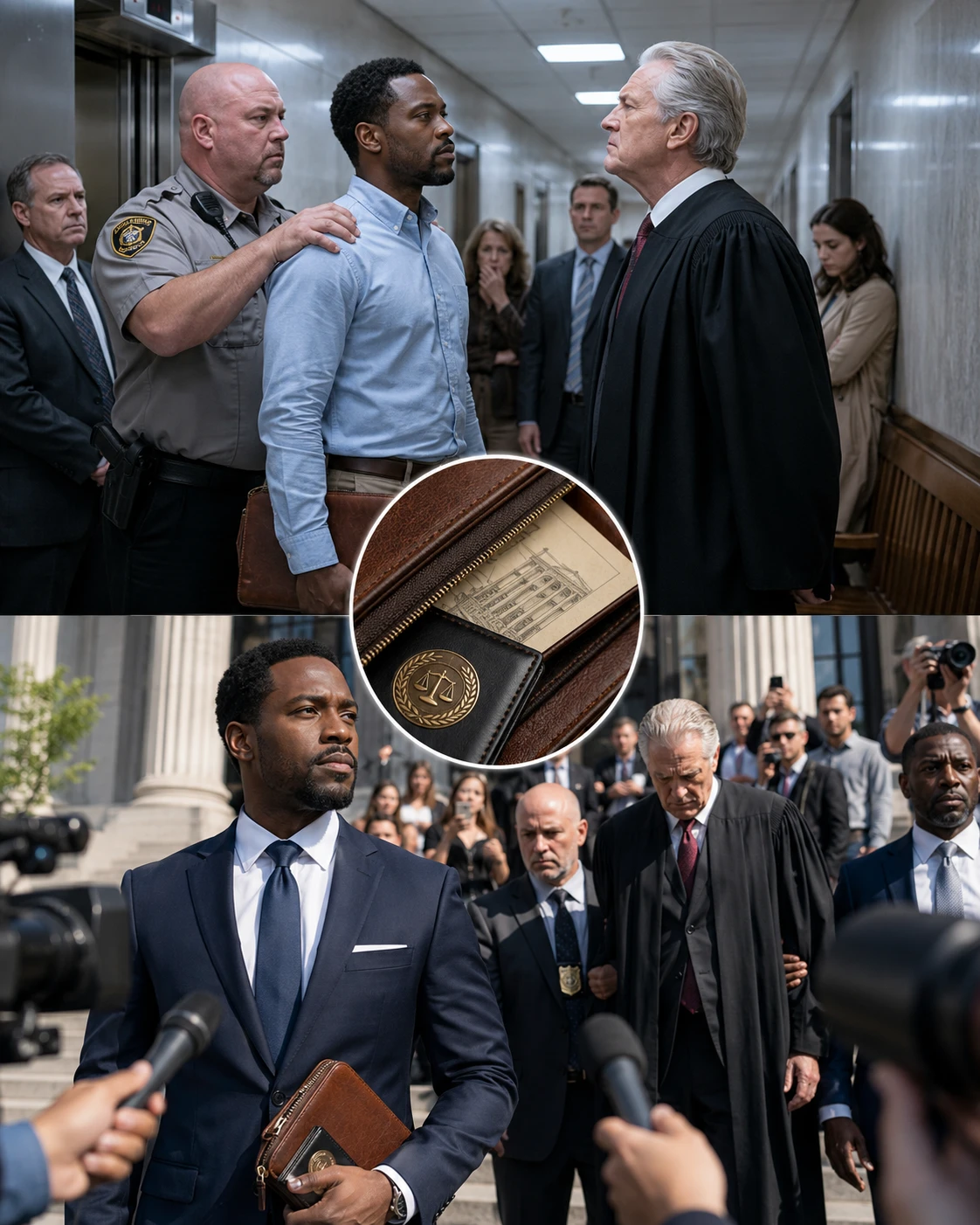
The judge looked at my skin and decided I was a criminal. Four hours later, he learned I was the prosecutor investigating him.
PART 1: THE MAN HE THOUGHT HE KNEW
“You look like someone who should be standing in front of my bench, not walking free in my hallway.”
Judge Harland Crestwood said it quietly.
That was what made it worse.
He didn’t shout.
He didn’t lose his temper.
He didn’t even look embarrassed when the words left his mouth.
He said them with the easy confidence of a man who had spent twenty-six years speaking and watching entire rooms rearrange themselves around his voice.
It was 9:47 on a Tuesday morning on the second floor of the Forsythe County Courthouse.
The fluorescent lights hummed overhead.
A clerk carrying a stack of files stopped walking.
A young attorney near the elevators lowered his eyes.
Two women on a wooden bench went silent.
And I stood there in a light-blue Oxford shirt, khaki pants, brown shoes, and no tie while Judge Crestwood slowly circled me as if he were studying something that had wandered into a place where it did not belong.
I had met men like him before.
Different uniforms.
Different buildings.
Different kinds of power.
The same eyes.
Eyes that made a decision about you first and searched for reasons second.
I kept my hands visible at my sides.
“Is there a problem, Your Honor?”
He stopped behind my right shoulder.
“I’m deciding that.”
His shoes clicked against the marble as he moved in front of me again.
Italian leather.
Dark brown.
Polished enough to reflect the ceiling lights.
His robe was open slightly at the neck, revealing a white shirt and burgundy tie beneath it. Silver hair swept back from a broad forehead. Thin mouth. Pale eyes.
The kind of face local newspapers called distinguished.
He looked at the document case in my hand.
“What are you doing on this floor?”
“Records office.”
“That’s downstairs.”
“I know.”
His eyes narrowed.
“Then why are you here?”
“The clerk downstairs directed me to Room 214 regarding a deed filing.”
“Which clerk?”
“I didn’t ask her name.”
That answer seemed to please him.
Not because it answered his question.
Because it gave him something he could treat as suspicious.
He glanced toward the court security officer standing near the stairwell.
“Brock.”
Officer Brock Sutterly straightened immediately.
He was forty-five, maybe two hundred twenty pounds, thick through the shoulders, with the stiff posture of a man who had spent years being obeyed by people who had no choice.
I already knew his name.
His badge was clipped above his left pocket.
SUTTERLY.
He walked toward us.
Judge Crestwood never took his eyes off me.
“Hold this man. I want to check something.”
Sutterly stepped behind me and placed his hand on my shoulder.
Not gentle.
Not quite violent.
Possessive.
“Sir, you’re coming with me.”
I looked down at his hand.
Then back at the judge.
“On what legal basis?”
Sutterly’s fingers tightened.
“On the basis that Judge Crestwood said so.”
“That isn’t a legal basis.”
His jaw flexed.
“It’s all the basis you need right now.”
Around us, nobody moved.
That silence told me more about the courthouse than the judge’s words did.
I had spent six months reading complaints about Forsythe County.
Anonymous letters.
Transcripts.
Internal memos.
Grievances that had gone nowhere.
Statements from attorneys who wrote three pages about judicial intimidation and then refused to sign their names.
I had seen descriptions of people being threatened with contempt for asking ordinary questions. I had reviewed records suggesting court procedures changed depending on who was standing in front of the bench and whether Judge Crestwood liked them.
But documents were flat things.
Ink on paper.
They could tell me what had happened.
They could not tell me what it felt like when an entire hallway watched a judge decide you were less than a citizen.
Now I knew.
And the strangest part was that none of this had been planned.
I wasn’t at the courthouse that morning as a prosecutor.
I was there because of my parents’ land.
Four hours earlier, I had woken before my alarm.
My eyes opened at 5:47 a.m.
The alarm was set for six.
It happened most mornings.
My body had learned rhythms civilian life never quite erased.
I lay still for a few seconds in the dark apartment, listening.
Refrigerator motor.
A truck somewhere outside.
Rainwater ticking through a gutter.
No danger.
No emergency.
Just another morning in Winston-Salem.
My apartment in the old Salem district was small enough that I could see most of it from the bedroom doorway. One bedroom. Narrow kitchen. Used dining table. Gray couch. Nothing expensive. Nothing memorable.
I liked it that way.
I had rented it after accepting the assignment from the attorney general’s office.
Three months paid in advance.
Few questions.
No framed credentials on the walls.
No photographs from my years in government service.
No evidence that Tobias Ashford was anything more than a thirty-nine-year-old man who kept his kitchen unusually clean and owned too many file folders.
The clothes I chose that morning were deliberate but ordinary.
Light-blue Oxford.
Khaki pants.
Brown leather shoes worn enough to look familiar.
No watch.
No ring.
No tie.
My mother would have complained about the lack of a tie if she had seen me.
My father would have said a tie was useless if a man’s paperwork was right.
The paperwork was right.
It was sitting inside the black document case on my kitchen table.
Original deed transfer documents.
Notarized copy.
Fee receipt dated March 12.
Confirmation code CRF20904471.
Every page in its own transparent sleeve.
My parents had owned the Clemmons property for thirty-two years. A modest piece of land with an old brick house, a shed my father kept promising to repair, and two pecan trees my mother considered members of the family.
They wanted to put the deed in a family trust.
The filing should have been simple.
It wasn’t.
Twice, the county records office had returned the paperwork for problems that did not exist.
The first time, they claimed the notarized signature was missing.
It was on page four.
The second time, they claimed the fee had not been paid.
I had the receipt.
My father wanted to drive down himself.
He was seventy-one and stubborn enough to argue with a hurricane.
I told him I would handle it.
That was why I was at Forsythe County Courthouse.
Personal business.
Nothing more.
The fact that I was also Special Counsel Tobias Ashford, lead prosecutor assigned by the North Carolina attorney general’s office to a confidential judicial-corruption investigation centered in that same courthouse, was something nobody in the building needed to know.
The investigation had been kept deliberately narrow.
My small team worked from Raleigh and a secured field office outside the county. We had not announced interviews. We had not filed public motions. We had not given local officials a list of our targets.
Especially not Judge Harland Crestwood.
He was not the only name in our files.
But he appeared more often than anyone else.
Complaints followed him like shadows.
Improper pressure.
Threats.
Unusual interventions in administrative matters.
Court personnel who claimed he treated ordinary procedures as personal commands.
People who said no to him once and never got the chance to say it twice.
Nothing in my parents’ deed problem had given me reason to believe it was connected to him.
I still don’t believe it was.
Sometimes a broken system damages people without a conspiracy.
Sometimes incompetence is only incompetence.
And sometimes a man exposes himself simply because he believes there will never be consequences.
At 8:58, I entered the courthouse.
At 9:21, the records clerk reviewed my papers.
At 9:34, she frowned at her monitor.
At 9:39, she sent me upstairs to Room 214 because an administrative hold had to be cleared.
At 9:45, I left Room 214 with instructions to return downstairs.
At 9:47, Judge Crestwood saw me.
And decided he knew exactly what I was.
Now Officer Sutterly’s hand was on my shoulder.
“Come on.”
I looked at the judge.
“Am I under arrest?”
Crestwood gave me a thin smile.
“You’re being detained while we determine why you’re wandering around a secure courthouse.”
“I was sent to this floor by a county employee.”
“So you say.”
“There are cameras.”
His expression changed for half a second.
Not fear.
Annoyance.
I noticed it.
I noticed everything.
“Then the cameras will clear this up,” I said.
He turned to Sutterly.
“Put him in Interview Two.”
Sutterly guided me toward a side corridor.
I didn’t resist.
I could have reached into my document case and shown them my state credentials.
I could have said the title.
Special Counsel.
Lead prosecutor.
Office of the Attorney General.
I could have watched Sutterly’s hand fall away.
I could have watched Crestwood recalculate.
But government authority is not a magic phrase citizens should need to speak in order to receive constitutional treatment.
I was there on personal business.
I had committed no offense.
I had made no threat.
I had not entered a restricted area.
And I was not going to use my office to buy myself the dignity they owed me anyway.
So I walked.
Interview Two was a small room with beige walls, a bolted table, three chairs, and a camera dome in the ceiling.
Sutterly opened the door.
“Inside.”
I stopped at the threshold.
“Before I enter, I want your name and badge number.”
“You can read.”
“Say it for the record.”
He looked up at the camera.
Then at me.
Something colder entered his face.
“Brock Sutterly. Court Security.”
“Badge number?”
“Sit down.”
“I’m asking for your badge number.”
He stepped closer.
“You want to turn this into a problem?”
“No. I want to establish what is happening.”
His nostrils flared.
Behind him, Judge Crestwood appeared in the corridor.
“He likes questions,” the judge said.
I turned.
Crestwood leaned one shoulder against the doorframe.
“People like him usually do until the questions come from the bench.”
People like him.
There it was again.
Not quite explicit enough for anyone to challenge.
Clear enough for everyone to understand.
I met his eyes.
“What exactly do you think I’ve done?”
He smiled.
“I think I’m going to find out.”
Then he looked at my document case.
“Search that.”
I tightened my grip.
“No.”
The hallway seemed to shrink.
Sutterly stepped toward me.
Crestwood’s smile disappeared.
“No?”
“You have no warrant, no consent, and you have identified no lawful basis to search my property.”
The judge stared at me.
For the first time, I saw uncertainty.
Only a flicker.
A man he had already classified was speaking in language he had not expected.
Then pride repaired the crack.
“You a lawyer?”
I said nothing.
He came closer.
“I asked you a question.”
“And I’m not required to answer it.”
His face hardened.
Sutterly shifted his weight.
Somewhere behind them, someone whispered.
Judge Crestwood looked past me into the room.
Then back at my face.
“Sit him down.”
I stepped inside voluntarily and placed the document case on my lap.
Sutterly stood near the door.
The judge remained in the hallway.
“You’re making a mistake,” Crestwood said.
That almost made me smile.
Not because it was funny.
Because it was the first completely true thing he had said.
“Yes,” I replied quietly.
“You are.”
And that was when his eyes changed.
PART 2: THE ROOM WITH NO CHARGE
The door closed at 10:03.
I know because I checked the wall clock before Sutterly blocked my view.
There are moments when anger makes time feel fast.
This wasn’t one of them.
Every minute became distinct.
At 10:06, Sutterly asked for identification.
I gave him my driver’s license.
Nothing else.
He studied it.
“Tobias Ashford.”
“Yes.”
“Winston-Salem address.”
“Yes.”
“What do you do?”
“I’m not discussing my employment.”
His mouth twisted.
“You unemployed?”
“No.”
“Then what do you do?”
“I’ve answered the identification question.”
He pulled out his phone.
“Judge wants a background check.”
“Through what system?”
He ignored me.
“Am I free to leave?”
“No.”
“What crime am I suspected of committing?”
He said nothing.
“Officer Sutterly?”
He looked up.
“You really don’t know when to stop, do you?”
“I know exactly when to stop. I’ll stop asking when you provide a lawful basis for holding me.”
He laughed once.
“You think knowing a couple legal words means something?”
I leaned back.
“Do you?”
That wiped the laugh away.
He stepped toward the table.
For a moment, I thought he might put his hands on me again.
I didn’t move.
He stopped.
The room was too controlled for violence.
Camera overhead.
Glass panel in the door.
People passing outside.
He knew it.
I knew it.
So instead he pointed toward my document case.
“Open it.”
“No.”
“You were told to open it.”
“I was told you intended to search it. I did not consent.”
“You got something illegal in there?”
“No.”
“Then why not open it?”
“Because constitutional rights do not require contraband to become relevant.”
He stared.
Then shook his head.
“You people watch too much television.”
I felt the anger then.
Hot.
Immediate.
Not because I had never heard the phrase.
Because he said it so casually.
As if he had inherited the right to put millions of strangers into one sentence.
I kept my voice even.
“What people?”
His eyes met mine.
For three seconds, he said nothing.
Then he looked toward the door.
“Cute.”
He left.
I sat alone.
I had been questioned under worse circumstances.
I had waited in smaller rooms.
I had heard men threaten things more serious than contempt.
The old instincts returned without permission.
Inventory exits.
Observe hinges.
Count footsteps outside.
Listen for changes in breathing before a door opens.
Control your own.
I hated that part of myself sometimes.
Not because it had failed me.
Because it had kept me alive so well that it refused to believe life could ever be ordinary again.
I pressed my thumb against the edge of the document case.
My parents’ deed was inside.
That anchored me.
My father standing on a ladder he was too old to climb.
My mother yelling from the porch.
Pecan shells in a metal bowl.
Normal things.
Things worth protecting.
At 10:18, the door opened.
A woman stood there.
Early fifties.
Gray cardigan over a county blouse.
Reading glasses hanging from a chain.
I recognized her from Room 214.
Her nameplate said ELAINE MERCER.
She had been the administrative clerk who sent me back downstairs.
She looked frightened.
Sutterly stood behind her.
“Is this the man you sent up here?”
Elaine looked at me.
“Yes.”
“Why?”
“Records sent him to us because of a deed hold.”
“Was he supposed to be wandering?”
“He wasn’t wandering.”
Sutterly’s jaw tightened.
Elaine swallowed.
“He came to the counter. I reviewed the file. I told him the hold was old and should already have cleared. I told him to go back downstairs.”
“So he had no business remaining on this floor?”
“He left when I told him to.”
Sutterly glanced over his shoulder.
The judge wasn’t visible.
“Anything suspicious?”
Elaine hesitated.
“No.”
“You sure?”
Her eyes flicked toward me.
Then toward the camera.
“Yes.”
The answer came stronger.
“No. Nothing suspicious.”
Sutterly’s face closed.
“Fine.”
He moved her away from the doorway.
Before the door shut, Elaine looked at me once more.
It wasn’t apology.
Not exactly.
It was recognition.
She knew what was happening.
More importantly, she knew it was wrong.
That mattered.
At 10:31, Judge Crestwood entered.
He closed the door himself.
Sutterly stayed outside.
Crestwood sat across from me.
For the first time, we were alone.
He folded his hands.
“I hear you refused a search.”
“I declined to consent.”
“Same thing.”
“No.”
He studied me.
“You have a record?”
“No.”
“Ever been arrested?”
“No.”
“Military?”
I didn’t answer.
His gaze sharpened.
Interesting.
Maybe Sutterly’s check had found something incomplete.
Some records from my earlier government work were not publicly descriptive.
That tended to make curious men more curious.
Crestwood leaned back.
“You’ve got the posture.”
I said nothing.
“What branch?”
“I’m still not discussing my background.”
“You like being difficult.”
“I like relevant questions.”
“Everything I ask in this building is relevant.”
There it was.
Not a statement of law.
A statement of belief.
He leaned forward.
“You know what I see when I look at you?”
I had no interest in helping him answer.
“I see a man who came into my courthouse, went where he wasn’t supposed to go, refused lawful instructions, and now wants to lecture people about rights.”
“Your courthouse?”
He paused.
I let the two words sit between us.
Then I continued.
“This is a county courthouse. It belongs to the public.”
His eyes hardened.
“You think that distinction matters?”
“Yes.”
“That’s your problem.”
“No, Judge. I think it may be yours.”
His chair scraped the floor.
For a moment, the polished version of him disappeared.
His face tightened.
Color rose above his collar.
Then he controlled it.
Twenty-six years of practice.
“You need to understand something, Mr. Ashford. I can make your day very unpleasant.”
“I already understand that you can.”
“You can spend the rest of it downstairs.”
“Charged with what?”
“Contempt is flexible.”
A chill went through me.
Not fear for myself.
Recognition.
We had three separate complaints in our investigative file describing almost that exact phrase.
Contempt is flexible.
One attorney claimed Crestwood had said it during a closed conversation after she objected to an off-record instruction.
Another witness remembered, I have broad contempt power. Don’t make me demonstrate it.
No recordings.
No corroboration strong enough to stand alone.
Now he had said a version of it directly to me.
I kept my expression neutral.
“Are you threatening to jail me for contempt because I refused a warrantless search?”
He saw the trap too late.
“I’m explaining possibilities.”
“What conduct of mine occurred in your courtroom?”
His mouth opened.
Closed.
Contempt authority had limits, especially outside an active proceeding.
He knew that.
I knew that.
More importantly, now he knew that I knew it.
He stood.
“You’re not as smart as you think you are.”
“Maybe not.”
He walked to the door.
My heart was beating harder than my voice suggested.
I had spent months trying to understand why intelligent people around Crestwood kept surrendering ground to him.
Sitting in that room, I finally understood.
He did not need to convince you he was legally right.
He only needed to convince you resistance would cost more than submission.
A missed afternoon.
A contempt hearing.
A damaged reputation.
A humiliating search.
A night in holding.
For most people, the rational choice was to comply.
Then he could point to that compliance as proof that no coercion had happened.
I had seen the pattern in files.
Now I could feel its machinery.
The judge opened the door.
I spoke before he stepped out.
“I want this detention formally recorded.”
He turned.
“It is.”
“I want the start time, legal justification, the identity of the ordering official, and every person who enters this room preserved.”
A faint smile returned.
“You planning a lawsuit?”
“No.”
That answer seemed to surprise him.
“What are you planning?”
I looked directly at him.
“To remember.”
The smile disappeared.
He left.
At 10:46, I was allowed one phone call.
Sutterly stood three feet away.
He pointed at the wall phone.
“One call.”
“Private?”
“No.”
“Attorney-client privilege?”
“You said you weren’t charged.”
“That wasn’t my question.”
He crossed his arms.
I picked up the receiver.
There were three numbers I could have called.
My supervisor in Raleigh.
My deputy prosecutor, Maya Ellison.
My parents.
I chose Maya.
She answered on the second ring.
“Ashford.”
She always used my last name.
“Morning.”
A pause.
She knew my voice.
More importantly, she knew what time I was supposed to meet her.
“Tobias?”
“Yes.”
“Where are you?”
“Forsythe County Courthouse.”
Another pause.
Longer.
“I thought your errand was supposed to be finished.”
“It’s been delayed.”
Sutterly watched me.
I kept my tone conversational.
Maya understood operational language well enough not to ask the obvious question.
“What kind of delay?”
“I’m in Interview Room Two on the second floor.”
Silence.
Then her voice changed.
Not louder.
Colder.
“Voluntarily?”
“No.”
Sutterly uncrossed his arms.
Maya said, “Who detained you?”
“Court Security Officer Brock Sutterly, at the direction of Judge Harland Crestwood.”
Sutterly stepped forward.
“That’s enough.”
I turned slightly away.
Maya stopped speaking for half a second.
She understood.
“Legal basis?”
“None has been provided.”
“What happened?”
“I was directed upstairs regarding my parents’ deed. Judge Crestwood encountered me in the hallway. He said I looked like someone who should be standing in front of his bench instead of walking free in the courthouse.”
Sutterly reached for the receiver.
I shifted just enough that he stopped.
Not resistance.
A warning that the call was being witnessed.
I continued.
“He ordered me detained and requested a search of my document case. I declined consent. He has now suggested contempt is flexible.”
Maya went completely silent.
She knew the file.
She knew the phrase.
Then she said, “Do you want me to activate protocol?”
That was the moment.
I could have ended it.
One word.
Yes.
Within minutes, the people holding me would know exactly who I was.
But there was another issue.
Our scheduled operation that afternoon.
At 2:00 p.m., Maya and I were supposed to meet representatives from the state judicial oversight unit and counsel from the attorney general’s office to formally notify courthouse leadership of the next phase of the corruption investigation.
Not arrest warrants.
Not a dramatic raid.
Something more dangerous to people like Crestwood.
Accountability with documentation.
Preservation demands.
Formal interviews.
Evidence notices.
Orders preventing records from disappearing before they could be reviewed.
Months of quiet work becoming visible.
Judge Crestwood had no idea it was coming.
If I activated the emergency protocol now, that plan would change.
People would rush.
Phones would ring.
Rumors would move faster than facts.
I looked at Sutterly.
Then at the camera overhead.
“No,” I told Maya.
“Not yet.”
“Tobias.”
“I’m safe.”
“You’re being unlawfully detained by a target of an active investigation.”
“I know.”
“That is not my definition of safe.”
Despite everything, I almost smiled.
“Keep the two o’clock schedule.”
She understood what I was saying.
Do not compromise the larger case because of me.
There was another pause.
Then she asked, “Do you want counsel?”
“Yes. But not yet in person. Document the call time.”
“Ten forty-seven.”
“Preserve it.”
“Already doing it.”
Sutterly pointed at the phone.
“Wrap it up.”
I said, “Maya.”
“Yes?”
“If I’m not released by eleven-thirty, move.”
Her answer came without hesitation.
“Understood.”
I returned the receiver.
Sutterly stared at me.
“Who’s Maya?”
I looked at him.
“My phone call.”
His face tightened.
At 10:52, he locked the door again.
And for the first time that morning, I stopped wondering how far Judge Crestwood would go.
I started wondering what he would do when he realized how far he had already gone.
PART 3: CONTEMPT IS FLEXIBLE
At 11:07, they took my document case.
Not legally.
Physically.
There is a difference, although power often tries to erase it.
Sutterly entered with another security officer, a younger man named Ruiz who looked uncomfortable before anyone spoke.
“Stand up,” Sutterly said.
“Why?”
“Judge’s order.”
“For what purpose?”
“Stand up.”
I did.
Ruiz moved to my left.
Sutterly pointed at the case.
“Put it on the table.”
“It’s already on the table.”
“Step away from it.”
“I do not consent to a search.”
“You’ve made that clear.”
“Then I want my objection recorded.”
He glanced at the camera.
“Sure.”
I stepped back because I had no intention of turning an unlawful search into a physical confrontation.
That distinction mattered to me.
People often misunderstand restraint.
They think if you do not fight with your fists, you are submitting.
Sometimes restraint is the opposite.
Sometimes it means refusing to give another person the excuse he is desperately trying to manufacture.
Sutterly opened the case.
The plastic sleeves caught the fluorescent light.
Deed.
Notarized copy.
Receipt.
County correspondence.
Nothing else.
My state credentials were not inside.
They were in the inside pocket of my shirt under a slim wallet insert, where they had been all morning.
Sutterly flipped through the papers.
His irritation grew with every harmless page.
“What’s this?”
“The deed I told you about.”
He held up the fee receipt.
“March twelfth.”
“Yes.”
“You kept a receipt five months?”
“Yes.”
“Why?”
“Because the county claimed I didn’t pay.”
Ruiz glanced at him.
Sutterly ignored it.
He lifted the deed transfer form.
“Parents?”
“Yes.”
“You own part of this?”
“No.”
“Then why are you handling it?”
“Because they asked me to.”
He searched every sleeve.
Nothing.
The absence of wrongdoing did not calm him.
That was the part people rarely understood.
When suspicion is based on evidence, innocence resolves it.
When suspicion is based on prejudice, innocence becomes provocation.
Sutterly closed the case harder than necessary.
“Sit down.”
“I want it noted that you searched my property after I expressly refused consent.”
He pointed toward the chair.
“Sit.”
Ruiz spoke quietly.
“Brock.”
Sutterly turned.
“What?”
The younger officer’s eyes moved toward the camera.
“Maybe we should get written authorization.”
A long silence.
I watched Sutterly’s face.
Something passed through it.
Not uncertainty about the law.
Fear of the judge.
“Crestwood authorized it.”
Ruiz swallowed.
“That’s not what I meant.”
Sutterly stepped closer to him.
“You want to explain to Judge Crestwood why you’re questioning him?”
Ruiz looked away.
There it was again.
The system inside the system.
Crestwood did not have to be physically present to control the room.
Sutterly picked up my document case.
“Where are you taking that?”
“Evidence.”
“Evidence of what?”
He opened the door.
I repeated it.
“Evidence of what?”
He left without answering.
Ruiz remained for one second.
Our eyes met.
Then he followed.
At 11:18, Elaine Mercer passed the small glass window in the door.
She looked in.
I stood and moved closer.
She slowed.
I raised one hand.
Not asking her to free me.
Just making sure she saw me.
Sutterly appeared at the end of the hallway.
Elaine walked on.
At 11:29, I heard voices outside.
One belonged to Maya.
She had moved one minute early.
I had never been so relieved to hear someone sounding angry.
“This is not optional.”
A man answered, too muffled to understand.
Maya again.
“Then call the courthouse administrator.”
Footsteps.
The door opened.
Sutterly entered.
His face had changed.
“You got people making trouble downstairs.”
“I made one phone call.”
“Who is she?”
“I told you.”
“No, you didn’t.”
He closed the door behind him.
“Judge Crestwood wants your employer.”
“Why?”
“Because we need to know who we’re dealing with.”
That sentence almost made me laugh.
Not because it was funny.
Because, finally, we agreed.
“You have my name and identification.”
“That woman says she’s your lawyer.”
“She’s an attorney.”
“Your attorney?”
“At this moment, she is acting in that capacity.”
“Where do you work?”
“I’m not answering employment questions.”
He stepped closer.
“You think this is some game?”
“No.”
“You send a lawyer down here, she starts throwing around words like unlawful detention and preservation notice, and now you don’t want to say what you do?”
“Correct.”
His eyes narrowed.
“What are you hiding?”
“Nothing relevant to why you stopped me.”
He slapped his palm against the table.
“Judge Crestwood can hold you.”
“Then have him come in and state the legal basis on camera.”
“You got an answer for everything.”
“No. I have the same unanswered question.”
The door opened behind him.
Judge Crestwood entered.
His robe was gone.
He wore shirtsleeves now, tie loosened slightly, as if the situation had interrupted a busy and important day.
He dismissed Sutterly with a look.
The officer left.
Crestwood remained standing.
“There is an attorney downstairs demanding your release.”
“Yes.”
“She claims you are being held unlawfully.”
“I agree with her.”
His jaw flexed.
“She also delivered a written demand that courthouse video from nine-thirty onward be preserved.”
I said nothing.
“Who are you?”
“Tobias Ashford.”
“I know your name.”
“Then what are you asking?”
“What do you do?”
“My employment does not determine whether this detention is lawful.”
His eyes narrowed.
“You keep saying that.”
“Because it’s true.”
He walked to the window.
For a moment, he stood with his back to me.
When he turned, some of the performance was gone.
He was calculating now.
“Maybe we got off on the wrong foot.”
Interesting.
Not an apology.
A negotiation.
“You stopped me in a public hallway,” I said.
“I asked questions.”
“You said I looked like someone who should be standing in front of your bench rather than walking free.”
His expression barely changed.
“I don’t recall those exact words.”
“There were witnesses.”
“You may have misunderstood me.”
“I didn’t.”
His eyes cooled.
“This is why people get themselves into trouble.”
“By remembering what you say?”
“By deciding they’re victims before anything has happened.”
I looked around the locked room.
“Something has happened.”
“You haven’t been charged.”
“That does not make detention imaginary.”
He exhaled through his nose.
“You’re determined to make this racial.”
I had been waiting for that.
I spoke carefully.
“I have not accused you of anything in this room.”
“You don’t need to. I know how this goes.”
“Do you?”
“A Black man gets questioned, suddenly everyone is a civil-rights lawyer.”
There was contempt in the words.
And something else.
Resentment.
As though accountability itself were an accusation he had been forced to endure.
I felt my anger sharpen.
“Judge Crestwood, you saw me in a hallway. You had no complaint, no report, no evidence of a crime, and no reason to believe I was somewhere unauthorized. A clerk has already confirmed that I was directed to that floor. You ordered me detained anyway.”
“I was protecting courthouse security.”
“You searched my private documents.”
“Security did.”
“At your direction.”
He said nothing.
“You threatened contempt.”
“I explained judicial authority.”
“You told me people like me usually have questions until the questions come from the bench.”
His face hardened.
“That is not what I meant.”
“What did you mean?”
Silence.
I waited.
One of the most powerful tools in an interview is silence.
Most people rush to fill it.
Judges are rarely forced to.
After six seconds, Crestwood looked away.
Then he said, “You’re free to go.”
I didn’t move.
He blinked.
“I said you’re free to go.”
“Where is my document case?”
“You’ll get it downstairs.”
“No.”
His face tightened.
“Excuse me?”
“You took my property from me in this room. Return it here.”
“You’re pushing this.”
“I’m asking for my property.”
“I just told you you’re released.”
“And I am telling you I will leave when my property is returned.”
For a moment, rage showed in his eyes.
Not because my request was unreasonable.
Because I had refused to accept his version of mercy.
He wanted the ending to be his.
He wanted to open the cage and be thanked.
I would not give him that.
He opened the door.
“Sutterly.”
The officer appeared.
“Bring his case.”
Sutterly looked between us.
“Judge—”
“Bring it.”
He left.
Crestwood leaned toward me.
“You should learn when you’ve won.”
I held his gaze.
“This isn’t about winning.”
“Everything in a courthouse is about winning.”
“No.”
I thought of the people whose complaints I had read.
The young public defender who had written that Crestwood humiliated her in open court after she challenged an improper instruction.
The father who claimed a routine hearing turned into a threat because he asked to see paperwork.
The clerk who had withdrawn her statement twice.
The lawyers who used phrases like everyone knows and then refused to put names beside them.
“No,” I repeated. “That may be what you’ve forgotten.”
Sutterly returned with the case.
I opened it.
Everything appeared to be there.
I checked anyway.
Original deed.
Copy.
Receipt.
Correspondence.
One by one.
Crestwood watched with visible irritation.
When I finished, I closed it.
“What are you looking for?” he asked.
“Whether anything is missing.”
“Nothing is.”
“I prefer to verify.”
He gave a bitter laugh.
“Of course you do.”
I stood.
He moved aside.
For the first time in nearly two hours, there was nothing between me and the hallway.
I took one step.
Then he spoke.
“Mr. Ashford.”
I stopped.
“You would be smart to let this end here.”
There are threats that wear obvious faces.
This one wore advice.
I turned.
“What happens if I don’t?”
His expression went blank.
“I didn’t say anything would happen.”
“No. You didn’t.”
I walked out at 11:43.
Maya was waiting near the elevators.
She wore a charcoal suit, carried a leather portfolio, and looked like she had spent the last fourteen minutes imagining several perfectly legal ways to tear the building apart.
She was not alone.
Elaine Mercer stood ten feet away.
Officer Ruiz was near the security desk.
Three attorneys lingered farther down the hallway pretending not to watch.
Maya looked me over.
“You hurt?”
“No.”
“Touched?”
“Shoulder when they first detained me.”
“Search?”
“Document case. Nonconsensual.”
Her eyes flashed.
“Camera?”
“In the room.”
“Good.”
Crestwood emerged behind me.
Maya’s gaze went to him.
The hallway fell quiet.
The judge looked at her.
“You’re the attorney?”
“For the purpose of Mr. Ashford’s detention, yes.”
“He’s been released.”
“I’m aware.”
“Then I assume we’re finished.”
Maya glanced at me.
It was my decision.
That mattered.
She knew who had authority over our investigation, but she also knew what had just happened to me was personal.
I looked at the clock.
11:44.
Two hours and sixteen minutes until the scheduled meeting.
I could have identified myself.
I didn’t.
Not yet.
Instead, I faced Crestwood.
“I want the video preserved.”
He rolled his eyes.
“Your lawyer has made that abundantly clear.”
“All video from the second floor between 9:30 and noon. Interview Room Two. Hallways. Security desk. Any audio associated with those systems.”
“I don’t manage courthouse recordings.”
“Then whoever does should receive the request.”
“You’re very demanding for someone who was just released without charge.”
Maya started to speak.
I lifted one finger.
Not yet.
I looked at him.
“Without charge is exactly how I arrived.”
Something shifted in the hallway.
A quiet sound.
Not laughter.
Agreement.
Crestwood heard it too.
He looked around.
For the first time that morning, the people near him were not looking down.
Then Elaine Mercer stepped forward.
“Mr. Ashford?”
“Yes?”
“I saw what happened.”
Crestwood turned sharply.
Elaine’s face lost color, but she kept going.
“I was at the copy station when Judge Crestwood stopped you.”
He stared at her.
“Elaine.”
She swallowed.
“I heard what he said.”
The hallway became completely still.
Crestwood’s voice dropped.
“You should be very careful about inserting yourself into something you don’t understand.”
There it was.
Pressure.
Public this time.
Elaine’s shoulders tightened.
I watched twenty-six years of authority work on her in real time.
She almost stepped back.
Then I asked gently, “Ms. Mercer, are you saying you witnessed the initial encounter?”
She looked at me.
“Yes.”
“Would you be willing to write down what you saw while it is fresh?”
Crestwood moved toward us.
“This is becoming inappropriate.”
Maya stepped between him and Elaine.
Her voice was calm.
“Do not speak to the witness.”
The judge froze.
The words landed harder than a shout.
Witness.
Until that moment, Crestwood had been treating the morning as an inconvenience.
A misunderstanding.
A matter he controlled.
But witness was a different kind of word.
It belonged to a process larger than his hallway.
His gaze snapped to Maya.
“What did you just call her?”
Maya did not answer.
She looked at me.
And I knew our schedule had just moved again.
Not because of what had happened to me.
Because Crestwood had now warned a witness in front of multiple people.
I checked the time.
11:46.
Then I looked at Maya.
“Activate preservation protocol.”
Her face changed immediately.
“Full?”
“Yes.”
Crestwood stared between us.
“What protocol?”
Maya reached into her portfolio.
I said nothing.
Not yet.
But the clock had started.
PART 4: THE NAME ON THE FILE
At 12:02, the courthouse administrator arrived.
His name was Gerald Pritchard.
Sixty years old, thinning hair, red tie, nervous eyes.
He approached the second-floor conference room where Maya and I had relocated with Elaine.
Judge Crestwood followed him without being invited.
Sutterly followed Crestwood.
Ruiz stayed outside.
By then Maya had made four calls.
I made two.
The preservation notices had gone out.
Digital courthouse recordings.
Access logs.
Security reports.
Any handwritten incident notes.
Any electronic messages concerning my detention.
Nothing erased.
Nothing overwritten.
Nothing “accidentally” misplaced.
That did not mean the morning itself was our corruption case.
It wasn’t.
A prosecutor who turns a personal grievance into the center of a public investigation has already lost his judgment.
But it was evidence of conduct.
And more importantly, it had produced witnesses.
Gerald Pritchard stood at the head of the conference table.
“I’m trying to understand the situation.”
Crestwood spoke first.
“This gentleman was briefly detained after behaving suspiciously in a courthouse corridor.”
I looked at Pritchard.
“That is false.”
Crestwood laughed.
“You see?”
Pritchard rubbed his forehead.
“Can we please keep this civil?”
“I am being civil,” I said.
Judge Crestwood pointed toward me.
“This is exactly what I dealt with all morning. Defiance. Hostility. Refusal to cooperate.”
“Did you order him detained?” Maya asked.
The judge looked at her.
“Who exactly are you?”
“My name is Maya Ellison.”
“That wasn’t my question.”
“It’s the answer you need right now.”
His eyes narrowed.
Maya could be merciless when someone mistook restraint for weakness.
Pritchard intervened.
“Ms. Ellison, are you representing Mr. Ashford?”
“Yes.”
“In what capacity?”
“Legal.”
He looked exhausted already.
Judge Crestwood turned to me.
“You see how unreasonable this looks?”
I almost admired the instinct.
He had spent decades being the person who decided which version of events entered the record.
Even now, with people around him and preservation notices moving through systems he could not control, he was still trying to narrate reality faster than the rest of us.
I placed my hands flat on the table.
“Mr. Pritchard, I entered this courthouse at approximately 8:58 this morning to resolve a deed filing for my parents. Records personnel sent me to Room 214. Ms. Mercer assisted me there and instructed me to return downstairs. While I was leaving the second floor, Judge Crestwood stopped me.”
Elaine nodded.
Crestwood looked at her.
She dropped her eyes.
I continued.
“He told me I looked like someone who should be standing in front of his bench rather than walking free in his hallway.”
“I dispute that wording,” Crestwood said.
Pritchard winced.
“He ordered Officer Sutterly to hold me. I asked for a legal basis. None was provided.”
“Security discretion,” Crestwood said.
I continued.
“I was placed in Interview Room Two. I repeatedly asked whether I was under arrest and what crime I was suspected of committing. Neither question was answered. Judge Crestwood threatened that contempt was flexible. Officer Sutterly searched my document case after I refused consent. I was held until approximately 11:43.”
Pritchard looked at Sutterly.
“Is that accurate?”
Sutterly shifted.
“We had concerns.”
“What concerns?”
“He was uncooperative.”
“That’s not a security concern.”
“He refused the search.”
“Before or after you detained him?”
Silence.
Pritchard’s face changed.
Crestwood stepped in.
“Gerald, don’t conduct an inquiry in front of him.”
“In front of whom?”
The question escaped Pritchard before he could stop it.
Crestwood gestured toward me.
“Him.”
I watched Pritchard register the contempt in that single pronoun.
Maya registered it too.
Her pen stopped moving.
The judge noticed.
His face tightened.
“Don’t twist my words.”
“Nobody has to,” Maya said.
Pritchard held up a hand.
“Enough.”
He looked at me.
“Mr. Ashford, I apologize for the inconvenience.”
Inconvenience.
I could have corrected him.
I didn’t.
Not yet.
He continued.
“I assure you we will review what happened.”
Judge Crestwood nodded as though the matter were settling.
Then Pritchard looked at Maya.
“As for the preservation demands, those seem excessive for what appears to be a courthouse-security misunderstanding.”
Maya closed her portfolio.
“That decision isn’t yours anymore.”
Silence.
Pritchard stared at her.
“I’m sorry?”
At 12:11, the elevator bell sounded outside.
Two people entered the hallway.
Deputy Attorney General Nathan Cole.
And Dr. Serena Vance, senior counsel to the state judicial oversight commission.
They were not supposed to arrive until 1:40.
Maya had moved them up.
Crestwood saw Nathan first.
Recognition registered immediately.
Most judges in the state knew him.
Nathan Cole had argued before the state supreme court, testified before legislative committees, and appeared beside the attorney general often enough to have a familiar face.
Judge Crestwood straightened.
Pritchard went pale.
Nathan entered the conference room and looked at me.
“Tobias.”
That was all he said.
But the room changed.
Crestwood looked at me.
Then Nathan.
Then Maya.
His face emptied.
Nathan placed a sealed folder on the table.
“Are you all right?”
“Yes.”
“Were you formally arrested?”
“No.”
“Were you free to leave?”
“Not until 11:43.”
He nodded once.
Dr. Vance entered behind him.
She greeted no one at first.
She simply observed.
Judge Crestwood recovered enough to speak.
“Nathan.”
“Judge Crestwood.”
“What is the attorney general’s office doing here?”
Nathan looked at me.
Not because he needed my permission to answer.
Because he understood the significance of the moment.
I stood.
For almost two and a half hours, I had refused to use my title.
I had done that because I believed the law was supposed to protect Tobias Ashford the private citizen as much as it protected Tobias Ashford the prosecutor.
But I was no longer being held.
My personal documents were back in my possession.
Witnesses had spoken.
Preservation had begun.
The line between my private errand and my public duty was no longer blurred.
So I reached into the inner pocket of my shirt and removed my credential wallet.
Judge Crestwood stared at it.
I opened it and placed it on the table.
State seal.
Photograph.
Name.
Office.
Title.
SPECIAL COUNSEL.
Nathan spoke.
“Judge Crestwood, this is Tobias Ashford, lead special prosecutor assigned by the attorney general to the Forsythe County judicial-integrity investigation.”
Nobody moved.
The fluorescent lights hummed.
Somewhere outside, a phone rang.
Judge Crestwood looked at the credential.
Then at my face.
Then back at the credential.
All the color drained from him.
Sutterly whispered, “Oh, God.”
Crestwood turned toward him so sharply the judge’s chair moved.
“You ran his name.”
Sutterly looked stunned.
“It didn’t show—”
“Of course it didn’t show,” Nathan said. “His assignment is confidential.”
The judge looked back at me.
For the first time since 9:47, he had nothing to say.
I wish I could tell you the moment felt satisfying.
It didn’t.
Not immediately.
I thought I would enjoy watching recognition destroy his certainty.
Instead, I felt tired.
Because I knew exactly what he was thinking.
Not I treated an innocent man unlawfully.
Not I judged someone because he was Black.
Not even I abused my authority.
His first thought was written all over his face.
I chose the wrong man.
And that was the problem.
I closed the credential wallet.
“If I had been unemployed,” I said quietly, “would this morning have been acceptable?”
Crestwood blinked.
“If I had been a delivery driver?”
He said nothing.
“A defendant’s father?”
Nothing.
“A man with a record?”
His lips parted.
I kept going.
“If I didn’t know the law? If I couldn’t call a prosecutor? If nobody from the attorney general’s office came through that elevator?”
“That’s not fair,” he said.
The words stunned me.
Not because they were powerful.
Because they were small.
After everything, Harland Crestwood was complaining about fairness.
I stared at him.
“No,” I said. “It isn’t.”
His face tightened.
Nathan opened the sealed folder.
“Judge Crestwood, today’s meeting was already scheduled before this incident.”
Pritchard sat down slowly.
Crestwood looked at the folder.
“What meeting?”
Nathan removed several pages.
“For the past six months, the attorney general’s office has been conducting a confidential review of allegations concerning abuse of judicial authority and improper interference with courthouse processes in Forsythe County.”
The judge’s face became rigid.
“This is absurd.”
Dr. Vance spoke for the first time.
“The judicial oversight commission has been coordinating independently on related complaints.”
Crestwood looked at her.
“You people came here because of him?”
“No,” she said.
That answer hurt him more than if she had said yes.
She continued.
“We were coming here anyway.”
The room went silent again.
I watched the meaning settle over him.
My detention was not the reason scrutiny had arrived.
He had not created the storm.
He had simply stepped into it and demonstrated, in front of witnesses and cameras, the kind of behavior people had been describing for years.
Nathan slid the first page across the table.
“This is a formal preservation directive covering specified courthouse records already identified in the investigation.”
Crestwood did not touch it.
“You have no authority to walk into my courthouse and intimidate me.”
I almost heard my own words from earlier.
Your courthouse?
Nathan answered before I could.
“This is not your courthouse.”
Crestwood’s eyes snapped toward him.
Nathan’s voice remained calm.
“It belongs to the public.”
For the first time all morning, I felt something close to relief.
Not victory.
Recognition.
The truth sounded different when someone else said it.
Crestwood pushed away from the table.
“I have a docket.”
Dr. Vance placed a document beside Nathan’s.
“Not this afternoon.”
The judge froze.
“What is that?”
“An emergency administrative directive. Pending preliminary review of today’s incident and the existing complaints already before the commission, you are to refrain from presiding over scheduled matters for the remainder of the day.”
His face went red.
“You cannot suspend me because some man claims his feelings were hurt.”
Dr. Vance’s gaze hardened.
“This is not a suspension from office. It is an immediate administrative measure while conduct is reviewed. And I strongly recommend that you stop minimizing an unlawful detention before we have even finished documenting it.”
Crestwood turned to Pritchard.
“Gerald.”
Pritchard looked miserable.
But he did not rescue him.
“I think you should comply.”
Twenty-six years of authority.
And there it was.
The first crack loud enough for everyone to hear.
Judge Harland Crestwood had given commands all morning and watched people move.
Now he gave one without words.
Help me.
And nobody did.
His gaze found mine.
“You planned this.”
It was almost a whisper.
“No.”
“You came in dressed like this. No tie. No credentials visible. You wanted something to happen.”
Anger rose through me so quickly I had to pause before answering.
Maya saw it.
Nathan saw it.
I folded my hands behind my back.
“I came here to file a deed for my parents.”
“You expect me to believe that?”
“The deed is in my case.”
“You knew I was under investigation.”
“Yes.”
“You knew I was here.”
“Yes.”
“So you baited me.”
“No.”
His voice rose.
“You stood there asking questions—”
“I asked why I was being detained.”
“You challenged me.”
“I asked what law I had broken.”
“You refused instructions.”
“I refused a warrantless search.”
He slammed one hand on the table.
“You knew exactly what you were doing!”
The room went silent.
I looked at him.
“Yes,” I said.
His chest rose and fell.
“I knew exactly what I was doing.”
I took one step closer.
“I was behaving like a citizen who knew his rights.”
That was the sentence that ended the argument.
Not because Crestwood agreed.
Because there was nothing he could say without admitting what he believed those rights depended on.
At 12:37, Dr. Vance asked him to leave the conference room.
He refused.
At 12:39, Nathan informed him that interference with preservation procedures would be separately documented.
At 12:41, Pritchard told the judge the afternoon calendar had already been reassigned.
At 12:43, Harland Crestwood walked out.
I watched through the glass wall.
People in the hallway moved aside.
But not the way they had that morning.
Before, they moved because he expected them to.
Now they moved because nobody wanted to stand near him.
PART 5: WHEN THE HALLWAY STOPPED LOOKING AWAY
The story did not end when Judge Crestwood learned my name.
That would have been too easy.
Titles can embarrass prejudice.
They do not cure it.
At 12:51, I sat with Elaine Mercer in a smaller office while Maya took her statement.
I stayed only long enough to clarify what she had seen.
Then I left.
I did not want my presence to shape her memory.
Before I reached the door, she said my name.
“Mr. Ashford?”
I turned.
Her hands were clasped tightly in her lap.
“I’m sorry.”
“You didn’t detain me.”
“No.”
She looked toward the closed door.
“But I almost kept walking.”
I understood.
“You came back.”
“Only after I saw other people here.”
Her voice cracked slightly.
“I’ve worked in this building seventeen years.”
I waited.
She rubbed one thumb over the other.
“You learn what not to notice.”
That sentence stayed with me longer than Crestwood’s insult.
You learn what not to notice.
Maybe that was how institutions rotted.
Not all at once.
Not because every person inside them was cruel.
Because decent people learned to survive by narrowing their vision.
Don’t hear that.
Don’t remember this.
Don’t write that down.
Don’t be the person who causes trouble.
I sat across from her.
“Why did you speak today?”
She looked at me.
“Because when he said you looked like you belonged in front of his bench…”
Her eyes filled.
“I knew what he meant.”
I said nothing.
“And then when Officer Sutterly took you away, everybody acted like it was normal.”
She swallowed.
“I acted like it was normal.”
“You corrected the record when they questioned you.”
“Because you kept asking them to say what they were doing.”
I frowned.
She continued.
“I could hear you from the hallway. You kept asking why you were being held. You kept asking for a reason.”
She looked down.
“It made me realize nobody had one.”
That was the first time all day I felt the weight of what I had done.
Not as a prosecutor.
As a man sitting in a locked room refusing to let vague authority become truth through repetition.
At 1:18, Officer Ruiz asked to speak with us voluntarily.
He confirmed the document search.
He confirmed that I had refused consent.
He confirmed Sutterly had invoked Crestwood’s name as sufficient authorization.
He also said something I did not expect.
“I should’ve stopped it.”
We were in the conference room again.
Nathan sat at the far end, taking notes.
I looked at Ruiz.
“Could you have?”
He hesitated.
“Not physically.”
“That’s not what I meant.”
He knew.
He stared at the tabletop.
“I could’ve said more.”
“Why didn’t you?”
His jaw tightened.
“Because I need the job.”
No dramatic confession.
No heroic speech.
Just pressure.
Mortgage.
Health insurance.
A daughter, I later learned, starting college.
Fear does not always look like fear.
Sometimes it looks like obedience.
At 1:36, Sutterly requested union representation before answering further questions.
He had that right.
We respected it.
That mattered too.
Justice becomes hypocrisy the moment you decide rights are only for people you like.
At 1:48, the afternoon courthouse calendar officially showed Judge Crestwood’s matters reassigned.
At 1:52, we received confirmation that the relevant video systems had been secured from routine overwrite.
At 1:57, I stood alone in the same second-floor hallway where it had begun.
Four hours and ten minutes earlier, Harland Crestwood had looked at me and decided I was a criminal.
Now the door to his courtroom was closed.
A printed notice had been taped beside it.
AFTERNOON MATTERS REASSIGNED.
People passed without speaking.
Some recognized me now.
That felt strange.
Not because I wanted anonymity.
Because I knew their expressions would have been different if they had known my title at 9:47.
Respect arrived so quickly once authority appeared behind my name.
That angered me more than open hostility.
A young Black man in a dark suit stopped several feet away.
I recognized him from the hallway that morning.
He had been carrying a red case file.
He looked twenty-seven at most.
“Mr. Ashford?”
“Yes?”
He glanced around.
“I’m Devin Ross. Public defender.”
I nodded.
“I saw what happened.”
“Then someone from our team may ask for your statement.”
“I’ll give one.”
His answer came immediately.
Then he hesitated.
“Can I say something off the record?”
“At the moment, I’d rather you assume anything relevant may need to be documented.”
He gave a nervous smile.
“Right.”
I waited.
He looked toward Crestwood’s closed courtroom.
“He does that.”
The words were soft.
“How often?”
Devin’s expression changed.
Not because he didn’t know.
Because he was deciding whether telling the truth was more dangerous than keeping it.
“I don’t know how to answer that.”
“Start with what you personally observed.”
He nodded slowly.
“He decides who people are before they talk.”
That matched the morning so precisely that my skin prickled.
Devin continued.
“If he thinks you’re disrespectful, it doesn’t matter what you actually said. If he thinks someone looks like trouble, suddenly security is standing closer. If you push back, he remembers you.”
“Has he retaliated against you?”
“I didn’t say that.”
“I know.”
He looked relieved.
That was important.
A prosecutor’s job is not to turn suspicion into fact because the suspicion fits.
It is to separate what can be proved from what people are afraid might be true.
Devin looked at me.
“Are you really the prosecutor investigating him?”
“I can’t discuss the scope.”
“That means yes.”
I didn’t answer.
He almost smiled.
Then the smile disappeared.
“People are going to talk now.”
“Why now?”
He looked straight at me.
“Because he did it to somebody powerful.”
The sentence landed like a blow.
Somebody powerful.
I hated it because he was right.
I looked back at the closed courtroom.
“That can’t be the reason this matters.”
“It shouldn’t be.”
“But it is.”
He shrugged slightly.
“It’s a courthouse.”
I shook my head.
“No.”
He looked at me.
“That’s exactly why it can’t be.”
At 2:14, I finally went downstairs to finish the errand I had come for.
The records clerk who had first sent me upstairs stared when she saw me.
News traveled fast in government buildings.
She pulled up my parents’ deed file.
Her hands shook slightly on the keyboard.
“I’m sorry about what happened.”
“Thank you.”
She clicked twice.
Then frowned.
“This hold should’ve been removed weeks ago.”
“That’s what Ms. Mercer said.”
“I can clear it now.”
“Please do.”
Three minutes later, she stamped the filing.
A simple sound.
Metal striking paper.
That was all my father had asked me to do.
I looked at the completed document and almost laughed.
Four hours of humiliation, threats, legal questions, attorneys, officials, preservation orders, and administrative directives.
And beneath all of it, I was still a son trying to fix his parents’ paperwork.
The clerk slid the documents back.
“You’re all set.”
“Thank you.”
As I turned away, she said, “Mr. Ashford?”
I looked back.
“For what it’s worth, I’m glad you asked why.”
I knew exactly what she meant.
Not why the deed had a hold.
Why I was being detained.
I nodded once.
“So am I.”
The formal consequences unfolded over the months that followed.
They did not happen with movie speed.
Real accountability rarely does.
There were interviews.
Transcripts.
Motions.
Responses from lawyers.
Arguments over wording.
Arguments over jurisdiction.
Arguments over what people remembered and why they had waited to report it.
Judge Crestwood denied racial bias.
He denied abusing contempt authority.
He claimed my detention had been a reasonable security precaution distorted by hindsight.
He said his hallway remark had been misunderstood.
The video did not capture every word clearly.
But it captured enough.
It showed him stopping me.
It showed Sutterly taking hold of my shoulder.
It showed me being escorted away while other people watched.
The interview-room recording captured more.
My repeated questions.
My refusal to consent to a search.
The absence of any identified crime.
The threat about contempt being flexible.
The search itself.
And, perhaps most damaging of all, the change in Judge Crestwood’s behavior once he realized I might have legal support.
The investigation did not depend on that morning alone.
It never had.
That was what he never understood.
Before he saw me in the hallway, there were already records.
Complaints.
Statements.
Patterns.
Questions he had avoided because each one existed in isolation.
Afterward, people stopped seeing themselves as isolated.
Elaine gave a full statement.
Then another clerk did.
Then an attorney.
Then a former court employee who had moved to another county.
Some allegations could be proven.
Others could not.
We treated them accordingly.
No shortcuts.
No revenge.
No special rules.
That was essential to me.
I did not want Harland Crestwood punished because he had humiliated me.
I wanted the truth documented because he had spent years relying on humiliation to prevent people from documenting it.
There was a difference.
His lawyers tried to make me the story.
They argued that I had a personal conflict.
So I disclosed everything.
Every minute of my detention.
Every instruction I had given Maya.
Every decision I had made that morning.
Then I removed myself from any charging decision directly tied to what had happened to me.
Another prosecutor reviewed that portion independently.
I remained responsible for the broader case because the evidence predated my encounter and the attorney general determined recusal from the entire investigation was unnecessary.
Some people called that too cautious.
I did not care.
Power is most dangerous when it starts explaining why ordinary safeguards should not apply this one time.
I had seen where that thinking led.
Months later, on a cold morning in January, I returned to the Forsythe County Courthouse.
This time I wore a dark navy suit.
White shirt.
Tie.
State credentials inside my jacket.
Cameras waited outside.
Not because I wanted them.
Because the Crestwood matter had become public.
The judicial commission had issued formal findings concerning abuse of authority and conduct prejudicial to the administration of justice. The broader corruption investigation had produced its own proceedings based on conduct documented long before my detention and testimony gathered afterward.
Judge Crestwood no longer presided over cases.
His twenty-six-year reign over that hallway was over.
People later asked me when I knew he was finished.
They expected me to say it was the moment I opened my credential wallet.
Or when Nathan Cole walked through the elevator.
Or when Dr. Vance handed him the directive removing him from that afternoon’s docket.
It wasn’t.
I knew the real turning point happened earlier.
11:46 a.m.
A frightened county clerk named Elaine Mercer stepped forward and said:
“I saw what happened.”
That was the moment.
Because abusive authority survives by convincing each witness that they are alone.
It tells one person:
You misunderstood.
It tells another:
You’re overreacting.
It tells the next:
Be careful.
It tells everyone:
Nothing happened unless I say it happened.
Then one person speaks.
And another realizes they saw it too.
I walked through the courthouse lobby that January morning and saw Devin Ross near the security checkpoint.
He raised a hand.
I walked over.
“Counselor.”
“Special Counsel.”
He grinned.
“How’s the public defender’s office?”
“Underfunded. Overworked. Still here.”
“Sounds familiar.”
He laughed.
Then his expression became serious.
“You remember what I told you?”
“That people would talk because he did it to somebody powerful?”
He nodded.
“I was wrong.”
“How?”
“They started talking because somebody finally listened.”
I thought about that.
Maybe he was partly right.
Maybe I was partly right.
Maybe systems changed only when both things happened at once.
Someone spoke.
Someone listened.
And someone with enough authority refused to look away.
That evening, I drove to Clemmons.
My parents’ porch light was on.
My father opened the door before I reached it.
“You get my paperwork?”
No hello.
No concern about the most public judicial scandal in the county.
Just the deed.
I held up the folder.
“Filed.”
He took it from me.
“Stamped?”
“Yes.”
“Correct date?”
“Yes.”
“Trust information?”
“Yes, Dad.”
He inspected the first page anyway.
My mother appeared behind him.
“Let the boy inside, Clarence.”
“He’s thirty-nine.”
“He’s still my boy.”
She pulled me into a hug.
For a few seconds, I stood there with my arms around her and closed my eyes.
The smell of cinnamon.
Laundry detergent.
The faint wood smoke from the fireplace.
Home.
She pulled back.
“You look tired.”
“It’s been a long few months.”
My father grunted from the dining table.
“You lawyers make everything take too long.”
“I’m a prosecutor.”
“Lawyer.”
I smiled.
“Yes, sir.”
We ate dinner.
Chicken.
Greens.
Cornbread.
My mother refused to discuss the courthouse until dessert.
Then she put down her fork.
“I watched your interview.”
I groaned.
“Which one?”
“The one where that reporter asked if you thought the judge stopped you because you were Black.”
I looked at her.
“And?”
“You gave a lawyer answer.”
My father laughed.
I leaned back.
“What did you want me to say?”
“The truth.”
“I did.”
“No. You said motive had to be determined from all available evidence.”
“That is the truth.”
She gave me the look she had used since I was eight.
I surrendered.
“Yes. I believe race mattered.”
My father stopped laughing.
The room became quiet.
My mother’s face softened.
“Were you scared?”
The question surprised me.
Not because nobody had asked.
Because everybody had asked differently.
Were you concerned?
Did you feel threatened?
Did you believe force might be used?
Legal language.
Interview language.
My mother asked the real question.
Were you scared?
I looked down at my hands.
“Yes.”
My father’s jaw tightened.
I continued before he could speak.
“Not that he would kill me. Not that kind of scared.”
“Then what kind?”
I searched for the right words.
“That if I reacted wrong, he would use the reaction to justify everything he already believed.”
My mother said nothing.
I looked toward the window.
Darkness reflected the room back at us.
“That’s what people don’t understand. When someone with authority has already decided what you are, every move becomes dangerous. If you’re angry, you’re aggressive. If you refuse, you’re uncooperative. If you know your rights, you’re arrogant. If you’re quiet, you’re suspicious.”
My father stared at the table.
“You knew who you were.”
I looked at him.
“Yes.”
“No.”
He shook his head.
“I don’t mean your job.”
His voice was rough.
“You knew who you were before that man saw you.”
Something tightened in my throat.
He continued.
“That’s why he couldn’t tell you.”
My mother reached across the table and touched my hand.
For months, people had treated the story like a reversal.
Racist judge humiliates Black man.
Black man reveals powerful title.
Judge destroyed.
It made a perfect headline.
But headlines simplify things until they become almost untrue.
My title had protected me eventually.
My connections had accelerated the response.
My knowledge of the law had kept me oriented.
I would never pretend otherwise.
But none of those things were what made Judge Crestwood wrong.
He was wrong before he knew who I was.
He was wrong when he thought I was nobody.
That distinction became the part of the story I cared about most.
A week after dinner with my parents, I stood outside Forsythe County Courthouse one final time after a hearing.
Reporters gathered near the steps.
One of them called my name.
“Mr. Ashford!”
I stopped.
“Do you think Judge Crestwood would have treated you differently if he knew you were the lead prosecutor?”
“Yes.”
The answer surprised them because it was so direct.
Another reporter raised a microphone.
“Does that make you feel vindicated?”
“No.”
“Why not?”
I looked back at the courthouse.
People moved through the glass doors.
Defendants.
Lawyers.
Clerks.
Parents.
Witnesses.
People with records.
People without them.
People in expensive suits.
People wearing the best clothes they owned.
People who knew the law.
People who were terrified of it.
I faced the cameras again.
“Because the point is that he should not have needed to know.”
Nobody spoke.
I continued.
“I should not have needed a state credential to be treated lawfully in that hallway. I should not have needed an attorney waiting on the phone. I should not have needed senior officials to walk through an elevator before my questions became legitimate.”
The microphones remained still.
“What should have been enough?” someone asked.
I thought about the first question I had asked Sutterly.
On what legal basis?
I thought about Elaine.
I saw what happened.
I thought about Ruiz.
I should’ve said more.
I thought about Devin.
He decides who people are before they talk.
Then I answered.
“That I was a citizen.”
Behind me, the courthouse doors opened.
For years, people had entered that building believing Harland Crestwood’s authority was permanent.
It wasn’t.
No authority is.
The robe comes off.
The courtroom empties.
The nameplate gets removed.
Eventually, the hallway belongs to ordinary people again.
I walked down the courthouse steps.
And for the first time since that Tuesday morning, I stopped hearing Crestwood’s voice in my head.
You look like someone who should be standing in front of my bench, not walking free in my hallway.
He had been wrong about two things.
I had never belonged in front of his bench.
And it had never been his hallway.
Not for one second.