PART 1: THE ONE THING I COULD NOT REMOVE
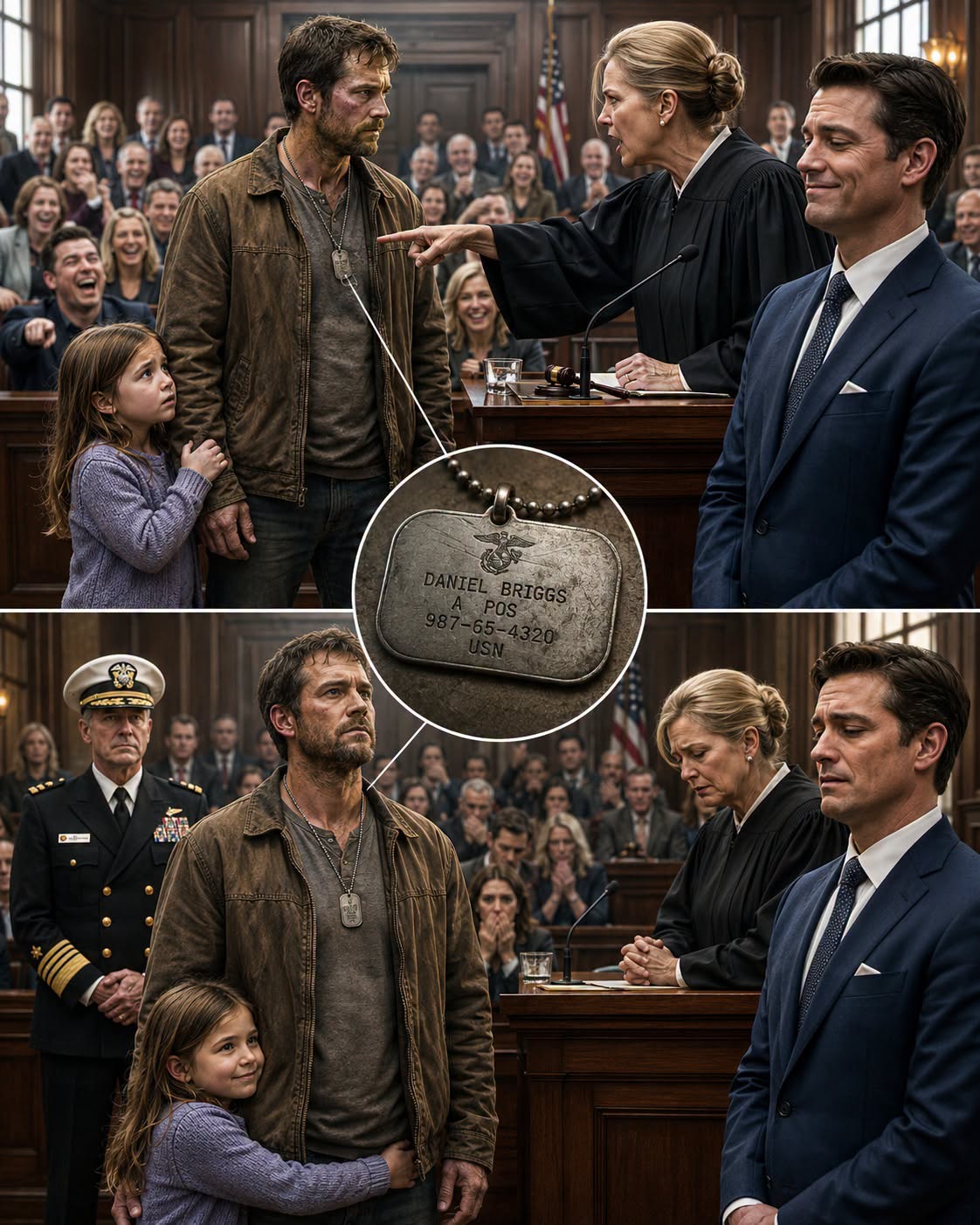
The judge ordered me to remove the one thing I had been forbidden to take off.
She did it in front of a packed courtroom, in front of strangers who already looked at me as if the verdict had been stamped across my forehead, and worst of all, in front of my six-year-old daughter.
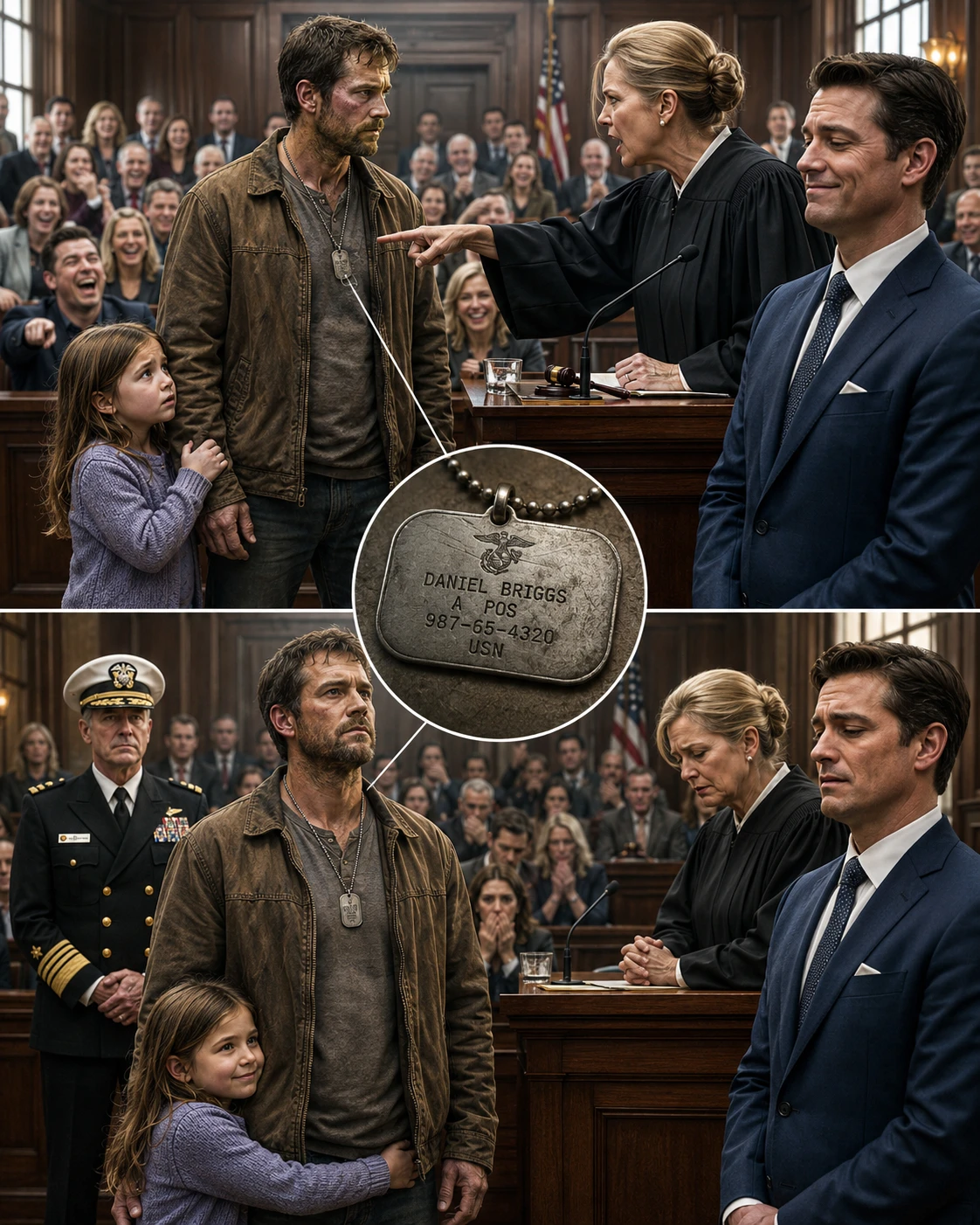
The metal tag against my chest was dull, scratched, and ugly. It hung from a plain chain beneath the collar of my shirt. Nothing about it looked valuable.
Judge Patricia Hartwell stared at it as though I had walked into her courtroom wearing a loaded weapon.
Then her gavel cracked against the bench.
Courtroom 4 went silent.
“Take it off.”
Her voice was sharp enough to cut glass.
I sat in the back row wearing a frayed brown jacket, old work boots, and the face of a man who had not slept properly in years. Sophie was pressed against my side, her small fingers wrapped around my sleeve.
She looked up at me.
“Daddy?”
“It’s okay.”
It wasn’t.
Every head in the courtroom had turned toward us.
I knew what they saw.
A poor man.
No lawyer.
No expensive suit.
No family sitting behind me.
A criminal charge hanging over my head.
I was accused of beating two men so badly in an alley behind a closed laundromat that one needed stitches and the other left in an ambulance.
The police report described me as aggressive.
The prosecutor called the attack unprovoked.
Evan Pike and Ryan Sutter, the two men I had supposedly attacked, said I was drunk, unstable, and looking for a fight.
And because I had no one who could watch Sophie that morning, I had brought my daughter to court.
That completed the picture.
To them, I wasn’t a man trying to defend himself.
I was exactly what they had already decided I was.
Judge Hartwell pointed at my chest.
“I won’t repeat myself, Mr. Briggs. That distraction comes off, or you leave my courtroom.”
My hand moved instinctively toward the tag.
Not to remove it.
To make sure it was still there.
The edge of the metal pressed against my thumb.
There were markings on it that meant nothing to anyone in that room.
At least, that was what I had believed.
Letters.
Numbers.
A narrow insignia almost worn smooth with age.
No name.
No rank.
Nothing a normal person could use to identify me.
That was the point.
It was not jewelry.
It was not decoration.
And it definitely was not something I wore because I thought it made me look tough.
It belonged to a part of my life that officially existed only in sealed records, compartmented files, and the memories of people who had signed the same papers I had.
Years ago, I had been given one simple instruction.
Keep the identification token on your person at all times.
No exceptions.
If questioned, request verification through the authorized channel.
Do not explain its purpose.
Do not surrender it.
That order had followed me into civilian life.
Into grocery stores.
Parent-teacher conferences.
Job interviews.
Emergency rooms.
And now into Courtroom 4.
Sophie’s fingers began trembling against my coat.
I leaned toward her.
“We didn’t do anything wrong.”
She nodded, although she clearly did not understand.
Neither did anyone else.
I stood.
Judge Hartwell’s expression hardened.
“Your Honor,” I said, “I can’t remove it.”
Someone behind me muttered, “Oh, come on.”
A few people laughed.
The judge raised one eyebrow.
“You can’t?”
“No, ma’am.”
“Is it medically necessary?”
“No.”
“Religious?”
“No.”
“Then remove it.”
I swallowed.
I could already feel the trap closing.
If I explained too much, I violated an order.
If I refused, I looked defiant.
If I surrendered it, I broke another order.
So I gave her the only answer I was permitted to give.
“It’s authorized, Your Honor.”
The reaction was immediate.
A ripple of laughter moved through the benches.
Sophie shrank against me.
Judge Hartwell leaned back.
“Authorized?”
“Yes, ma’am.”
“By whom?”
I said nothing.
Her eyes narrowed.
“Mr. Briggs, I asked you a question.”
“I understand.”
“Then answer it.”
“I’m not at liberty to say.”
That earned louder laughter.
I heard somebody whisper, “This guy’s insane.”
The prosecutor at the front table did not laugh out loud.
He did something worse.
He smiled.
Just slightly.
Caleb Voss was maybe forty, clean-cut, expensive haircut, dark blue suit. Everything about him looked pressed, prepared, and certain.
From the first time I had met him, he had treated me like a case already won.
Not a father.
Not a defendant who might actually be telling the truth.
A file.
A number.
Something standing between him and lunch.
Judge Hartwell looked at my tag again.
“Authorized by whom? Some biker gang?”
This time the courtroom erupted.
Even the bailiff looked away to hide a smile.
I felt Sophie flinch.
That was the moment something changed inside me.
I had been screamed at by men with rifles in their hands.
I had spent nights in places where using a flashlight could get someone killed.
I had learned how to keep my breathing steady while things exploded close enough to shake dirt from the ceiling.
I could endure humiliation.
What I could not endure was seeing my daughter learn that humiliation because of me.
Her face was bright red.
Her eyes were wet.
She stared down at her shoes because strangers were laughing at her father.
I kept my voice level.
“It isn’t a gang symbol, Your Honor.”
“Then what is it?”
“I’ve told you what I’m allowed to tell you.”
The prosecutor turned slightly toward the gallery.
That same smirk.
I knew that look.
He thought I was digging my own grave.
Judge Hartwell lifted the gavel.
“You will sit down, Mr. Briggs.”
I did.
“And if that object interferes with these proceedings again, I will have the bailiff remove it.”
My body went cold.
I looked toward the bailiff.
He was a broad man with gray at his temples. His nameplate read HARRIS.
He glanced at the tag.
Then at me.
For the first time, he wasn’t smiling.
Maybe he saw something in my face.
Maybe training recognizes training even when uniforms are gone.
Whatever it was, he did not come toward me.
Judge Hartwell moved on.
For the next three hours, Sophie and I sat on the hard wooden bench waiting for my name.
People with lawyers came and went.
Men in polished shoes whispered to attorneys carrying leather briefcases.
Women signed papers.
Deals were negotiated.
Charges were reduced.
Dates were changed.
Lives were decided in ten-minute conversations filled with words most people barely understood.
I had four pages.
That was it.
Four pages I had typed at the public library because the printer at the apartment had stopped working months earlier.
At the top I had written:
MOTION TO DISMISS OR, IN THE ALTERNATIVE, REQUEST FOR EVIDENTIARY HEARING.
I had researched every word myself.
Sophie had colored beside me while I read cases I barely understood.
She drew a purple horse on the back of one discarded draft.
I still had that page in my pocket.
The charges were simple on paper.
Assault.
Aggravated battery.
Disorderly conduct.
The story behind them was not.
Three weeks earlier, Sophie and I had been walking home from a twenty-four-hour grocery store because my truck needed a fuel pump I couldn’t afford yet.
It had rained earlier that night.
The sidewalks were wet.
Sophie had fallen asleep in her stroller with a yellow blanket tucked beneath her chin.
We were cutting past a closed laundromat when I heard a woman scream.
Not yell.
Not argue.
Scream.
There is a difference.
I stopped.
Every instinct I possessed told me not to go toward it.
I had Sophie with me.
That changed everything.
Years ago, danger had been my job.
Now my job was getting my daughter home safely.
I started pushing the stroller again.
Then a woman stumbled out of the alley.
Barefoot.
Wet hair stuck to her face.
Her blouse was torn at one shoulder.
There was blood at the corner of her mouth.
She almost ran past me.
Then she saw Sophie.
Then me.
Then the tag.
My jacket had been open.
The metal had slipped outside my shirt.
The woman froze.
Her eyes locked onto it.
I still remember the change in her face.
It wasn’t recognition of me.
She had never seen me before.
She recognized what I was wearing.
And whatever that tag meant to her, it turned terror into desperate hope.
“Please,” she whispered.
One word.
That was all.
Behind her, footsteps splashed through a puddle.
Two men emerged from the alley.
Evan Pike.
Ryan Sutter.
I did not know their names then.
I only knew one was taller, one heavier, and both looked angry that the woman had reached the street.
Pike pointed at me.
“Keep walking.”
I looked down at Sophie.
Still asleep.
Then at the woman.
Her arms were wrapped around herself.
“Is she with you?” I asked.
Pike smiled.
“She’s drunk.”
The woman shook her head.
Sutter stepped forward.
“Mind your business.”
I gave them every opportunity to leave.
I would later repeat that sentence in court.
No one cared the first time.
I moved the stroller behind me.
“I am minding my business,” I said. “My business is getting my daughter home. You two go back the other way.”
Pike laughed.
Sutter didn’t.
He reached for the woman.
She recoiled.
I caught his wrist.
Not hard.
Just enough.
His face changed.
There are moments when you can see the future arrive in someone’s eyes.
He had expected a tired man in old boots.
He realized too late that he had grabbed the wrong situation.
“Let go of me,” he said.
I did.
Immediately.
I wanted no fight.
Pike gave me one anyway.
He swung first.
The police report never mentioned that.
Sutter came second.
The whole thing lasted maybe eleven seconds.
It felt longer.
I stepped inside Pike’s punch and put him down.
Sutter grabbed my coat from behind.
I turned.
He hit the wall.
Pike got back up.
I warned him.
He rushed me again.
That was his choice.
When it ended, Pike was on his knees bleeding from his nose.
Sutter was on the pavement clutching his shoulder.
I had a split lip and blood on my knuckles that wasn’t mine.
Then sirens came.
I turned toward the woman.
She was gone.
Just gone.
I saw the empty mouth of the alley.
Rainwater.
A blinking security light.
Nothing else.
The police arrived thirty seconds later.
Two injured men pointed at me.
I was standing over them.
My daughter was asleep ten feet away.
Guess who they believed.
They put me in handcuffs before asking my name.
By the time Sophie woke, I was sitting on the curb with my hands behind my back.
She screamed.
That sound stayed with me longer than the jail cell did.
Now, three weeks later, the clerk finally called my name.
“Daniel Marcus Briggs.”
My stomach tightened.
I stood.
Sophie took my hand.
We walked to the defense table together.
Her sneakers dangled above the floor when she climbed into the chair.
Judge Hartwell looked down at my file.
Then at me.
“Mr. Briggs, you are representing yourself?”
“Yes, Your Honor.”
“I advised you at your arraignment that this was unwise.”
“I remember.”
“Do you truly believe you can win like this?”
There it was.
Not a legal question.
A judgment.
No lawyer.
No money.
No witness.
No chance.
I looked at Sophie.
Then at my four typed pages.
Then at Caleb Voss.
“I believe the truth matters whether I can afford someone to say it for me or not.”
Voss’s smile disappeared.
The judge’s expression hardened.
I opened my mouth to continue.
The courtroom doors opened.
The sound itself was not loud.
But the footsteps that followed were controlled.
Measured.
Heavy.
Every head turned.
I already knew that walk.
My heart stopped before my mind understood why.
A man in a pristine white uniform came down the center aisle.
Ribbons covered the left side of his chest.
Four silver stars gleamed on his shoulders.
Vice Admiral Marcus Webb had more gray in his hair than the last time I had seen him, but nothing else about him seemed to have changed.
He did not look left.
He did not look right.
He walked directly toward the defense table.
Sophie stared.
So did everyone else.
Admiral Webb stopped behind my chair.
For half a second, his eyes met mine.
There was no smile.
Only recognition.
Then he looked at Judge Hartwell.
He raised one hand and pointed at the scratched piece of metal hanging from my neck.
“Your Honor,” he said, his voice low enough that no one dared breathe over it, “you just issued an order that violates national security.”
And suddenly, nobody was laughing.
PART 2: THE MAN WITH FOUR STARS
The courtroom froze so completely that I could hear Sophie breathing beside me.
Judge Hartwell stared at Vice Admiral Webb.
For the first time all morning, she seemed unsure what to say.
Caleb Voss slowly rose from the prosecution table.
Bailiff Harris straightened.
Webb remained behind me, still as stone.
The judge finally found her voice.
“I’m sorry?”
“You ordered Mr. Briggs to surrender a controlled identification token.”
Her eyes shifted toward my chest.
The tag suddenly looked different to everyone.
Five minutes earlier, it had been trash.
Now nobody could stop staring at it.
Judge Hartwell set down her pen.
“Admiral, this is a state criminal proceeding.”
“I’m aware.”
“And I am responsible for maintaining order in this courtroom.”
“I’m aware of that as well.”
“Then perhaps you can explain why an object worn by a criminal defendant is a matter of national security.”
Webb’s jaw tightened slightly.
The word criminal did not escape him.
But his voice remained professional.
“Defendant, Your Honor. He has not been convicted of anything.”
The silence that followed was uncomfortable.
I stared at the table.
Part of me wanted to look at the people who had laughed.
I didn’t.
I had learned long ago that vindication can become arrogance very quickly if you let it.
Judge Hartwell leaned back.
“Very well. Defendant.”
Webb stepped forward.
“That token was issued under a restricted personnel security directive. It is assigned to Mr. Briggs. It is not transferable, and he is not authorized to separate from it without clearance from the issuing authority.”
The prosecutor glanced at me.
Then back at Webb.
“Are you telling this court Mr. Briggs is active military?”
“No.”
“Then why would he possess—”
“I will answer questions from the bench,” Webb said.
Voss stopped.
The admiral never raised his voice.
He did not need to.
Judge Hartwell folded her hands.
“Why is Mr. Briggs wearing it?”
“That answer is classified.”
Someone in the gallery inhaled sharply.
The judge looked annoyed again.
“Admiral, you cannot simply enter my courtroom, use the word classified, and expect—”
“I can provide the court with verification through secure channels.”
Webb reached inside a folder carried beneath his arm.
He removed a single sealed envelope.
“I came prepared to do exactly that.”
My throat tightened.
I had not asked him to come.
That bothered me almost as much as it relieved me.
There was only one way Webb would have known what had happened that morning.
The verification request.
When court security had questioned the tag downstairs, I had given Bailiff Harris the number printed on the reverse side.
He had made a call.
I had assumed someone at a desk would confirm I was permitted to retain it.
I had not expected a four-star admiral.
Judge Hartwell looked toward Harris.
“Did you contact this office?”
Harris cleared his throat.
“Yes, Your Honor.”
“When?”
“About two hours ago.”
“And you didn’t think to tell me?”
“I was waiting for verification.”
Webb answered for him.
“The verification reached me.”
That told me more than I wanted to know.
He had come personally.
Why?
I had not spoken to Marcus Webb in almost four years.
Not since the last closed-door debriefing.
Not since I had walked out of a secure building carrying a box that contained everything the Navy was willing to admit belonged to me.
He had shaken my hand that day.
“You did your duty, Briggs.”
I had looked at him and said, “That’s not the same thing as coming home.”
He had no answer.
Now he stood behind my daughter in a county courtroom because two men had lied about an alley fight.
The past had found me anyway.
Judge Hartwell opened the sealed envelope.
She read the first page.
Then the second.
The color in her face changed.
Not dramatically.
Just enough.
Her eyes lifted toward me.
Then toward Webb.
She lowered her voice.
“This document indicates special access authority.”
“Yes.”
“And this identifier must remain on his person?”
“Yes.”
“Why?”
“That portion is not releasable in open court.”
She looked at me again.
I did not enjoy it.
This was exactly what I had spent years trying to avoid.
People see one uniform, one classified document, one four-star officer, and suddenly they build a legend around a man.
They imagine medals.
Missions.
Heroism.
They do not imagine waking at 3:17 in the morning because a refrigerator compressor sounds too much like something you heard in another country.
They do not imagine checking every window twice.
They do not imagine a six-year-old asking why Daddy hates fireworks.
I had wanted Sophie to know me as her father.
Nothing else.
Judge Hartwell resealed the document.
“Mr. Briggs.”
I stood.
“The court withdraws its order regarding the item around your neck.”
I nodded.
“Thank you, Your Honor.”
She hesitated.
Then added, “And the remark I made earlier was inappropriate.”
Nobody moved.
It was not an apology exactly.
But it was closer than I had expected.
I looked at Sophie.
She was studying the admiral’s uniform with enormous eyes.
Webb looked down at her.
“You must be Sophie.”
She moved closer to me.
“How do you know my name?”
For the first time, his expression softened.
“Your father talks about you.”
I looked at him.
“No, I don’t.”
One corner of his mouth moved.
“You did once.”
Sophie frowned at me.
“You know him?”
“A long time ago.”
Webb looked at the judge.
“I am not here to interfere with the criminal proceeding.”
Voss seemed relieved to hear that.
The relief lasted three seconds.
“I am here because Mr. Briggs is prohibited from disclosing information that may be relevant to assumptions being made about him.”
The prosecutor’s jaw tightened.
“What assumptions?”
Webb looked directly at him.
“The assumption that because Mr. Briggs declines to discuss his background, he has none.”
I felt every eye return to me.
This was getting dangerous.
Not physically.
Personally.
I had spent years building walls around that part of myself.
Now Webb was opening a door.
Judge Hartwell said, “Are you able to tell the court whether Mr. Briggs has training relevant to the incident before us?”
Webb looked at me first.
That mattered.
He was asking permission without saying the words.
I gave the smallest nod.
“Mr. Briggs received extensive training in defensive tactics, personnel recovery, threat assessment, and civilian extraction.”
Voss’s face changed.
Judge Hartwell asked, “Special operations?”
Webb paused.
“I did not say that.”
Which, of course, told everyone exactly what he could not say.
The courtroom whispered.
The judge struck her gavel once.
“Order.”
I sat down.
Sophie whispered, “Daddy, were you a soldier?”
“Navy.”
“You drove boats?”
A laugh nearly escaped me.
“Sometimes.”
Webb looked away to hide his.
The hearing resumed.
And that was when I understood something.
The admiral’s presence had changed the room.
But it had not changed the charges.
Pike and Sutter were still listed as victims.
The missing woman was still missing.
The police had still found me standing over two injured men.
If I relied on Webb’s uniform to save me, then Voss would be right about one thing.
I would not have proven what happened.
I would only have proven I knew powerful people.
I didn’t want that.
I needed the truth.
Judge Hartwell looked at my motion.
“You requested an evidentiary hearing.”
“Yes.”
“On what basis?”
I stood.
“Because the statements from Mr. Pike and Mr. Sutter contradict each other.”
Voss immediately rose.
“Your Honor—”
“They both say he attacked them,” he said.
“That’s not what I said.”
Voss looked at me.
I opened my folder.
My hands had stopped shaking.
“Mr. Pike says in his statement that I approached them from the street and struck Mr. Sutter without warning.”
I turned a page.
“Mr. Sutter says I was already in the alley when Mr. Pike confronted me.”
Voss said, “Minor discrepancies are common in traumatic events.”
“Then there’s this.”
I raised the second statement.
“Mr. Pike says the fight began at 10:16 p.m.”
Another page.
“Mr. Sutter says they had just left the laundromat.”
Judge Hartwell frowned.
“So?”
“The laundromat closed at nine.”
Voss leaned forward.
“That proves nothing.”
“No. But it proves the story deserves questions.”
The judge watched me differently now.
Not kindly.
Not favorably.
But she was listening.
I continued.
“Neither statement explains why I was there with a sleeping six-year-old in a stroller if I went looking for a fight.”
Sophie looked at me.
I hated bringing her into it.
But she was already in it.
“Neither statement explains the blood found on the rear wall of the alley before the place where the fight occurred.”
Voss stiffened.
That detail was already in the police photographs attached to discovery.
I had stared at those photographs for hours in the library.
Not new evidence.
Just something everyone had ignored.
“And neither man mentions the woman.”
Judge Hartwell’s eyes narrowed.
“What woman?”
“The woman I stepped between them and.”
Voss exhaled loudly.
“An unidentified woman no officer saw and no investigator has located.”
“That doesn’t mean she didn’t exist.”
“It means there is no evidence she did.”
I stared at him.
“She existed.”
“Then where is she?”
I had no answer.
And he knew it.
Voss sat down.
The judge looked toward me.
“Mr. Briggs?”
“I don’t know.”
The room shifted again.
That was the problem with truth.
Sometimes the part you cannot prove sounds exactly like a lie.
Judge Hartwell considered my motion.
Then she said, “I’ll hear limited testimony regarding the conflicting accounts.”
Voss stood.
“Your Honor, the state is prepared to call Mr. Pike.”
My stomach tightened.
Across the aisle, the courtroom doors opened again.
Not dramatically this time.
A lieutenant in a dark service uniform entered.
He walked quickly to Admiral Webb and bent close to his ear.
Webb listened.
His expression changed.
Then he turned toward me.
Just once.
I knew that look too.
Something had happened.
Judge Hartwell noticed.
“Admiral?”
Webb spoke quietly.
“I apologize, Your Honor. I need ten minutes.”
“This is not your proceeding.”
“No.”
He looked at me again.
“But this may become relevant to Mr. Briggs’s.”
I stood.
“What happened?”
Webb did not answer immediately.
Then he said the words that made my heart strike hard against my ribs.
“We found her.”
PART 3: WHAT REALLY HAPPENED IN THE ALLEY
For three weeks, I had wondered if the woman from the alley had been real enough to save me.
That sounds cruel.
I knew she was real.
I remembered her face.
The fear in her eyes.
The torn fabric hanging from her shoulder.
But a courtroom does not care what lives inside your memory.
It cares what can stand up, swear an oath, and survive questions.
When Webb said they had found her, my first feeling was relief.
My second was shame.
Because immediately afterward I wondered whether she would help me.
Not whether she was safe.
Not whether she had recovered.
Whether she could save me.
I looked down at Sophie and hated myself for it.
Webb must have read something in my face.
“She’s alive,” he said.
I breathed out.
“Is she okay?”
His answer took too long.
“She will be.”
Judge Hartwell called a recess.
The courtroom erupted into whispers.
Caleb Voss rushed toward one of his assistants.
Pike and Sutter were not in the room yet. They had been waiting outside to testify separately.
I wondered whether someone would tell them.
I hoped they did.
I wanted them to have a few minutes with the same uncertainty I had lived with for three weeks.
Sophie tugged my sleeve.
“Daddy, who did they find?”
“The lady from that night.”
“The lady who was scared?”
I looked at her.
“You remember?”
She nodded.
“I woke up when the police car came.”
I had thought she had slept through everything before that.
Apparently not.
Children always know more than adults want to believe.
“She’s okay?”
“I think so.”
Sophie leaned against me.
“That’s good.”
Just that.
No thought about what the woman meant to my case.
No fear about prison.
No anger.
She was six.
Someone was hurt.
Now they were alive.
That was enough.
Sometimes I think children understand morality better before adults teach them how complicated it is supposed to be.
Admiral Webb stood by one of the tall courtroom windows.
I walked over.
“You shouldn’t have come.”
He glanced at me.
“That’s the first thing you say?”
“You know what I mean.”
“Yes.”
“Then why are you here?”
His eyes moved toward Sophie.
“Because the verification request had your name on it.”
“That doesn’t answer me.”
His face became harder.
“Because I read the arrest report.”
I waited.
“And?”
“And I knew you.”
“Four years ago.”
“That does not mean I stopped knowing what kind of man you are.”
I looked away.
There were things I did not want to feel.
Gratitude was one of them.
It made old wounds open.
“You could have sent a lawyer.”
“I offered.”
“You know I wouldn’t take one tied to the program.”
“Yes.”
“Then you came yourself?”
“Yes.”
“Why?”
Webb lowered his voice.
“Because you always carried everyone else out, Briggs.”
The words hit somewhere beneath my ribs.
He looked toward Sophie again.
“I thought somebody should show up for you once.”
I had no answer.
So I asked another question.
“How did you find the woman?”
“Your description was enough to narrow it down once we requested lawful coordination with local investigators.”
“No classified resources?”
His expression sharpened.
“Do you really think I would commit a felony to help you beat an assault charge?”
“Just checking.”
He almost smiled.
“She sought medical treatment the night of the incident. Local investigators had not connected her to your case because she gave a different location for where she was injured.”
“Why?”
“We’ll let her tell you.”
That worried me.
“How did she recognize the tag?”
Webb looked at mine.
“You noticed that?”
“I notice things.”
“Yes. Unfortunately, you always did.”
“Marcus.”
His eyes met mine.
“I don’t know yet.”
That frightened me more than if he had.
Because Webb usually knew.
When the recess ended, Evan Pike took the stand.
He wore a neck brace.
I did not remember doing anything to his neck.
But there it was.
White foam wrapped around him like a costume.
His lawyer sat behind Voss.
Pike looked at me with hate.
Not fear.
Hate.
Voss led him carefully.
“Mr. Pike, did you know the defendant before the night of May fourteenth?”
“No.”
“Did you threaten him?”
“No.”
“Did you threaten anyone with him?”
“No.”
“Did he strike you?”
“Yes.”
“Without provocation?”
“Yes.”
“Describe what happened.”
Pike looked toward the judge.
“We were leaving the alley. He came up acting crazy. Said something I couldn’t understand. Then he hit Ryan.”
Voss nodded.
“And then?”
“I tried to stop him.”
I nearly laughed.
“He attacked me too.”
“Did you see a woman?”
Pike’s face stayed still.
“No.”
Voss looked at the judge.
“No further questions.”
My turn.
I stood.
I had never cross-examined anyone in my life.
I had interrogated terrified men in worse places.
This felt harder.
Because if I made one mistake, Sophie could lose me.
I walked toward the lectern.
“Mr. Pike, you said you were leaving the alley?”
“Yes.”
“Why were you in it?”
He hesitated.
“Shortcut.”
“To where?”
“Home.”
“Your home is west of the laundromat, correct?”
Voss stood.
“Objection.”
I looked at the judge.
“It goes to whether his account makes sense.”
Hartwell considered it.
“Overruled.”
Pike’s mouth tightened.
“Yes.”
“The alley runs east.”
“So?”
“So it isn’t a shortcut home.”
“I was meeting somebody.”
I waited.
He realized what he had done.
“You just testified you were taking a shortcut.”
“I forgot.”
“Forgot why you were in the place where you say I attacked you?”
Voss objected again.
Sustained.
I backed off.
“Did I have my daughter with me?”
“Yes.”
“Was she in a stroller?”
“I think so.”
“Was she asleep?”
“I don’t know.”
“Did I ever approach you before you approached me?”
“Yes.”
“That’s your testimony?”
“Yes.”
I opened his written statement.
“You told Officer Mendel that I was standing next to the stroller when you first saw me.”
Pike stared at me.
“I don’t remember.”
“Would you like me to read it?”
Voss stood.
“Your Honor—”
Hartwell raised a hand.
“Mr. Pike may answer.”
Pike swallowed.
“I might’ve said that.”
I closed the page.
“Which is true?”
Silence.
“You said I was drunk.”
“You acted drunk.”
“Did you see me drink anything?”
“No.”
“Smell alcohol?”
“I don’t remember.”
“Did the hospital test my blood after I was arrested?”
Voss stood again.
“Mr. Briggs—”
“I’ll withdraw it.”
I did not need the answer.
The state already knew the result had been negative.
So did Pike.
I returned to the question that mattered.
“Was there a woman in that alley?”
“No.”
“Never?”
“No.”
“No barefoot woman?”
“No.”
“No woman with a torn sleeve?”
His eyes flickered.
Tiny.
Almost nothing.
But I saw it.
So did Judge Hartwell.
I stepped closer.
“I didn’t ask whether she was injured.”
Pike’s face changed.
Voss stood.
“Objection!”
Hartwell’s gavel struck.
“Mr. Briggs, step back.”
I did.
But the damage was done.
Pike looked toward the prosecutor.
The judge noticed that too.
I had not proven anything.
Not yet.
But the truth had cracked the door open.
Ryan Sutter was worse.
His shoulder remained in a sling.
He claimed he had never touched me.
I asked how his shoulder had been injured.
“I fell.”
“After attacking me from behind?”
“No.”
“After grabbing my jacket?”
“No.”
“Then how did your handprint get on the back of it?”
Voss stood so quickly his chair rolled.
I had found that one in the evidence inventory.
My coat had been photographed after arrest.
A blood smear ran across the back.
Sutter’s blood type matched it.
Again, nothing new.
Just ignored.
Sutter stared at me.
“I don’t know.”
“Were you bleeding before I touched you?”
“No.”
“Then your blood got on my back while you were facing me?”
He said nothing.
I felt the room changing.
Not because of Webb.
Because of questions.
Because lies are strong when nobody touches them.
Once you start pulling threads, they become fragile.
Then the courtroom door opened.
Every instinct in me went still.
A woman entered beside a deputy.
Her jaw was bruised yellow and purple.
One arm rested in a sling.
Her hair was pulled back.
She wore flat shoes.
For one second, I did not recognize her.
Then she looked at me.
Her eyes dropped immediately to the metal tag.
The same reaction.
The same certainty.
The woman from the alley was alive.
And when Evan Pike saw her, every trace of color vanished from his face.
PART 4: THE WOMAN WHO RAN
Her name was Mara Ellis.
I learned it when the clerk asked her to state it for the record.
She stood beside the witness chair with one hand raised.
“Do you swear the testimony you are about to give is the truth?”
“I do.”
Her voice shook.
I could not stop looking at the bruises along her jaw.
Three weeks earlier, in the rain, I had only seen the blood.
Now I could see what came afterward.
Judge Hartwell leaned forward.
“Ms. Ellis, you understand you are appearing voluntarily?”
“Yes.”
“Do you need counsel?”
“No.”
“Are you in any danger by testifying here?”
Mara looked at Pike.
Then Sutter.
Both men avoided her eyes.
“I’m afraid,” she said.
The courtroom became very quiet.
“But I’m here.”
Something about that sentence hit me.
Bravery is not being unafraid.
I knew that better than most.
Judge Hartwell nodded.
“Mr. Voss?”
The prosecutor looked deeply unhappy.
Not because he hated the truth.
Because the case he had believed in was changing underneath him.
He approached carefully.
“Ms. Ellis, were you behind the laundromat on May fourteenth?”
“Yes.”
“Did you see Mr. Briggs?”
She looked at me.
“Yes.”
“Had you met him before?”
“No.”
“Did he attack Mr. Pike or Mr. Sutter?”
She took a breath.
“He stopped them from hurting me.”
Nobody moved.
Voss glanced toward his notes.
“How did you come to be in the alley?”
Mara looked down at her hands.
“I was walking to my car.”
Her voice became quieter.
“Those two men followed me from the block behind the laundromat.”
She pointed at Pike and Sutter.
“They kept trying to talk to me. I told them I wasn’t interested.”
Pike shook his head.
The judge looked sharply at him.
He stopped.
Mara continued.
“They followed me anyway.”
“What happened next?”
“Mr. Pike grabbed my arm.”
Pike whispered something to his attorney.
“I told him to let go.”
Her breathing changed.
I recognized it.
Memory does strange things to the body.
A person can be sitting in a safe courtroom and still be trapped in an alley.
“Sutter stood behind me. I tried to get away. Pike hit me.”
Voss’s face tightened.
“Why?”
“I scratched him.”
I remembered the marks on Pike’s cheek in the booking photographs.
I had assumed the pavement had done it.
Another thread.
Always there.
Nobody had pulled it.
Mara touched her bruised jaw.
“I got away from them for a few seconds. I ran toward the street.”
Her eyes met mine.
“And I saw him.”
Me.
“He had a little girl in a stroller.”
Sophie sat perfectly still.
“I was going to keep running.”
Mara’s eyes moved to the tag around my neck.
“Then I saw that.”
Judge Hartwell followed her gaze.
Voss asked the question I had been asking for three weeks.
“You recognized it?”
“Yes.”
“How?”
Mara hesitated.
Then she looked at Admiral Webb.
Something passed between them.
Not familiarity exactly.
Permission.
Webb said nothing.
Mara turned back toward the judge.
“Years ago, I worked overseas as a civilian language specialist under a federal contract.”
My pulse slowed.
Now I understood.
She continued.
“There was an evacuation after a security situation deteriorated. I can’t discuss where.”
Webb remained expressionless.
“The team that came for us wore those.”
She pointed toward my chest.
“Not visible like his was. Under their gear. But I saw one when a medic treated another civilian.”
The room seemed to recede around me.
Mara’s voice trembled.
“We had been told that if everything went wrong, we were to stay with the people carrying that identification.”
I looked at Webb.
He was watching me.
Mara swallowed.
“So when I saw Mr. Briggs wearing one, I thought…”
She stopped.
Judge Hartwell softened slightly.
“You thought what?”
Mara’s eyes filled.
“I thought if I could reach him, he wouldn’t leave me there.”
I stared at the table.
The weight of the tag suddenly felt different.
For years, I had hated it.
Not the metal itself.
What it represented.
Names I could not say.
Places I could not discuss.
People we brought out.
People we didn’t.
A whole life sealed behind orders.
To me, the tag had become a chain connecting me to everything I wanted to forget.
To Mara, it meant something else.
It meant someone would stay.
Voss cleared his throat.
“What did you say to Mr. Briggs?”
“One word.”
I already knew.
“Please.”
She looked at me.
“And he stopped.”
Sophie slid her hand into mine beneath the table.
Mara described the fight.
Not dramatically.
That made it more powerful.
I had placed the stroller behind me.
I had told Pike and Sutter to leave.
Sutter reached for her.
I stopped him.
I released him when he demanded it.
Pike swung at me.
I defended myself.
Sutter attacked from behind.
I turned.
Pike attacked again.
I put him down.
Every part matched what I had said.
Then Voss asked the question I feared.
“Why did you leave before police arrived?”
Mara went pale.
“I panicked.”
“Why?”
“Because I was afraid.”
“Of the defendant?”
“No.”
“Of Mr. Pike and Mr. Sutter?”
“Yes.”
Voss glanced toward the judge.
“You had police coming.”
“I know.”
“Then why run?”
Mara’s chin trembled.
“Because when you’ve just been held against a wall by two men who keep telling you nobody is going to believe you, seeing police lights doesn’t magically make your body understand that you’re safe.”
Voss stopped.
The words landed harder than anger would have.
Mara continued before he could ask.
“I ran behind the buildings and called a rideshare from another street. I went to an urgent care clinic.”
“Did you tell them you had been assaulted?”
“I said I fell.”
“Why?”
“Because I was ashamed.”
That word filled the courtroom.
Ashamed.
I knew something about that too.
The shame of being poor.
The shame of needing help.
The shame of watching strangers laugh while your child sat beside you.
Mara looked toward me.
“I didn’t know he had been arrested.”
“When did you learn?”
“Yesterday.”
“How?”
“A local investigator contacted me after trying to match the medical report with a description from the case.”
Voss nodded slowly.
He was no longer attacking her.
He was verifying.
“Why did you agree to come?”
Mara looked straight at Pike.
“Because he didn’t leave me there.”
Then she looked at me.
“So I wasn’t going to leave him here.”
I had to look away.
Voss returned to his table.
“No further questions.”
Judge Hartwell looked at me.
“Mr. Briggs, you may question the witness.”
I stood.
For a moment, I had nothing.
Every question I had wanted answered was already there.
I walked toward the lectern.
Mara watched me.
I could see fear in her face.
I did not want to make her relive anything else.
So I asked only what mattered.
“Ms. Ellis, did I know those men before that night?”
“No.”
“Did I threaten you?”
“No.”
“Did I ever ask you for anything?”
“No.”
“Did I tell you to run?”
“No.”
“Did I start that fight?”
“No.”
I nodded.
Then paused.
“There’s one more thing.”
Judge Hartwell looked at me.
I turned back to Mara.
“When you saw my daughter that night, was she in danger because I chose to stop?”
The question surprised everyone.
Especially Webb.
Mara looked at Sophie.
“I think…”
She breathed carefully.
“I think there was danger either way.”
I nodded.
That was the answer I had been carrying inside myself since the alley.
I could have walked away.
That would have protected Sophie from seeing me arrested.
From court.
From all of this.
But what would I have taught her?
That when someone whispers please, the correct response is to keep walking if helping is inconvenient?
There are costs to doing the right thing.
People rarely put that part on posters.
I returned to my table.
Mara said my name.
“Mr. Briggs?”
I turned.
“Thank you.”
My throat closed.
I gave her a small nod.
“You got yourself out.”
She shook her head.
“Not alone.”
Judge Hartwell called another recess.
This one felt different.
Pike’s attorney immediately pulled him into a corner.
Sutter’s lawyer did the same.
Voss stood alone at the prosecution table, reading through the file as if the words might rearrange themselves into the case he thought he had that morning.
I sat beside Sophie.
She climbed into my lap.
“You helped her.”
“Yes.”
“Because you were Navy?”
“No.”
She frowned.
“Then why?”
I wrapped one arm around her.
“Because she asked.”
Across the courtroom, Judge Hartwell had not yet left the bench.
She heard me.
Our eyes met.
Neither of us said anything.
Then Caleb Voss walked toward me.
I stood.
He looked at Webb.
Then at Sophie.
Finally at me.
“When the court returns,” he said, “I’m moving to dismiss all charges against you.”
I should have felt victory.
Instead I felt something stranger.
Anger.
Not wild anger.
Cold anger.
The kind that survives after fear is gone.
“That’s it?”
Voss blinked.
“What?”
“You dismiss it.”
“Yes.”
“And I go home.”
“That’s what you wanted.”
“No.”
I looked toward Pike and Sutter.
“What I wanted was for somebody to ask the right questions before putting handcuffs on me in front of my daughter.”
Voss’s expression tightened.
“I wasn’t the arresting officer.”
“You read the statements.”
“I did.”
“You saw the contradictions.”
“I saw discrepancies.”
“You saw the blood on my coat.”
“Yes.”
“You saw the scratches on Pike.”
His jaw moved.
“And you decided the easiest story was the right one.”
“That is not fair.”
I almost laughed.
“Fair?”
Webb stepped forward slightly.
I raised one hand.
This was mine.
I had spent the entire morning being spoken about.
Now I was speaking.
“I understand why the police arrested me that night,” I said. “Two injured men. One man standing. Witness missing. I understand it.”
Voss said nothing.
“But once everybody had time to look? You still treated me like a conviction waiting to happen.”
“I prosecuted based on the evidence available.”
“No. You prosecuted based on which evidence was convenient.”
His face hardened.
Judge Hartwell spoke from the bench.
“Mr. Voss.”
We both turned.
She was still seated.
“I suggest you consider carefully whether you wish to argue with that distinction.”
Voss stared at her.
Then lowered his eyes.
“Yes, Your Honor.”
He turned back to me.
For the first time since we met, he did not look confident.
“I should have looked harder.”
It was not everything.
But it was something.
I nodded.
Then I said, “Make sure you look harder at them.”
I pointed toward Pike and Sutter.
“And what they did to her.”
Voss looked at Mara.
Then at the two men.
His expression changed.
He closed my file.
“I will.”
That should have been the end.
It wasn’t.
Because when Judge Hartwell returned from recess, she did something none of us expected.
She looked straight at me and said:
“Mr. Briggs, before I rule on the state’s motion, there is something this court needs to address.”
PART 5: WHAT MY DAUGHTER REMEMBERED
Everyone stood when Judge Hartwell returned.
Then everyone sat.
She did not immediately look at the prosecutor.
She looked at me.
I could feel Sophie’s hand inside mine.
Judge Hartwell removed her glasses.
“Mr. Briggs, this morning I made a remark about the identification token you were wearing.”
I said nothing.
She continued.
“I did so before understanding what it was.”
Webb stood near the back wall.
Mara sat behind us.
Pike and Sutter had been moved to separate areas under instructions from their attorneys.
The courtroom was still packed.
Some of the same people who had laughed were still there.
I recognized several faces.
Now none of them looked at me.
Judge Hartwell spoke carefully.
“My lack of knowledge did not justify ridicule.”
That surprised me.
She looked toward the gallery.
“Nor did this courtroom’s reaction.”
Silence.
Then she looked at Sophie.
My daughter stared back.
“And a child should not have been forced to watch her father be mocked in a court of law merely because he was unable to explain something the rest of us did not understand.”
Something tightened behind my eyes.
I looked down.
I did not want Sophie to see me cry.
Judge Hartwell turned back to me.
“Mr. Briggs, I apologize.”
Not if you were offended.
Not for the misunderstanding.
I apologize.
The words mattered.
I stood.
“Thank you, Your Honor.”
She nodded.
Then looked toward Caleb Voss.
“The state has a motion?”
He rose.
“Yes, Your Honor.”
His voice no longer carried the confidence it had that morning.
“In light of testimony received today, contradictions in the complaining witnesses’ statements, and evidence supporting the defendant’s account of third-party defense and self-defense, the state moves to dismiss all charges against Daniel Marcus Briggs.”
Judge Hartwell looked at me.
“Any objection, Mr. Briggs?”
A few people almost smiled.
“No, Your Honor.”
“The motion is granted.”
Her gavel struck.
The sound hit me harder than I expected.
That was it.
Four words on a piece of paper.
Charges dismissed with prejudice.
No trial.
No conviction.
No possibility of the state simply bringing the same case back next week.
I was free.
Sophie looked up at me.
“Can we go home now?”
A laugh broke out in the courtroom.
Not cruel this time.
Even Judge Hartwell smiled.
“In just a moment.”
She turned toward Voss.
“What is the state’s intention regarding the testimony of Mr. Pike and Mr. Sutter?”
Voss stood.
“We are referring the matter for investigation into the assault on Ms. Ellis and potential false statements made during this proceeding.”
Pike erupted.
“This is insane!”
His attorney grabbed his arm.
Judge Hartwell struck the gavel.
“Mr. Pike, I strongly recommend you say nothing further.”
He sat.
Sutter stared at the floor.
I did not feel satisfaction watching them panic.
Maybe I should have.
Instead I felt tired.
They had nearly taken years from me because they expected the system to accept their story before anyone looked closely.
Watching consequences arrive did not give me back the nights I had spent wondering who would take Sophie if I went to prison.
It did not erase her scream when I was handcuffed.
Justice does not always feel like revenge.
Sometimes it feels like finally being able to breathe.
The hearing ended.
People began moving.
Reporters were not waiting outside. There were no cameras. No dramatic crowd.
Life is rarely as interested in your vindication as it was in your humiliation.
I preferred it that way.
I gathered my four-page motion.
The corners were bent.
Sophie reached into my folder.
“What’s this?”
She pulled out the purple horse she had drawn at the library.
I laughed.
“I thought I lost that.”
“It’s mine.”
“You drew it on my legal research.”
“It made it better.”
“It probably did.”
She folded it carefully and returned it to the folder.
Mara approached us.
For a second, neither of us knew what to say.
Up close, her bruises looked worse.
“You okay?” I asked.
She nodded.
“Getting there.”
I believed her.
There was a difference between being healed and getting there.
“You?”
I looked at Sophie.
“Getting there.”
Mara smiled.
Then her eyes moved to the tag.
“Can I ask you something?”
“Depends.”
She hesitated.
“Were you one of them?”
I knew what she meant.
One of the people who had come during that evacuation years earlier.
I looked toward Webb.
He was far enough away not to hear.
Or pretending to be.
“I can’t answer that.”
Mara laughed softly.
“Right.”
I thought she would leave it there.
Instead she said, “I remember one of them.”
My chest tightened.
“He carried an older man for almost two miles after the vehicles couldn’t get through.”
I said nothing.
“He kept telling everybody we were going home.”
The courtroom disappeared for a second.
Heat.
Smoke.
A narrow road.
An old man whose legs had stopped working.
A young woman translating instructions through tears.
A voice in my earpiece telling me we had four minutes.
The memory vanished as quickly as it came.
Mara studied my face.
She understood.
She did not ask again.
“Thank you,” she said.
“For which time?”
Her eyes filled.
“Both.”
I watched her walk toward the exit.
Admiral Webb came over.
Sophie stood straighter when she saw him.
She clearly liked the uniform.
“Are you the boss of Daddy?” she asked.
Webb looked at me.
I shook my head.
“Be careful.”
He ignored me.
“Your father has never been especially good at having a boss.”
Sophie giggled.
“True.”
I stared at her.
“You’re six.”
“I know things.”
Webb actually laughed.
It was the first time I had heard him do that in maybe ten years.
Then Sophie saw the stars on his shoulders.
“Are those because you’re important?”
Webb looked down at them.
“They mean I have a certain job.”
“My dad doesn’t have stars.”
“No.”
“Was he important?”
The question hit me in a place I was not prepared for.
Webb did not answer immediately.
He crouched so he was closer to her height.
“Your father was the man people wanted nearby when they were scared.”
Sophie looked at me.
I wanted to disappear.
“Really?”
Webb nodded.
“Really.”
She thought about that.
Then asked, “Is that why the lady asked him for help?”
Webb’s eyes moved to mine.
“Maybe.”
Sophie wrapped her arms around my waist.
“I knew he was good.”
That did it.
I turned my face away.
For years, I had carried memories of what I had done and what I had failed to do.
I had measured myself by people I could not save.
By missions that ended badly.
By choices no one should have to make.
My daughter measured me differently.
She cared that I packed her lunch.
That I cut the crust off grilled cheese.
That I checked under her bed when she heard noises.
That I stayed.
Maybe that was enough.
Webb stood.
“You should call sometime.”
“I don’t think the Navy wants me back.”
“I didn’t say call the Navy.”
I looked at him.
Four years ago, I had walked away from men who knew every version of me except the civilian one.
I had convinced myself distance was the same thing as peace.
It wasn’t.
“I’ll think about it.”
“That means no.”
“Probably.”
He extended his hand.
I took it.
His grip was firm.
“Take care of yourself, Briggs.”
“I’ve got somebody handling that.”
I looked down at Sophie.
Webb nodded.
“Yes. You do.”
He turned to leave.
“Admiral.”
He looked back.
“Thank you for showing up.”
His expression softened.
“Anytime.”
When he was gone, Judge Hartwell was still at the bench gathering papers.
I thought about leaving.
Instead I walked toward her.
Sophie came with me.
The judge looked up.
“Mr. Briggs.”
“Can I ask you something?”
“Yes.”
“If Admiral Webb hadn’t walked through that door, would you have heard me?”
Her hand stopped.
It was a dangerous question.
Maybe disrespectful.
I did not care.
She looked at my old jacket.
My boots.
The folder in my hand.
Then at the tag.
Finally at my face.
“I would like to say yes.”
“That’s not what I asked.”
She exhaled.
“No.”
The answer surprised me more than a lie would have.
She looked toward the emptying courtroom.
“I saw an unrepresented defendant with serious charges and an unusual explanation. I made assumptions.”
“And if I had been what I looked like?”
She frowned.
“What do you mean?”
“If I had no classified past. No admiral. No special training. If I really was just some broke father who worked hourly jobs and showed up in old boots…”
I touched the folder.
“Would the contradictions have mattered less?”
Judge Hartwell was silent for a long time.
Then she said, “They shouldn’t.”
“That isn’t an answer either.”
“No.”
Her voice was quieter.
“They should not have mattered less. But this morning I acted as though they did.”
I nodded.
That was all I wanted.
Not humiliation.
Not revenge.
Recognition.
Judge Hartwell looked at Sophie.
“What do you think of all this?”
Sophie leaned closer to me.
She considered the judge with six-year-old seriousness.
“You shouldn’t laugh at people.”
I closed my eyes.
Hartwell blinked.
Then nodded.
“You’re right.”
Sophie added, “Especially my daddy.”
A smile touched the judge’s face.
“Understood.”
We left.
Outside, the afternoon sun was brighter than I remembered sunlight being.
Maybe because I had entered the courthouse convinced I might lose everything.
Sophie skipped down the steps.
I followed more slowly.
Halfway down, she stopped.
“Daddy?”
“Yeah?”
“Are you a hero?”
I looked at the courthouse behind us.
At the people moving through the doors carrying their own folders, charges, divorces, debts, fears, and secrets.
Then I looked at my daughter.
“No.”
She frowned.
“The admiral said—”
“The admiral talks too much.”
She giggled.
I crouched.
“You want to know what I am?”
She nodded.
“I’m your dad.”
“I know that.”
“And sometimes being somebody’s dad means you try to do the right thing even when you’re scared.”
“You were scared?”
That question almost made me laugh.
“Very.”
“Of those bad men?”
“No.”
“Of the judge?”
“A little.”
She smiled.
“What were you most scared of?”
I looked at her.
“You.”
Her smile disappeared.
“Me?”
“I was scared I’d make the wrong choice and you’d have to pay for it.”
She thought about that.
“Did you?”
“I don’t know.”
She reached up and touched the metal tag.
For years, almost no one had touched it.
I allowed her.
“Can you ever take this off?”
“Not yet.”
“Does it make you brave?”
“No.”
“Then what does?”
I thought about Mara whispering please.
About Pike swinging at me.
About Sophie screaming beside the police car.
About standing alone at a defense table while a prosecutor smirked.
About refusing to surrender the tag even while an entire courtroom laughed.
About Mara walking through the doors despite being afraid.
About Judge Hartwell admitting she had been wrong.
About Webb showing up after four years because somebody should.
“Being brave doesn’t come from a thing,” I said.
“Then where?”
I put my hand over hers.
“From deciding what kind of person you’re going to be before you know how much it might cost.”
She did not completely understand.
I could tell.
That was okay.
She was six.
We started walking.
At the bottom of the courthouse steps, Sophie slipped her hand into mine.
“Can we get pancakes?”
“It’s two in the afternoon.”
“So?”
I looked at the last twelve hours of my life.
“Fair argument.”
We walked three blocks to a diner.
I bought her chocolate-chip pancakes with money I had been saving for gas.
She covered them in too much syrup.
I drank coffee.
For the first time in weeks, food actually tasted like something.
Halfway through the meal, Sophie looked at the tag again.
“Daddy?”
“Hmm?”
“That lady knew you would help because she saw that.”
She pointed at it.
“Yes.”
“But she didn’t know you.”
“No.”
“Then she trusted the tag.”
“I guess she did.”
Sophie cut a pancake into a crooked square.
“Was she right?”
I looked through the diner window at people crossing the street.
Years ago, men I barely knew had given me that tag after making me swear I would carry things I could never talk about.
I used to think its weight came from secrecy.
From orders.
From everything buried behind it.
I understood now that I had been wrong.
The metal weighed almost nothing.
What mattered was what people believed when they saw it.
To a judge, it had looked like disrespect.
To strangers, it had looked ridiculous.
To Mara Ellis, terrified in a wet alley, it had meant something else.
Someone is coming.
Someone will stand between you and danger.
Someone will not walk away.
I reached across the table and stole one of Sophie’s chocolate chips.
She slapped my hand.
“Hey!”
I smiled.
“Yes.”
She narrowed her eyes.
“Yes what?”
I touched the tag beneath my shirt.
“Mara was right.”
Sophie smiled back.
Outside, traffic moved.
People hurried past.
The world had no idea who I was.
I preferred it that way.
I did not need them to know where I had served.
I did not need anyone to understand the marks on the metal around my neck.
I did not need applause.
I did not need four stars walking through every door where somebody underestimated me.
What I needed was much smaller.
A booth by a window.
A little girl with syrup on her cheek.
A future in which she remembered that terrible morning differently than I feared she would.
Not as the day strangers laughed at her father.
Not as the day a judge thought he looked guilty.
Not even as the day an admiral walked into Courtroom 4 and made everybody stop laughing.
I hoped she remembered something simpler.
That when the world told her father to surrender the one thing he knew he was supposed to protect, he stayed calm.
When two men lied, he asked questions.
When a frightened woman needed him, he stopped.
When powerful people judged him before listening, he made them listen.
And when the truth finally opened the door, he walked through it himself.
I had spent years thinking courage meant running toward danger.
That afternoon, sitting across from my daughter while sunlight flashed against a scratched piece of metal beneath my collar, I finally understood something I should have learned a long time ago.
Sometimes courage is much quieter than that.
Sometimes it is one frightened person whispering:
“Please.”
And another person deciding not to walk away.