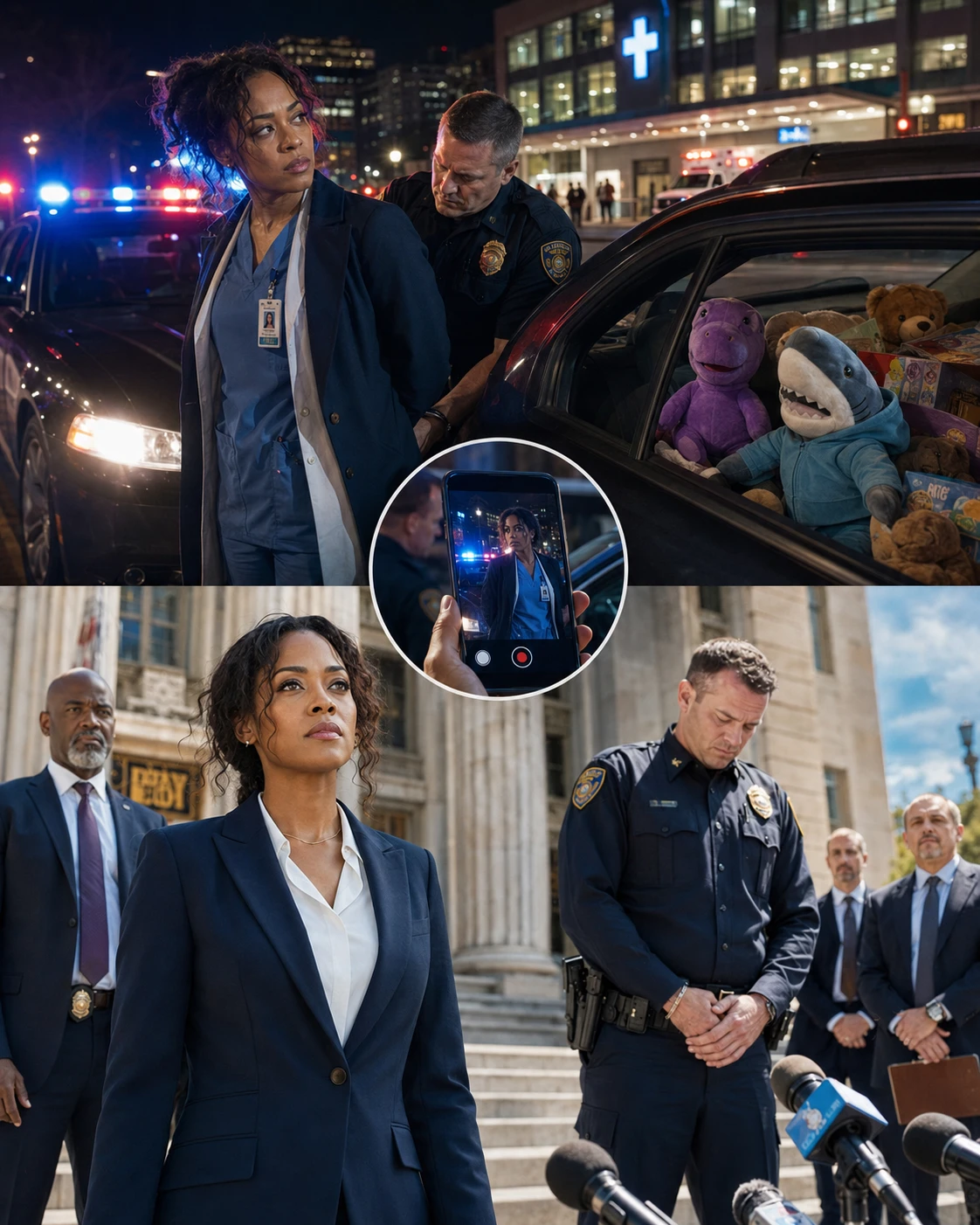
Then a Stranger’s Video Exposed What the Department Had Been Hiding for Years
PART 1: EVERYTHING I WAS TAUGHT
The moment the police lights lit up my rearview mirror, I knew something was wrong.
Not because I had done anything wrong.
Because I knew exactly what I had done for the last ten minutes.
I had left St. Matthew’s Medical Center at 9:47 p.m. after a twelve-hour emergency-room shift. I had driven three blocks below the speed limit because exhaustion had turned every traffic light into something I had to consciously process. I had stopped fully at the red light on Franklin. I had used my turn signal before changing lanes.
I knew all of that because my father had trained awareness into me before I was old enough to drive.
And because when you grow up as the daughter of a police chief, you learn two things at the same time.
You learn what officers are supposed to do.
And you learn what you are supposed to do when one of them decides you are a problem.
I pulled over immediately.
No sudden braking.
No reaching toward the glove compartment.
I turned off the engine, lowered my window, switched on the interior light, and placed both hands high on the steering wheel where they could be seen.
Ten and two.
Just like Dad had taught me when I was twelve.
Back then, I had laughed at him.
“Dad, I can’t even drive.”
“That isn’t the point, Simone.”
“What is the point?”
His face had changed in the way it always did when he stopped being my father for a second and became Chief Douglas Harmon.
“The point is that someday somebody wearing a badge may not know who you are. I need you to know how to get home safely anyway.”
At twelve, I had thought he was being dramatic.
At thirty-four, sitting beneath flashing red and blue lights with my hospital ID still hanging around my neck, I understood why he had never laughed with me.
I watched the officer approach through my side mirror.
Slow.
Deliberate.
One hand resting near his belt.
My heart rate climbed automatically, but I controlled my breathing.
I had spent the evening intubating a nineteen-year-old after a motorcycle accident. I had held pressure on a gunshot wound while blood soaked through two pairs of gloves. I had told a mother that her little boy’s fever was not leukemia returning, just influenza, and watched her collapse against me in relief.
I knew how to function under pressure.
But this felt different.
The officer stopped beside my window.
“License and registration.”
No greeting.
No explanation.
His tone wasn’t neutral.
It was already loaded.
“Yes, officer.”
I kept one hand visible.
“My license is in my purse on the passenger seat. Registration is in the glove compartment. Is it okay if I reach for them?”
His eyes stayed on my face.
“Did I tell you not to?”
“No.”
“Then get them.”
I hated the tiny satisfaction in his voice.
Like I had already annoyed him by asking.
I moved slowly, telling him what I was doing.
“My right hand is moving toward my purse.”
“I can see that.”
I handed him my license.
Then my registration.
He looked down.
“Simone Carter.”
“Yes.”
He looked at the hospital badge around my neck.
Then back at the license.
“You work at St. Matthew’s?”
“I’m an ER physician there.”
His gaze moved past me.
The passenger seat was crowded with stuffed animals: bears, rabbits, a purple dinosaur, two dolls, a plush shark wearing a tiny blue hoodie.
More were packed in boxes in the back seat.
His expression changed.
“Where’d you get all that?”
I blinked.
“The toys?”
“Obviously.”
“They were donated. I’m taking them to the pediatric oncology unit tomorrow.”
“You got receipts?”
The question was so absurd I thought I had misheard him.
“For donated stuffed animals?”
He leaned closer to the window.
“You got a problem answering questions?”
“No, officer.”
“Then answer.”
“They were donated through a hospital charity drive. Some employees helped collect them.”
He stared at me for another long second.
Then he handed nothing back.
“Step out of the vehicle.”
My stomach tightened.
Every instinct told me the situation had shifted.
I still didn’t know why I had been stopped.
He had my license.
He had my registration.
I had answered every question.
“May I ask why?”
His jaw flexed.
“I said step out.”
“I’m complying.”
I unbuckled my seat belt.
Slowly.
My hands remained visible.
I opened the door.
Stepped onto the pavement.
The night air was cold enough to sting my face.
Traffic passed in the far lane, headlights sweeping over us and disappearing.
The officer took two steps backward.
“Turn around.”
I looked at him.
“Am I being detained?”
“Turn around.”
“Officer, I’m asking because I’d like to understand—”
“Turn around now.”
I did.
My palms were open.
My shoulders relaxed.
No sudden movements.
No argument.
No threat.
Everything by the book.
It didn’t matter.
The first cuff closed around my right wrist before I understood that he had decided to arrest me.
Cold metal.
A sharp ratcheting sound.
Then the second.
My hands were trapped behind me.
“Officer, what is this about?”
“Stop talking.”
“I’m trying to understand why I’m being handcuffed.”
He grabbed my upper arm.
Hard.
Pain shot through my shoulder.
“I said stop talking.”
I turned my head slightly.
Not enough to face him.
Just enough to make sure he could hear me.
“I have not resisted you. I have complied with every instruction.”
That was when he leaned close enough for me to smell coffee on his breath.
“You people always got an answer, don’t you?”
Everything inside me went silent.
There are moments when anger arrives hot.
This wasn’t one of them.
This anger was cold.
Precise.
I knew what he meant.
He knew what he meant.
And the worst part was the casualness of it.
He hadn’t shouted.
He hadn’t lost control.
The words had come easily.
As if he had said them before.
I swallowed.
Not here.
Not now.
Dad’s voice returned from years ago.
You survive the encounter first.
You deal with what was wrong afterward.
“I haven’t done anything wrong,” I said.
His fingers tightened around my arm.
“We’ll see about that.”
Then he shoved me against the hood of my own car.
My ribs hit metal.
Pain flashed through my side.
My cheek nearly struck the windshield.
“I am cooperating.”
“You need to calm down.”
“I am calm.”
“Stop resisting.”
My head snapped toward him.
“I’m not resisting.”
He twisted my right arm upward.
Pain shot from my wrist to my shoulder so violently that I gasped.
“Stop resisting!”
“I’m standing still!”
My voice broke across the roadside.
Cars kept passing.
For one horrible second, I wondered how many people would see flashing lights and assume the person in cuffs had done something to deserve them.
Then I saw the phone.
Across the street, beside a closed laundromat, a man stood beneath a streetlight.
Maybe fifty.
Dark jacket.
Baseball cap.
Phone held vertically in both hands.
Recording.
Our eyes met.
It lasted less than a second.
But something changed inside me.
Witness.
Good.
I wasn’t alone.
The officer followed my gaze.
His body stiffened.
“You think that’s gonna help you?” he muttered.
I looked forward again.
“I didn’t say anything.”
He shoved me harder against the hood.
Then raised his voice so dramatically that I understood immediately what he was doing.
“MA’AM, STOP RESISTING!”
“I am not—”
He yanked my arm again.
I cried out.
Sirens sounded in the distance.
One set.
Then another.
Backup.
My pulse accelerated.
Too much backup.
For me.
One doctor.
Handcuffed.
Standing beside a car full of stuffed animals.
I knew enough about police procedure to understand that officers sometimes requested assistance routinely.
But I also knew something else.
The first officer controlled the story until someone challenged it.
If he told arriving officers that I had been aggressive, they would approach expecting aggression.
If he said I had resisted, they would see a resistor.
If he said I was dangerous, they would prepare for danger.
Narrative could become reality before I ever got a chance to speak.
Two cruisers pulled behind his.
Three officers got out.
The man across the street kept filming.
Thank God.
One of the new officers looked at me.
Then at the stuffed animals visible through my car windows.
Then at my hospital badge.
Something uncertain passed across his face.
The officer holding me noticed.
“Combative from the start,” he said.
I stared at the hood.
My heartbeat sounded like thunder in my ears.
That was a lie.
Not an exaggeration.
Not a misunderstanding.
A lie.
“This woman refused lawful commands and resisted detention.”
“I did not,” I said.
“Quiet.”
“I have complied with every instruction you gave me.”
One of the arriving officers shifted his weight.
The first officer squeezed my arm.
“See?”
I almost laughed.
The absurdity was so complete it was terrifying.
Speaking was resistance.
Silence would become guilt.
Standing still was resistance because he said it was.
No response I could make existed outside the story he had already decided to tell.
That was when the fear finally arrived.
Real fear.
Not fear of spending a night in jail.
Not fear for my career.
Fear of what could happen between the roadside and the station if the only official version of events belonged to the man twisting my arm.
I forced myself to breathe.
“Officer,” I said carefully, “I would like to know the reason for my detention.”
He smirked.
“You’ll find out at the station.”
Then he started walking me toward his cruiser.
My shoes scraped against the pavement.
Behind me, my car door remained open.
My purse sat on the passenger seat.
My stethoscope was lying between a stuffed bear and the purple dinosaur.
The image was so ordinary that it almost broke me.
I had spent all day saving strangers.
Now I was being put into the back of a police car as though I were dangerous.
At the cruiser door, I stopped.
Not physically resisting.
Just planting the thought before panic could take over.
“I want to make a phone call.”
The officer laughed.
“You’re not in a position to make requests.”
I turned my head and met his eyes.
Calm.
Steady.
“Yes,” I said quietly. “I am.”
His smile disappeared.
I had spent years refusing to use my father’s position as a shield.
When classmates had been pulled over in college and joked that I should “call the chief,” I had hated it.
When someone at the hospital found out who Dad was and asked whether parking tickets disappeared magically in our family, I told them I paid mine like everybody else.
I had built my career under my own name.
My own reputation.
My own work.
I did not want special treatment.
But this wasn’t about getting special treatment anymore.
This was about making sure somebody outside this officer’s control knew where I was.
Somebody who understood exactly what could happen to a report once it entered a system that wanted to protect itself.
“Who you gonna call?” he asked.
“My father.”
He rolled his eyes.
“Everybody’s got somebody.”
“Get me my father.”
Something in my voice must have reached him.
He paused.
“Who’s your father?”
I leaned back against the cruiser, metal cuffs biting into my wrists.
“Chief Douglas Harmon.”
For the first time that night, the officer’s face changed.
Not much.
A blink.
A tiny tightening around the mouth.
But I saw it.
One of the officers behind him looked sharply in my direction.
The man with the phone was still recording.
The officer leaned toward me.
“You expect me to believe that?”
I didn’t look away.
“You have my license. You know my name. Call him.”
He studied me.
And in that moment I realized something that frightened me more than his disbelief.
He knew the name.
Maybe everyone in the department knew the name.
But he hadn’t known me.
Until now.
His hand tightened around my elbow.
Then he shoved me into the back seat.
The door slammed.
Through the glass, I watched the officers gather near the hood of my car.
Their conversation was too quiet to hear.
But their faces had changed.
The confidence was gone.
And suddenly I understood that my father’s name had not ended the danger.
It had only made them realize the person they had handcuffed might be able to prove what happened.
Then the officer who arrested me turned toward the man recording across the street.
And started walking straight at him.
PART 2: THE STORY THEY WROTE ABOUT ME
I pressed myself toward the cruiser window.
The stranger lowered his phone slightly as the officer crossed the road.
For one sick second, I thought he was going to surrender it.
Instead, he backed away.
The officer pointed.
I couldn’t hear the words through the glass, but I could read the body language.
Stop recording.
Leave.
Move along.
The stranger said something.
The officer stepped closer.
The stranger stepped backward again but kept the phone raised.
Then another officer called from our side of the street.
The arresting officer turned.
Whatever had been shouted pulled him back.
The stranger remained beneath the streetlight.
Still filming.
I let out a breath I hadn’t realized I was holding.
A few minutes later, the cruiser door opened.
One of the backup officers stood there.
He was younger than the man who had arrested me.
Maybe early thirties.
His expression was controlled, but not hostile.
“Dr. Carter?”
The fact that he used my title told me somebody had finally looked at the hospital ID hanging around my neck.
“Yes.”
“Are the cuffs too tight?”
I almost said, What do you think?
Instead I gave him the answer my father had trained into me.
“Yes. My fingers are tingling.”
He looked down.
The skin around my wrists was already swelling.
He reached in and adjusted one cuff by a notch.
“Better?”
“Slightly.”
He nodded.
I watched him.
“What am I being arrested for?”
His eyes moved away from mine.
“I’m not the primary.”
“That doesn’t answer my question.”
“No, ma’am.”
“Did he tell you?”
The officer hesitated.
That hesitation told me more than words.
“He said you failed to comply with commands and resisted.”
“I did neither.”
He glanced across the street.
At the man with the phone.
Then back at me.
“I wasn’t here for the beginning.”
“Exactly.”
His jaw tightened.
He shut the door.
I sat in the cruiser for another fifteen minutes.
Fifteen minutes is nothing during a hospital shift.
It is endless when your hands are cuffed behind your back and men outside are deciding what version of you will exist on paper.
I watched the arresting officer write.
He kept stopping to speak with the others.
Once, he pointed toward my car.
Once, toward the stranger.
Twice, one of the backup officers looked directly at me.
I began reconstructing everything.
The time I had been stopped.
Every command.
Every response.
Where his hands had been.
When he had tightened the cuffs.
When he had said “you people.”
When he had first shouted that I was resisting.
I repeated the sequence silently.
Again.
Again.
Again.
I knew what stress did to memory.
I knew that trauma could blur order, sound, timing.
I refused to let mine blur.
I was still repeating it when the driver’s door opened.
The arresting officer climbed in.
His nameplate was close enough now for me to read.
Officer Grant Mercer.
I fixed it in my mind.
Mercer.
He adjusted the mirror until he could see me.
“Your father’s been notified.”
“Thank you.”
The corner of his mouth twitched.
I couldn’t tell whether he was angry or amused.
“Bet you feel pretty important right now.”
“No.”
That seemed to bother him more than anything else I could have said.
He started the cruiser.
I looked out the window as we pulled away.
The stranger with the phone became smaller.
Then disappeared.
I didn’t know his name.
I didn’t know whether he had captured the beginning.
I didn’t know whether the recording was clear.
I didn’t know if Mercer had managed to frighten him.
All I knew was that somebody had seen.
At the station, they put me in a processing room.
Not a cell.
That distinction felt deliberate.
I sat on a hard plastic chair while another officer removed the cuffs.
Red grooves circled both wrists.
My right shoulder throbbed.
My ribs hurt every time I inhaled deeply.
The officer who uncuffed me stared at the marks but said nothing.
A woman behind a desk asked routine questions.
Name.
Date of birth.
Address.
Occupation.
When I said emergency physician, her eyes flicked upward.
I watched the information travel through the room without anyone speaking.
Doctor.
Chief’s daughter.
Video.
Something had changed.
But nobody was willing to name it.
Then the door opened.
My father walked in.
For most people, Chief Douglas Harmon entered a room before Douglas Harmon did.
Broad shoulders.
Dark uniform.
Silver at the temples.
Thirty years of command in the way he carried himself.
But I knew the small details no one else noticed.
The muscle that moved in his cheek when he was furious.
The way his left hand closed into a fist when he was forcing himself not to react.
The slight narrowing of his eyes when he was afraid.
That night, all three happened.
He saw my wrists.
His face went still.
“Simone.”
I stood.
For half a second, I was seven years old again.
I wanted him to cross the room and tell me everything was over.
Instead, he stopped two steps away.
Because other officers were watching.
Because he was chief here.
Because we both understood that from this moment forward, everything he did would be examined.
“Are you hurt?”
“My shoulder. My ribs. My wrists.”
“Do you need medical attention?”
“I want photographs first.”
His eyes changed.
Not surprise.
Recognition.
He had taught me that too.
Document what can disappear.
He turned toward the watch commander.
“I want her injuries photographed according to procedure.”
The commander cleared his throat.
“Chief, we’re still sorting out—”
“According to procedure,” Dad repeated.
No raised voice.
He didn’t need one.
Then he looked at me again.
“Tell me what happened.”
“Not here.”
That surprised him.
I saw it.
I also saw Mercer standing through the glass outside the processing room.
Watching us.
“I want to give a formal statement,” I said. “Recorded. With someone who wasn’t involved in the stop.”
Dad held my gaze.
“Good.”
Mercer entered before anyone could answer.
“Chief.”
Dad turned.
Mercer’s posture was rigid.
Professional now.
Nothing like the man who had leaned into my ear on the roadside.
“Officer Mercer,” Dad said.
Mercer looked briefly at me.
Then back at him.
“Your daughter became argumentative during a lawful traffic stop and failed to follow repeated commands. When I attempted to detain her pending investigation, she resisted physically.”
The ease of the lie stunned me.
Even after everything.
He said it like he believed it.
Dad did not look at me.
“What was the reason for the initial stop?”
Mercer hesitated.
“Erratic lane movement.”
I almost spoke.
Dad lifted one hand slightly.
Not to silence me.
To tell me he had heard the hesitation too.
“And what were you investigating when you ordered her out of the vehicle?”
“Possible stolen property.”
I actually laughed then.
One short sound.
I couldn’t stop it.
Mercer looked at me.
“The vehicle contained a large quantity of new merchandise with no immediately available proof of purchase.”
“They’re stuffed animals,” I said.
“They’re property.”
“They’re donated toys for children with cancer.”
“You didn’t provide documentation proving that.”
“You never asked for documentation. You asked if I had receipts.”
“Simone,” Dad said quietly.
I stopped.
Not because Mercer deserved restraint.
Because my father was right.
I needed the official record more than I needed the argument.
Dad turned to Mercer.
“Were you wearing an activated body camera?”
The room changed.
Mercer’s eyes shifted.
Only once.
But I saw it.
“Yes, Chief.”
“Good.”
A small relief passed through me.
Then Mercer said, “There may be an issue with the first portion.”
Dad’s expression hardened.
“What kind of issue?”
“It appears activation may have occurred after initial contact.”
The relief vanished.
“How long after?” I asked.
Mercer ignored me.
Dad didn’t.
“Officer Mercer. How long after?”
“I’d have to review the footage.”
Of course.
The beginning.
The unexplained tone.
The questions.
The order to step out.
“You people always got an answer.”
All of that might be missing.
My nails dug into my palm.
Dad’s voice became colder.
“Preserve the entire recording.”
“Yes, Chief.”
“Preserve the vehicle camera.”
Mercer nodded.
“All dispatch records.”
Another nod.
“Every audio file associated with the stop.”
“Yes, Chief.”
“And the arrest report will not be altered after submission without a documented amendment.”
Mercer’s face tightened.
“Understood.”
I looked at my father.
There was something different in his expression now.
Not just anger.
Concern.
The specific concern of a man recognizing a shape he had seen before.
“Dad?”
He looked at me.
“What?”
“You know something.”
Mercer’s head turned toward us.
Dad answered carefully.
“Not here.”
The echo of my own words chilled me.
Twenty minutes later I gave my statement to an internal-affairs lieutenant I had met twice in my life.
I told her everything.
I did not embellish.
I did not speculate.
I said exactly when Mercer had touched me.
Exactly what he had said.
Exactly when I had seen the stranger recording.
When I repeated “you people always got an answer,” the lieutenant’s pen stopped.
Just for a second.
Then continued.
I noticed.
“You’ve heard that before,” I said.
She looked up.
“This is your statement, Dr. Carter.”
“That wasn’t an answer.”
“No.”
“Has Officer Mercer been accused of saying something similar?”
Dad, sitting silently in the corner as my father rather than my chief, looked at her.
The lieutenant closed the file.
“Your statement is complete.”
My stomach dropped.
That was an answer.
Not a complete one.
But enough.
Something already existed.
Something they knew.
“Dad.”
He stood.
“Simone.”
“How many?”
His face told me I had asked the right question.
“How many complaints?”
The lieutenant looked at him.
He looked at her.
Then at me.
“I don’t know.”
I stared at him.
“You’re the chief.”
“I said I don’t know.”
That frightened me more than if he had given me a number.
Because my father did not say I don’t know easily.
He said it only when admitting that he should know.
Mercer had not invented himself on the side of that road.
Whatever he had done to me had felt practiced because it was practiced.
And suddenly I understood why my father had looked afraid when he entered the station.
Not because his daughter had been arrested.
Because somewhere inside his department, he had just realized there might be a history that had never reached his desk.
At 2:13 in the morning, they released me without charges pending review.
Dad offered to drive.
I refused.
I wanted my own car.
I wanted the stuffed animals.
I wanted one thing from that night to end the way it had been supposed to.
We returned to the roadside together.
My car had been towed to a secured lot.
The stranger was gone.
The street was empty.
At home, I stood beneath the shower until the water ran cold.
I couldn’t lift my right arm above my shoulder.
I could still feel Mercer’s hand gripping it.
I could still hear him.
Stop resisting.
I slept for forty-three minutes.
At 6:31 a.m., my phone began vibrating so violently on the nightstand that it woke me.
Nine missed calls.
Twenty-seven messages.
A text from a nurse at the hospital.
SIMONE. PLEASE TELL ME YOU’VE SEEN THIS.
Underneath it was a link.
The thumbnail showed me bent over the hood of my car.
Mercer’s hand was on my arm.
Across the bottom of the screen were five words.
SHE IS NOT RESISTING. WATCH.
My throat closed.
I pressed play.
And for the first time, I saw what had happened to me from the outside.
The stranger had recorded almost everything.
Including the part Mercer’s body camera had somehow missed.
PART 3: THE VIDEO THAT WOULD NOT DISAPPEAR
I watched the video once.
Then I put my phone down.
My hands were shaking too hard to hold it.
I had spent the whole night afraid my memory would betray me.
The video proved it hadn’t.
That should have felt like relief.
Instead, I felt sick.
There I was.
Standing beneath the streetlights with my hands visible.
Answering questions.
Moving slowly.
Stepping out when ordered.
Turning around.
Then Mercer cuffing me.
The audio was clearer than I expected.
“Officer, what is this about?”
“Stop talking.”
“I’m trying to understand why I’m being handcuffed.”
Then his voice, low but audible.
“You people always got an answer, don’t you?”
I stopped the recording.
Walked to the bathroom.
Threw up.
When I came back, the phone was still playing.
My own voice came through the speaker.
“I haven’t done anything wrong.”
“We’ll see about that.”
Then my body hit the hood.
Even knowing it was coming, I flinched.
The camera moved as the stranger crossed slightly closer.
“I am cooperating.”
“You need to calm down.”
“I am calm.”
Then Mercer shouted the words that had kept echoing in my head all night.
“Stop resisting!”
The video showed the truth with merciless clarity.
I wasn’t moving.
Not away from him.
Not toward him.
My hands were cuffed behind me.
My chest was against the hood.
My feet were planted.
The only movement was Mercer pulling my arm upward.
“I’m not resisting!”
He pulled again.
I cried out.
The person filming said quietly, “She ain’t doing anything.”
Mercer looked toward the camera.
“You think that’s gonna help you?”
It was there.
Everything.
Not every second of the stop.
But enough.
Enough to destroy the version he had written.
Enough to prove that what happened inside my own body had happened in the world too.
My phone rang.
Dad.
I answered.
“Have you seen it?”
“Yes.”
A pause.
“Are you alone?”
“Yes.”
“I’m coming over.”
“No.”
“Simone—”
“Dad, where are you?”
“At headquarters.”
“Then stay there.”
“Why?”
I looked at the frozen image on my screen.
My face against the hood.
“You need to find the complaints.”
Silence.
“Simone.”
“You knew there might be complaints before we left that station.”
“I knew there had been concerns raised about Mercer’s communication and escalation during prior contacts.”
“How many?”
“I’m finding out.”
“How many, Dad?”
Another pause.
“More than there should have been.”
Something inside me hardened.
That answer hurt worse than my shoulder.
“How many reached you?”
“Not enough.”
“That isn’t a number.”
“I know.”
I closed my eyes.
For the first time in my life, the title before my father’s name felt less like protection and more like accusation.
Chief.
Chief meant responsibility.
Chief meant the building was his whether or not every file reached his desk.
“You taught me the badge doesn’t make somebody right.”
“I know.”
“You taught me systems matter because people can fail.”
“I know.”
“You taught me procedure exists so nobody gets to decide the truth by themselves.”
His voice dropped.
“I know what I taught you.”
“Then find out why none of it protected me.”
He was silent for several seconds.
When he spoke again, he sounded older.
“I will.”
“No.”
My voice surprised both of us.
“You won’t do it for me.”
“What?”
“You’ll do it because if Mercer did this before, those people deserved the same urgency I’m getting now.”
Silence.
Then my father said, “You’re right.”
I sat on the edge of my bed.
The video had been online for less than four hours.
It already had hundreds of thousands of views.
By noon, television stations had picked it up.
By one, the hospital issued a statement confirming that I was a physician employed there and that the toys visible in the vehicle had been collected for pediatric cancer patients.
I hadn’t asked them to.
One of the pediatric nurses texted me a photograph of the empty corner where the donated toys had been stacked before I loaded them.
We have the records if anyone needs them.
I stared at the message for a long time.
Mercer’s suspicion had been so easy.
A Black woman driving at night with boxes of toys became suspicious before he knew anything else.
And once I had failed to become what he expected, he had written a version that made his treatment of me seem necessary.
I returned to the hospital that afternoon.
Not to work.
The attending physician on duty examined my shoulder and ribs.
No fracture.
Soft-tissue injury.
Bruising.
Wrist abrasions.
The kind of injuries that sounded small when listed clinically.
Pain does that on paper.
It becomes tidy.
Measured.
Manageable.
Nothing on the chart said what it felt like to hear footsteps behind me now.
Nothing on the chart said my pulse jumped when a security guard walked too close.
Nothing on the chart said I had nearly cried when a nurse gently touched my wrist.
I was leaving through the staff entrance when a man stood up from a bench across the sidewalk.
Dark jacket.
Baseball cap.
For half a second, fear surged.
Then I recognized him.
The stranger.
The man with the phone.
He raised both hands slightly.
Not coming closer.
“Dr. Carter?”
I stopped.
“Yes?”
“My name is Marcus Reed.”
His voice was careful.
“I’m the one who recorded you.”
I looked at him.
There are people who change your life without knowing your name.
Marcus Reed had been one of those people.
Now he stood ten feet away looking almost apologetic for it.
“Thank you,” I said.
His shoulders lowered.
“I almost left.”
That surprised me.
“Why?”
“Because when the officer came toward me, I figured he was going to tell me I was interfering.”
“He did.”
Marcus nodded.
“He said I was obstructing police activity and needed to move.”
“But you stayed.”
“I moved.”
A faint smile touched his face.
“Across the street. Not home.”
For the first time since the stop, I laughed.
It hurt my ribs.
I didn’t care.
Marcus pulled out his phone.
“I want you to know I saved the original.”
My smile disappeared.
“Where?”
“More than one place.”
Smart.
“Did anyone ask you for it?”
“Three reporters. Two people claiming to be attorneys. Somebody from the department.”
My chest tightened.
“Who?”
“Internal affairs. They were professional.”
He watched my expression.
“I gave them a copy. Not my only copy.”
“Good.”
“My brother told me I was paranoid.”
“You weren’t.”
He looked at me for a moment.
Then his face changed.
“There’s something else.”
My heartbeat picked up.
“What?”
“Since I posted it, people have been sending me messages.”
“What kind of messages?”
He took a breath.
“People saying the same officer stopped them.”
The sidewalk seemed to tilt.
“How many?”
“Enough that I stopped counting last night.”
I stared at him.
“What are they saying?”
Marcus unlocked his phone but didn’t hand it over.
“I don’t think I should show you names without asking them.”
Respect.
Even now.
I nodded.
“But the stories?” I asked.
His mouth tightened.
“Same kind of thing. Traffic stops. Questions that didn’t make sense. Being ordered out. Being told they were aggressive when they said they weren’t. A couple said his camera wasn’t on at the beginning.”
Cold spread through me.
Body camera.
Beginning missing.
I heard Mercer at the station.
There may be an issue with the first portion.
Not malfunction.
Pattern.
“What else?”
Marcus hesitated.
“One man said Mercer arrested him for resisting. Charges got dropped later.”
“Was there video?”
“He says there wasn’t.”
Of course there wasn’t.
The thought landed so hard I had to sit on the bench.
If Marcus had gone home that night, what would I have had?
My word.
Mercer’s report.
A body camera that started late.
Backup officers who arrived after the handcuffs.
A chief for a father—which would have helped me, yes, but would also have allowed people to say the outcome was about privilege.
Without the video, Mercer could have said anything.
Argumentative.
Combative.
Furtive.
Aggressive.
Resisting.
Words that looked objective once typed into an official report.
Words that could follow a person long after bruises disappeared.
Marcus sat at the far end of the bench.
“I’m sorry.”
“For what?”
“That I didn’t start recording sooner.”
I turned toward him.
“You recorded.”
“Yeah.”
“You stayed when he tried to make you leave.”
“Yeah.”
“You saved it.”
He nodded.
“Then don’t apologize.”
My phone rang.
Dad again.
This time I answered immediately.
“I found them,” he said.
His voice sounded wrong.
“How many?”
“Simone, I need you to come to headquarters.”
“How many?”
He exhaled.
“Eleven formal complaints over four years.”
I stopped breathing.
“Eleven?”
“Not including informal supervisor notes.”
“How many sustained?”
A long silence.
“None.”
I stood so quickly pain ripped through my ribs.
“None?”
“Three were classified insufficient evidence. Five were not sustained. Two were closed after complainants stopped responding. One was categorized as a policy misunderstanding.”
“Were there body cameras?”
“Some.”
“Missing beginnings?”
Another silence.
My hand tightened around the phone.
“Dad.”
“Four complaints mention late activation.”
The world went quiet.
Not the sidewalk.
Cars were moving.
People were talking.
Somewhere an ambulance siren wailed.
But inside me, everything went quiet.
Four.
Four people had already said something.
Four people had already described the missing beginning.
Eleven had complained.
And Mercer was still on the road.
Still deciding who looked suspicious.
Still creating the official story before anyone else could.
“Who reviewed them?” I asked.
“I’m tracing that.”
“You don’t know?”
“I know which supervisors signed the dispositions. I don’t yet know why the pattern was never elevated.”
“Never elevated to you.”
“Yes.”
I almost said something cruel.
Something about how convenient that was.
But I knew my father.
And I heard the shame in his voice.
That did not excuse anything.
It simply made the truth harder.
“I’m coming in.”
“Simone, you don’t need to be part of the administrative review.”
“Yes, I do.”
“You’re the complainant.”
“I’m also the reason anyone is finally looking at eleven other complaints together.”
“That creates complications.”
“So does pretending mine matters more because I’m your daughter.”
He said nothing.
“I’m not asking to interfere with the investigation,” I continued. “I’m asking to know whether what happened to me was allowed to happen to other people.”
“I understand.”
“Do you?”
My voice broke.
I hated that it did.
“Because you trained me my whole life for that road, Dad. I did everything right.”
“I know.”
“And it still happened.”
“I know.”
“So stop telling me what I don’t need to see.”
There was a pause.
Then he said, “Come in.”
I hung up.
Marcus was watching me.
“Bad?”
“Worse.”
I looked down at his phone.
The video that had changed everything was still open on the screen.
Eleven complaints.
Four late cameras.
Zero sustained findings.
And my father, the police chief who had taught me to trust procedure, had not even known the pattern existed.
As I walked toward my car, one thought settled into me with frightening clarity.
Mercer was no longer the biggest question.
The biggest question was how many people had been required to look away for him to become possible.
PART 4: WHAT THE BADGE COULD HIDE
Headquarters looked different when I entered through the front doors that evening.
I had been inside that building hundreds of times.
Birthday visits.
Retirement ceremonies.
Holiday toy drives.
Teenage afternoons spent doing homework in my father’s office because my mother was working late.
I knew the smell of the lobby.
Coffee, floor wax, old paper.
I knew which vending machine stole dollar bills.
I knew which stairwell had the cracked tile on the third step.
It had once felt familiar.
Now every closed office door looked like a place where something could disappear.
Dad was waiting in a conference room with the internal-affairs lieutenant from the night before.
Lieutenant Denise Walsh.
A stack of files sat in front of her.
Eleven.
I counted immediately.
Dad saw me counting.
His face tightened.
“Those are the formal complaints?”
“Yes,” Walsh said.
I sat down.
“I don’t want names unless the complainants have consented.”
She seemed surprised.
“Understood.”
“I want patterns.”
Dad leaned forward.
“Simone, some of this is still confidential.”
“Then tell me what you legally can.”
Walsh glanced at him.
He nodded.
She opened the first folder.
Over the next hour, I learned how abuse can hide inside ordinary language.
Not dramatic language.
Not words like brutality or corruption.
Ordinary bureaucratic language.
Subject perceived officer’s tone as hostile.
No independent corroboration.
Camera activation occurred after initial verbal exchange.
Complainant became increasingly agitated.
Officer reported concern for safety.
Unable to establish allegation by preponderance of evidence.
Again.
Again.
Again.
Different people.
Different dates.
Same shapes.
A young man stopped after leaving a late shift at a warehouse.
A mother questioned about items in the back seat of her vehicle.
A college student ordered out after asking why he had been stopped.
A delivery driver accused of becoming confrontational.
I didn’t know their names.
I didn’t need to.
Their lives were not evidence for my story.
My story was evidence that theirs deserved another look.
“Were any of these reviewed together?” I asked.
Walsh shook her head.
“No.”
“Why?”
“The complaints came through different supervisors over several years.”
“That isn’t what I asked.”
She looked down.
“No mechanism automatically grouped them by allegation type.”
“So nobody noticed.”
Dad answered this time.
“They should have.”
I looked at him.
“Did anybody?”
His face hardened.
“There were two supervisor notes recommending closer monitoring of Mercer’s citizen interactions.”
“And?”
“The recommendations did not become formal corrective action.”
“Why?”
Walsh spoke carefully.
“One supervisor later wrote that Mercer’s enforcement activity was high and that complaints could be expected from frequent citizen contact.”
I stared at her.
“So because he stopped more people, complaints mattered less?”
“I’m telling you what was written.”
Dad pushed back from the table.
The fury I had seen at the station returned.
But this time I wasn’t comforted by it.
Anger after discovery was easy.
The question was what came after anger.
“How long has Mercer been assigned to patrol?” I asked.
“Seven years,” Walsh said.
“And eleven formal complaints are just what survived the process.”
She didn’t answer.
I thought of Marcus.
People messaging him.
People who had never filed anything.
People who had started a complaint and stopped responding.
Maybe because they worked two jobs.
Maybe because forms were exhausting.
Maybe because nobody called back.
Maybe because being told there wasn’t enough evidence felt like being told what happened to you wasn’t real.
I looked at Dad.
“What happens now?”
“Mercer has been placed on administrative leave pending investigation.”
“That’s him. What happens to the system?”
Walsh shifted.
Dad didn’t.
“What do you mean?”
“You know what I mean.”
I pointed toward the files.
“Eleven separate complaints were processed individually until the pattern disappeared. Late camera activation happened four times, and nobody connected it. Supervisors wrote warning notes that went nowhere. What happens to that?”
Dad was silent.
I leaned forward.
“You can fire one officer and announce the problem is solved.”
His eyes narrowed.
“Don’t assume that’s what I intend to do.”
“Then tell me what you intend to do.”
He looked exhausted.
For a moment he wasn’t Chief Harmon.
He was my father.
The man who had taught me to drive in an empty school parking lot.
The man who had sat beside my hospital bed when I got appendicitis in residency even though I kept telling him I was fine.
The man who had built his life around believing that rules, properly enforced, protected people.
“I’m ordering an outside review,” he said.
Walsh looked at him sharply.
Apparently that decision was new.
“Outside this department?”
“Yes.”
“All complaints involving Mercer?”
“All use-of-force, resistance, escalation, and body-camera compliance complaints in the department for the last five years.”
I stared at him.
Not just Mercer.
Everything.
“That’s going to be ugly,” I said.
“Yes.”
“People will say you lost control of your department.”
“They may be right.”
The answer stunned me.
Dad looked at the files.
“I spent years telling officers that integrity isn’t proven when someone is watching. It’s proven by what happens when nobody important is watching.”
His gaze lifted to mine.
“You were treated differently the moment they learned whose daughter you were.”
I thought about the station.
The room changing.
The cuffs coming off.
The photographs being ordered.
The careful language.
“Yes.”
“That is the part I can’t excuse.”
His voice thickened.
“Not because you should have been treated badly. Because nobody should have needed my name to make the rules matter.”
The anger inside me loosened slightly.
Not disappeared.
Never that quickly.
But shifted.
“What about Mercer’s report?”
Walsh opened another folder.
“He submitted it.”
“Can I hear what he said?”
She hesitated.
Dad nodded.
Walsh read.
“Officer observed vehicle drift within lane and initiated traffic stop for safety inquiry. Driver displayed argumentative behavior when asked routine investigatory questions. Driver repeatedly challenged lawful instructions. Officer developed suspicion regarding large quantity of property visible in vehicle. Driver was directed to exit and became verbally combative. During detention, driver stiffened arms and resisted handcuffing—”
“Stop.”
My stomach rolled.
Stiffened arms.
My arms had been behind me.
He had already cuffed me when he started shouting.
“Keep going,” I said.
Walsh did.
“Officer utilized control hold. Driver continued resistance while stating she was cooperating. Backup units requested due to escalating behavior.”
I laughed bitterly.
“There it is.”
Dad didn’t speak.
“He wrote the video before he knew there was one.”
Walsh looked at me.
“What do you mean?”
“He narrated the behavior he needed.”
I could hear it again.
Stop resisting.
Not a reaction.
A creation.
He had shouted the words loudly because he knew what they would sound like to arriving officers.
Maybe to his microphone.
Maybe to a supervisor reviewing part of the encounter later.
His report and his shouted commands supported each other.
Unless someone could see my body.
Unless someone outside the system had been recording.
“Play Marcus’s video next to the report,” I said.
Walsh nodded.
“We already have.”
“And?”
She closed the file.
“They materially conflict.”
“No. One conflicts with reality.”
Dad looked at me.
I held his gaze.
“Words matter.”
He nodded slowly.
“Yes.”
That night, the department announced the outside review.
The public reaction was immediate.
Some people praised it.
Others called it damage control.
A few accused my father of launching an investigation only because his daughter had been involved.
That one hurt because it contained enough truth to be dangerous.
Would eleven old complaints have been reopened if Mercer had stopped somebody else that night?
Would anybody have noticed four late camera activations?
Would the files still be separate?
Probably.
I knew it.
Dad knew it.
And the public knew it.
So two days later, I asked to speak at the press conference.
Dad said no.
I said I wasn’t asking permission.
He stared at me across his kitchen table.
“You’re recovering.”
“I have bruises.”
“You haven’t slept.”
“Neither have you.”
“This is not about me.”
“Exactly.”
He rubbed both hands over his face.
“Simone, the media will tear apart every word.”
“Then I’ll choose them carefully.”
“They’ll accuse you of using my position.”
“I’m going to say they should.”
He looked up.
“What?”
“They should question why my complaint got immediate attention.”
He stared at me.
“Because I’m questioning it too.”
The press conference was held the next afternoon.
Cameras filled the room.
Dad spoke first.
He confirmed that Officer Mercer had been placed on administrative leave.
He confirmed an independent review.
He confirmed that previous complaints would be reexamined.
He did not call them misconduct.
Not yet.
He called them unresolved questions.
Then I walked to the microphone.
My wrists were still bruised.
I did not cover them.
The room erupted with camera shutters.
I looked at the reporters.
Then directly into the television cameras.
“My name is Dr. Simone Carter.”
My voice trembled once.
I steadied it.
“Three nights ago, I was stopped while driving home from work. I followed every instruction I was given. I kept my hands visible. I spoke calmly. I did not resist. I was handcuffed, pushed against my vehicle, and accused of behavior that a video later showed did not occur.”
Silence.
“I am grateful that video exists.”
I swallowed.
“But I need everyone to understand something.”
I looked toward my father.
Then back at the cameras.
“I should not have needed a stranger’s camera to make my word matter.”
Nobody moved.
“I should not have needed to say my father’s name.”
Dad lowered his eyes.
“And if the reason my complaint is being taken seriously is because my father is police chief, then the question is not whether I received justice.”
I paused.
“The question is who did not.”
The room exploded.
Questions.
Shouting.
Flashes.
I stepped back.
My phone began vibrating in my pocket before Dad finished the press conference.
Messages.
More stories.
More people.
By that evening, six individuals who had previously filed complaints agreed publicly to have their cases reexamined.
Two others contacted the outside review team for the first time.
And Marcus sent me one message.
You need to see what they found in the old footage.
I called him immediately.
“What footage?”
“Not mine.”
My pulse quickened.
“Then whose?”
He hesitated.
“One of the old complaints.”
I stood in the middle of my apartment.
“What did it show?”
Marcus took a breath.
“The body camera started late.”
“I know that.”
“No,” he said. “You don’t understand.”
His voice dropped.
“They recovered the pre-event buffer.”
I gripped the phone.
“What was on it?”
“Enough to prove your stop wasn’t the first time Mercer shouted ‘stop resisting’ at someone who wasn’t resisting.”
PART 5: WHAT HAPPENS WHEN THE TRUTH HAS WITNESSES
I didn’t sleep that night.
At six the next morning, Dad called.
“The outside team wants to interview you again.”
“Because of the recovered footage?”
A pause.
“So you know.”
“Marcus told me.”
“He shouldn’t have.”
“He didn’t give me details.”
“Good.”
“What did they recover?”
“Simone—”
“Dad.”
He sighed.
“One prior incident.”
“Only one?”
“One that is relevant and recoverable so far.”
I sat at my kitchen table.
Morning sunlight lay across the wood.
Normal sunlight.
Normal coffee.
Nothing about the room matched the weight of the conversation.
“Tell me.”
“The complainant was stopped approximately eighteen months ago. Mercer’s body camera was manually activated after physical contact had already begun.”
“Same as mine.”
“Yes.”
“The original review treated the missing beginning as what?”
“A policy violation that was handled informally.”
I closed my eyes.
“What did the recovered buffer show?”
“Video without full audio for part of the pre-activation period.”
“And?”
“The complainant had his hands visible.”
I said nothing.
“Mercer ordered him against a vehicle.”
Still nothing.
“The complainant appears to comply.”
My stomach tightened.
“And then?”
Dad’s voice turned flat.
“The physical movement shown in the recovered segment is inconsistent with Mercer’s written description.”
There it was.
Police language.
Precise.
Careful.
Legally safe.
But I knew what it meant.
“He lied.”
“We need the investigation to make that determination.”
“You’re my father right now, not the chief.”
Silence.
Then he said quietly, “It looks like he lied.”
I stared out the window.
A year and a half.
Someone had told them.
A recording had existed.
A piece of the truth had been sitting inside a system designed to store evidence.
And nobody had put enough pressure on the right question.
“What happened to that person?”
“The resistance-related charge was dismissed.”
“Did anyone tell him the video could support his complaint?”
“No.”
The word landed like a stone.
I thought about how different my own life would look without Marcus.
Would the charges against me have disappeared quietly?
Would Mercer have returned to patrol?
Would my complaint have become number twelve?
Would somebody write that I had perceived his tone as hostile?
I touched the fading bruise on my wrist.
“Can I speak to the other complainants?”
“Not through the department.”
“I’m not asking the department to arrange it.”
Dad was quiet.
“Be careful.”
“I am.”
“No, Simone. I mean emotionally.”
I almost snapped at him.
Then I heard the fear beneath his words.
He wasn’t trying to control me.
He knew what I was about to do.
I was going to hear versions of my own worst night told by people who had lived with theirs much longer.
“I need to,” I said.
“I know.”
Over the next two weeks, I spoke with five people who chose to contact me.
Not because I asked publicly.
Because they found me.
A message through the hospital.
An email.
A handwritten letter.
Marcus connected me with one person only after getting permission from both of us.
I listened.
That was all at first.
I listened.
A father told me he had been driving home from his daughter’s school concert when Mercer stopped him and accused him of being aggressive after he asked why he had been ordered out.
A woman told me Mercer had questioned her about boxes in her back seat while she was moving apartments. When she became frightened, he described her as emotionally unstable.
A delivery driver told me he spent hours in custody after being accused of resisting.
“What did you do?” I asked.
He laughed without humor.
“I asked him not to twist my arm.”
My throat closed.
That was the cruelty of it.
Not that every detail matched mine.
They didn’t.
Lives are not copies.
The cruelty was that the logic matched.
Question the officer.
Become argumentative.
Show fear.
Become unstable.
Ask why you are being detained.
Become noncompliant.
React to pain.
Become resistant.
And once those words entered a report, the report became the frame through which everything else was viewed.
“What happened when you complained?” I asked the delivery driver.
He looked away.
“They said there wasn’t enough evidence.”
“Did he have a body camera?”
“Started after I was already against the car.”
I felt anger rise so fast I had to unclench my jaw.
He noticed.
“You got lucky.”
The words hurt.
I knew he didn’t mean that the stop was lucky.
He meant Marcus.
The video.
My father.
The attention.
“I know,” I said.
“No.”
He looked directly at me.
“You got believed.”
I had no answer.
That sentence stayed with me.
Not cuffed.
Not released.
Believed.
That was the dividing line.
Weeks passed.
The outside investigation expanded.
Mercer remained off patrol.
Two supervisory decisions were placed under separate administrative review.
The department announced that body-camera activation failures would no longer be treated as isolated technical issues when connected to force or resistance complaints.
A new tracking system was ordered to flag repeated allegations involving the same officer, even when individual complaints had been classified as unsubstantiated.
But policies were words.
I had learned how dangerous words could be.
So when Dad showed me the proposed changes, I read every line.
“This one is weak,” I told him.
We were in his office late one evening.
He looked exhausted.
“Which?”
“‘Supervisors should consider reviewing prior complaints when evaluating a new allegation.’”
“What’s wrong with it?”
“Should consider.”
He leaned back.
“You sound like an attorney.”
“I sound like someone who has read too many charts where ‘consider’ means nobody has to do anything.”
He almost smiled.
“What do you want?”
“‘Supervisors shall review prior complaints involving similar allegations.’”
“That creates workload.”
“Then create workload.”
His smile disappeared.
I waited.
Finally, he took a pen and crossed out the sentence.
“Shall,” he said.
“Thank you.”
He looked at me.
“You know this won’t fix everything.”
“I know.”
“You know there will still be bad stops.”
“I know.”
“Bad officers.”
“I know.”
“Bad decisions by good officers.”
“Yes.”
He put down the pen.
“So what does fixing it look like to you?”
I thought about the question.
Before that night, I might have said accountability.
Training.
Body cameras.
Supervision.
All important.
But now I understood something deeper.
“Making it harder for the truth to depend on who the victim is.”
Dad looked at me for a long time.
Then nodded.
The final report came three months after the traffic stop.
I read the public version at my dining-room table.
The investigation substantiated multiple policy violations connected to my stop, including improper escalation, failure to properly activate body-worn recording equipment, inaccurate statements in official documentation, and use of force inconsistent with my observed behavior.
It also substantiated serious concerns in two prior incidents.
Several additional complaints could not be conclusively resolved because records were incomplete.
That line made me furious.
Incomplete records.
Missing recordings.
Lost opportunity.
Truth decays when institutions wait too long to look for it.
Mercer was terminated.
But when Dad called to tell me before the announcement, I didn’t feel triumphant.
I thought I would.
I had imagined relief.
Justice.
Maybe even satisfaction.
Instead, I sat quietly.
“You there?” Dad asked.
“Yes.”
“You okay?”
“I don’t know.”
He understood.
Removing Mercer mattered.
It mattered to me.
It mattered to the people he had stopped.
It mattered to the officers who did their jobs correctly and had watched someone use the same badge as permission.
But one firing could not undo years.
It could not erase the night a delivery driver spent in custody.
It could not remove fear from a woman who still tensed when she saw police lights.
It could not give me back the version of myself who believed that if I followed every rule, rules would protect me.
That person was gone.
Maybe she needed to be.
The investigation did not end with Mercer.
That was the part people had not expected.
Two supervisory failures were formally sustained.
The department acknowledged that its complaint-review system had treated each allegation as an isolated event and therefore failed to detect recurring warning signs.
Dad said those words himself at a public meeting.
We failed to connect information that should have been connected.
He did not say mistakes were made.
He said we failed.
I respected him for that.
I was still angry with him.
Both could be true.
Afterward, we sat alone on the steps outside city hall.
He had removed his uniform jacket.
For once, he looked like my dad instead of a chief.
“You’re still angry at me,” he said.
“Yes.”
“Good.”
I looked at him.
“That’s a strange response.”
“I’d worry more if you weren’t.”
I stared toward the street.
Cars passed through the intersection.
A police cruiser stopped at the red light.
My body reacted before my mind did.
Chest tight.
Shoulders rigid.
Dad noticed.
He said nothing.
I was grateful.
After the cruiser passed, I asked, “When I was twelve, why did you start teaching me how to survive traffic stops?”
He took his time answering.
“Because I knew the world.”
“And you thought compliance would keep me safe.”
“I thought it would improve your chances.”
“That’s not the same thing.”
“No.”
“Did you know that then?”
“Yes.”
The answer hurt.
I turned toward him.
“Then why didn’t you say that?”
“Because you were twelve.”
“I’m not twelve now.”
“No.”
“So say it.”
My father looked down at his hands.
“I could teach you every rule,” he said. “I could teach you how to move, how to speak, where to put your hands. I could teach you how an officer is supposed to behave. But I could never promise the person on the other side of the window would follow his rules just because you followed yours.”
I felt tears burn behind my eyes.
“That’s a terrible thing to teach a kid.”
“Yes.”
“A terrible thing to live with.”
“Yes.”
I wiped my face angrily.
Dad looked toward the street.
“I became chief because I thought changing the institution meant writing better rules and hiring better people.”
“And now?”
“Now I think it also means building a system that expects someone will eventually ignore the rules—and making sure the system catches it before a stranger with a phone has to.”
We sat there quietly.
Months later, I saw Marcus again.
The hospital finally delivered the donated toys to pediatric oncology after they had been returned from evidence storage and cleared.
Some of the boxes were crushed.
The purple dinosaur had a bent ear.
The little shark in the blue hoodie was fine.
I carried the last box into the pediatric playroom.
A six-year-old girl undergoing chemotherapy immediately grabbed the dinosaur.
She held it against her chest.
“This one,” she announced.
I laughed.
“That one’s been through a lot.”
She examined its bent ear.
“He’s brave.”
Something in my chest broke open.
“Yeah,” I said. “I guess he is.”
When I stepped back into the hall, Marcus was waiting near the nurses’ station.
The hospital had invited him quietly after I asked.
No cameras.
No reporters.
Just the man who had chosen not to walk away.
I hugged him.
He seemed surprised.
Then hugged me back.
“You doing okay?” he asked.
“Better.”
He nodded toward the playroom.
“They finally got the toys.”
“They did.”
“Good.”
We stood in silence for a moment.
Then I asked the question I had wanted to ask for months.
“Why did you record?”
He shrugged.
“At first?”
“Yeah.”
“I heard the officer yelling.”
“That’s it?”
“I looked over. You weren’t doing what he said you were doing.”
He paused.
“It bothered me.”
Such a small sentence.
It bothered me.
Not heroism.
Not destiny.
A human being saw something wrong and decided not to look away.
“You know people call you the man who saved me,” I said.
Marcus shook his head immediately.
“You saved yourself.”
“I was handcuffed.”
“You kept talking. You remembered everything. You made them document the injuries. You challenged your father when everybody else would’ve used his name and gone home.”
He smiled.
“I just had a phone.”
“That phone mattered.”
“Yeah.”
He looked through the glass at the children playing with the stuffed animals.
“But what happened after wasn’t the phone.”
I knew what he meant.
The video opened the door.
What came through it were years of voices.
People who had complained.
People who had been dismissed.
People who had stopped believing anybody wanted to hear them.
My father once taught me that evidence tells a story.
I believe that differently now.
Evidence does not speak by itself.
Someone has to preserve it.
Someone has to look at it.
Someone has to believe it deserves to be examined.
Someone has to compare one story to the next.
Someone has to ask why the same words keep appearing.
And sometimes, when every official camera starts too late, the truth survives because a stranger across the street refuses to stop recording.
I still work in the ER.
I still drive home at night.
I still keep my license where I can reach it without sudden movement.
When police lights appear behind me—even when they pass me—my hands sometimes tighten around the steering wheel.
I hate that.
I don’t know whether it will ever disappear completely.
But something else changed too.
I no longer confuse survival instructions with justice.
What my father taught me may have helped me stay calm.
It may have helped me remember.
It may even have kept that night from becoming worse.
But the fact that I did everything right did not make what Mercer did wrong.
It was wrong already.
That distinction matters.
Because the burden can never be placed entirely on the person standing beside the car.
Stay calm.
Keep your hands visible.
Don’t argue.
Don’t move.
Don’t sound angry.
Don’t sound afraid.
Don’t ask too many questions.
Don’t make the officer nervous.
I followed all of it.
And I still ended up in handcuffs.
That was the truth no one could explain away once Marcus’s video went public.
The department could have treated me as one bad encounter.
One officer having one bad night.
One unfortunate misunderstanding.
Instead, the video made people ask who else had stood where I stood.
The answer was too many.
Eleven old complaints became more than eleven separate files.
Missing camera footage became more than technical error.
Repeated accusations of resistance became more than coincidence.
And my father’s position, the thing that could have turned my story into a private apology and a quiet release, became something neither of us could hide behind.
He had to answer for the system he led.
I had to decide whether being protected by his name was enough.
It wasn’t.
The stranger’s video saved me from Mercer’s version of the truth.
But the people who came forward afterward did something bigger.
They proved I had never been alone on that roadside.
Not really.
I was simply the first person whose pain arrived with an undeniable witness and a name the department could not ignore.
So I used that name once.
Just once.
Not to escape accountability.
To demand it.
And when they shoved me into the back of that cruiser and asked who my father was, Officer Mercer believed the danger had finally become mine.
He was wrong.
The danger was everything his department had allowed to remain hidden.
All the unanswered complaints.
All the late cameras.
All the reports no one compared.
All the people who had been told there was not enough evidence.
That night, beneath those flashing lights, I thought I was fighting to get myself home.
I didn’t understand yet that a stranger’s camera had captured something much larger.
It had captured the exact moment a system ran out of places to hide.
And once the truth had witnesses, none of us—not Mercer, not my father, not the department, not even me—could pretend we hadn’t seen it.