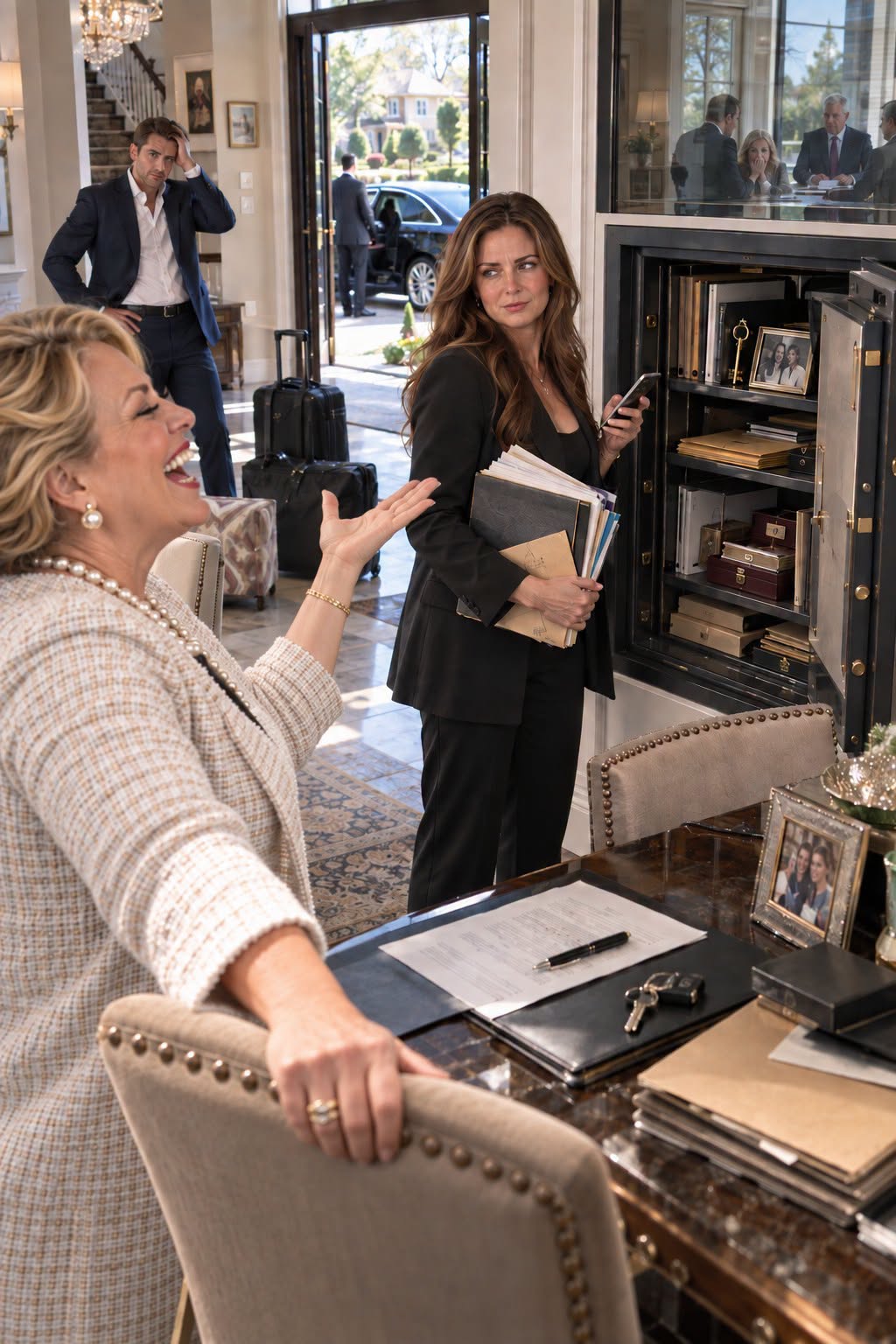
I Had Just Signed The Divorce Papers When My Mother-In-Law Told Me To Be Gone By Morning. I Opened The Safe, Took A Stack Of Files, And Called A Car. She Laughed, “Putting On A Show!” I Simply Smiled And Said, “You’ll See Everything Tomorrow.”
I had barely signed the papers ending my seven-year marriage when my mother-in-law ordered me out of the house I had helped build and told me every company file belonged to her son. My ex-husband sat there silently while his sister checked my bags like I was a thief. So I walked upstairs, opened the safe they had forgotten existed, and removed one envelope. When my mother-in-law laughed at my “little pile of papers,” I almost thanked her. By the next morning, those papers would matter more than the house.
### Part 1
The moment the final divorce papers were signed, Vivian Holloway placed her coffee cup on the glass table with a tiny click that sounded strangely final. “You have until tomorrow evening, Nora,” she said, folding her hands in her lap as calmly as if she were confirming a dinner reservation. “Pack your personal things, clear your office, and leave the house.”
I was thirty-four years old, sitting in a living room I had helped design, furnish, paint, and pay for during seven years of marriage to her son, Grant Holloway. Grant sat across from me wearing the navy blazer I had bought him two birthdays earlier, staring at a spot somewhere near my shoulder because apparently looking directly at the woman whose marriage he had just ended required more courage than he possessed.
His younger sister, Claire, had positioned herself on the arm of the sofa with her phone in one hand, scrolling while our entire life was being divided into categories. Mine, his, company property, personal property, approved, disputed, irrelevant.
Vivian continued in the same smooth voice. “As for the office, anything connected to Holloway & Bennett Creative stays with the company. Client files, designs, research, correspondence, presentations, drafts, working documents. Nothing leaves in your possession.”
“That’s right,” Claire added without looking up. “We just don’t want anything accidentally disappearing.”
I turned toward Grant. “Do you have anything to say?”
His jaw moved before the words came. “Mom is trying to keep things clean, Nora. Please don’t make this bigger than it has to be.”
I almost laughed because there was something impressive about a man reducing the theft of years of someone’s work to housekeeping. Instead, I studied his face and wondered exactly when the person who once stayed awake with me until two in the morning sketching concepts on restaurant napkins had become someone who needed his mother to explain what I was allowed to own.
Vivian leaned back. “This family gave you an opportunity. You came to Austin with a graphic design degree, some student projects, and ambition. Grant gave you a platform, connections, stability.”
More than I came in with.
That was the story they had apparently agreed to tell themselves.
I had arrived in Austin with a partial scholarship to the University of Texas, worked restaurant shifts to cover what the scholarship didn’t, graduated with degrees in design and communications, and freelanced from a converted storage room above a dry cleaner on South Congress. Grant had arrived in my life later with confidence, connections, a last name that opened doors, and PowerPoint slides so ugly that I had told him so ten minutes after meeting him.
Together, we had built something useful from the parts each of us possessed.
Somewhere along the way, the story changed from what we built to what he gave me.
“I understand,” I said.
Vivian’s expression softened into the faint, satisfied smile of someone who believed surrender had finally occurred. “Good. Keep this dignified.”
I picked up the signed decree and slipped it into my bag. “This will be the last time I call you Vivian.”
Her eyebrows lifted. Claire finally stopped scrolling, and Grant’s eyes actually met mine.
“Excuse me?” Vivian asked.
I stood.
Some answers improve when you don’t give them.
Upstairs, I walked past the bedroom Grant and I had shared and entered my home studio at the end of the hall. I locked the door, and almost immediately I heard Claire’s voice downstairs telling her mother she would make sure I didn’t touch anything in the filing cabinet.
That nearly made me smile.
The filing cabinet was the least interesting thing in that house.
I removed a framed typographic study from the wall, exposing the small safe I had installed years earlier. My grandmother Ruth had insisted that every woman should have at least one place in the world whose lock she controlled herself, advice I had once considered charmingly old-fashioned.
Grandma Ruth had been wrong about very few practical things.
I entered the combination.
Inside sat a legal-size manila envelope, an external hard drive wrapped in a gray velvet pouch, and one photograph of Grandma Ruth standing on the porch of her house in Harland County, Kentucky. She was squinting into summer sunlight, one hand on her hip, smiling as though she had already seen every foolish mistake I would make and had decided I would survive them.
I opened the envelope.
The original operating agreement for Holloway & Bennett Creative sat on top.
Equal founders.
Fifty percent Grant.
Fifty percent Nora.
Underneath were copyright registration certificates, printed emails, dated sketches, original research materials, annotated PDFs, version histories, financial documents, and three years of records no one in the Holloway family knew I had preserved. The external drive contained digital copies of everything, along with enough metadata to establish exactly who created what and when.
There was a knock at the door.
“Nora?” Claire called. “Mom wants to know if you need help packing.”
I opened the door.
Her eyes immediately swept behind me, searching the studio.
“I’m fine.”
“What’s in the envelope?”
“Something you probably wouldn’t recognize as valuable even if I put it in your hands.”
Her mouth tightened. “You’re being dramatic.”
“Maybe.”
I zipped the envelope into my suitcase. “Or maybe I finally stopped performing calm so your family could keep pretending nothing happened.”
Downstairs, Vivian inspected the suitcase before I reached the front door. I opened it myself because I wanted there to be absolutely no argument later.
Clothes.
My personal laptop.
My grandfather’s old watch.
Grandma Ruth’s photograph.
One hard drive.
One envelope.
Vivian glanced at the papers and actually laughed. “That’s what all this is about? Old documents?”
“That’s what I’m taking.”
“Fine. Take your papers.”
Grant appeared in the hallway behind her. “Nora, you don’t have to make this ugly.”
I looked at him carefully.
This was the man who had held my hand at Grandma Ruth’s funeral and told me she would have been proud of the company we built. This was also the man who had spent years accepting praise for work he knew originated on my desk.
“What you call ugly,” I said quietly, “I call honest.”
Outside, a black sedan waited near the driveway.
Vivian’s face changed when she saw it. “Daniel Mercer sent a car?”
Daniel owned fifteen percent of the company and had been our quietest investor from the beginning.
“He did.”
Vivian recovered quickly. “Leaving in style. How theatrical.”
The late October air was warm, and dry leaves scraped faintly against the pavement beneath the live oaks. I rolled the suitcase toward the car while Grant remained in the doorway, hands buried in his pockets.
“Don’t worry,” I said. “I’m not coming back to ask you for anything.”
Vivian tilted her chin. “Then what exactly will you come back for?”
I stopped with one hand on the car door.
Grandma Ruth’s envelope rested against my side.
“You’ll understand tomorrow.”
I got into the sedan and never looked back.
What Vivian did not know was that the most important paper in that envelope was not the divorce decree, a copyright certificate, or even the original operating agreement. It was a document bearing my signature on a transaction I had never agreed to—and I had proof of exactly how that signature had gotten there.
### Part 2
I was born in Harland County, in the eastern Kentucky mountains, where the ridgelines could hold back sunrise until midmorning and everyone knew which family you belonged to before they knew what you did for a living. My parents died in a highway accident when I was four, so Grandma Ruth became the person who raised me, corrected me, praised me sparingly, and taught me that survival depended less on being fearless than on paying attention.
She supported us as a seamstress and quilter, taking alteration jobs, selling handmade quilts at county fairs, and teaching classes twice a month at the community center. Her fingers were constantly moving, threading needles, smoothing cloth, pinning seams, but whenever she talked about money or ownership, those hands became very still.
“Nora,” she told me more than once, “the most dangerous thing a woman can do is let somebody else keep track of what she’s worth.”
I took that sentence with me to Austin.
Years later, I met Grant Holloway at a downtown branding conference where he gave a smart presentation using terrible visuals. Afterward, he caught me taking notes in the coffee line and asked what I thought.
“Your strategy is good,” I said. “Your slides look like a dentist made them in 2008.”
He stared at me for two seconds and then laughed.
That laugh mattered because Grant didn’t seem threatened by criticism then. He invited me to dinner, dinner turned into months of conversations, and those conversations became plans for a company neither of us could have built as well alone.
Grant understood people in a room.
I understood ideas before they became visible.
He could convince a skeptical executive to listen. I could spend six weeks discovering what that executive’s customers actually needed and build something that made sense beyond the sales pitch.
We married on a September Saturday beneath cedar trees outside Austin with fewer than forty guests. Grandma Ruth wore a lavender dress, ate three slices of wedding cake, and announced that Grant seemed “useful enough to keep around,” which made him laugh harder than anyone.
Two months later, we formed Holloway & Bennett Creative.
The original operating agreement named us equal founders.
My surname appeared beside his on everything.
For one year.
Then Vivian moved to Austin.
She did not enter our lives like a villain; she entered through tiny corrections. A raised eyebrow when I answered a client’s question before Grant, a comment about how confusing it could be to have two creative leaders, an observation at dinner that successful companies needed “one recognizable captain.”
Grant’s response was always identical.
“That’s just how Mom talks.”
Those five words eventually became permission for nearly anything.
Claire joined the company as brand communications manager two years later, and unlike Vivian, she did not bother hiding what she wanted. If I presented a concept, Claire later described it as something “Grant’s team” had developed; when a client praised a design, she would mention how deeply involved Grant had been in setting the creative direction.
At one networking reception she introduced me as “Grant’s wife, who helps with the design side.”
I smiled.
Then I went home and registered the original work from our three largest accounts under my own name.
That evening became the beginning of a habit.
Keep the files.
Keep the dates.
Keep the drafts.
The account that changed everything was Crestline Health, a regional hospital network operating across six Texas cities. The contract was worth slightly over four million dollars and covered everything from digital systems and patient communications to signage, environmental design, and complete brand modernization.
Grant landed the meeting.
I built the substance.
For six weeks, I traveled through hospitals interviewing doctors, nurses, staff members, families, and patients. One afternoon in Waco, a charge nurse stood beside me in an emergency corridor smelling faintly of disinfectant and burnt coffee and said something I wrote down immediately.
“People come here scared, and the building makes them feel more scared. Everything says this is where sick people go. I wish it said this is where people get help.”
That sentence became the center of my design system.
I created a visual language based around the emotional idea of assistance rather than illness, building everything from typography and color structure to wayfinding principles and patient-facing materials. The completed brand manual ran more than two hundred pages and consumed four months of my life.
At the executive presentation, Grant stood at the front of the room.
“The insight driving this identity,” he said beside my slides, “is that healthcare spaces should communicate safety instead of sterility.”
He had never visited the Waco emergency department.
He had, however, read my research brief.
The executives loved the work.
Crestline signed.
That night Vivian served brisket and roasted potatoes on her good tablecloth and toasted “Grant’s extraordinary vision.” Claire took photographs while Grant wrapped an arm around me and said, almost as an afterthought, “Nora was invaluable.”
I smiled for the picture.
Then I went upstairs and created an encrypted folder labeled CRESTLINE ORIGINAL DEVELOPMENT.
Nine months before our divorce, that habit saved me.
I arrived at work on a Tuesday morning and noticed a new file in the shared corporate drive.
OPERATING AGREEMENT AMENDMENT — SHARE RESTRUCTURE.
I opened it.
For several seconds, I thought I was misunderstanding what I was reading.
The document claimed I had voluntarily transferred twenty percent of my founding equity to Grant, reducing my ownership from fifty percent to thirty.
My signature appeared at the bottom.
I had never signed it.
But I recognized the page.
Two years earlier, Vivian had called me into our living room on a Sunday afternoon and explained that the company’s bank needed supplemental authorization sheets for a credit line. The lawyers were supposedly rushing, Grant was traveling the next morning, and she needed me to sign several blank signature pages so the completed documents could be assembled later.
Something about it had bothered me.
So before signing anything, I photographed each blank page.
The empty signature lines.
The clock behind Vivian.
The corner of her gold bracelet resting beside the papers.
Then I texted the images to my longtime attorney, Thomas Hale.
“Signing blank pages tonight for LLC banking documents,” I wrote. “Logging this in case anything strange appears later.”
Thomas responded, “Good instinct. Call me if it does.”
Standing at my office desk two years later, I forwarded him the amendment.
His phone call came forty-three minutes afterward.
“Nora, listen carefully,” he said. “Do not delete anything, confront anyone, or change your behavior. Give me forty-eight hours.”
“What do you think?”
“I think somebody made a very serious mistake.”
For the next nine months, I behaved like nothing had changed.
I attended meetings, designed campaigns, smiled beside Grant, listened to Vivian explain business to me at dinner, and watched Claire take credit in rooms where I had done the work.
At night, I built a record.
Then six weeks before Grant asked for a divorce, I saw a message flash across his phone from a woman named Elise.
“Glad you finally told her. I’ll be here when you’re ready.”
I never asked who she was.
By then, Grant’s affair was almost ordinary compared to everything else.
When he gently suggested we had “grown in different directions,” I agreed faster than he expected.
What Grant mistook for emotional exhaustion was preparation.
And the morning after I left his house, Thomas placed the disputed equity amendment beside my photographs of those blank pages and said something I had been waiting months to hear.
“This isn’t just leverage anymore, Nora. This may be fraud.”
### Part 3
Thomas Hale’s office on West Sixth smelled like burnt coffee, printer toner, and old legal books, three odors that somehow made me feel safer than anything in the Holloway house had for years. Three paralegals moved in and out while Thomas examined the contents of Grandma Ruth’s envelope one document at a time, rarely speaking until he reached the disputed equity amendment.
“The metadata puts creation of this file three weeks after the date printed on it,” he said. “That alone isn’t enough, but the witness signature creates another problem.”
“What problem?”
“The witness was supposedly in Austin.”
He rotated a laptop toward me.
“Our preliminary records put him at a conference in Houston that entire weekend. If the hotel and transaction records confirm it, they have to explain how a man physically located in Houston witnessed you signing something here.”
For the first time since leaving the house, I felt my shoulders loosen.
Thomas tapped the copyright certificates. “Crestline is even stronger. You registered the completed creative system individually, but more importantly, your development trail is unusually clean.”
“Grandma Ruth.”
“Remind me to thank her if we ever meet.”
“She died five years ago.”
Thomas paused. “Then she planned ahead.”
I looked at the photograph tucked beside the documents. “That was basically her religion.”
There was still one person I needed.
Daniel Mercer owned fifteen percent of Holloway & Bennett Creative and had invested at the end of our second year. He had always been difficult to read, not because he was deceptive but because he treated emotional displays as inefficient uses of oxygen.
I met him that afternoon in his office near Lamar.
He poured me water, sat opposite me, and waited.
I placed the operating agreement, disputed amendment, copyright records, and Crestline development history in front of him. Daniel read every page without interrupting, his office so quiet that I could hear traffic several floors below.
When he finally finished, he looked up. “You have one question.”
“Yes.”
“Ask it.”
“If there’s a shareholder vote, will you support restoration of the original operating agreement and recognize my authorship of the Crestline system?”
He leaned back.
“I invested because the creative output was exceptional. I knew who produced most of that output, even when your company became increasingly vague about saying so.”
“That isn’t an answer.”
“No.”
I waited.
Daniel picked up the disputed amendment. “I don’t vote based on what I like, and I don’t vote based on who I’m angry with. I vote according to the strongest records in front of me.”
He tapped the papers.
“Right now, yours are stronger.”
It was not loyalty.
It was better.
“I need three days,” I said.
“You have them.”
Thomas moved first.
He filed a formal intellectual property claim attaching my copyright registrations, original design files, research notes, timestamped versions, and evidence concerning the disputed equity amendment. More importantly, Crestline Health’s legal department received formal notice that ownership and authorship of the brand system they were using had become contested.
Grant called Daniel within hours.
Daniel did not call me.
Vivian did.
I let the first call ring out.
Then the second.
Then the third.
Her voicemail lasted two minutes and forty-one seconds.
“You are making an enormous mistake, Nora. This company supported you for years, and now you’re trying to damage it because your marriage ended badly. Whatever Thomas Hale is telling you, remember that lawsuits cost money, reputations disappear quickly, and Crestline will not appreciate being dragged into a domestic dispute.”
There was a slight tremor near the end.
I replayed it twice.
Fear.
Not anger.
Fear.
I forwarded the voicemail to Thomas.
“Save it,” he wrote.
Two days later, Grant finally called.
I answered.
“What are you doing?” he asked.
His voice sounded exhausted.
“Keeping things clean.”
Silence.
He recognized the phrase.
“Nora, pulling Crestline into this could destroy the company.”
“Interesting.”
“What?”
“You didn’t say I could destroy your company. You said the company.”
“Don’t play games.”
“I’m not.”
He inhaled sharply. “Whatever happened between us personally, we built this together.”
There it was.
Together.
The word he remembered only when ownership became inconvenient.
“I agree,” I said.
“Then stop this.”
“That isn’t what together means.”
He went quiet.
I could almost see him standing in the glass hallway outside his office, one hand pressed against his forehead.
“We can negotiate,” he finally said.
“We already are.”
“Nora—”
I ended the call.
The Crestline meeting was scheduled for Thursday morning in a conference room fourteen floors above downtown Austin. Thomas and I arrived early, carrying two binders and one laptop.
Grant arrived with company counsel.
Vivian came with him.
She wore a cream-colored suit and sat in the corner without speaking, which was the first genuinely surprising event of the morning.
Crestline’s lead counsel, Rebecca Sloan, entered at exactly nine and wasted no time.
“We are not here to arbitrate a divorce,” she said. “We are here to establish a chain of authorship and determine whether Crestline has been given inaccurate information regarding rights to creative assets for which we have paid substantial fees.”
She looked at me.
“Ms. Bennett, begin.”
I did not talk about my marriage.
I talked about work.
I showed my Waco interview notes, including the charge nurse’s observation about frightened patients. I displayed original sketches carrying my initials and dates, then opened the version histories showing hundreds of incremental changes under my individual account.
I produced travel receipts from hospital visits Grant never attended.
I presented research recordings, early color studies, rejected concepts, and finally the United States Copyright Office registration for the completed identity system.
Then I placed one page from Grant’s original Crestline pitch deck beside my interview transcript.
The nurse’s words were there almost verbatim.
Rebecca looked at Grant.
“You conducted this interview?”
“No. Nora handled most of the field research.”
“What patient experience principle determined the primary typography system?”
Grant hesitated.
“It was based on accessibility and warmth.”
Rebecca waited. “The principle has a name in your own design standards.”
He looked toward his attorney.
“What is it?”
He did not know.
She asked about the color architecture.
Then environmental hierarchy.
Then the specific reason the emergency signage departed from the outpatient palette.
Grant answered vaguely until vague became impossible.
The room grew quieter with every question.
Finally, company counsel introduced the amended operating agreement.
Thomas slid his metadata report across the table.
Then the blank-page photographs.
Then records showing the supposed witness had checked into a Houston hotel before noon on the date he allegedly watched me sign the amendment in Austin.
Rebecca read without expression.
When she finished, she placed the amendment to one side.
“Crestline recognizes Nora Bennett as the primary creative author of the brand identity system currently in use,” she said. “We will immediately correct our attribution records.”
I heard Grant shift in his chair.
Rebecca continued.
“Additionally, until ownership issues are resolved, Crestline will suspend further creative payments to Holloway & Bennett Creative and negotiate the remaining implementation directly with Ms. Bennett’s authorized team.”
Grant’s attorney began speaking.
Grant raised a hand.
Vivian stood.
“This is a private family matter being weaponized against my son.”
Rebecca looked at her evenly.
“Mrs. Holloway, you are not a party to this contract.”
Vivian slowly sat.
I did not smile.
I did not need to.
Then Rebecca slid one more document toward Thomas, and his expression changed.
“What is that?” I asked.
Rebecca folded her hands.
“Something discovered during our payment review. I believe your company’s independent shareholders are going to want to see it.”
### Part 4
The document Rebecca Sloan handed Thomas had nothing to do with my designs.
It was a vendor-payment summary.
During Crestline’s internal review, their accounting department had noticed several consulting invoices routed through Holloway & Bennett Creative and charged proportionally to large client accounts. The vendor name sounded generic enough to disappear inside bookkeeping software, but Rebecca’s team had traced the registration address to a mailbox service used by an entity connected to Vivian.
Thomas read the first page and looked at me.
“Did you know about this?”
“No.”
Grant did.
I knew because he stopped moving.
Vivian leaned forward. “Those are legitimate strategic consulting expenses.”
Rebecca’s voice remained neutral. “Then an audit should establish that very easily.”
No one answered.
Daniel Mercer called an emergency shareholder meeting for the following Tuesday.
The six days between those meetings were some of the strangest of my life because nothing looked dramatic from the outside. I slept in a short-term apartment near downtown, bought groceries, answered emails, and sat at a little kitchen counter each morning while an entire company I had spent seven years building began to shake apart in rooms I could no longer see.
Grant texted twice.
The first message said, We need to talk before Tuesday.
The second said, Please don’t let attorneys decide everything.
I answered neither.
Elise, the woman whose name I had seen on his phone, never contacted me. I later learned she stopped answering Grant shortly after the Crestline dispute became public inside the company, which would have been funny if I had cared enough for it to hurt.
Claire resigned on Monday morning.
Her email to staff described a desire “to protect her mental health from an increasingly hostile environment.”
Thomas forwarded it to me with one line.
“Interesting timing.”
The shareholder meeting began at nine the next morning.
Daniel sat at the center of the conference table.
Grant was to his right, looking as though he had aged five years in one week. Vivian sat behind him despite not being a shareholder, and for once she did not try to control the room.
Thomas presented the disputed equity amendment first.
He explained the file creation dates, my blank-page photographs, the messages I had sent him two years earlier, and the witness-location records. Grant’s attorney argued that the corporate document should remain effective until a court ruled otherwise.
Daniel listened.
Then he voted to recognize the original fifty-fifty ownership structure pending final legal resolution.
Grant’s face went pale.
That vote alone changed everything.
My original equity, combined with Daniel’s fifteen percent, gave us enough authority to require an independent audit and suspend certain management powers. Daniel immediately proposed both.
The motion passed.
Then Thomas presented the vendor payments.
Over three years, Holloway & Bennett Creative had sent substantial amounts to a consulting business tied indirectly to Vivian. Some services might have been legitimate, but the records were vague, repeated, and unusually concentrated around our largest client accounts.
Grant looked at his mother.
“Mom?”
Vivian’s cheeks colored. “You knew I advised this company.”
“I knew we reimbursed expenses.”
“These were consulting fees.”
Daniel leaned forward. “Then produce engagement letters, work records, reports, deliverables, and approvals.”
Vivian said nothing.
Grant turned toward her again.
That moment stayed with me longer than I expected.
For years, Grant and Vivian had operated almost as a single unit whenever I was the inconvenient person in the room. Now I watched doubt appear on his face for the first time, and I understood something important.
Being betrayed by someone you trusted did not automatically make you innocent of everyone you had betrayed yourself.
I did not feel sorry for him.
Daniel proposed suspending Grant as managing partner until completion of the audit.
The motion passed.
Grant stared down at the table.
“Nora,” he said.
I waited.
“Is this what you wanted?”
“No.”
He looked surprised.
“What I wanted was my name on my work and my ownership left alone.”
Vivian gave a bitter laugh. “Don’t pretend this isn’t revenge.”
I turned toward her.
“Revenge would have required me to create something that hurt you. I didn’t create any of this.”
I gestured toward the records.
“I just stopped hiding it.”
The legal process continued for months.
There were interviews, forensic reviews, document requests, and negotiations that made the divorce itself seem almost simple. The disputed amendment eventually collapsed under evidence showing that my signature had been transferred onto a completed document after I signed the blank banking pages.
My fifty percent interest was restored permanently.
The audit uncovered enough questionable payments to require repayment and settlement, although I chose not to follow every personal consequence once the corporate money was returned. Vivian stopped appearing at the office entirely.
Grant reached a settlement that removed him from day-to-day management.
I bought part of his remaining interest, Daniel retained his stake, and the agency was reorganized under a new name.
Bennett Creative.
The first morning the new lettering went onto the office door, I stood across the hallway and stared at it longer than I expected.
Not because I needed my name in large letters.
Because nobody had been able to erase it.
I hired two designers I had trusted for years and promoted our quietest senior account manager, a woman named Julia Moreno who had repeatedly watched Claire take credit for her work. I also brought in a new bookkeeper and gave her one instruction on her first morning.
“Every dollar gets a trail.”
She smiled. “That’s usually the idea.”
“In this office, it’s the rule.”
An audit of payroll revealed that two junior designers had gone eighteen months without being properly compensated for overtime. We calculated what they were owed and paid it.
One of them, Marcus, came to my office holding the statement.
“Did you know about this before?”
“No.”
He nodded.
Then he looked at my name on the glass wall.
“Thanks for fixing it.”
I almost told him he didn’t need to thank me for money that already belonged to him.
Instead, I said, “From now on, if your name belongs on something, make sure it stays there.”
Months passed.
Crestline resumed its implementation contract through Bennett Creative, and the hospital network began installing the redesigned signage across six cities.
Then one afternoon, a handwritten envelope arrived at my office.
The return address belonged to Vivian Holloway.
Three pages.
No attorney copied.
No threats.
She admitted that she had spent most of Grant’s life confusing protection with control and ambition with entitlement. She did not fully confess to everything I wished she would, but she apologized for allowing my contributions to be minimized because she believed her son’s success mattered more than fairness.
The last line surprised me.
I did not understand what I was taking from you until I watched everything I thought I had protected fall apart.
I read the letter twice.
Then I placed it beside Grandma Ruth’s photograph.
My reply was five sentences long.
I accepted the apology.
I wished her well.
I told her I did not hate her.
I also told her there would be no restored relationship between us.
Forgiveness, when I finally understood it, did not mean reopening the door.
Sometimes it only meant you stopped standing behind it listening for another knock.
Then, three weeks later, Grant appeared outside Bennett Creative without an appointment. He looked through the glass door at my name on the wall, and when our eyes met, I knew immediately why he had come.
He wanted one thing the divorce papers could never give him.
He wanted me to tell him he could still be forgiven.
### Part 5
Grant waited in the small conference room while I finished a client call.
When I walked in, he stood automatically.
For a few seconds, neither of us spoke.
He looked different without the expensive blazer, the polished confidence, or Vivian beside him. He wore a gray sweater and dark jeans, and there were shadows under his eyes I had never seen during our marriage.
“Thanks for seeing me.”
“I have twenty minutes.”
He nodded.
On the other side of the glass wall, I could see Julia laughing with one of the designers over a presentation board. The office sounded alive in a way the old company rarely had, keyboards clicking, low conversation, the hiss of the espresso machine near reception.
Grant followed my gaze.
“You’ve changed the place.”
“Yes.”
“It feels different.”
“It is.”
He rubbed his palms together. “I’m not here about money.”
“Good.”
“I’m not asking for the company back either.”
“That would also be good.”
A faint smile appeared and disappeared.
“I wanted to apologize.”
I leaned back.
Grant looked down at the table before continuing.
“I spent years telling myself Mom was difficult but harmless. Claire was competitive but useful. You were talented but sometimes too sensitive about recognition.”
He swallowed.
“Every explanation made it easier for me not to look too closely at what I was benefiting from.”
I said nothing.
“When the Crestline attorney asked me those questions, I realized I had repeated your work so many times that I had started believing knowing your conclusions was the same thing as doing the thinking.”
That sentence, at least, sounded true.
“And Elise?” I asked.
His face tightened.
“That was selfish.”
“Yes.”
“I told myself our marriage was already over.”
“It wasn’t.”
“I know.”
I looked through the glass again.
For years, I had imagined Grant eventually understanding everything he had done and believed that moment would feel like justice. Now that it had arrived, it felt surprisingly small.
“I’m sorry,” he said.
“I believe you.”
His eyes lifted.
Hope appeared so quickly that I almost felt cruel for recognizing it.
“I forgive you too.”
He exhaled.
Then I continued.
“But we’re not rebuilding anything.”
The hope disappeared.
“Nora—”
“No.”
I kept my voice calm.
“I don’t hate you, Grant. I don’t wake up thinking about what you did, and I don’t want anything bad to happen to you. That’s the forgiveness you get.”
He stared at me.
“But I spent years making myself smaller so our marriage could survive the version of you that needed to be bigger. I’m never doing that again.”
His eyes reddened.
“I’ve changed.”
“Maybe you have.”
“You don’t believe me?”
“It doesn’t matter.”
That seemed to hurt him more than anger would have.
And it was true.
Grant’s improvement was no longer my project.
His regret was no longer my responsibility.
Whatever man he became afterward could benefit the next people in his life, but I did not owe him the reward of returning simply because he had finally learned a lesson at my expense.
He stood slowly.
“At least I wanted you to know I’m sorry.”
“I know.”
At the door, he paused.
“Grandma Ruth really would have been proud of you.”
My throat tightened unexpectedly.
“Yes,” I said. “I think she would.”
Grant left.
I returned to work.
That spring, Crestline completed installation of the new identity system across all six Texas cities.
I drove to Waco on the morning the final emergency-department wayfinding signs went up.
The hospital smelled exactly the way I remembered, clean air, coffee, sanitizer, something warm coming from the cafeteria down the corridor. Workers removed the last temporary barrier while nurses moved around them with the practiced impatience of people who had more important things to do.
I stood beside the wall where my original research had begun years earlier.
Warm colors.
Clear directions.
Human type.
Nothing spectacular if you did not know how much thought had gone into it.
A nurse walking beside another staff member glanced around and said, “It actually feels better in here now.”
The other nurse nodded.
Neither recognized me.
That made the moment better.
The work was doing what it had been designed to do without needing me standing beside it asking for applause.
Near the main entrance was a small attribution plaque.
Brand identity design: Bennett Creative.
Nora Bennett, Creative Director.
The letters were small.
They were enough.
A month later, I traveled back to Harland County.
Grandma Ruth’s old house had been sold after her death, but I drove past anyway. The green shutters had been painted blue, the garden was smaller, and somebody had installed a basketball hoop beside the driveway.
For a moment, I could almost see her sitting on the porch with a basket of fabric scraps near her feet.
She had made me a quilt the year before I left for college.
Navy and cream.
Double wedding ring pattern.
She always laughed at the name because, according to her, the quilt had nothing to do with marriage.
“It’s about connection,” she once told me. “Everything touches something else. Just make sure you know where your own piece begins.”
That quilt now hung over the back of the chair beside my office window.
Every morning, I saw it before I opened my laptop.
Bennett Creative grew slowly, which was exactly how I wanted it.
We took fewer clients than Grant would have liked and charged them enough to do the work properly. Designers presented their own ideas, researchers received credit in meetings, and nobody was introduced as someone’s spouse who “helped out.”
Daniel remained an investor.
Thomas remained the person I called whenever paperwork looked even slightly strange.
Vivian never contacted me again after my reply.
Claire sent one short email nearly a year later saying she hoped someday we could “put the past behind us.”
I did not answer.
Putting something behind you does not require inviting the people who caused it to walk beside you afterward.
As for love, I did not rush toward another relationship simply to prove I had moved on.
For the first time since my twenties, my home belonged entirely to me.
I chose the furniture without compromise.
I left books on the kitchen counter.
I bought terrible art from a neighborhood street fair because it made me laugh.
Some evenings I ate takeout by the window while Austin traffic moved below, and I remembered the converted room above the dry cleaner where I had first lived when I came to Texas.
That apartment had smelled faintly of cleaning solvent.
The air conditioner rattled.
The shower took ten minutes to become warm.
I had been happy there because nothing inside it required permission.
It took me years to understand why that memory mattered.
Love should not make ownership unclear.
Partnership should not require someone to disappear.
Forgiveness should not become another word for surrender.
And patience without boundaries is not strength; sometimes it is only endurance wearing respectable clothes.
Grandma Ruth had understood all of that before I was old enough to understand any of it.
“Keep your own records,” she had told me.
I thought she was teaching me about paperwork.
She was teaching me about identity.
The morning after my divorce, Vivian Holloway believed I had walked away from her family carrying nothing but old papers.
She was partly right.
They were old papers.
Contracts.
Certificates.
Printouts.
Photographs.
Dates.
Signatures.
Things most people would have thrown into a drawer and forgotten.
But those papers carried something the Holloways had spent years trying to separate from me.
Proof.
Proof that I had created the work.
Proof that I owned what I had built.
Proof that my name had existed beside Grant’s before his family learned how convenient it was to erase it.
And proof that silence does not always mean surrender.
Sometimes the quiet person in the room is simply keeping records.
Waiting.
Watching.
Letting everyone else become comfortable enough to believe the story they invented.
Then morning comes.
The safe opens.
The papers come out.
And the truth finally has nowhere left to hide.
THE END!