# THE MAID WHO DARED TO TOUCH THE PRINCE’S CRYSTAL HAND
## PART 1 — THE GIRL WHO DIDN’T BELONG
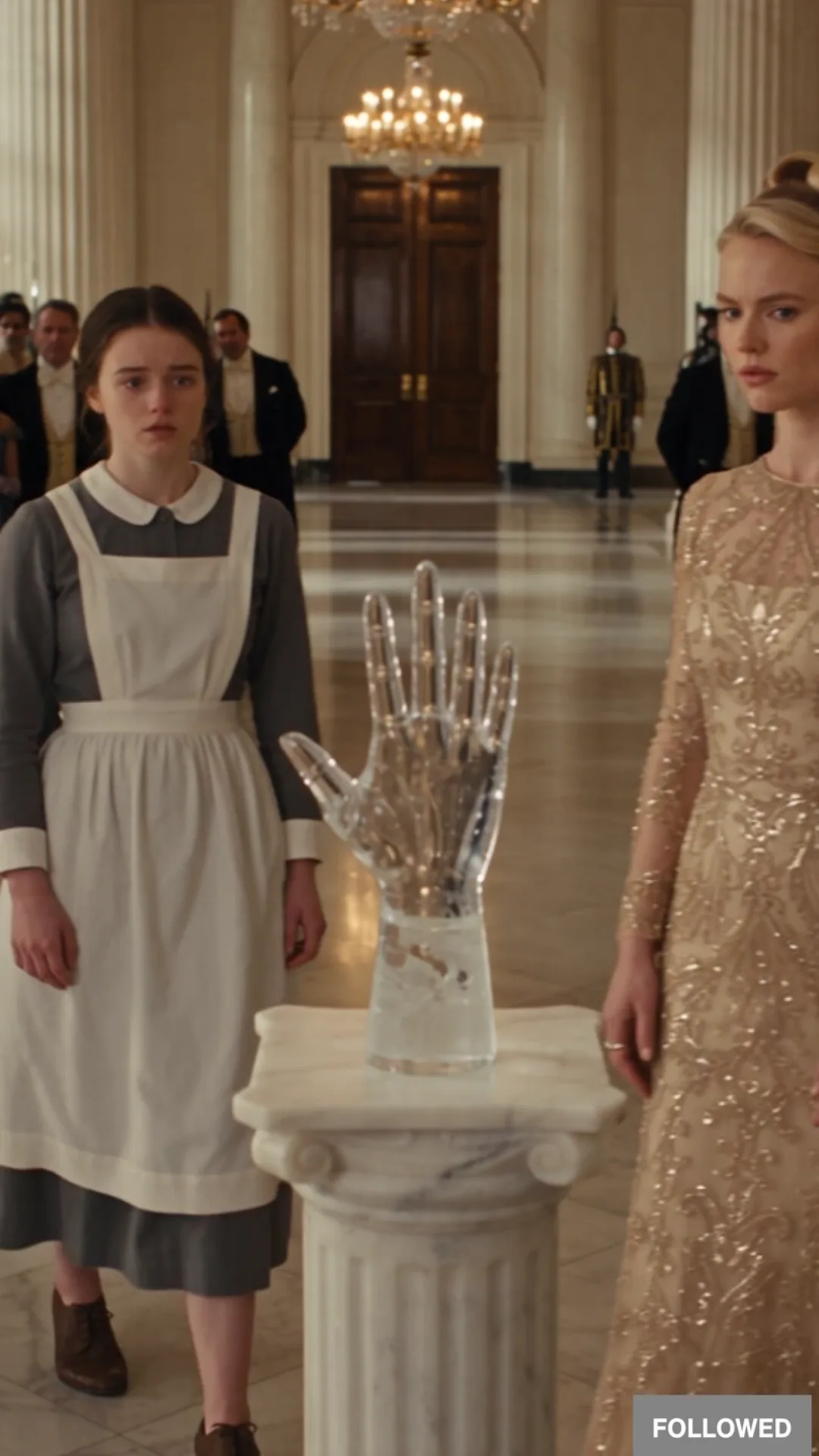
The entire royal court burst into laughter when a poor young maid dared to approach the crystal hand that would determine the future queen.
She was only twenty-two years old, wearing a faded gray dress and a plain white apron. Her shoes were worn, her hands were rough from years of cleaning, and she had never owned a single piece of jewelry.
Yet something about the crystal hand seemed strangely familiar.
When Elia raised her fingers toward it, a wealthy noblewoman shouted, “What do you think you’re doing?”
Another woman laughed.
“A miserable servant? How pathetic!”
Elia lowered her head in shame.
But then she looked at her own hands.
And a terrifying possibility crossed her mind.
What if the crystal was made for her?
What no one in that magnificent palace knew was that Elia’s hands carried a secret buried for twenty-two years.
And if that secret came to light, the royal family would never be the same.
The Kingdom of Valoria was famous for three things: its extraordinary wealth, its magnificent palaces, and an ancient royal tradition known as the Trial of the Crystal Hand.
For more than four hundred years, every crown prince had been expected to choose his future queen through a ceremony held in the palace’s Grand Hall.
At the center of the room stood a white marble pedestal.
Resting upon it was a transparent crystal sculpture shaped like a woman’s right hand.
Five perfectly carved fingers rose from its surface.
According to legend, the crystal had been shaped centuries earlier by a master craftsman who served the kingdom’s first queen.
The queen had commissioned it to preserve the exact shape of her hand after she saved the royal family from a violent rebellion.
Before her death, she made one unusual request.
The royal family must never forget that courage mattered more than bloodlines.
Over the years, however, the meaning of the tradition changed.
The nobles began believing that only a woman of sufficiently noble ancestry could match the crystal.
Royal daughters from neighboring kingdoms traveled across oceans to place their hands against it.
Countesses spent fortunes on elaborate gowns.
Duchesses practiced elegant movements for months.
And every woman hoped to become the future queen of Valoria.
But the crystal had rejected them all.
Not through magic.
Not through fire or mysterious light.
Their hands simply did not match its unusual proportions.
Some fingers were too long.
Others were too short.
The curvature of the palm was wrong.
And one small space between the thumb and index finger seemed impossible to match.
That evening, Prince Adrian sat on his throne beside his mother, Queen Helena.
He was thirty years old, handsome, intelligent, and exhausted by the endless ceremony.
He wore a blue-and-gold royal uniform, with dark-brown hair neatly styled.
His mother sat beside him in a magnificent royal gown.
Her silver hair was arranged beneath an elegant crown.
Below them, the kingdom’s wealthiest families waited for the final candidates to be tested.
Lady Celeste, a beautiful twenty-five-year-old noblewoman with blonde hair and a shimmering gold gown, approached the pedestal.
She smiled confidently.
Every person in the room expected success.
Her family controlled valuable shipping routes and owned several castles along the southern coast.
Her father had already informed his friends that the royal engagement was practically guaranteed.
Celeste raised her right hand.
Pressed her palm against the crystal.
And froze.
Her fingers did not fit.
She tried adjusting her hand.
The mismatch became even more obvious.
Her thumb was too short.
Her middle finger extended beyond the crystal’s carved shape.
A ripple of disappointment swept through the room.
Celeste withdrew her hand, her face burning with embarrassment.
Prince Adrian sighed.
“Another failure. None of them is the chosen one.”
Queen Helena remained silent.
But her eyes revealed concern.
For twenty-two years, the royal family had waited for someone whose hand matched the crystal.
Now the tradition threatened to become a national embarrassment.
Standing near the left column was Elia.
She worked as a palace maid.
Her responsibilities included polishing the marble floors, arranging fresh flowers, cleaning the royal chambers, and preparing the Grand Hall before ceremonies.
She had grown up inside the palace’s servant quarters.
Her earliest memories were of narrow hallways, old wooden doors, and the smell of bread baking in the kitchen.
She knew nothing about her birth parents.
The woman who raised her, an elderly palace laundress named Martha, had always claimed Elia was an orphan brought to the palace during a winter storm.
Martha had loved her like a daughter.
But she had died three years earlier, leaving Elia alone.
Before her death, Martha had given Elia a small cloth pouch containing a silver pendant and a folded letter.
“Keep these safe,” she whispered.
“One day, you may need to know where you came from.”
Elia had never opened the letter.
She feared that whatever it contained might destroy the only life she understood.
Now, standing inside the Grand Hall, she stared at the crystal hand.
Something about it troubled her.
Its narrow palm.
The unusual curve of the thumb.
The small separation between the second and third fingers.
She looked at her own right hand.
Then back at the crystal.
Her heartbeat quickened.
Without thinking, she took two cautious steps toward the pedestal.
She raised her hand.
But before her fingers could reach the transparent sculpture, a woman’s voice shattered the silence.
“Elia! What do you think you’re doing?”
A noblewoman standing beside the eastern columns pointed at her.
Every head turned.
Elia froze.
Lady Victoria, a twenty-seven-year-old aristocrat wearing a magnificent emerald gown, stepped forward.
Her black hair was arranged in an elaborate updo.
She looked Elia up and down.
Then laughed.
“A miserable servant? How pathetic!”
Several nobles exchanged amused glances.
Elia’s cheeks burned.
She lowered her hand.
“I… I shouldn’t have done that.”
The words barely escaped her lips.
She bowed her head and prepared to retreat.
But then she stopped.
Slowly, she lifted both hands in front of her face.
She studied her fingers.
Her thumb.
The narrow shape of her palm.
And the tiny crescent-shaped scar near her right wrist.
The same mark she remembered seeing carved into the crystal’s base.
Her breathing changed.
“Wait… my hands… could it really be me?”
The room fell silent.
Prince Adrian leaned forward.
For the first time that evening, he was genuinely interested.
And Queen Helena, who had remained composed throughout the ceremony, suddenly gripped the arm of her throne.
Because she recognized something about the young maid.
Not her face.
Not her clothing.
The pendant hanging beneath her gray uniform.
A pendant Helena had last seen twenty-two years earlier.
On the night her infant daughter disappeared.
—
## PART 2 — THE SECRET BURIED IN THE PALACE
“Let her approach.”
Prince Adrian’s voice carried across the Grand Hall.
Every noble turned toward him.
Lady Victoria looked horrified.
“Your Highness, surely you cannot be serious.”
Adrian remained seated.
“Did I ask for your opinion?”
Victoria immediately lowered her head.
“No, Your Highness.”
Adrian turned toward Elia.
“Come forward.”
Elia stood motionless.
She had spent her entire life being instructed to keep her eyes lowered around royalty.
She had been told never to interrupt a noble.
Never to enter a room without permission.
Never to imagine she belonged among the people she served.
Now the crown prince was speaking directly to her.
“I’m sorry, Your Highness,” she whispered.
“You have nothing to apologize for.”
He gestured toward the pedestal.
“If you believe your hand might fit, you may try.”
A murmur spread across the hall.
Lady Celeste looked outraged.
“My prince, the trial is reserved for women of noble birth.”
Adrian’s expression hardened.
“Show me where that requirement is written in the original royal decree.”
Celeste said nothing.
Because no such requirement existed.
The tradition had been distorted over generations by aristocrats who believed royalty should only marry royalty.
Adrian stood.
Queen Helena watched him carefully.
“Mother,” he asked, “do you object?”
The queen looked at Elia.
For several seconds, she did not answer.
Then she spoke.
“No.”
Her voice trembled.
“Let the girl try.”
Elia approached the crystal.
Her brown flats made soft sounds against the polished marble.
Every step seemed impossibly loud.
She stopped in front of the pedestal.
The crystal hand stood perfectly still.
Clear.
Cold.
Unchanging.
Elia raised her right hand.
Her fingers trembled.
Then she placed her palm gently against the sculpture.
A gasp swept through the room.
Her fingers aligned.
The thumb settled into the unusual curve.
The narrow palm matched.
Even the small space between the second and third fingers fitted precisely.
Elia stared.
She didn’t understand.
The crystal did not glow.
No bells rang.
No supernatural force swept across the hall.
There was only silence.
And a perfect match.
Prince Adrian descended from his throne.
He approached the pedestal slowly.
Then he looked at Elia’s hand.
“Impossible,” he whispered.
Lady Celeste stepped forward.
“This must be a trick!”
Victoria nodded sharply.
“She works here! She could have studied the crystal!”
Adrian ignored them.
He examined the narrow contact between Elia’s palm and the transparent surface.
Then he turned toward the queen.
“Mother?”
Helena was already standing.
Her face had gone pale.
She descended the steps, unable to take her eyes off Elia.
“Child,” she whispered, “where did you get that necklace?”
Elia instinctively touched the silver pendant beneath her collar.
“My mother gave it to me.”
Helena’s expression changed.
“Your mother?”
“The woman who raised me.”
“What was her name?”
“Martha.”
The queen stopped breathing.
“Martha Evelyn?”
Elia stared.
“Yes.”
A strange sound escaped Helena’s lips.
She looked toward the pendant.
“May I see it?”
Elia hesitated.
Then carefully pulled the silver chain from beneath her uniform.
At its end hung a small pendant shaped like a white rose.
On the back was a tiny engraved crown.
Helena covered her mouth.
Tears filled her eyes.
Prince Adrian stepped closer.
“Mother, what is it?”
But Helena couldn’t answer.
She reached toward the pendant with trembling fingers.
“I gave this to my daughter.”
The room became completely silent.
Adrian frowned.
“Your daughter?”
Helena nodded.
“Twenty-two years ago.”
Adrian stared.
“Mother, you told me my baby sister died.”
The queen’s face crumpled.
“I was told she had died.”
Elia felt the floor shift beneath her feet.
She looked from Helena to Adrian.
Then toward the crystal hand.
The queen continued.
“Your sister was born during a terrible winter storm. She had dark hair, brown eyes, and a small mark near her right wrist.”
Elia slowly turned her hand.
The crescent-shaped scar was clearly visible.
Helena began crying.
“The royal physician told me she had stopped breathing.”
Her voice broke.
“They wouldn’t let me hold her.”
Adrian’s expression hardened.
“Who was the physician?”
Helena swallowed.
“Lord Malrec.”
A wave of recognition moved through the nobles.
Lord Malrec had served as the kingdom’s royal physician for more than thirty years.
He was also the father of Lady Victoria.
Elia felt a sudden chill.
Victoria stepped backward.
“That means nothing.”
Adrian turned toward her.
“Where is your father?”
Victoria’s lips trembled.
“He’s ill.”
“Then we shall summon him.”
“No!”
The word escaped too loudly.
Everyone stared.
Victoria immediately lowered her eyes.
“I mean… he’s elderly. He shouldn’t be disturbed.”
Adrian studied her.
“Why would you be concerned about a simple question?”
She said nothing.
Meanwhile, Elia remembered Martha’s final gift.
The cloth pouch.
The silver pendant.
And the sealed letter.
Her heart began pounding.
“Your Majesty?”
Helena turned toward her.
“Yes, child?”
“I have something.”
“What?”
“A letter from Martha.”
The queen stepped closer.
“Where is it?”
“In my room.”
Adrian called for a trusted palace attendant.
“Bring it here.”
Within minutes, the sealed letter was delivered.
Its paper was yellowed.
The edges were worn.
Martha’s handwriting covered the front.
Elia’s hands trembled as she opened it.
Inside were three pages.
She began reading silently.
Then tears filled her eyes.
Martha had confessed everything.
Twenty-two years earlier, she had been summoned to the palace nursery during a storm.
Lord Malrec handed her a newborn girl wrapped in a wool blanket.
He claimed the infant was the illegitimate daughter of a servant who had died in childbirth.
He ordered Martha to take the baby away.
But Martha noticed the child’s clothing.
Fine embroidered fabric.
A silver pendant.
And a small royal crest stitched into the blanket.
She realized the baby had not come from the servants’ quarters.
She had been taken from the royal nursery.
Martha tried to return her.
But Lord Malrec threatened to have her imprisoned.
Terrified, she hid the child and raised her as her own.
For years, Martha feared the truth would place them both in danger.
Only when her health began failing did she write the confession.
At the bottom of the final page was one sentence.
Forgive me, Elia. I could not give you the life you were born into, but I loved you with everything I had.
Elia covered her face.
She had always believed Martha was her mother.
Now she understood why the old woman had cried whenever she watched royal children playing in the gardens.
Why she had refused to discuss Elia’s birth.
And why she had insisted that the silver pendant never be lost.
Helena reached for the letter.
She read it slowly.
Then looked at Elia.
“My daughter.”
Her voice shattered.
“My little girl.”
The queen began moving toward her.
But Elia instinctively stepped backward.
The entire room froze.
“I don’t understand,” Elia whispered.
Helena stopped immediately.
“You don’t have to understand everything tonight.”
Elia looked toward Adrian.
Then back at the queen.
“Are you saying I’m a princess?”
Helena nodded through her tears.
“I believe you are.”
Adrian stared at his mother.
Then at Elia.
Something in his expression changed.
He stepped away from the pedestal.
The crystal hand had not identified his future bride.
It had uncovered his missing sister.
And if Martha’s letter was true, someone inside the royal court had stolen a child from the queen.
But the greatest betrayal had yet to be revealed.
Because Lord Malrec had not acted alone.
—
## PART 3 — THE QUEEN THEY NEVER EXPECTED
By midnight, the royal palace had become the center of an investigation.
Lord Malrec was summoned under royal authority.
When he entered the Grand Hall, his expression was calm.
But his confidence disappeared when he saw Elia standing beside Queen Helena.
The silver pendant hung openly around her neck.
And Martha’s letter rested on the conference table brought before the throne.
Prince Adrian stood nearby.
“Lord Malrec,” he said, “do you recognize this woman?”
The physician looked at Elia.
Then away.
“No, Your Highness.”
Adrian lifted the letter.
“Do you recognize Martha Evelyn?”
Malrec’s jaw tightened.
“A former servant.”
“Did you give her a newborn girl twenty-two years ago?”
“No.”
Adrian studied him.
“Then perhaps you can explain why this document bears your signature.”
He placed an old hospital record on the table.
The royal archivist had discovered it that evening.
For twenty-two years, the document had been hidden inside a collection of medical records never transferred to the public archives.
The record described a healthy infant girl born to Queen Helena.
But a second entry, written hours later, declared the child deceased.
The signature belonged to Lord Malrec.
And beneath it was a second name.
Lord Victor Ashbourne.
The former royal chancellor.
Lady Victoria’s grandfather.
Helena stared at the document.
“Why?”
Her voice was barely audible.
“Why would you take my child?”
Lord Malrec remained silent.
Adrian stepped forward.
“Answer the queen.”
Malrec finally lowered his eyes.
“The succession,” he whispered.
Helena frowned.
“What?”
“At the time, the kingdom’s laws allowed the firstborn child of the reigning monarch to inherit the throne, regardless of gender.”
Adrian became still.
He had been born three years after his sister’s disappearance.
Malrec continued.
“Lord Ashbourne wanted his own family joined to the throne. A surviving princess would have complicated those plans.”
Elia stared at him.
“You stole me because of a crown?”
Malrec looked away.
“I was following orders.”
Adrian’s expression hardened.
“Orders don’t erase responsibility.”
The investigation that followed revealed a conspiracy reaching back more than two decades.
Lord Ashbourne had planned to marry his granddaughter Victoria into the royal family.
With the missing princess presumed dead, Adrian had become the heir.
A marriage between Adrian and Victoria would have placed the Ashbourne family at the center of royal power.
The Crystal Hand ceremony had interfered with those plans.
Under the original royal decree, the crystal was not exclusively a test for marriage.
It was an heirloom designed to preserve a distinctive physical characteristic shared by the descendants of Valoria’s first queen.
The royal women of that bloodline had unusually narrow palms and a particular curve of the thumb.
Over centuries, the ceremony had been misunderstood.
The family resemblance was never a guarantee that every descendant would fit the sculpture.
But Elia’s perfect match, combined with the pendant, medical records, Martha’s confession, and the queen’s memories, gave investigators a compelling reason to examine her identity.
Independent genealogical and biological testing later confirmed the truth.
Elia was Princess Aurelia Helena of Valoria.
The queen’s firstborn child.
And under the kingdom’s succession laws, she was the rightful heir to the throne.
The announcement shook the entire kingdom.
For twenty-two years, the girl who should have grown up surrounded by royal tutors had scrubbed floors.
She had carried laundry.
She had served dinners where guests refused to look at her.
She had bowed before women who mocked her poverty.
And now those same aristocrats were expected to bow before her.
Lady Victoria was questioned about her family’s involvement.
Investigators established that she had known of suspicious family records but had not known the full truth about Elia’s disappearance until the ceremony.
She was removed from consideration for a royal marriage while the investigation continued.
Her father was stripped of his medical position and faced prosecution.
But Elia found little satisfaction in watching anyone fall.
She was overwhelmed.
Everything she had believed about herself had changed.
Her name.
Her family.
Her future.
Even the memories of the woman who had raised her.
For several days, Elia remained in her small servant’s room.
Queen Helena offered her a royal suite.
Elia refused.
Not because she was angry.
Because she needed time.
One evening, Prince Adrian knocked gently on her door.
“May I come in?”
Elia nodded.
He entered carrying two cups of tea.
She smiled faintly.
“You don’t have to serve me, Your Highness.”
He raised an eyebrow.
“And you don’t have to call me that.”
She looked down.
“It’s difficult.”
“I imagine it is.”
He placed one cup beside her.
Then sat on a wooden chair.
For a while, neither spoke.
Finally, Adrian said, “I’ve been thinking about the ceremony.”
Elia looked up.
“The crystal?”
He nodded.
“I spent years searching for someone to become my wife.”
She smiled sadly.
“And found your sister instead.”
Adrian laughed softly.
“Apparently.”
Then his expression became serious.
“Elia, I’m sorry.”
She frowned.
“For what?”
“For the way people treated you.”
“You didn’t know.”
“That doesn’t make it acceptable.”
He looked toward the window.
“I watched noblewomen humiliate servants for years. I told myself it was simply how court life worked.”
Elia listened.
Adrian turned toward her.
“Now I understand how wrong I was.”
She studied him.
Then whispered, “I don’t know how to be a princess.”
Adrian smiled.
“Neither did I know how to be a prince when I was born.”
“That’s different.”
“Is it?”
He leaned forward.
“You know how to work hard. You know what it means to go hungry. You know how it feels to be ignored.”
Elia looked at him.
“Those aren’t royal qualities.”
“Perhaps they should be.”
Her eyes filled.
For the first time since the ceremony, she smiled without fear.
Months passed.
Elia slowly adjusted to her new life.
She studied Valoria’s history.
Learned its laws.
Met representatives from the kingdom’s provinces.
And spent long evenings speaking with Queen Helena about the years they had lost.
Their relationship was not instantly perfect.
Sometimes Elia felt like a stranger.
Sometimes Helena became overwhelmed by guilt.
Sometimes they sat together in silence, unsure how to recover twenty-two missing years.
But little by little, they built something real.
Elia also refused to abandon the people who had raised her.
She visited Martha’s grave.
Placed fresh white roses beside the stone.
And whispered, “You kept me alive. You gave me love. I’ll never forget you.”
One year after the Crystal Hand ceremony, Queen Helena called a special gathering in the Grand Hall.
The same chandeliers glowed above the polished marble.
The same white columns rose toward the ceiling.
The same crystal hand stood upon its pedestal.
But the atmosphere was different.
This time, Elia entered wearing a beautiful royal gown of deep burgundy velvet.
Her dark-brown hair was arranged elegantly, though she had insisted on keeping the small silver pendant around her neck.
Prince Adrian stood beside the queen.
The nobles waited respectfully.
Helena approached her daughter.
“My people,” she announced, “today we recognize Princess Aurelia as the rightful heir to the throne of Valoria.”
The hall fell silent.
Then the queen continued.
“But before she accepts her responsibilities, she wishes to speak.”
Elia stepped forward.
Her hands trembled.
She looked toward the crystal sculpture.
Then toward the servants standing near the columns.
Some wore gray dresses and white aprons.
Others wore simple dark uniforms.
They reminded her of the life she had lived.
She took a slow breath.
“A year ago, I stood in this room wearing a maid’s uniform.”
Nobody moved.
“I was told that someone like me had no right to approach the crystal.”
She looked toward the nobles.
“Some of you laughed.”
Several faces lowered.
Elia continued.
“I used to believe that wealth made people important. That fine clothing made them superior. That a title determined whether someone deserved respect.”
She paused.
“But I was wrong.”
Her voice grew stronger.
“Every person who cleaned this palace, prepared your meals, carried your belongings, and worked while you slept deserved dignity long before anyone discovered who I was.”
Queen Helena’s eyes filled.
Elia looked toward the crystal hand.
“This object did not make me worthy.”
She placed her right hand beside it.
Not touching.
Simply comparing.
“I was worthy when I scrubbed the floors.”
She turned toward the servants.
“I was worthy when I had nothing.”
Then she faced the court.
“And so is every person standing in this hall.”
For a long moment, nobody spoke.
Then Prince Adrian began applauding.
Queen Helena followed.
Soon the entire Grand Hall filled with applause.
But Elia’s greatest victory came later.
She established educational programs for palace workers.
Created protections against mistreatment.
Opened royal scholarships to children from poor families.
And required every noble seeking a government position to complete a period of public service.
Some aristocrats complained.
Others resisted.
But Elia remained firm.
Because she knew that a kingdom could not truly be great while the people holding it together were treated as insignificant.
Years later, when Queen Helena retired, Elia became Queen Aurelia of Valoria.
On the morning of her coronation, she returned alone to the Grand Hall.
The crystal hand still stood on its white pedestal.
She approached it quietly.
Then raised her right palm.
This time, she touched the crystal without hesitation.
Her fingers matched perfectly.
Nothing glowed.
Nothing moved.
The sculpture remained exactly as it had always been.
Elia smiled.
Because she finally understood the truth.
The crystal had never possessed the power to make someone royal.
It had simply helped reveal a truth others had tried to bury.
She lowered her hand.
Then looked toward the throne waiting at the far end of the hall.
Once, the nobles had called her a miserable servant.
Now she was their queen.
But she never forgot the young woman in the gray dress.
The frightened girl who had lowered her head while others laughed.
The girl who had whispered:
Could it really be me?
And every time Elia entered the Grand Hall, she remembered the answer.
Yes. It had always been her.

