Chapter 1 — Save Some for Daniel
The maid looked over her shoulder before slipping the leftover bread into her beige canvas bag.
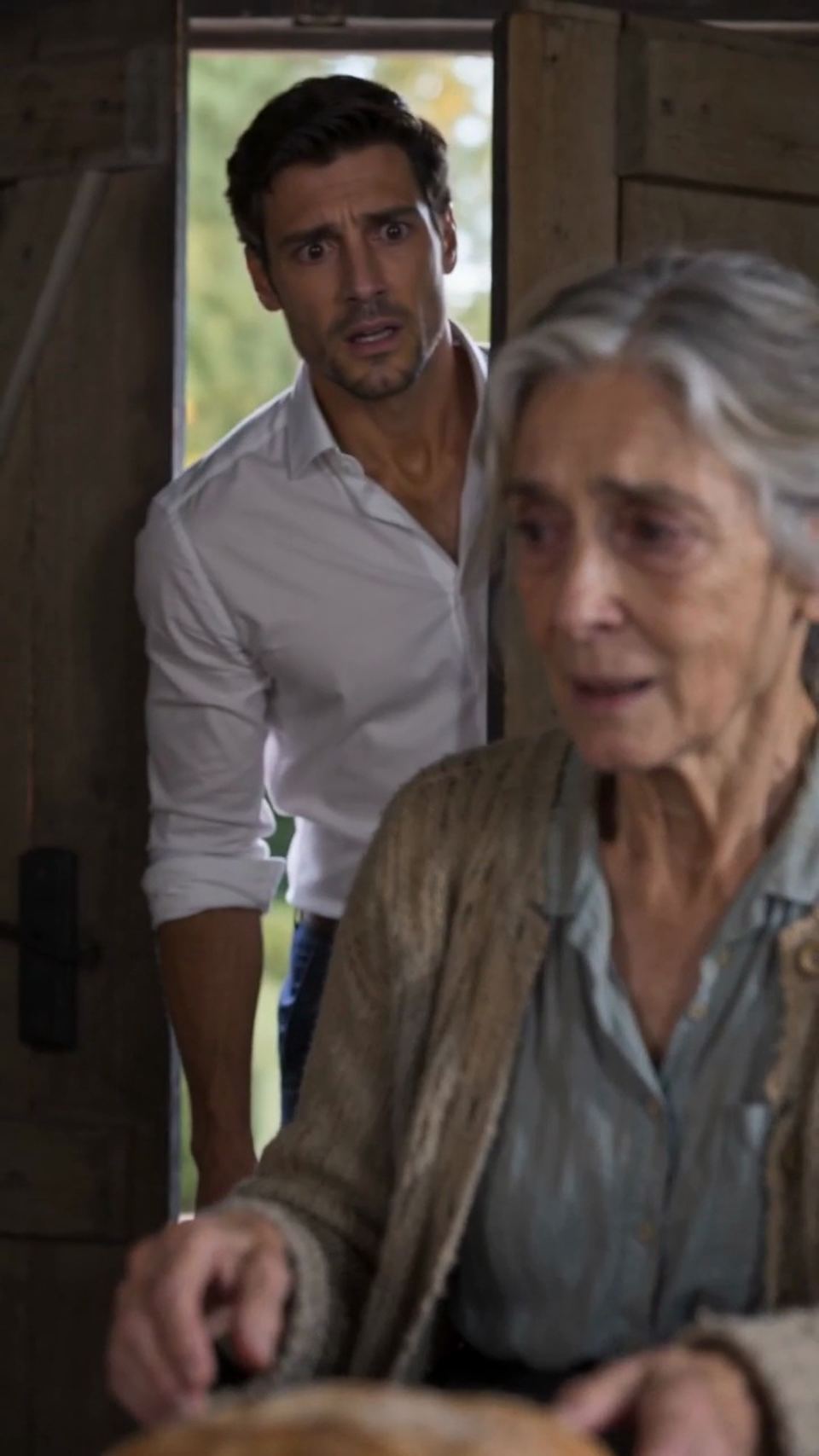
Daniel stood behind the kitchen doorframe, half his face in shadow. A small loaf struck the edge of the bag. She caught it before it fell, held the bag against her apron, and looked toward the doorway again.
He stayed still.
Every night… the leftover food.
He had noticed the pattern three evenings in a row. Tonight, the question would not leave him alone.
Who is she taking it to?
The maid settled the strap over her pale blue uniform and hurried out through the back door. Daniel waited until her footsteps had faded before following. She never looked back.
He kept his distance along the garden wall and through the narrow streets beyond the estate. By the time she reached an old cottage near the disused mill, the last sunlight was fading from the roofs.
She pushed open the wooden door with her shoulder. The canvas bag brushed against the frame. She went inside, leaving the door slightly ajar.
Daniel approached quietly and stopped beside it.
Through the gap, he saw a gray-haired woman sitting by the window with her back toward him. Her beige cardigan hung loosely around her shoulders.
The maid took bread from the same bag and placed it in the woman’s hands. Then she knelt beside her chair.
The woman did not eat. She set the bread gently on the table.
“Save some for Daniel.”
His suspicion vanished so abruptly that he could not remember what he had intended to say.
He knew that voice.
His hand closed around the doorframe. He moved half a step nearer.
“Mom?”
The maid turned sharply. The old woman’s shoulders stirred, and she began to look around.
When Daniel saw her face, he could not make himself cross the threshold.
There was the small scar beside her eyebrow, the pale blue eyes, the expression he had spent eighteen months trying to remember without crying.
“They told me you were dead.”
Her lips trembled. For a moment, no answer came.
Then she held out her hand.
“They told me you didn’t want me anymore.”
Daniel crossed the room and knelt so quickly that his knee struck the floorboards. Her fingers touched his cheek, tentative at first, then desperate.
He had stood beside a sealed coffin. He had scattered white roses over fresh earth. His uncle had held him upright when the grief became too much.
Now his mother was warm beneath his hands.
Behind him, the maid rose slowly.
“My name is Anna,” she said. “I can explain what I know. But please let her finish her supper first.”
Chapter 2 — The Name on the Bracelet
Daniel wanted to call everyone at once. The police. A doctor. His uncle Richard, who had arranged the funeral while Daniel was stranded overseas.
At the mention of Richard, his mother’s fingers tightened around his wrist.
“Not him.”
Anna shut the door.
“That’s the first thing she said clearly when I found her,” she told Daniel. “Not him.”
His mother, Margaret, drank a little soup from a chipped bowl. Anna had brought more than bread on other evenings; a covered saucepan stood on the stove, and fruit lay beside the window. But the room was cold, and Margaret was thinner than she should have been.
Daniel lowered his voice. “Where did you find her?”
“Outside a closed bus station. Twelve days ago.”
Anna worked mornings at the estate and evenings cleaning a small medical practice. On her way home, she had seen Margaret trying to buy a ticket without money or an address. The station attendant wanted to call someone, but Margaret panicked whenever a telephone was mentioned.
“She had a discharge envelope,” Anna said. “And a bracelet.”
From a drawer she took a plastic hospital bracelet bearing the name Mary Ellis.
Daniel stared at it.
“That’s not her name.”
“I know that now.”
“Why didn’t you tell me?”
Anna did not look away. “I didn’t know who she was. She called for Daniel, but she couldn’t give me a surname. There are other Daniels.”
She had joined his household only a month earlier. Margaret’s photographs had been removed from the public rooms after the funeral because Daniel could not bear to pass them. He had never considered what that absence might mean to anyone else.
“The doctor I clean for examined her,” Anna continued. “With her permission. We were trying to find her family without frightening her away.”
On the table lay appointment notes and a number for an adult support service. Anna had not simply hidden a stranger and hoped bread would solve everything. She had been working through a problem with very little money and no authority.
Margaret set down her spoon.
“I remember a garden with locked gates,” she said. “They told me I was confused. Sometimes I was.”
Daniel took out his phone but did not dial Richard.
Instead, he called the family doctor who had known Margaret for twenty years.
“Come alone,” he said. “And don’t call my uncle.”
While they waited, Anna cut the remaining loaf into three pieces.
Margaret pushed the largest toward her son.
Even now, she was trying to feed him.
Chapter 3 — The Funeral He Remembered
Margaret spent that night in a quiet hospital room under her own name.
Her old doctor recognized her immediately, but recognition alone would not untangle the records. Daniel agreed to the examinations and identity checks she wanted. He also contacted an independent lawyer and the police.
Richard called before breakfast.
“I hear you missed the board meeting.”
“Something came up.”
“Nothing serious, I hope.”
Daniel looked through the glass panel in his mother’s door. Anna sat beside the bed, listening while Margaret described the roses that used to grow outside her kitchen.
“I’ll call you later,” Daniel said.
He ended the conversation before anger could give away what he knew.
Eighteen months earlier, Margaret had suffered a head injury in a car accident. Daniel was working abroad, and a storm had delayed his flight home. Richard had handled the arrangements. By the time Daniel returned, he was told she had died from complications.
The coffin had been sealed. Richard had said it would be kinder to remember her as she was.
Daniel had accepted that kindness because he could not bear the alternative.
Now his lawyer asked for the original documents, not the copies Richard had emailed. The hospital named on the death paperwork found discrepancies. The care facility identified by Anna’s envelope had records for a Mary Ellis, including payments from a company Daniel had never heard of.
A retired nurse remembered that woman.
“She asked for her son every day,” she told the investigator. “We were told the family didn’t want contact.”
Margaret’s recovery had come in fragments. She remembered being unable to form sentences. She remembered Richard sitting beside her, explaining that Daniel had signed the papers. Later, when her speech improved, she was told her calls upset him.
“He said you blamed me for the accident,” she whispered to Daniel.
“I didn’t even know you were alive.”
She searched his face for a long time.
Then she began to cry—not loudly, but with the exhausted grief of someone who had been trying not to need anybody.
Daniel held her hand until she slept.
Outside, Anna waited with her coat over one arm.
“I should go. My shift starts at seven.”
“You don’t have to work tomorrow.”
“I need to know whether that’s permission or dismissal.”
The question stopped him.
“Paid leave,” he said. “In writing. And thank you for asking.”
For the first time that night, her shoulders relaxed.
Chapter 4 — The Price of a Signature
The missing company led to Richard.
It had paid the care facility under Margaret’s false name. It had also received money from the family business after she was declared dead.
Margaret owned a controlling share of a property holding company. Before the accident, she had refused to approve a sale that Richard strongly favored. After her supposed death, authority over the estate had shifted under documents he supplied.
Daniel had signed some of those papers while grieving. He had trusted the uncle who appeared to be saving him from practical burdens.
His lawyer laid the signatures out on a table.
“Some of these are yours. Some are presented as your mother’s. We need to establish exactly what each document did and who prepared it.”
There was no single page that solved everything. Investigators followed payments, interviewed staff, and compared records. The evidence accumulated slowly, which made Daniel impatient until he remembered what another hurried conclusion had cost them.
The care facility had recently changed ownership. During the transition, Margaret had been transferred to a short-term unit, and an administrative mistake had resulted in her leaving with incomplete discharge arrangements. She had wandered toward the bus station with the name Daniel repeated in her mind and little else she could trust.
The error had endangered her. It had also broken the isolation Richard had purchased.
When investigators finally questioned him, Richard called Daniel again.
“You don’t understand how ill she was.”
“Then why change her name?”
A silence.
“I protected this family.”
“From my mother?”
“She would have destroyed the deal.”
There it was—not a confession to every offense, but the priority beneath every excuse.
Daniel ended the call and gave the details to his lawyer. He did not visit Richard alone or try to force an admission. His mother had already lost enough time to decisions made behind closed doors.
The investigation exposed falsified records and people who had accepted money to keep inconvenient questions unanswered. The false death registration was challenged. Control of Margaret’s affairs began to return to her, with support she chose herself.
One afternoon, she asked to see the estate accounts.
Daniel hesitated. “You don’t have to deal with this yet.”
“Perhaps not today,” she said. “But don’t confuse needing help with having nothing to say.”
He brought her the folder.
Later, Anna found them arguing gently over a penciled calculation. Margaret looked tired, irritated, and unmistakably herself.
It was the happiest sound Anna had heard in weeks.
Chapter 5 — A Place at the Table
By spring, Margaret was living in a sunny ground-floor apartment adjoining the estate gardens.
She had chosen it over her old rooms. The stairs were difficult, and she liked having a door she could open herself.
Richard’s case took months. Financial records and testimony supported charges arising from the fraud and Margaret’s confinement. Daniel attended the hearings she wanted him to attend. On the days she preferred to stay home, he stayed with her.
The empty grave was dealt with privately. Margaret did not want a photograph of herself beside it, or an interview about forgiveness. She wanted her correct name on her medical records and fresh basil outside her kitchen.
Some memories never returned completely. Others arrived when she least expected them: the smell of rain on warm stone, a song on the radio, Daniel’s laugh from another room.
He learned not to turn every recovered detail into an examination.
Anna continued working at the estate, but the terms changed. Her hours became regular, her pay increased to reflect the responsibilities she had actually been carrying, and she enrolled in a care-support course she had long postponed.
Daniel offered to buy her a house.
She declined.
“You can help me pay for the course,” she said. “And you can stop treating your kitchen like a place where people have to be frightened of a loaf of bread.”
He remembered her catching the bread against the canvas bag, glancing toward the doorway as though hunger were a crime.
“I thought you were stealing.”
“I was taking food without asking.”
“For someone who needed it.”
“That doesn’t make a proper arrangement unnecessary.”
They made one. The kitchen began setting aside safe surplus food through a local community group, with staff participation and clear permission. Nobody had to carry it away in secret.
Margaret insisted on visiting the little cottage once more before Anna’s lease ended.
The furniture had been moved, and the room echoed. By the window, a pale rectangle marked where the small table had stood.
“This is where you found me,” Margaret said to her son.
“This is where Anna brought me to you,” he answered.
Anna shook her head. “I didn’t bring you. You followed me.”
Margaret laughed. Daniel laughed too, surprised by how freely the sound came.
That evening they ate in the garden kitchen. Anna arrived after class, her beige canvas bag hanging from one shoulder. Margaret took the bread from it and set it in a basket at the center of the table.
Daniel reached for a piece, then paused out of old habit, waiting for his mother to serve herself.
She put the basket into his hands.
“There’s enough,” she said.
Outside, the garden lights came on. Inside, nobody stood behind a doorframe, nobody waited for permission to be remembered, and nobody saved a place for someone they believed would never come home.
Daniel pulled out the third chair.
Anna sat down.

