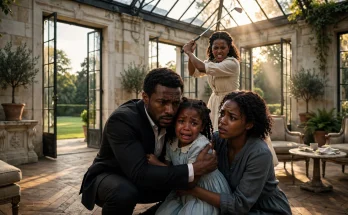
“Your Sister Got The Utility Bills A Few Days Ago And Your Mom’s Loan Is Already Overdue. Why Haven’t You PAID Anything Yet? Want Me To HIT You For Motivation?” Shouted My Dad, Stepping Toward Me. What Happened Next… He Never Expected.
Part 1
The utility bill was lying on the kitchen table when I got home, folded once down the middle like somebody had tried to make it look less ugly.
It was late October, the kind of cold that came in mean and early in western Pennsylvania, and the house had that stale, overheated smell I’d known my whole life—dust from the vents, old coffee cooked down to tar on the burner, fried onions from the night before, and underneath it all that faint sourness of damp carpet that never really goes away. The overhead light above the table flickered every few seconds, buzzing like an angry insect.
My sister, Chloe, was sitting on the counter in leggings and a college sweatshirt she’d stolen from some ex-boyfriend, eating dry cereal out of a mug and scrolling her phone. She looked up just long enough to say, “Mom said don’t touch that.”
I set my work bag down by the chair. “That” had the electric company logo in the corner and FINAL NOTICE stamped in red across the front. I didn’t need to open it to know what it was. The gas bill had come three days ago. The water one came last week. They always came in clusters, like bad luck traveled in packs.
“Did Dad see it?” I asked.
Chloe shrugged without looking at me. “He asked if it was mine. I told him I don’t open old-people mail.”
I stared at her. She was twenty-two and somehow still managed to live like the world owed her snacks and Wi-Fi. “It’s not old-people mail. It’s the lights.”
She popped another handful of cereal into her mouth. “Then maybe the lights should pay themselves.”
That was Chloe. Always joking two inches away from disaster, because disaster somehow never landed on her. It landed on me. If Dad was angry, I had a tone. If money was short, I was selfish. If dinner ran late, I was disrespectful. If Chloe forgot something, she was just being Chloe.
I slipped my thumb under the envelope and pulled out the bill. The balance made my stomach drop even though I’d expected it. Not just overdue. Past due enough for disconnection. I looked at the payment history, and my chest went tight.
There was a payment made last week from my debit card.
I hadn’t made it.
For a second the room seemed to narrow, the buzzing light turning sharper, the kitchen clock ticking louder. I checked the last four digits twice. My card. Again.
“Did Mom use my card?” I asked.
Chloe snorted. “You always ask like it matters which one of them did it.”
That answer told me enough.
I went down the hall and found Mom in the laundry room, standing in front of the dryer with a basket balanced against her hip. She looked tired in a way that had gone past temporary years ago. Her hair was tied back too tight, and there was a little bleach stain on the shoulder of her sweatshirt from work. She worked mornings in the hospital laundry department, eight hours on her feet folding sheets that didn’t belong to her, then came home and folded the rest of her life around my father’s temper.
“Mom,” I said, keeping my voice low. “Who used my card?”
She didn’t turn right away. “What card?”
“My debit card. Don’t do that.”
She shut the dryer with more force than she needed. “Your father said he was borrowing it.”
“He didn’t ask.”
“He said he was going to put the money back.”
I laughed once, and there was no humor in it. “And did that seem likely to you?”
She finally faced me, and guilt flashed through her expression so quickly I almost missed it. “Lena, lower your voice.”
That was her reflex. Not Are you okay? Not I’m sorry. Always lower your voice, like the volume was the danger, not the thing being said.
“He took it from my room?”
“He asked Chloe where your purse was.”
I closed my eyes for a second. “And she told him.”
Mom shifted the basket from one arm to the other. “He was trying to keep the lights on.”
“With my money.”
“He lost another job,” she whispered.
I opened my eyes. “He lost another job because he showed up drunk.”
Her mouth pulled tight. “Don’t start.”
There it was. I hadn’t even raised my voice and already I was the one starting.
I wanted to keep pushing. I wanted to ask about the loan statements I’d seen tucked under the sugar jar last month, about the calls from unknown numbers that made Mom flinch, about why my paychecks always seemed to disappear into a house where nothing ever got fixed. But if I pushed too early, the whole night would ignite before I was ready.
So I changed tactics.
“When is he getting home?”
“Soon.”
That meant any minute. My shoulders tightened automatically.
I went to my room and closed the door. The space was barely mine—same narrow bed from high school, same cheap blinds, same dresser with one drawer that stuck in humid weather. I knelt by the bed and pulled out the plastic storage bin I kept shoved against the wall. Inside were copies of bills, screenshots of bank charges, two photos of bruises I’d taken and never shown anyone, and a manila folder with my birth certificate and passport tucked inside. I’d started collecting things six months ago after Dad slapped me hard enough to split my lip because I “looked smug” when he couldn’t find his truck keys.
At first I told myself it was just to feel less crazy. Proof for me, even if nobody else ever saw it.
Then I started thinking maybe proof was only useful if it was eventually used.
My phone buzzed. A text from Sasha at work.
You okay? You looked weird when you left.
Sasha was one of those people who noticed more than she said. Mid-thirties, sharp eyeliner, practical shoes, and the kind of calm that made you want to confess things in parking lots.
I typed back: Not really.
She answered almost immediately. Want me to call?
I stared at the screen. Through the wall I heard Chloe laughing at something on her phone, then the front porch groaning under heavy steps. Keys hit the door. My pulse kicked hard.
I typed: Maybe later.
The front door slammed.
Dad’s voice rolled through the house before I even heard him take off his coat. “Why is it so damn hot in here? You trying to bankrupt me?”
Then Chloe, syrup-sweet. “Hi, Daddy.”
Then Mom, already nervous. “Dinner’s almost ready.”
Then the sound of his boots in the hallway, the floorboards complaining under each step.
I slid my phone face down on the bed and listened.
He stopped in the kitchen.
Silence.
Paper rustled.
And then his voice came, loud and sharp and ugly with drink. “Lena!”
My stomach turned to ice anyway. Twenty-seven years old and my body still reacted before my mind could catch up.
“Lena!” he shouted again. “Get in here and explain why the hell the power bill looks like this.”
I stood up slowly. In the mirror over the dresser, my face looked calm enough to pass. But my hands were trembling.
I opened the bedroom door, and the smell hit me before I reached the kitchen—beer, sweat, cold air clinging to his coat, the metallic scent of the outside. Dad stood at the table with the bill in one hand and my mother’s silence in the other. Chloe was back on the counter, watching like this was free cable.
He jabbed the paper toward me. “Your sister got the utility bills a few days ago. Why am I seeing this now?”
I looked at Chloe. She looked away.
My father mistook that pause for guilt and took one step closer. “Answer me.”
I could hear the refrigerator humming. I could hear Mom’s spoon clink against the pot on the stove even though she wasn’t stirring anything. I could hear my own heartbeat in my ears.
And I knew before I said a single word that whatever happened next was going to split my life clean in two.
Because tucked halfway under the bill was another envelope I had never seen before, and my mother’s name was on it in thick black letters from a loan company I recognized immediately. The payment due date was today.
I looked from the envelope to my mother’s face, and for the first time, I realized the bills weren’t the whole story. They were just the spark.
And Dad was already reaching for gasoline.
Part 2
I didn’t answer right away, because in my house silence was sometimes the only way to buy yourself three extra seconds.
Dad hated silence. It denied him rhythm. He liked things fast—quick apologies, quick fear, quick surrender. He liked to throw a sentence like a hook and feel somebody jerk on the other end. But I had learned over the years that a pause, if you could survive it, made him show more than he meant to.
He slapped the utility bill against his palm. “I asked you a question.”
I kept my eyes on the loan envelope for one more beat before I looked up at him. “Why are you asking me like I’m the one who spent my rent money?”
The kitchen changed temperature. I swear it did. Even Chloe stopped chewing.
Mom turned from the stove. “Lena.”
Dad blinked, like he hadn’t heard me correctly. Then his face shifted into that crooked half-smile he wore before things went bad. “Want me to hit you for motivation?”
That line. So casual. So practiced. As if violence were just another household tool, hanging there with the oven mitts and the can opener.
I felt my pulse slam once, but something else happened too. Some old, tired part of me just sat down and quit.
Maybe that’s what people mean when they talk about a final straw. It isn’t dramatic while it’s happening. No thunder. No movie music. Just one ordinary cruelty too many, landing on top of a thousand others until the whole rotten stack finally caves.
Mom took one step toward him. “Frank, don’t.”
He waved her off without looking at her. “She’s got a mouth on her because nobody ever shut it.”
My voice came out calmer than I felt. “I paid the bill once already.”
His eyes narrowed.
“With my card,” I added. “The one you took from my room.”
He laughed, but it was thin. “So now I’m stealing from my own family to keep this house running?”
“You said that, not me.”
Chloe slid off the counter. “Oh my God, Lena, why do you always do this when he’s already mad?”
That got me. Not because it hurt. Because it was so absurdly familiar I almost smiled. The order of things in our house had never changed: Dad was weather, Mom was apology, Chloe was survival by alignment, and I was the problem that explained everybody else.
I reached past the bill and picked up the loan envelope with Mom’s name on it. “What is this?”
Mom moved faster than I expected and tried to take it from me. “Nothing.”
The paper crinkled between our hands. Dad’s eyes flicked to it, and there—just for a second—something nervous crossed his face. Not fear exactly. More like irritation that a drawer had opened before he’d arranged what was inside.
I let go of the envelope and looked at my mother. “You took out another loan?”
“No,” Dad said sharply.
Mom said, at the exact same time, “It’s almost paid off.”
That little collision of lies told me more than either answer could have.
I laughed again, quietly this time. “Wow.”
Dad pointed at the hallway. “Go to your room.”
I stared at him. I was not fourteen. I was not even living there as a child. I paid for groceries half the time and my own insurance and, apparently, their utilities. But my body still recognized the command. My spine locked. My shoulders pulled tight. Go to your room. Wait there. Cry there. Heal there. Come back when you’re useful.
And because I hated that my body still belonged to him in those small ways, I did the opposite.
“No.”
The word landed like a plate shattering.
Mom’s hand flew to her mouth. Chloe whispered, “Jesus.”
Dad took one slow step toward me. He was broader than me, taller than me, older in the heavy, thick way some men get, but there was a shakiness in him tonight I had seen more often lately—too much drinking, too much unemployment, too much rage burning through the machine that carried it. His face was flushed, his pupils slightly uneven, his belt unbuckled one loop off center like he’d dressed himself in the dark.
“You think you’re brave because you got a paycheck and an attitude?” he said. “Everything in this house is mine.”
My house. My rules. My money. My family. The vocabulary of a man who owned nothing that wasn’t currently slipping.
I said, “Then why is Mom’s name on the loan?”
The silence after that was so clean it almost rang.
Mom started crying first. Not loud. Just a soft, defeated sound, like air leaking out of something old. Chloe swore under her breath. Dad’s face hardened into something blank and dangerous.
“Give me that envelope.”
I didn’t move.
“Lena,” Mom whispered. “Please.”
I looked at her properly then. Her cheeks were hollower than they’d been in the summer. Her hands were dry and red around the knuckles from hospital detergents. There was a small purple mark near her wrist, half-hidden by her sleeve. Not new. Not old. Just one more thing.
“How much?” I asked her.
She didn’t answer.
Dad lunged—not a full strike, not yet, but fast enough to snatch for the paper. I stepped back on instinct, and the chair legs screeched against the floor. Chloe yelped. The overhead light buzzed louder, and one of the magnets fell off the fridge and snapped onto the tile.
“Don’t test me,” he said.
I could smell the beer on him, bitter and yeasty, mixed with winter air and that sharp skin smell anger seems to have. It flashed me backward for a second: age ten, him smashing a plate because the roast was dry; age sixteen, him gripping my jaw hard enough to leave finger-shaped bruises because I rolled my eyes; age twenty-four, him apologizing at breakfast by pushing toast toward me and asking if I wanted jam.
My hand went to my pocket and found my phone.
He saw the movement. “What’s that?”
“My phone.”
“You recording me?”
Not yet, but the fact that he jumped there first was almost funny.
I looked him dead in the face. “Should I be?”
For the first time all evening, he hesitated.
It was small. Just a beat. But I saw it. The tiny calculation. How loud had he been? What had Chloe heard? What had Mom let slip? Did I actually have anything? Men like my father survive for years on the belief that terror destroys memory. That nobody can prove a pattern if every incident gets scattered into a hundred separate nights.
What they forget is that patterns can be collected.
“I’m not playing games with you,” he said, voice lower now.
“That’s good,” I said. “Because I’m done playing them.”
I took my phone out and unlocked it slowly, right in front of him. The camera app reflected in his eyes before the red recording light even came on.
Mom shook her head hard. “Lena, no.”
Chloe hissed, “Are you insane?”
Maybe. Or maybe sane was the thing I’d been pretending to be in order to survive a house that made no sense.
I hit record.
The kitchen screen on my phone framed all of us badly: the flickering light, the crooked fruit bowl, Dad in his work jacket with one sleeve stained dark at the cuff, Mom by the stove with tears on her chin, Chloe barefoot on cold tile. It looked smaller on camera than it felt in real life. Sadder too.
“Say it again,” I said quietly.
Dad stared at the phone. “Put that away.”
“Say what you just said about hitting me.”
His face changed. Not softer. Not sorry. Just careful.
“I didn’t say anything.”
That was when I knew I’d already won something, even if I hadn’t won enough.
Because men who feel untouchable don’t rewrite themselves in real time.
I kept filming. “Tell them whose card you used.”
He moved so fast then that Mom screamed before I did. He knocked the phone sideways, not out of my hand but enough to send the image spinning. My shoulder slammed into the pantry door. Pain shot down my arm, hot and immediate.
Chloe shouted, “Dad!”
And over all of it, from the counter where I’d dropped the mail, I heard a little electronic chime.
Not my phone.
Mom’s.
A reminder notification had lit up her cracked screen.
Loan payment overdue. Final attempt before collections review.
Dad saw it too.
His face went from rage to something worse.
Panic.
And in that moment, with my shoulder throbbing and my phone still recording from a crooked angle, I understood that the bills were only the outer layer. There was money missing I didn’t know about, debt I hadn’t seen, and some secret tied to my mother’s name that my father would do anything to keep buried.
Then the doorbell rang.
Once, sharp and hard.
And when it rang a second time, nobody in the kitchen breathed.
Part 3
The first ring could have been anybody.
A neighbor returning a casserole dish. A package delivery. Some kid fundraising in the wrong neighborhood. But the second ring was longer, firmer, the kind that carries expectation in it. The kind that says the person outside plans to stay there until somebody answers.
Dad turned toward the front door.
Then he turned back to me.
It happened fast, but I saw all of it—the calculation, the anger, the fear sliding over each other like cards being shuffled. If the person outside was ordinary, he could still pull the night back into shape. Threaten me, shame Mom, get Chloe on his side, make the whole thing feel hysterical by morning. If the person outside wasn’t ordinary, then the shape of the night was already gone.
“Who is that?” he demanded.
I steadied my phone with my good hand. My shoulder was still burning where it hit the pantry, and the pain made everything look too bright. “Open it and find out.”
Mom made a sound like a trapped animal. “Lena, did you call someone?”
Chloe’s eyes snapped to me. “No way.”
I hadn’t meant to do it so early. That was the truth. My original plan, if you could call the loose panicked thing in my head a plan, had been to wait until he crossed a line I could clearly prove. A threat. A shove. Something simple enough for strangers to understand without footnotes. But when I saw the final notice on the electric bill and the loan envelope and realized my debit card had been used again, I’d stepped into the bathroom at work during lunch and made a call with shaking fingers.
Not to 911. Not yet.
To Sasha.
She had listened for less than a minute before saying, in that flat practical tone of hers, “Lena, this is not one of those situations you manage with a color-coded spreadsheet. If he escalates tonight, you call the police. If you freeze, text me the word lamp and I’ll call for you.”
At six thirty-eight, while I sat in my car outside the house trying to convince myself I was overreacting, I had sent her one word.
Lamp.
Then I’d gone inside.
Now, with my father’s face going pale by degrees and the doorbell slicing through the house again, I said, “Maybe somebody finally got tired of hearing this place from the street.”
It was cruel, and I knew it. But something in me had stopped protecting his image. Maybe that was the first real freedom.
Dad took two long strides toward me, and for one wild second I thought he was going to snatch the phone and smash it. Instead he hissed, so low only I could hear, “If you embarrass me in front of this neighborhood, I’ll make the rest of your life hell.”
The old terror moved through me like a remembered song. My hands went cold. My mouth dried out. But there was something different this time. Fear wasn’t the same as obedience anymore.
I lifted the phone higher so it caught his face.
Then I walked past him.
My knees felt unreliable, but I kept moving. The hallway smelled like old wood polish and damp coats. The framed family photo by the door—taken at Ocean City when I was twelve—hung crooked from where someone had bumped it months ago. In the picture Dad had his arm around my shoulders, smiling wide, and anybody looking at it would have thought we were normal. I’d spent years hating that photo because it looked like evidence against me.
The doorbell rang again just as I reached the lock.
“Don’t you dare,” Mom whispered behind me.
My hand was already on the knob.
I opened the door.
Cold air hit my face first, carrying rain and wet leaves and the far-off smell of somebody’s fireplace. Then I saw them: two police officers on the porch, both in dark uniforms slicked with drizzle, one older and broad in the shoulders, the other younger with a jaw that looked too young for the job.
The older one spoke first. “Evening, ma’am. We got a report of a domestic disturbance from this address.”
Behind me, Dad’s voice cracked through the hall. “This is a family matter.”
The younger officer looked past me, not rudely, just carefully. “Sir, we still need to check.”
I don’t remember deciding to say it. I think the words had been waiting longer than I knew.
“I called,” I said.
The rain clicked softly off the porch rail. Somewhere down the block a dog barked and then stopped. The older officer’s expression shifted—not shocked, exactly, but attentive. The kind of attention that makes a room stop being private.
Dad laughed once, sharp and disbelieving. “You called the cops on your own father?”
My throat wanted to close, but I kept my head up. “I called the police on a man who threatened to hit me.”
Mom started crying in earnest then. “Please, officers, it’s a misunderstanding.”
Chloe, from somewhere near the kitchen, said, “Can we not do this in front of the neighbors?”
I almost turned around and laughed in her face. Neighbors. That was the tragedy for her. Not the threat, not the bruises, not the debt or the theft. The neighbors.
The older officer spoke to me, but his eyes kept tracking the movement behind me. “Are you injured?”
“My shoulder,” I said. “He shoved me into the pantry.”
“I did not touch her,” Dad barked.
The younger officer stepped one foot inside, enough to shift the geometry. “Sir, I need you to keep your distance for a moment.”
Dad squared up instinctively. Not a punch stance, not exactly. More that broad territorial pose men use when they think the size of their anger should be enough to settle things. “You don’t get to come in here because my daughter’s throwing a tantrum.”
That word, tantrum, would have worked on me once. When I was little, everything I felt that inconvenienced him became a tantrum. Fear. Crying. Saying no. Wanting a lock on my bedroom door. Wanting him not to call me stupid in front of company. Wanting to keep my tips from the diner job I worked in high school.
But the officers heard it differently than we did. Not as household language. As minimizing. As control.
The older one said, calm and flat, “Sir, step back.”
Mom fluttered toward Dad as if she could talk him down with enough softness. “Frank, please. Please just listen.”
He jerked his arm away from her, not hard enough to knock her down, but enough that she stumbled into the umbrella stand by the door. It clattered over, old umbrellas sliding across the floor like dropped bones.
The younger officer moved fast then. One hand out toward Mom, the other angled toward Dad. “That’s enough.”
Everything became very crisp.
The rain smell from outside. The blue reflection of the patrol car lights washing over the hallway wall. My own breathing loud in my ears. Chloe saying, “Dad, stop,” but sounding annoyed instead of scared, as if she still believed this could be negotiated back into our usual misery.
Dad pointed at me, arm shaking. “She lies. She always lies.”
I held up my phone. “I have video.”
His eyes snapped to it, and I watched the exact second he understood the night had escaped him.
The older officer asked, “Can you show me?”
I nodded.
Dad moved again, maybe to stop me, maybe just from instinct, but the younger officer was already between us. “Hands where I can see them, sir.”
That line changed the room more than the badge had. For the first time in my life, another man was telling my father no and expecting him to obey.
He didn’t obey.
Not immediately.
He shouted, “This is my house!”
And I swear those four words sounded smaller than they ever had before.
I handed my phone to the older officer. On the screen, shaky and slightly crooked, was the kitchen: my father’s face, my voice asking him to say it again, the motion toward me, the jolt, Mom’s scream. It wasn’t perfect. It wasn’t cinematic. But it was enough to make the officer’s mouth flatten.
The younger one said, firmer now, “Sir, turn around.”
Mom grabbed my sleeve so hard her nails bit through the fabric. “Tell them not to do this.”
I looked at her hand on my arm, then at her face. “He did this.”
Dad twisted toward me, red and wet-eyed with rage. “Lena, you ungrateful little—”
The younger officer took his wrist.
What happened next felt both chaotic and weirdly slow. Dad pulling back. The scrape of boots on hardwood. Chloe gasping. Mom pleading. The old family choreography falling apart under fluorescent porch light and two strangers’ trained patience.
When the handcuffs clicked around his wrists, the sound was tiny. Almost delicate.
But I felt it in my chest like a door finally locking from the inside.
Dad looked at me over his shoulder, furious and disbelieving and suddenly older than I had ever seen him. “You’re going to regret this.”
Maybe I should have flinched. Maybe some version of me did, deep down where old habits live.
Instead I heard myself say, “No. I’m going to remember it.”
The officers led him toward the porch. Rain misted into the hallway. Mom followed them a few steps, sobbing, then stopped as if she’d reached the edge of something she didn’t know how to cross. Chloe stood back against the wall, hugging herself, mascara smudged under one eye.
The older officer turned to me before he stepped outside. “We’ll need your full statement. And if there are financial documents you think matter, keep them somewhere safe.”
Financial documents.
The words landed hard.
Because just then, under the blue-red wash of the patrol lights, I saw the floor by the table where everything had fallen during the chaos.
The utility bill.
The loan envelope.
And a second envelope, one I hadn’t noticed before, addressed to my mother from a law office.
Across the front, in block letters, it said:
Notice of intent to repossess collateral.
I stared at it, my heartbeat loud and uneven, because my mother did not own anything worth repossessing.
Unless the collateral wasn’t an object.
Unless it was this house.
And if that was true, then my father hadn’t just been stealing from me.
He’d been burying all of us alive.
Part 4
After the police car pulled away, the house sounded wrong.
For years every room had been tuned to my father—his boots, his throat clearing, the rise and fall of his temper, the television always too loud, cabinet doors slammed for emphasis. Without him there, the silence was not peaceful at first. It was exposed. Like when a refrigerator finally stops humming and you realize how much noise you’d gotten used to.
Mom sat on the couch with both hands pressed over her mouth. Chloe stood in the middle of the living room in her socks, staring at the front window as if Dad might somehow reappear there, pounding on the glass.
I closed the door and locked it.
That simple motion made all three of us look at the bolt.
For one ugly second, I remembered being thirteen and trying to lock my bedroom door after he’d ripped a poster off my wall for having “that trashy singer” on it. He’d taken the screwdriver from the kitchen drawer and removed the lock that night while I stood there crying. “Privacy is for people with their own mortgage,” he had said.
Now the deadbolt slid home with one clean metallic click.
Chloe spoke first. “Are they actually taking him in?”
I turned around slowly. My shoulder ached, deep and hot. “You watched them put him in a car, Chloe. What do you think?”
Her face pinched. “You don’t have to be a bitch.”
I laughed once, sharp and exhausted. “That’s still your first instinct?”
Mom made a weak sound. “Please stop.”
I wanted to stop. God, I wanted one person in that house to say Lena, are you okay? Just once. Instead I walked back to the kitchen table and picked up the law office envelope.
Mom stood so fast the couch cushion wheezed. “Don’t.”
I looked at her over the paper. “Then tell me what this is.”
Her eyes dropped.
That was answer enough.
I slid a finger under the flap and unfolded the letter. Legal language has a smell to it somehow—cold and toner-heavy and final. The words were dense, but not dense enough to hide the truth. Home equity line. Default. Immediate action required. Collateral secured by residence at our address.
The house.
He’d put the house up.
Or she had.
Or both.
I looked at Mom. She was crying again, but quieter now, almost automatically, like the tears had worn grooves and knew where to go.
“How much?” I asked.
She didn’t answer.
“Mom.”
Her lips trembled. “I don’t know the exact number anymore.”
That terrified me more than if she’d said something huge. Exact number anymore meant there had been stages. Applications. Statements. Past due notices. Collections. Maybe refinances. Maybe lies stacked on lies until the math itself got slippery.
Chloe came into the kitchen, arms wrapped around herself. “What do you mean the house?”
I handed her the letter.
She skimmed it once, then again slower. The color drained out of her face. “No. No, Dad said—”
“What did Dad say?” I asked.
She didn’t answer. Which meant he’d said something, probably many things, and none of them sounded good now in the light.
Mom sank into the chair nearest the table. Her wedding ring clicked against the wood when she reached for the edge. “It was supposed to be temporary.”
That sentence belonged in museums of bad decisions.
“Temporary for what?” I said.
“For the truck repairs at first. Then his union dues when he was between contracts. Then…” She swallowed. “Then he said if we could consolidate a few things, we’d catch up.”
“Catch up on what?”
She looked at the utility bill like it had personally insulted her. “Credit cards. Medical. Your sister’s semester when her aid fell through.”
Chloe snapped, “I paid that back.”
Mom’s face flickered in a way that made me think no, she hadn’t, not really.
I leaned both hands on the table to steady myself. “And my card?”
Mom wiped her cheeks with the heel of her palm. “He said he only used it once.”
I let out a breath that turned into a laugh and nearly into a sob. “He’s been using it for months.”
Chloe’s head whipped toward me. “Why didn’t you say anything?”
I looked at her. Really looked. “To who?”
That shut her up.
The kitchen light flickered again. Outside, rain dragged softly along the gutters. Inside, the smell of overcooked spaghetti had gone sweet and stale.
My phone buzzed on the counter. Sasha.
I stepped into the hallway to answer, not because I wanted privacy—there was none in that house—but because I wanted one conversation where I didn’t have to watch somebody else collapse while I spoke.
“Hey,” she said, and her voice was all business. “Are you safe?”
I looked toward the locked front door. “For the next five minutes? Probably.”
“That means no.”
I leaned my head against the wall. The wallpaper there had tiny faded blue flowers on it, and one edge was peeling near the baseboard. I used to trace those flowers with my finger when I was a kid, counting them to stay quiet during fights.
“The police took him,” I said. “But there’s more. A loan against the house, overdue utilities, my card being used. I think it’s been going on for a while.”
Sasha was silent for half a second, and in that half second I heard computer keys on her end, office noise, the small ordered world of other people’s evenings. “Listen to me carefully. Gather your documents tonight. ID, bank info, passport if you have it, pay stubs, anything connected to your money. If there’s any chance he has access to your accounts, you change your passwords now.”
“I know.”
“No. You know in the abstract. I need you to do it.”
There was a firmness in her that didn’t make me defensive. It made me feel held together.
I slid down the wall until I was sitting on the floor. “Okay.”
“And Lena?”
“Yeah?”
“You need to assume tonight is only the visible part.”
I closed my eyes. “I already figured that out.”
When I went back to the kitchen, Chloe was sitting where I’d been standing, staring at the pile of mail like it might rearrange itself into a kinder answer.
Mom was whispering, almost to herself. “He said if I just signed, he’d handle the rest.”
I put my phone down and looked at her. “Signed what?”
She gestured weakly toward the drawer by the fridge. “There are copies.”
Inside the drawer were takeout menus, dead batteries, a flashlight with no back cover, birthday candles, pens without caps, and underneath all that a neat stack of folders held together with two cracked rubber bands.
Nothing in that house had prepared me for neat folders.
Dad was sloppy in obvious ways—socks on the floor, beer cans on the porch, receipts in the truck. But men who live double lives often turn meticulous around the parts that can expose them. I sat at the table and started opening them.
Loan documents. Bank notices. Credit statements.
And one folder labeled, in my father’s blocky handwriting, Lena.
My skin went cold.
Chloe saw my face and reached for it before I could stop her. Inside were photocopies of my driver’s license, old tax forms, a printed screenshot of my direct deposit setup from work, and two credit card applications I had never seen before.
One had been approved.
Not in my father’s name.
In mine.
For a second I could not hear anything. Not the rain, not Chloe swearing, not Mom asking what it was. The room went silent in the particular way it does when your body decides one emergency at a time, please.
Then all the sound came back at once.
“You opened credit in my name?” I said, but I wasn’t asking Mom anymore. I was asking the room, the house, the whole stupid rotten history of it.
Mom stared at the papers and looked honestly confused. “I didn’t know that.”
Chloe whispered, “Holy shit.”
My hands started shaking so hard I had to set the folder down. The edges of the pages were soft from being handled. He had come back to this folder. Added to it. Managed it.
That was the thing about betrayal inside a family. It isn’t one wound. It’s bookkeeping.
I looked at my mother. “How long?”
She shook her head too fast. “I swear, I didn’t know about those cards.”
“How long have you been signing things?”
Her mouth opened and closed.
“How long?”
“Since last spring,” she whispered. “Maybe before. I don’t—I don’t know anymore.”
Last spring. That was when Dad suddenly started insisting he’d handle the mail. When he’d become weirdly interested in whether I was getting paper statements. When he’d asked what my credit score was in that joking voice people use when they’re actually fishing.
I stood up so quickly the chair legs screeched.
“I need air.”
Mom reached toward me. “Lena—”
I stepped back. “No.”
That word felt easier now. Not easy. Easier.
I grabbed the folder, my phone, my keys, and my coat and went out the back door into the cold wet dark.
The yard smelled like mud and dead leaves. Rain needled my face. I stood under the weak porch light with my breath fogging in front of me and opened the approved credit card statement with numb fingers.
Balance: $8,413.27.
Past due.
My name at the top. My father’s spending underneath. Gas stations. Liquor stores. Hardware. Online sports betting. Cash advances.
And the last charge, made two nights ago, was at a pawn shop across town.
I stared at that line until my eyes blurred, because there was only one piece of jewelry missing from the house that my mother still pretended she’d “misplaced.”
Her wedding set.
I looked back at the kitchen window. Mom’s shape was bent over the table. Chloe stood beside her, rigid and stunned, and for the first time in my life my sister looked less spoiled than scared.
Then my phone lit up with a blocked number calling.
I knew before I answered that it was him.
And somehow that wasn’t the worst part.
The worst part was that I also knew he wasn’t calling to apologize.
He was calling because he had just realized what I might have found.
Part 5
I let the phone ring twice before I answered.
Rain tapped on the aluminum awning over the back steps. My fingers were so cold they barely felt like mine. The porch light made the wet grass shine sickly yellow, and somewhere beyond the fence a car rolled past slowly, tires whispering over the street.
I put the phone to my ear and said nothing.
Dad breathed once on the other end, heavy and annoyed. “You think you’re clever?”
The sound of his voice still did things to my body I hated. My stomach tightened. My shoulders drew up. But there was distance in it now too—jail echo in the background, a metallic hollowness, somebody else coughing somewhere far away. He didn’t sound like the center of the world. He sounded like a man in a room he couldn’t control.
“You opened a credit card in my name,” I said.
He let out a short laugh. “So that’s what this is about.”
I almost dropped the phone. That response—so easy, so unsurprised—felt worse than denial. Denial at least pretends a line exists. He had stepped over mine and now talked like I was the one being dramatic about a puddle.
“You committed fraud.”
“Don’t use words you don’t understand.”
My mouth tasted metallic. “I understand my name. I understand eight thousand dollars. I understand a pawn shop charge two nights ago.”
Silence.
Then, “You were living under my roof. I had every right to use family resources to keep this household afloat.”
That sentence was so insane it made me laugh, and the sound frightened me. It came out thin and cracked. “My identity is not a family resource.”
He ignored that. “Put your mother on.”
“No.”
“Lena.”
“No.”
I heard him exhale hard through his nose, the way he always did before his temper turned. “Listen to me carefully. What happened tonight can still be fixed.”
I stared out into the yard. The old swing set was still back there, rusted through and listing to one side, a ghost of the thing Chloe and I used to fight over. “You think this is about tonight?”
“Stop acting smart.”
“Stop acting like this started with a utility bill.”
For a second there was nothing on the line but static and distant movement. Then his voice changed. Less shouting. More dangerous.
“If you go to the police with paperwork you don’t understand, you’ll destroy your mother.”
That got me. Not because I believed him. Because I recognized the move. He had spent my whole life turning harm into burden, making his choices feel like our responsibility to contain. Don’t tell your aunt, it’ll upset your mother. Don’t complain to school, it’ll embarrass the family. Don’t push him when he’s stressed. Don’t make it worse.
As if there were some version of abuse that stayed politely manageable if the women around it learned enough choreography.
“What did Mom sign?” I asked.
He didn’t answer directly. “She knew what was necessary.”
“That’s not what I asked.”
“You think judges care about family debt? About men trying to hold things together while their daughters stab them in the back?”
Men. Daughters. Stab. Back. He couldn’t even talk about theft without making it mythic and masculine.
My voice came out flat. “You pawned her wedding ring.”
His silence was all the confirmation I needed.
When he spoke again, the rage had slipped and something uglier peeked through. Shame, maybe. Or hunger. “It was temporary.”
That phrase again. Temporary. The national anthem of people digging graves with borrowed shovels.
I said, “I’m reporting everything.”
Then I hung up.
My hand was shaking so hard I nearly fumbled the phone into the mud.
The back door opened behind me. Chloe stood there hugging herself in Dad’s old gray hoodie, which on her looked oversized and childish in a way that made me suddenly furious. Not at her exactly. At the years it had taken from both of us in different ways.
“Was that him?” she asked.
“Yes.”
“What did he say?”
“The usual. It’s my fault, your fault, Mom’s fault, the economy’s fault, everybody’s dramatic.”
A tiny unwilling smile flashed over her face and disappeared. She stepped out under the awning beside me. Up close she smelled like vanilla body spray and laundry soap. Her mascara had bled into faint shadows under her eyes.
“I didn’t know,” she said.
I looked at her profile in the porch light. “About which part?”
She swallowed. “Any of it. Not really.”
I wanted to ask how that was possible. How do you not know when you live in the same house, hear the same shouting, see the same missing money? But I also knew the answer. You know just enough to survive your lane. You learn where the blast radius usually lands and keep your body outside it.
She stared into the yard. “He yelled at me too, sometimes.”
I let that sit. Not because I doubted her. Because sometimes people say things like that when they’re not asking for comfort so much as trying to find a doorway back into the room.
“Did he hit you?” I asked.
“No.”
Of course not. Chloe was his mirror project, the pretty one, the easy one, the one he could still imagine reflected well on him. He had used her too, obviously, but differently. Not as a punching bag. As a shield. A witness who could say, He’s not always like that.
She rubbed at the sleeve over her hand. “I just thought… I don’t know. I thought you fought back more. I thought maybe if you didn’t—”
“Finish that sentence,” I said.
She didn’t.
We stood there with the rain and the cold and the swing set leaning crooked in the dark.
Finally she whispered, “I’m sorry.”
I looked at her then. Really looked. My sister with chapped lips and chipped pink nail polish and a face I had spent years resenting for being spared. Except nobody in that house had really been spared. That was the trick. We were just harmed in different currencies.
I said, “I’m not ready to make you feel better.”
She nodded like she deserved that.
Back inside, Mom had spread more papers across the table. Not because she was suddenly brave. Because the secret was out and there was no point hiding the wrappers from the broken dishes.
I sat down opposite her and started sorting.
Utilities.
Loan notices.
Two maxed credit cards in Mom’s name.
One in mine.
A notice from the IRS about underpaid taxes on a contracting job Dad had apparently never reported correctly.
A stack of medical bills from the year he sliced his hand open working on his truck in the driveway and refused to go to urgent care until it got infected.
And then, in the very bottom of the folder, a single-page document from a life insurance company.
My name was on it.
I stared so hard at the page my eyes hurt.
Primary insured: Lena Carter.
Beneficiary: Frank Carter.
Policy amount: $250,000.
Issue date: eleven months ago.
I looked up slowly. “What is this?”
Mom frowned, took the page, and went white. Actually white. The kind where the blood leaves so fast you can see the age in a person all at once.
“Mom.”
Her mouth worked before the sound came. “He said it was one of those work things. Like a protection policy.”
“For me?”
“He said because you lived here and contributed to the house, if anything ever happened—”
“If anything ever happened to me,” I said.
The kitchen smelled suddenly too strong—old tomato sauce, wet wool from our coats, burnt dust from the heater. I had the awful sense that if I breathed too deep, I might throw up.
Chloe reached for the page, read it, and recoiled. “Why would he—”
But I already knew why. Not the full shape of it, not yet. But enough.
Debt changes people. Addiction changes people. Entitlement rots them from the inside until other human beings start looking less like loved ones and more like inventory.
I pushed back from the table. “I’m leaving tonight.”
Mom looked stricken. “Where will you go?”
“Somewhere he doesn’t have a key.”
Her eyes filled again. “Lena, please don’t abandon us.”
That word landed wrong. Abandon. As if all the years I had stayed counted for nothing, and one decision to save myself would become the defining crime.
I stood up. “He abandoned us. Financially, emotionally, legally, every way available. I’m just refusing to go down with him.”
Mom started crying harder. Chloe sat frozen, still holding the insurance paper by one corner like it might stain her.
I went to my room, pulled out the storage bin, and started packing for real this time. Passport. Social Security card. laptop. Chargers. Two pairs of jeans. Work clothes. The silver earrings Dad once called “too flashy.” The folder of photos and screenshots and statements. I changed my banking password. Froze my credit. Emailed myself copies of everything.
By the time I zipped the suitcase, my hands had steadied.
Then I heard voices in the front yard.
Male voices.
One of them familiar.
I went to the window and pulled the blind aside half an inch.
A car I recognized was parked at the curb.
Dad’s cousin Ray stood on our walkway in a camouflage jacket, talking to the same older officer who had taken my statement. Ray had always been one of those men who called everything “family business” right before helping bury it.
Then the officer looked toward the house.
And behind him, on the sidewalk, I saw a woman in a tan coat holding a clipboard and a thick envelope.
She wasn’t with the police.
She was from the bank.
And she was walking to our door at nine-thirty at night for one reason only.
To serve notice.
Part 6
Nobody knocks like someone bringing legal consequences.
Friends hesitate. Neighbors use the bell. Delivery drivers tap quick and leave. But the woman from the bank knocked in three hard, patient beats that carried straight through the walls and into my ribs. Not angry. Not apologetic. Professional.
Mom made a choking sound in the kitchen.
Chloe looked at me from the hallway, eyes wide. “What do we do?”
There was something almost funny about her asking me. After years of being treated like the family disaster, I had somehow become the emergency plan.
Ray’s voice drifted through the front window. “Janet, open up. Let’s talk before this gets out of hand.”
His tone was all fake concern and male confidence, like if the women inside would just calm down, the practical grown-ups could smooth this ugly little misunderstanding into the carpet.
I picked up my suitcase and carried it to the hall. “We do not open the door for Ray.”
Mom stood halfway between the kitchen and the living room, wringing her hands so hard the knuckles blanched. “He’s your father’s cousin.”
“Exactly.”
The bank woman knocked again.
Then she called through the door, clear and calm. “Mrs. Janet Carter? I have documents requiring signature. If you do not wish to open the door, I can leave contact information and note the attempted delivery.”
That voice, more than anything, made it real. Not Dad’s lies. Not the police. Paper. Procedure. A person with a clipboard who had probably done this a hundred times to a hundred other collapsing households.
Mom looked like she might faint.
I walked to the door but kept the chain on. Through the narrow opening I saw the woman up close—mid-forties maybe, hair pinned neatly back despite the rain, tan coat damp at the shoulders, sensible shoes darkened by water. Ray stood a few feet behind her with his baseball cap in his hand, performing concern.
The older officer was still at the curb, speaking into his radio but watching all of us.
“Mrs. Carter?” the woman asked.
“My mother is not discussing anything tonight,” I said.
Her eyes flicked over my face, then the chain, then the suitcase by my leg. She was not stupid. “Understood. I’m required to inform the borrower that failure to respond within the stated window may accelerate legal proceedings.”
Ray stepped toward the porch. “Lena, don’t make this worse. Your daddy’s in a rough spot and everybody’s upset.”
I looked at him. Rain had darkened the brim of his cap, and his boots were leaving damp marks on the concrete. He smelled faintly like cigarette smoke and wet denim, and his face had that same family structure as Dad’s—same jaw, same little dip in the nose. I had hated that resemblance since childhood.
“He opened credit in my name,” I said. “And used Mom to put the house up for debt.”
Ray blinked. That had not been the script he came prepared for.
“Now hold on,” he said. “These things get complicated.”
“No,” I said. “They get criminal.”
The bank woman’s expression didn’t change, but I saw the slight sharpening in her attention. The officer at the curb looked up fully now.
Ray lowered his voice. “You don’t need to throw words like that around. Your dad’s got enough on him.”
“Good.”
The word seemed to hit him in the chest. Men like Ray always counted on women being willing to preserve some soft center of loyalty no matter what had been done to them.
He tried a different angle. “Your mother needs the house.”
I almost laughed. “Then maybe the people who used it like a casino should have thought of that.”
Behind me, Mom whispered, “Lena…”
I kept my eyes on Ray. “If you’re here to help, get a real estate attorney for her, not a speech.”
For a second, something ugly flashed in his face. Not surprise. Resentment. The old family resentment at women who stop playing grateful.
The bank woman handed me a card through the gap. “My direct line is on the back. Mrs. Carter should call in the morning. There may be hardship options, but I cannot discuss account specifics without her authorization.”
I took the card. “Thank you.”
She nodded once and stepped back.
Ray lingered. “Tell your mother your father didn’t mean for any of this.”
That sentence made my skin crawl.
Not because it was false. Because it was the same one Mom had been feeding me since childhood, reheated and passed around again for another generation.
I shut the door in his face.
Mom sank onto the bottom stair and started crying into both hands. Chloe hovered beside her, helpless and pale. I slipped the bank card into my pocket and turned the deadbolt again even though it was already locked.
The officer knocked once more, this time softer. When I opened the door on the chain again, he said, “Ma’am, before I leave, I want to make sure you know how to request an emergency protective order tonight if needed.”
I nodded.
He lowered his voice. “And if there’s financial fraud involved, don’t wait. Report it separately. Different process.”
His eyes flicked toward my suitcase. “You have somewhere to go?”
“Yes.”
“Good.”
When he left, the porch lights from the patrol car washed red-blue over the wet hedges one last time, then disappeared.
The house exhaled.
I turned to Mom. “Get your ID. Any account numbers. Anything with a password written down. Tomorrow morning you call that bank, and after that we go to legal aid.”
She looked up at me like I was speaking another language. “We?”
There it was again—that expectation, half need and half trap. Stay. Fix. Carry. Become the good daughter now that the bad man had briefly been removed.
I set my suitcase upright. “I will help you make calls tomorrow. I am not staying here.”
Her face crumpled. “He’ll be furious.”
I stared at her. “Mom, he already was.”
Chloe sat down two stairs above her, suddenly seeming much younger than twenty-two. “What if he comes back tonight?”
“He won’t,” I said. “Not tonight.”
And if he did, I had already decided I would not be there.
I went back to my room for the last of my things and found one drawer standing slightly open. I was sure I’d closed it. Inside, under a stack of old T-shirts, was a photograph I had never seen before.
Me at maybe six years old, sitting on Dad’s lap in the backyard, both of us smiling at the camera. The edges were bent. On the back, in my mother’s handwriting, were the words: Lena always trusted you.
I sat on the bed with the picture in my hand and a wave of grief hit so suddenly I had to put my head down between my knees.
That was the hidden cost nobody tells you about when you finally stop protecting an abuser. It isn’t just fear or paperwork or the logistics of leaving. It’s mourning every version of the person you kept trying to recover. The father from the photo. The man who taught me to ride a bike in the church parking lot. The one who once brought me orange popsicles when I had strep throat. Small real things, weaponized by memory. Enough tenderness to keep the machinery running.
My phone buzzed again.
Sasha: I’m outside. Take your time, but not too much.
I looked out the window. Her old blue Subaru was at the curb, wipers moving against the rain.
That sight nearly undid me more than anything else.
I tucked the photograph into the folder instead of leaving it behind. Not because I wanted it. Because I needed proof that monsters are rarely born with fangs out. Sometimes they start as men in backyard chairs holding little girls who still believe in them.
When I walked into the hallway with my suitcase, Mom was standing now, arms wrapped around herself. Chloe had changed into sneakers like she might need to run. The kitchen table was still buried in mail and debt and the remains of dinner nobody had eaten.
“I’ll come tomorrow,” I said. “In daylight. We’ll figure out next steps.”
Mom nodded too quickly. “Okay.”
Then, almost in a whisper, “I should have protected you.”
The words hung there. Late. True. Useless and precious all at once.
I looked at her face, really looked, and saw not just the woman who had failed me but the one who had been trained to fail herself first.
“Then start now,” I said. “Tell the truth when they ask.”
Chloe walked me to the front door. Her voice was so low I almost missed it. “Do you hate me?”
I put my hand on the knob. The metal was cold and slick from the damp air coming through the frame.
“I don’t have room for hate tonight,” I said.
It wasn’t forgiveness. It wasn’t absolution. It was all I had.
She nodded, eyes bright.
I stepped out into the rain and pulled my coat tighter. Sasha got out of the Subaru and took one look at my face before coming to grab the suitcase without a word. The street smelled like wet leaves and oil and winter.
As she loaded my bag, I glanced back at the house.
The upstairs light in my room was still on. The kitchen window glowed weak yellow behind Mom’s silhouette. Chloe stood in the doorway, one hand on the frame. From the outside, it looked like any tired suburban home on a wet Thursday night. Nobody driving past would have known it had just split open.
I got in the car.
Sasha waited until we’d turned the corner before she said, “Okay. Give me the short version.”
So I did. The utility bill. The police. The loan. The credit card in my name. The insurance policy. By the time I got to the pawn shop charge, my voice had gone flat from overuse.
Sasha gripped the steering wheel tighter. “He insured you?”
“Yes.”
“Jesus.”
Streetlights slipped across the windshield in pale streaks. I watched familiar blocks turn strange as we left them behind.
Then my phone lit up with an email notification.
Not from Dad.
From my bank.
Subject line: New login attempt detected from an unrecognized device.
I stared at it, blood going cold all over again, because the timestamp was from three minutes ago.
Somebody was in the house.
And somebody was trying to get into my money right now.
Part 7
“Pull over,” I said.
Sasha glanced at me but didn’t ask why. She signaled, turned into the dark parking lot of a closed pharmacy, and idled under a buzzing sign that made everything look tired and green. Rain clicked against the roof. My heartbeat was so loud I almost missed the second notification.
Password reset requested.
Not completed yet.
My hands started moving before my brain caught up. I opened the banking app, changed the password again, turned on every alert I could find, froze the debit card, then froze the account entirely. My fingers slipped twice on the screen because they were shaking.
Sasha killed the engine. “Talk.”
I showed her the phone.
She read the notifications and let out a long breath through her nose. “Was your laptop left behind?”
“No. It’s in the back.”
“Then somebody in that house knows enough personal info to try browser reset.”
“Dad has copies of my tax forms. My license. Everything.”
She stared at the screen another second, then looked at me. “Call the non-emergency line and report attempted account access. Tonight. Create a timestamp. Then tomorrow you call the bank fraud department.”
I nodded, but I didn’t move.
Not because I disagreed. Because I was so tired I could feel the edges of my thoughts going soft, and if I started handling one more adult catastrophe, I was afraid I might crack straight through.
Sasha saw it.
She took my phone gently out of my hand, found the number, and handed it back open on the keypad. “One step.”
That’s how you can tell the difference between someone who wants to rescue you and someone who wants you steady. Rescuers make you smaller. Steady people make the next step visible.
I made the call. Gave my name, address, a short statement, the time of the attempted login. The dispatcher’s voice was kind but detached in the way professional voices have to be. When I hung up, I leaned back against the seat and closed my eyes.
The pharmacy lot smelled faintly like wet asphalt and old cigarettes. Somewhere nearby, a shopping cart bumped lazily against a curb in the wind.
“I keep thinking this has to be the bottom,” I said.
Sasha snorted softly. “I’ve worked around crisis housing for nine years. Never say that until the paperwork is done.”
That made me laugh, and the laugh hurt.
She started the car again. “You’re staying in the apartment above the resource center for a few nights. It’s not glamorous, but it’s secure. Tomorrow we deal with institutions.”
Institutions. The word should have made me nervous. Instead it felt almost luxurious. Judges, banks, police reports, credit bureaus—cold systems, flawed systems, but systems all the same. Better than the swamp logic of family.
The apartment above the resource center was on the second floor of an old brick building downtown, over a nonprofit thrift store that smelled like detergent and donated books. The stairs creaked but the locks were solid. Inside, the space was simple: white walls, beige couch, tiny kitchen, two lamps with warm yellow light, a quilt folded neatly over the arm of a chair. Somebody had left a box of chamomile tea on the counter and a note in blue ink that said, You’re safe here tonight.
I stood in the middle of the living room with my coat still on and nearly burst into tears over the note.
Sasha set my suitcase down by the sofa. “Shower. Tea. Sleep if you can. Tomorrow starts ugly.”
I nodded.
At the door she paused. “Lena?”
“Yeah?”
“You do not owe anyone access tonight. Not your mom. Not your sister. Not him.”
After she left, I locked the door twice and stood listening.
Nothing.
No television roaring in the next room. No footsteps overhead. No Dad opening cabinets too hard for no reason. Just old building quiet, radiator ticking, rain at the windows.
I took the longest shower of my life.
The hot water brought the ache out of my shoulder until I could feel the bruise forming. Purple by morning, I thought automatically. Good for photographs. That realization made me sit down on the closed toilet lid in my towel and laugh again, quietly and brokenly. Even alone, I was already turning pain into evidence.
I made tea. I plugged in my phone. I spread the documents across the small kitchen table and started a list.
Freeze credit — done.
Bank fraud report — in progress.
Police supplement — needed.
Photos of bruise — needed.
Call employer HR — maybe.
Legal aid for Mom — if she cooperates.
Life insurance company — investigate.
Pawn shop — ask for transaction records?
My phone buzzed with messages.
Mom: Please tell me you got there safe.
Chloe: He tried to log into your email from the desktop. I unplugged the Wi-Fi.
Then another from Chloe, thirty seconds later.
Also there’s more stuff in the garage. I think you need to see it before Mom “cleans.”
I stared at that one for a long time.
The garage. Of course.
Every family has a room where truth goes to ferment. Ours was the garage—cold concrete, old paint cans, Christmas decorations, his tools, boxes nobody touched because if you touched them you might have to admit what was in them.
I typed back: Don’t move anything. Take pictures.
She sent three almost immediately.
The first showed shelves cluttered with extension cords and oil bottles. The second was blurrier, taken too fast. The third made my mouth go dry.
On Dad’s workbench, under a dusty tarp Chloe had clearly yanked back in a hurry, sat a stack of opened mail trays. Organized. Sorted. Labeled in black marker.
Mom.
Lena.
Taxes.
Bank.
Collections.
Underneath the trays was a metal lockbox with the lid open.
Inside were cards.
My debit card from last year, which I thought I’d lost.
A replacement debit card from this summer that had “never arrived.”
Two credit cards in my name.
And a little spiral notebook.
I zoomed in on the notebook image until the pixels broke apart, but I could still make out his handwriting.
Dates.
Amounts.
Account numbers.
Due dates.
A ledger.
My father had been running the family like a stolen business.
My phone rang before I could respond. Mom.
I almost let it go to voicemail. Then I answered.
She was crying so hard I could barely make out the words. “He called from the station.”
I sat down slowly at the kitchen table. “What did he say?”
“He said I need to fix this. That if I just tell them you overreacted and he never touched you, they’ll let him come home until court.”
Rage moved through me so clean and bright it felt clarifying. Even now. Even after handcuffs, after police, after exposure, his first instinct was not remorse. Not protection. Return me to the scene.
“What did you say?”
There was a pause. I could hear the old fridge at home humming in the background through the phone, a sound I knew so well it made my chest ache.
“I didn’t answer him,” she whispered.
Something inside me shifted.
Not healed. Not forgiven. Just shifted.
“Good,” I said.
Another pause. Then, quieter, “Chloe found boxes in the garage.”
“I know.”
“How bad is it?”
I looked at the photos again. The trays. The notebook. The cards. “Bad enough that this isn’t just a domestic case anymore.”
Mom made a little frightened sound. “Lena, if he goes to prison—”
I cut her off. “I am not discussing his future before we discuss what he did.”
Silence.
Then, so quietly I almost missed it, “I know.”
It was the closest she had ever come.
After the call, I photographed my shoulder in the bathroom mirror, then emailed the images to myself with timestamps. I uploaded copies of the garage photos to cloud storage and forwarded them to a new folder I named Evidence. The word looked clinical on the screen. That helped.
At midnight, I was still awake on the couch, staring at the ceiling fan turning lazily in the dim lamp light, when another message came through from an unknown number.
You think paperwork will save you? Ask your mother what she signed in March.
No name. No explanation.
But I didn’t need one.
Dad.
I stared at the text until the letters blurred. Ask your mother what she signed in March. That wasn’t a threat exactly. It was bait. A move. There was something in March he thought could still destabilize me if I found it the wrong way.
I opened the folder of photographed documents again and searched dates. March loan renewal. March insurance issue date amendment. March cash advance. March…
Then I found it.
A scanned notarized form with my mother’s signature at the bottom and a title across the top I had missed before because I hadn’t understood what I was looking at.
Limited Power of Attorney.
Granted by Janet Carter.
To Frank Carter.
For financial transactions relating to household assets, dependent records, and listed accounts.
Listed accounts.
My account number was there.
My mother had signed something in March that let him move through my finances with a legal key.
I sat up so fast the blanket slid to the floor.
Because suddenly his confidence made sense. The cards. The transfers. The missing statements. Even the bank login attempts tonight.
He hadn’t just stolen from me in secret.
At some point, on paper, he had convinced my mother to help him authorize it.
And by morning, I was going to have to decide whether saving myself meant turning my mother in too.
Part 8
Morning in the apartment above the resource center smelled like burnt toast and radiator heat.
For a few blurry seconds after I woke up, I didn’t know where I was. Then my shoulder throbbed when I rolled onto it, and memory came back all at once—Dad’s face in the kitchen, the police on the porch, the trays in the garage, the power of attorney form with my account number typed into a neat little box like my life could be itemized.
I sat up on the couch and checked my phone.
No new login attempts.
Three texts from Sasha.
- Coffee downstairs.
- Bring every document.
- Do not decide your mother’s legal fate before you’ve spoken to an attorney.
That last one told me my face must have given me away last night, even over text.
By eight-thirty we were in a conference room at the resource center with burnt coffee, a box of tissues nobody touched, and a volunteer attorney named Miriam Feld who wore gray slacks, red lipstick, and an expression that suggested nonsense bored her on a moral level.
I liked her immediately.
She reviewed the domestic incident report first, then the photos of my shoulder, then the garage images, then the loan notices and the credit card statements. When she got to the life insurance policy, she took her glasses off and rubbed the bridge of her nose.
“Well,” she said finally. “Your father is either spectacularly reckless or more strategic than he appears.”
“Both,” I said.
She gave me a quick sharp look, the kind lawyers give when they’ve just learned something useful about your credibility. “Likely.”
I slid the power of attorney document across to her. “What about my mother?”
Miriam read it twice. The room was so quiet I could hear somebody wheeling a rack of donated clothes downstairs.
“This is limited,” she said. “But it’s broad enough to create real problems. The question is whether she understood what she was signing, whether there was coercion, and whether the bank relied on it in good faith.”
My stomach tightened. “So she helped him.”
Miriam folded her hands. “People living under coercive control often sign things to survive an evening, not because they meaningfully consent to the consequences. The law does not always handle that distinction elegantly.”
That answer irritated me because it was careful. And because it was true.
“I need a less elegant version.”
The corner of her mouth twitched. “The less elegant version is this: you can report every piece of fraud attached to your identity without deciding your mother’s entire moral worth this morning.”
Sasha, leaning against the wall with coffee in hand, said, “Told you.”
I ignored her. “If I report it, could she get charged?”
Miriam didn’t bullshit me. “Possibly. More likely she gets interviewed, pressured, and frightened. Whether she becomes a target depends on facts we don’t yet have.”
I looked down at the papers. My mother’s signature was everywhere. Loopy, hesitant, the pen pressing harder at the end of her last name like she always got tired before she was done.
“I hate that he did this through her.”
Miriam nodded. “That is not an accident.”
Then she tapped the insurance policy. “This worries me more than the debt.”
I looked up. “Because it’s creepy?”
“Because it suggests planning. Financial desperation plus a beneficiary interest in an abused household is an ugly combination.”
The room went colder somehow.
Miriam made a list for me on a legal pad:
- File police supplement with financial evidence.
- Dispute fraudulent credit immediately.
- Notify bank of unauthorized access and questionable POA usage.
- Contact insurer and freeze any policy activity if possible.
- Do not return to residence alone.
- Preserve all communications.
She tore off the page and handed it to me.
Then she said, “If your mother wants help, I’ll speak to her. But I’m not chasing someone who still thinks the fire is a weather pattern.”
That line stayed with me.
By ten-thirty, I was back at the house in daylight with Sasha and a female patrol officer standing by while I collected the rest of my belongings. The street looked offensively normal. Halloween decorations on porches. A leaf blower whining two houses down. Somebody’s golden retriever losing its mind at a squirrel. My old life sitting there in broad daylight like it hadn’t tried to eat me.
Mom opened the door before I knocked. She looked worse in daylight. Gray around the mouth, eyes swollen, hair unwashed and pinned back carelessly. Chloe stood behind her with a cardboard box already in her arms, as if she had finally understood that inaction was just another way of picking a side.
“I called in sick,” Mom said, as though that mattered.
“Good,” I said.
Sasha stayed near the door while the patrol officer stood on the porch making notes. Boundaries. Witnesses. Air.
We worked mostly in silence. Clothes. Laptop cables. Books. The ridiculous cactus mug from my office. The quilt my grandmother had made me. Every object I carried out felt half ordinary and half archaeological, like I was excavating a person I used to be.
In the garage, the lockbox was still open on the workbench.
I photographed everything again with better light.
The spiral notebook was worse up close.
Dad had kept columns in neat block letters:
Lena payday.
Move after deposit.
Cover electric.
Cash app from LC account.
Card replacement mailed 7/12 — intercept.
Intercept.
My skin crawled.
Sasha leaned over my shoulder just enough to read without touching. “That’s intent,” she said.
I photographed every page.
At the bottom of one page, squeezed into the margin beside a list of due dates, were three words in my father’s handwriting:
March POA handled.
Handled.
That was what he called convincing my mother to sign away access to her daughter’s money. Handled.
I was still staring at the page when Chloe said quietly from behind me, “There’s something else.”
She crossed to the metal shelf by the freezer and pulled down an old fishing tackle box. Inside were pawn slips, folded and rubber-banded together. Mom made a broken noise from the doorway.
The wedding rings were there, listed by weight and stone description.
Also Mom’s gold bracelet from Aunt Renee.
Also my laptop from college—the one I thought had been stolen from my car two years ago.
And then, near the bottom, a slip for a silver charm bracelet engraved L.C.
Mine.
I had lost it when I was nineteen. Dad had spent a whole evening helping me look under couch cushions and accusing Chloe’s friends of stealing it.
Chloe covered her mouth. “Oh my God.”
I set the pawn slips down carefully because suddenly my hands were numb. That was the real violence of it sometimes. Not even the big crimes. The petty intimate thefts with their little theater of concern wrapped around them.
Mom sagged against the door frame. “I thought I misplaced so many things.”
I turned to her. “No. He took them.”
She started crying again, but there was something new mixed in with it now. Not just fear. Recognition. The first ugly clean shape of truth.
Good, I thought, and then hated myself a little for thinking it.
By noon we had loaded two carfuls of my things and one banker’s box of evidence. Before I left, I stood in the kitchen one last time. The utility bill was still on the table, now creased and damp at the corner where somebody’s tears or coffee or both had hit it. Funny, how the whole avalanche had started with a piece of mail and a number in red ink.
Mom came in behind me. “Miriam called.”
I turned. “You talked to her?”
“She said I need my own lawyer.”
“You do.”
Mom nodded, twisting a dish towel in her hands. “Lena… if they ask whether I knew about your account…”
There it was. The question under all the questions.
I thought about lying for her. Really, seriously thought about it. Thought about the years of her small kindnesses—a warm washcloth when I was sick, half a sandwich wrapped for my shift, the way she used to rub circles on my back when thunderstorms scared me as a kid. Thought about her being cornered at the kitchen table by a drunk angry husband with papers she didn’t understand.
Then I thought about my father’s ledger. About intercepted cards. About my name typed into insurance and debt and risk like a resource to be mined.
“If they ask,” I said slowly, “I’m telling the truth.”
Mom closed her eyes.
When she opened them, she looked older and straighter at the same time. “Okay.”
I nodded once.
That should have been the end of the conversation.
Instead she said, almost in a whisper, “There’s one more thing from March.”
My whole body stilled. “What?”
She gripped the dish towel tighter. “He made me sign a paper saying you agreed to contribute to household debt if you kept living here.”
I stared at her.
“He said it was just for the bank,” she rushed on. “That it wasn’t real-real, just to show stable income in the household.”
A sound came out of me then, not quite a laugh and not quite a gasp.
“Mom.”
“I know.”
“No, you don’t.” I stepped closer, not to intimidate her but because I needed her to hear the shape of the sentence. “He forged my consent. Through you.”
Tears spilled over again. “I know.”
I looked around the kitchen—at the crooked blinds, the chipped mug by the sink, the dent in the wall near the pantry door, the ordinary stage where every version of our family had been performed badly—and I understood with a horrible clarity that my father had not just been surviving month to month. He had been building an entire legal fiction around my labor and my name.
Then my phone buzzed with a voicemail notification from an unknown number.
Timestamp: twelve minutes ago.
Sasha saw my face. “Play it.”
I hit speaker.
Dad’s voice filled the kitchen, calmer than I had ever heard it when angry, which made it ten times worse.
“Lena. If you go through with the fraud report, I’ll tell them what really happened to Michael.”
The room tilted.
Michael.
Not my father. Not my cousin. Not some lawyer.
Michael Harlan was my ex-fiancé.
And he had been dead for three years.
Part 9
For a second, nobody in the kitchen breathed.
The voicemail ended with a soft click and the faint institutional echo of whatever room Dad was calling from. The kind of quiet that follows a threat when everyone present is still figuring out where it lands.
Sasha was the first to speak. “Who is Michael?”
I didn’t answer right away because I had already left the kitchen in my head. I was back in a hospital hallway three years earlier, staring at a vending machine I couldn’t afford to care about while a nurse with kind eyes explained that there had been too much blood. I remembered the smell first—antiseptic, stale coffee, rain trapped in people’s coats. Then the rest. Michael’s brother sitting with his elbows on his knees. My engagement ring suddenly heavy on my hand. My father arriving late, somehow loud even in a quiet building, and saying, “These things happen,” like Michael had been a delayed package instead of the person I planned to marry.
“Lena,” Sasha said, sharper now.
I blinked. The kitchen came back into focus. Mom was gripping the edge of the counter so hard I thought she might split a nail. Chloe looked between us, confused and scared.
“My ex,” I said. “He died in a car accident.”
“Why would your father say that?” Sasha asked.
Because he knew exactly where to press. Because Michael was the one place in me that never scarred over right. Because grief scrambles memory and abusers love fog.
But underneath those answers was a colder one: because there was something there.
I sat down slowly at the table before my knees made the decision for me. “Dad hated him.”
Mom made a small sound. “Frank said he thought Michael was weak.”
I almost laughed. Weak. Michael had worked twelve-hour shifts as an EMT, came home smelling like rain and latex gloves and diner coffee, and still remembered how I took my eggs. He had wanted to leave town with me. Not dramatically, not as some rescue fantasy. Just move. Save. Build a life where my father didn’t know which shadows belonged to us. Dad had hated that more than he hated Michael himself. Control doesn’t like witnesses, and it likes exits even less.
Sasha pulled out a chair across from me. “Tell me the short version.”
I rubbed my hands over my face. “We were engaged. He died driving home from an overnight shift. Hydroplaned on Route 28. That’s the official story.”
“Official?”
I looked at her. “Dad’s wording.”
Sasha nodded once. “Okay. So we do not spiral into his narrative. We verify.”
That should have calmed me. Instead it made the room tilt again, because verifying meant opening a grave I had spent three years trying to walk around without falling in.
Mom sank into the chair beside me. “There was a fight.”
I turned so hard the chair squeaked against the floor. “What?”
Her face had gone gray. “The day Michael died. At the house. You were at work.”
My mouth dried out completely. “What fight?”
She looked at Chloe, then back at me. “Michael came over while your father was home. He wanted to talk about you moving out sooner than planned.”
I could see it suddenly. Michael in his dark green rain jacket, hands shoved in his pockets to keep from pointing while he was angry. Dad in the kitchen doorway, drunk enough by noon to call it back pain instead of what it was. Two men who were never going to understand each other and both knew it.
“What happened?” I asked.
Mom’s eyes filled. “Frank told him he wasn’t man enough to support a wife. Michael said maybe the reason I looked tired all the time was because I lived with a bully.”
The room held still around us.
“That sounds like Michael,” I whispered.
“He shouldn’t have said it,” Mom whispered back, reflexive even now.
I stared at her until she flinched.
She swallowed. “Your father pushed him.”
The words hit me like a blunt object.
Chloe covered her mouth. Sasha’s expression went flat and very alert.
“You told me Michael was never here that day,” I said.
Mom nodded, crying now. “I know.”
“Dad told me he only called later when he heard about the accident.”
“I know.”
Rage moved through me so hard and clean I had to grip the table to keep from standing up too fast. “What else?”
Mom shook her head too quickly.
“What else, Mom?”
She looked at the floor. “Michael left angry.”
The kitchen was suddenly too bright. The overhead bulb hummed. A truck rattled past outside. Somewhere upstairs a floorboard creaked as the old house settled around its secrets.
“Did Dad touch his car?” I asked.
Mom’s head snapped up. “What?”
“The brakes. Tires. Anything.”
“No!” She looked shocked enough that I believed that part, or wanted to. “No, no. He just—he shoved him. They yelled. Michael left.”
Sasha spoke carefully. “Did Frank go after him?”
Mom hesitated.
That hesitation told me more than a yes would have.
My voice came out strange, thin and shaking. “Did he?”
“He left in the truck maybe ten minutes later,” she whispered. “I thought he was going to cool off.”
Cool off.
I laughed then, because if I didn’t laugh I was going to scream. “Did he follow him?”
“I don’t know.”
“Did you ask?”
She cried harder.
Which meant no. Or yes. Or she knew enough to understand what the question might cost.
I stood up and walked to the sink because I needed something solid in front of me. Outside the kitchen window the backyard looked exactly as it had yesterday—patched grass, rust on the swing set, a plastic flowerpot tipped on its side by the fence. Ordinary things are obscene when placed next to possible murder.
Michael’s accident report. I had read it once, in fragments, while shaking so badly I could barely hold the pages. Wet road. Driver fatigue not ruled out. No evidence of third-party collision. I had not asked for more because there was no more, just the giant ugly stop sign of loss. People die. Cars slide. Grief hardens around whatever story is available.
Now Dad had reopened it with one sentence.
If you go through with the fraud report, I’ll tell them what really happened to Michael.
Not I’ll tell them what I know.
What really happened.
That wording mattered.
I turned back around. “Did he ever mention Michael after that day?”
Mom wiped at her face with shaking fingers. “Sometimes when he was drunk. He’d say you were lucky he didn’t let that boy ruin your life.”
Chloe whispered, “Mom, what the hell?”
Mom looked at her like she had forgotten she was there.
Sasha was already taking notes in her phone. “You need the voicemail saved in multiple places. Email it. Upload it. Then we request the accident report and any existing statement from that day.”
I nodded automatically.
My mind had moved into that cold overfocused place crisis creates. Save voicemail. Back up files. Call Miriam. Call detective? Highway patrol? Michael’s brother?
Michael’s brother.
The thought hit like another bruise. Evan Harlan and I hadn’t spoken in almost two years. Not because of a fight exactly. Because grief had made us bad company for each other. He blamed the weather; I blamed fate; neither of us had room for more. But if Dad followed Michael that day, if there was any witness or detail buried in the old report, Evan might know what I didn’t.
I forwarded the voicemail to three email addresses, uploaded it to cloud storage, and texted Miriam: Need urgent advice. Threat re: ex fiancé’s death.
She called within five minutes.
By the time I explained, she was already in lawyer mode. “Do not accuse him of homicide to anyone yet. But yes, that voicemail changes the landscape. Preserve it. We add it to the existing case file and separately request all records related to the accident. If he’s bluffing, the threat itself is relevant. If he’s not bluffing, we move carefully.”
Carefully. There was that word again. Necessary and infuriating.
When I hung up, Mom was still crying quietly at the table. Chloe was making coffee nobody wanted. Sasha stood by the door, watchful.
I looked at my mother. “If there is anything else you haven’t told me, this is your last easy chance.”
She nodded rapidly through tears. “That’s all. I swear. That’s all I know.”
I believed she believed that.
Which didn’t mean it was enough.
I took my coat off the chair and slipped it on. “I have to go.”
“Where?” Chloe asked.
“To get the report. And talk to someone who loved Michael enough to tell me the truth even if it hurts.”
Mom whispered, “Lena, please don’t make this bigger than it is.”
I laughed in disbelief. “Bigger than what? Financial fraud? Assault? Threats? The possibility that Dad followed my fiancé before he died?”
Her face crumpled. “I meant—”
“I know what you meant.”
That was the problem. I always knew what she meant. Minimize. Survive. Reduce the scale until it fits in the hand. But some things get smaller only when they’re buried.
I walked to the door. Chloe followed me onto the porch.
Cold air hit my face. The afternoon sky was low and white, promising more rain.
“Do you think he killed Michael?” she asked.
I looked at the street, at my father’s empty parking spot, at the neighborhood that had watched us for years and probably called us loud but normal.
“I think,” I said carefully, “that if there’s even a chance he knows something, I’m done protecting him from the question.”
She hugged herself. “If you find out Mom knew more…”
I finished the sentence for her. “Then I still won’t lie.”
She nodded, not because she liked that answer but because she had finally started understanding the world we were in.
As Sasha and I got into the car, my phone buzzed with an incoming text from a number I did know.
Evan Harlan.
I stared at the preview.
He must have seen my missed call from ten minutes earlier.
The message was only one line long.
If this is about the voicemail your father left me two years ago, we need to talk in person.
Part 10
Evan asked me to meet him at the diner off Route 28 where Michael and I used to stop after his overnight shifts.
I almost said no.
Not because I was afraid of Evan. Because grief has geography, and that diner sat in one of mine. Chrome trim, cracked red booths, coffee strong enough to sand wood, the smell of bacon grease trapped in the walls since the nineties. Michael used to slide into the booth across from me in his EMT jacket with his hair still damp from rain and say, “Tell me one thing your family did this week that would get us kicked out of polite society.”
Then I’d tell him, and he’d laugh in that tired soft way that made horror feel briefly survivable.
Now I walked in three years later and the bell over the door gave the same cheerful jingle, which felt obscene.
Evan was already there in a back booth. He had Michael’s eyes but not his softness. Same blue-gray color, different temperature. He’d gotten broader since I last saw him, beard a little rougher, hands scarred from construction work. When he stood up, there was no hug, just a long look that took in my face and decided not to be gentle about it.
“You look like hell,” he said.
“Thanks.”
“You too,” Sasha muttered behind me.
That almost made him smile.
We sat. A waitress poured coffee without asking. It smelled burnt and perfect. Outside the window, traffic hissed over wet pavement.
Evan got right to it. “Your father called me two years ago. Drunk. Middle of the night. Said I should stop talking about Michael’s accident before somebody got hurt.”
My spine went cold. “Why didn’t you tell me?”
His jaw tightened. “Because when I tried to suggest your father was around that day, you shut down and said I was grieving sideways.”
I closed my eyes for a second. He was right. Not exactly in those words, but right enough. Back then I had no room for suspicion. Suspicion would have required energy. Anger. A future. All I had was loss.
“I’m sorry,” I said.
He nodded once like he accepted the apology but wasn’t going to cuddle it.
Then he reached into his jacket and slid a folded paper across the table.
“I requested the full accident report months later,” he said. “There was something weird.”
I unfolded it with fingers that had gone clumsy.
Supplemental witness note. A gas station clerk two miles before the crash site reported seeing Michael’s vehicle leave heading north with a dark pickup accelerating behind it. Driver of pickup described as “male, heavy build.” Partial plate maybe matched my father’s old truck but not enough for formal identification.
I read it twice. Then a third time.
“Why wasn’t this followed up?”
“It was,” Evan said. “Briefly. The trooper wrote that road cameras were inconclusive due to weather and that no collision evidence was found at the scene. Official cause stayed hydroplaning.”
Sasha leaned in. “Could a truck following aggressively force speed or panic without impact?”
Evan nodded. “Sure.”
I looked up. “You think Frank ran him off the road.”
Evan’s expression hardened. “I think your father was obsessed with control, furious that Michael was helping you leave, and stupid enough to drive after him in the rain. Whether he meant to kill him or just scare him doesn’t matter much to a dead man.”
I stared at the report until the printed words blurred. In the booth behind me, somebody laughed too loud at something on their phone. Plates clinked. The coffee machine hissed steam. The world kept doing diner things while my life rearranged itself again.
“There’s more,” Evan said.
Of course there was.
He took out his own phone, tapped once, and set it between us. “Voicemail. Saved it because it was too weird to delete.”
I hit play.
Dad’s voice, unmistakable even through static and slur.
“You tell Lena’s family to keep my name out of that boy’s death. Weather killed him, not me. And if you know what’s good for you, you’ll let her move on.”
The message ended.
For a few seconds I could only hear the hum of the refrigerator case near the pie display and my own pulse in my ears.
Weather killed him, not me.
Not me.
People don’t deny things that no one has accused them of unless the accusation already lives in their head.
Sasha said quietly, “That’s bad.”
Evan looked at me. “I didn’t go to the cops because I had grief and a maybe-truck and a drunk voicemail. Not enough. But when you called this morning and said he left you a threat—yeah. Now maybe we’ve got a pattern.”
I pressed my hands flat on the table because if I didn’t anchor them, I was afraid they’d start shaking and never stop.
My father had perhaps not cut brake lines or staged a murder. Maybe not. But I could see him so clearly now—following Michael in the rain, furious and righteous, wanting to teach him something. Wanting to remind him who had power. Maybe flashing headlights. Maybe riding the bumper. Maybe turning ordinary weather into a weapon.
Intent and outcome are different in court.
Not in grief.
I looked at Evan. “Would you come with me to make the statement?”
“Yes.”
No hesitation.
I almost cried then, not from sadness exactly but from the sharp relief of somebody else being willing to hold the reality still with me.
We went straight from the diner to the state police barracks handling the original accident jurisdiction. The building smelled like floor cleaner and paper and winter coats drying near a heater. Bureaucracy has its own weather.
A detective named Ruiz met with us in a small interview room with beige walls and a table scratched by years of elbows and ring marks from coffee cups. She listened without interrupting while I gave the timeline: domestic incident, financial fraud evidence, voicemail threat, my mother’s statement about the fight, the old witness supplement, Evan’s saved message.
When I finished, she folded her hands and said, “I’m not going to promise you a homicide case out of old weather and ugly men. But I am going to reopen the review.”
That was enough to make my lungs work again.
She took copies of everything. Asked whether Dad had access to weapons. Asked whether he had prior violent incidents. Asked whether I had ever seen him drive recklessly after someone in anger.
Yes, yes, and yes.
By the time we left, the sky had darkened toward evening. Sasha took the front seat of Evan’s truck back to the resource center while I sat in the back staring at wet road lines slipping under us. I felt emptied out and overfull at the same time, which I guess is what trauma really is—too much reality with nowhere to put it.
My phone buzzed around six.
Miriam.
“Good news first,” she said. “Your emergency protective order was granted.”
I closed my eyes. “And the bad news?”
“Your father has retained counsel. His attorney reached out this afternoon proposing an informal family resolution on the financial issues if you decline further criminal complaints.”
I laughed out loud. Evan glanced at me in the mirror.
“Tell them no,” I said.
“Already did. But there’s more. They also floated the idea that your mother may testify you previously consented to household financial sharing.”
Of course they did. Turn the women against each other. It was the family business model.
“What did you tell them?”
“That we’ll be interested in their theory after discovery. And that any future communication goes through me.”
God, I loved that woman.
When we pulled up to the resource center, Sasha looked back at me. “You coming inside?”
“In a minute.”
They left me there with the engine ticking as it cooled.
I sat alone and watched dusk settle over the brick buildings. Across the street, a kid in a puffer jacket dragged a trumpet case up apartment steps. A bus sighed at the corner. Somewhere nearby somebody was making garlic and onions and the smell drifted sweet and homey through the cold.
Homey.
I almost laughed.
My phone buzzed again.
This time it was Mom.
I answered.
She sounded steadier than I expected. “I met with the lawyer.”
“Okay.”
“She said I need to stop protecting Frank.”
I looked out at the streetlights coming on one by one. “Yes.”
A long pause.
Then: “I told her about March. All of it. The papers. The pressure. The way he made me sign after yelling for hours.”
I said nothing. I wanted to trust it, but trust had become expensive.
Mom inhaled shakily. “There’s one more thing I never told you because I was ashamed.”
The old dread rose again, sour and immediate.
“What?”
“The night Michael died,” she whispered, “your father came home with mud all over the truck and a crack in the passenger mirror.”
I gripped the phone so hard my knuckles hurt.
“What did he say happened?”
“He said a branch hit it.”
Outside, a bus pulled away from the curb in a sigh of air and diesel.
I stood very still in the gathering dark, because now we had the witness note, the voicemail, the fight, the pursuit, and damage to the truck on the night of the crash.
Not proof.
Not yet.
But maybe enough for the question to finally stop being buried.
And just as I opened my mouth to tell Mom to call Detective Ruiz immediately, another call came through on the second line.
Detective Ruiz.
Part 11
I switched calls so fast I almost dropped the phone.
“Ruiz,” I said, and my voice came out rough.
Detective Ruiz didn’t waste words. “We executed a search warrant on your father’s truck.”
For one suspended second, all I could hear was the rush of blood in my ears and traffic moving somewhere beyond the resource center parking lot.
“What did you find?”
“Old repair records hidden in the glove compartment. Passenger-side mirror replacement dated two days after Michael Harlan’s crash.”
I closed my eyes.
Ruiz continued, steady and precise. “More important, the mechanic’s handwritten note mentions damage consistent with impact from ‘roadside object or side swipe,’ not a branch. We’re also pulling archived insurance photos.”
I leaned against the cold brick wall outside the building because my knees had turned unreliable again. “So he lied.”
“Yes. And your mother’s statement about mud and mirror damage helps. We’re not done, but this is now formally reopened as a suspicious-death investigation.”
Suspicious death.
Not closure. Not justice. But language with weight in it. Language that could force the past to sit up.
I thanked her, hung up, and called Mom back.
When I told her, she started crying in a way that sounded less like panic and more like surrender. “I should have said it then.”
“Yes,” I said.
That was all. No cushioning.
Because love without truth had already cost too much.
Over the next six weeks, my life turned into paperwork, interviews, and waiting rooms.
There is nothing glamorous about justice. It smells like toner and courthouse coffee and wet wool coats. It sounds like pens clicking and names being called and people clearing their throats before they say things that alter other people’s futures. It is not cinematic. It is administrative. Which, after the chaos I grew up in, started to feel almost holy.
The domestic assault case moved first. Dad’s attorney tried the expected things. Stress. Misunderstanding. Family conflict blown out of proportion by an emotionally volatile adult daughter. My recorded video and the officer testimony made that strategy limp. The financial fraud complaints widened the damage. The ledger from the garage was devastating. So were the intercepted cards and the applications in my name.
Mom, to my astonishment, did not backpedal.
She cried in every meeting. Shook while speaking. Asked for water twice as often as anyone else. But when they asked whether Frank pressured her to sign documents, she said yes. When they asked whether I had authorized use of my accounts, she said no. When they asked whether she feared him, she said yes again, and this time her voice didn’t drop.
Chloe testified too.
Not beautifully. Not bravely in the movie sense. She stumbled and got defensive and admitted she had looked away from things because it was easier. But she also confirmed the shouting, the card theft, the way Dad treated me like the family shock absorber. Truth from people like my sister comes in awkward pieces. It still counts.
As for Michael’s case, Detective Ruiz kept me updated more than she had to. Archived insurance photos showed the truck’s passenger side scraped in a line too low and clean for a branch strike. A retired tow operator remembered Dad calling anonymously a week after the crash asking whether weather investigations could tell if another car had “pushed panic” without touching. A weird question, he said, which was why he remembered it.
None of it gave us a neat murder charge wrapped in ribbon.
But it did something almost as important.
It destroyed Dad’s last refuge, which was ambiguity.
By the time both matters converged in court negotiations, the story he’d lived inside for years—that he was just a hard man under pressure, a provider misunderstood by weak women—had collapsed under the weight of his own records, his own voice, his own habits.
He took a plea on the domestic assault and fraud-related charges to avoid a trial that would have dragged everything into public in even uglier detail. Eighteen months in state custody, restitution orders, no-contact provisions, and separate ongoing review tied to the reopened investigation into Michael’s death. Ruiz was honest: the death case might never become what my grief wanted it to be. The standard was high. Time had passed. Rain destroys a lot.
But the official record now reflected aggressive pursuit, threatening statements, concealed damage, and credible suspicion.
For me, that mattered.
It meant Michael had not simply been reduced to weather.
The day of sentencing, I wore a navy suit and the silver earrings my father once called too flashy. The courthouse smelled like floor wax and old paper. My shoulder had long since healed, but sometimes under stress I still felt a ghost ache there, like memory had nerves.
Dad looked smaller at the defense table. Jail had taken the shine out of his bluster. His face was puffier, his hair grayer at the temples, and his hands—those hands that had pointed, grabbed, slammed doors, intercepted cards, signed papers like other people’s names belonged to him—rested too quietly on the wood.
He looked at me once.
Not with love. Not even with full hatred. More like disbelief that I had remained real after disobedience.
When the judge asked whether I wished to make a statement, I stood.
The room went soft around the edges the way it does when adrenaline narrows everything to a single clear line.
“I don’t want revenge,” I said. “I want the record to reflect reality.”
I heard a pen stop moving somewhere behind me.
“For years, my father relied on two things—that fear would keep me quiet, and that family would make me lie. I’m done offering either.”
Dad’s jaw tightened.
I kept going.
“He stole money, names, choices, safety. He used my mother’s fear, my sister’s denial, and my love for him as cover. And when I finally said enough, he acted like the betrayal was mine. It wasn’t. The betrayal happened first. Over and over.”
The judge watched me with the particular stillness good judges have.
“I will not be reconciling with him. I will not be participating in private healing theater to make anyone more comfortable. Some things do not become forgivable because enough time passes. They become clearer.”
My voice trembled on that last sentence, but it held.
When I sat down, Mom was crying in the row behind me. Chloe stared at the floor. Dad looked straight ahead.
The sentence came down an hour later.
No dramatic outburst. No final movie speech. Just legal language and consequence.
Afterward, in the hallway, Mom reached for my hand and then stopped halfway like she wasn’t sure she’d earned contact. I appreciated that more than if she’d grabbed me.
“I’m filing for divorce,” she said.
I nodded once. “Good.”
“I know that doesn’t fix—”
“No,” I said. “It doesn’t.”
She accepted that.
That was new too.
Over the next year, life became less about surviving and more about building.
I moved into a small apartment with real locks and terrible water pressure and windows that faced west so the late afternoon light turned the kitchen gold. I got promoted at work. I went to therapy twice a week at first, then once. I learned that healing is boring in the best way—sleep routines, boundaries, bills paid on time, groceries that belong only to you, the radical peace of knowing no one will scream if you buy the good coffee.
Mom rented a one-bedroom across town near the hospital. She joined a support group. Sometimes she still started sentences with excuses for him and had to stop herself halfway. But she stopped. That counted.
Chloe moved in with a friend, got a job she actually kept, and once—awkwardly, over tacos—said, “I used to think staying out of it meant I was innocent.”
I said, “It doesn’t.”
She nodded. “I know.”
We are not close in the way TV sisters become close after one season finale. But we are honest, and I’ve learned that honest can be enough.
As for love, it came back slowly and in a form I trusted more because it did not demand collapse first. About ten months after the sentencing, I met Noah at a volunteer tax clinic Miriam guilted me into helping with. He wore cheap reading glasses only when reviewing forms, smelled like cedar soap and printer ink, and never once treated my boundaries like puzzles he was entitled to solve. On our third date, when I flinched at a plate breaking in the restaurant kitchen, he didn’t say “calm down” or “you’re safe” like a line from a script. He just asked, “Want to go somewhere quieter?”
Reader, I nearly loved him on the spot for that.
But the real ending isn’t romance. It’s ownership.
Last week, I stood in my own kitchen—my lease, my mugs, my power bill paid by auto-draft from an account nobody can touch—and opened the mail. Light from the window fell across the counter in clean stripes. The kettle hissed softly. Outside, somebody was mowing a lawn too early on a Saturday.
One envelope was from the district attorney’s office.
Inside was a formal notice: the investigation into Michael’s death remained open under suspicious circumstances, and while no additional charges had yet been filed, the record now permanently reflected my father as a person of investigative interest connected to reckless pursuit prior to the fatal crash.
It wasn’t everything.
It wasn’t the miracle version where the dead sit up and point.
But it was truth with a stamp on it, and sometimes that’s the closest justice comes.
I made tea and stood at the sink looking out at the street. My phone buzzed with a message from Mom asking if I wanted soup on Sunday. Another from Chloe complaining about rent like she had discovered adulthood personally. And one from Noah: Saw a used bookshelf on 5th. Looks like your style.
Ordinary life. The inheritance I had wanted all along.
On the shelf above my desk, I keep the old photograph of me at six on my father’s lap, turned backward in its frame so only the note on the back shows: Lena always trusted you.
I keep it not to remember him kindly, and not to punish myself for that trust.
I keep it because it reminds me that trust is not stupidity. Betrayal belongs to the betrayer.
My father still writes letters sometimes through his attorney, usually full of religion and regret and family language, the kind that asks for forgiveness without ever really naming the damage. I never answer. I never will.
Some doors are not meant to be reopened just because the person on the other side finally got cold.
I paid the electric bill this morning while the tea steeped. The receipt hit my inbox with a cheerful little chime.
And for the first time in my life, that sound didn’t mean dread.
It meant the lights were staying on because I chose it.
Because the house, the money, the truth, the silence—none of it belongs to him anymore.
It belongs to me.
THE END!