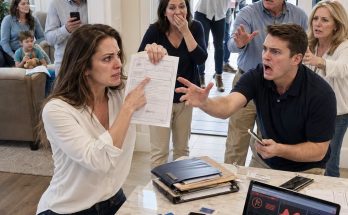
Clueless About Who I Really Am, My Husband Scoffed: “Listen, You Miserable, Frail Woman! The Divorce Papers Are Done! Get The Hell Out Of My House Tomorrow!” But 3 Days Later, He Called Me Frantically…
### Part 1
The night my husband threw me away, the house smelled like cold marble, stale roses, and rain pressing against the windows.
I was lying in the middle of our enormous bed in Lincoln Park, wrapped in a white blanket that felt too heavy for my bones. My skin burned, but my fingers were icy. Every breath scraped through my throat. The ceiling above me blurred in and out like I was looking at it from underwater.
For two days, I had barely moved.
That morning, I had asked Ethan to pick up something from the pharmacy. Nothing complicated. Just anything that would help me get through the fever until I could see my doctor in the morning.
He had looked annoyed even then.
“Fine,” he’d said, tying his watch around his wrist. “Don’t make it dramatic.”
Then he left.
The sun went down. The lights outside came on. The house stayed quiet.
I tried calling him three times. He did not answer once.
Around 10 p.m., the garage door finally rumbled open. For one stupid second, relief softened my chest. I thought he had come back worried. I thought maybe he had felt guilty. I even tried to sit up, one hand gripping the carved wooden bedframe, waiting to hear the rustle of a pharmacy bag.
Instead, the front door slammed.
His footsteps came fast and hard across the first floor, up the stairs, down the hall.
Not worried footsteps.
Angry ones.
The bedroom door burst open so violently it hit the wall behind it. Ethan stood in the doorway wearing a crisp white dress shirt, dark slacks, and the coldest expression I had ever seen on his face.
He was not holding medicine.
He was holding a brown folder.
“Ethan,” I whispered. My voice sounded like sandpaper. “Where were you? I’m really sick.”
He laughed.
Not a nervous laugh. Not a tired laugh.
A laugh that made something inside me go very still.
“Still playing the helpless victim?” he said.
I blinked at him, trying to understand. The bedside lamp cast a yellow glow over his face, and for a moment, I saw the man he used to be. The man who once ate instant noodles with me in a tiny Wicker Park apartment and promised we would build a life together.
Then his mouth twisted.
“I brought you something better than medicine.”
He walked to the bed and threw the folder onto my blanket. The corner struck my wrist.
“Open it,” he said.
My fingers shook so badly I almost dropped it. When I pulled out the papers, the words at the top seemed to tilt sideways.
Petition for Divorce.
For a moment, the room made no sound at all. Even the rain stopped tapping the glass.
“Divorce?” I said.
“Don’t act surprised.” Ethan shoved his hands into his pockets. “You’ve been dead weight for months.”
My chest tightened. “I’ve been sick.”
“You’ve always been weak,” he snapped. “Weak, quiet, dependent. And now you’re a sick, broke little woman expecting me to waste my life taking care of you.”
I stared at him.
He had called me many things over the past year. Lazy. Useless. Embarrassing. But hearing him say broke while standing inside a house he thought he owned made my fevered mind sharpen for one strange second.
He paced near the foot of the bed like he was presenting a quarterly report.
“I’ve handled everything. This house, everything in it, and the SUV will be mine. The accounts are in my name. The paperwork is already moving. You won’t get alimony. You won’t get assets. You won’t get anything.”
I could barely breathe. “Why are you doing this?”
His eyes lit with cruel satisfaction.
“Because when this is over, I’m marrying Isabella.”
The name landed between us like broken glass.
He smiled as if he had just won.
“She understands what kind of man I am. She fits my life. She doesn’t cough all day in bed like a dying stray dog.”
The pain in my throat vanished beneath something colder.
Ethan leaned closer.
“You have until dawn. Get out of my house. Don’t take anything except whatever cheap clothes you can carry.”
I wanted to scream. I wanted to remind him who sat beside him when he lost his first job, who stretched thirty dollars of groceries for a week, who held his head in her lap when he cried because he felt like a failure.
But I had no voice left for begging.
And he mistook my silence for defeat.
“I’m sleeping at Isabella’s tonight,” he said, smoothing his collar. “I refuse to breathe the same air as you.”
Then he left.
The Porsche roared out of the driveway minutes later.
I lay in that bed, shaking so hard my teeth clicked. Tears ran into my hair. The divorce papers rested on my chest like a death notice.
For fifteen minutes, I let myself break.
Then I stopped crying.
Slowly, painfully, I reached under the decorative pillow beside me and found the slim black phone Ethan had never known existed.
It unlocked under my thumb.
Only one contact was saved.
Director Olivia Hayes.
She answered on the first ring.
“Miss Ava?” Her voice was calm, alert. “Is everything all right?”
I looked at the divorce papers in my lap.
Then I said, “Activate the contingency plan.”
On the other end, Olivia went silent.
When she spoke again, her voice had changed completely.
“What did he do?”
I swallowed through the fire in my throat.
“He kicked me out.”
Outside, headlights swept across the bedroom wall.
And for the first time that night, I wondered if Ethan had made a mistake so large even he would not survive it.
### Part 2
Olivia arrived twenty-seven minutes later.
Not in an ambulance with flashing lights. Not with sirens screaming through Lincoln Park and neighbors peeking through curtains.
A matte black Mercedes Sprinter pulled into the driveway without a sound.
By then, I had dragged myself out of bed and into a long beige trench coat. It was ridiculous, maybe even vain, but I refused to leave that house looking like something Ethan had tossed into the garbage.
The hallway lights were dim. The air smelled faintly of lemon polish and the expensive candle Isabella once told Ethan was “too old-lady” when she thought I could not hear her on speakerphone.
The front door opened.
Two private medical staff entered first, moving with quiet precision. Behind them came Olivia Hayes.
She was in her early fifties, tall, silver-haired, and dressed in a dark tailored suit that looked sharper than any blade. She took one look at me and the controlled calm on her face almost cracked.
“Miss Ava,” she said softly.
“I can walk,” I lied.
“No, ma’am,” she replied. “Tonight, you don’t have to prove anything.”
That sentence almost broke me again.
They helped me onto a compact stretcher. One of the medical staff checked my temperature and exchanged a quick look with Olivia. No one panicked, but everyone moved faster.
As they carried me down the staircase, I turned my head.
The living room was immaculate. Cream sofa. Glass coffee table. White orchids. Wedding photo above the fireplace.
Ethan and I smiled from that frame like two people who had no idea betrayal could grow quietly in the corners of a beautiful house.
I remembered our old apartment in Wicker Park. The radiator clanked all winter. The kitchen window stuck when it rained. Ethan used to kiss the top of my head while I made cheap coffee before sunrise.
Back then, we had almost nothing.
Then he lost his first corporate job.
For months, he sank into bitterness. He slept until noon, snapped at me over nothing, and stared at job postings like they were personal insults.
I suggested finding work.
His face darkened.
“No wife of mine is going to embarrass me by working some little job,” he said. “I’m the man. I’ll provide.”
So I stayed home.
At least, that was what he believed.
He never noticed the notebooks hidden under the sink, filled with formulas and ingredient ratios. He never cared that I had a degree I had buried to protect his pride. He never asked why our tiny kitchen smelled like rosehip oil, citrus peel, and warm glass jars at two in the morning.
He called it “playing with lotions.”
I called it survival.
The first serum sold to a woman from my old college network. Then five more. Then thirty. Then a boutique owner in Milwaukee ordered two hundred units after her clients kept asking what she had used on her face.
At night, Ethan heard me typing and sneered.
“Must be nice having nothing real to do.”
I said nothing.
That same night, I closed my first wholesale order.
Months later, I attended a women’s business summit downtown without telling him. I wore a plain navy dress and sat in the back row, clutching samples in a cheap canvas tote.
Olivia Hayes was the keynote speaker.
I waited until the lobby almost emptied before approaching her. My palms were sweating so badly I almost dropped the little glass bottle.
She listened for five minutes.
Then ten.
Then she asked questions nobody had ever thought to ask me.
“What is your production capacity?”
“What is your margin?”
“Who owns the formula?”
I answered all of them.
By the end, she was staring at me as if she had found a diamond under a pile of laundry.
“You are not a hobbyist,” she said. “You are a company waiting to happen.”
That was the first day someone looked at me and saw power.
The stretcher rolled through the open front doors. Cold air hit my face.
Before they loaded me into the van, I looked back one last time at the mansion Ethan had called his.
“Leave everything,” I whispered.
Olivia’s jaw tightened.
“We don’t need anything from this house.”
Inside the vehicle, the equipment glowed blue and white. A doctor spoke quietly while checking my vitals. Olivia sat beside me, one hand resting near mine without touching it.
“You need treatment first,” she said. “Everything else can wait.”
“No,” I rasped. “Nothing waits. Prepare the legal team.”
Olivia’s eyes sharpened.
“When?”
I closed my eyes and saw Ethan’s face when he told me Isabella would replace me.
“Give him three days,” I said.
Olivia leaned closer.
“Three days to do what?”
“To celebrate,” I whispered. “I want him to believe he won.”
The van began moving through the dark Chicago streets.
Olivia looked down at the crumpled divorce papers beside me.
And in her silence, I heard the first door of Ethan’s future closing.
### Part 3
Ethan spent the first morning of his freedom exactly the way I expected him to.
He woke up in Isabella’s Gold Coast penthouse with sunlight pouring through floor-to-ceiling windows and a woman half his age curled against his chest. I knew this because Olivia’s first report arrived on my private tablet while a nurse adjusted the IV near my hand.
I should have felt something sharp.
Jealousy. Grief. Rage.
Instead, I felt a strange, clean emptiness.
Maybe betrayal is like fever. At first, it burns through everything. Then one morning, if you survive it, you wake up cold.
Olivia stood near the window of my private hospital suite, speaking into her phone in a low voice. Northwestern Memorial’s VIP floor was quiet, all soft carpet and muted lights. Outside the glass, Chicago looked silver under the morning clouds.
“He returned to the Lincoln Park property at 10:14 a.m.,” she told me after ending the call. “With Isabella.”
I pictured him unlocking the front door, expecting to find chaos. Maybe torn curtains. Broken dishes. Me collapsed somewhere, begging.
Instead, he found a spotless house.
Before leaving, Olivia’s team had removed every trace of my illness. The broken glass, the damp sheets, the tissues by the bed. Even my modest dresses and old shoes were gone.
Let Ethan wonder how a nearly delirious woman had vanished without leaving a footprint.
“He’s walking through the master bedroom now,” Olivia said. “Confused.”
I almost smiled.
“Good.”
The doctor told me to rest. I nodded and ignored him.
For years, rest had been the cage Ethan assigned me. Rest, Ava. Stay home, Ava. Don’t embarrass me, Ava. Don’t ask questions, Ava.
Now I watched the man who thought he controlled my entire world step into a trap built from his own arrogance.
By noon, Isabella was redecorating a house she did not own.
Olivia’s updates came in fragments.
She hates the sofa.
She wants the bedroom gutted.
She asked whether the marble could be replaced with something “less boring.”
I closed my eyes and smelled the faint antiseptic of the room. My body still ached, but my mind was clearing.
That house had never been my dream. It had been Ethan’s monument to himself. He wanted the neighbors to envy the driveway, the windows, the imported fixtures. I had signed nothing, claimed nothing, and watched him brag about loans he barely understood.
One year earlier, I had discovered the truth by accident.
A late notice. A hidden account. A desperate side investment he had never mentioned.
The mansion and Porsche were not signs of success. They were collateral tied to a corporate credit facility he had mismanaged so badly the bank was preparing to bury him.
I saved him then.
Quietly.
Stupidly.
Olivia’s firm bought the debt before foreclosure could touch him. Ethan never knew. He strutted around the house telling guests Bank of America loved him because he was “a man with serious earning power.”
I let him believe it.
Because some part of me still hoped kindness might wake up the man I married.
It didn’t.
At 4:36 p.m., Ethan tried to order luxury catering for a victory party.
The first card declined.
Then the second.
Then the third.
Olivia read the update from her phone and gave me a look over her glasses.
“He is blaming the bank’s servers.”
“Of course he is.”
“He used a backup account to pay the deposit.”
“How much is left in it?”
“Not enough to matter.”
The medical monitor beside my bed beeped steadily. For the first time in two days, my temperature had dropped. My hands no longer shook.
That evening, while Ethan poured expensive wine for people who laughed too loudly in my living room, a certified legal courier arrived at the front door.
The envelope was thick.
The sender was Miller & Reed LLP.
Inside was a formal notice from AC Enterprises.
Immediate default.
Full balance due.
Three-day grace period.
Collateral subject to seizure: the Lincoln Park estate and Porsche.
Olivia handed me a copy at 9:02 p.m.
I read every line.
My fever was almost gone by then, but when I reached the bottom of the page, a different heat moved through me.
Not weakness.
Not heartbreak.
Power.
“He’ll call the bank first thing in the morning,” Olivia said.
“No,” I replied, setting the paper down. “First, he’ll panic. Then he’ll lie to Isabella. Then he’ll call the bank.”
Olivia studied me.
“You know him that well?”
I looked out at the Chicago skyline.
“I used to love him. That is much worse.”
That night, while Ethan hosted his fake victory party beneath my wedding photo, I slept for six uninterrupted hours.
When I woke before dawn, there was another message waiting.
Ethan has not slept. He is leaving for the bank.
And I knew the second day would hurt him far more than the first.
### Part 4
Ethan’s favorite Bank of America branch opened at 8 a.m.
He was there at 7:58.
Olivia projected the security summary onto the screen in my temporary hospital office. I was well enough to sit upright by then, wrapped in a cream robe, sipping ginger tea that tasted sharp and clean.
“He cut the line,” Olivia said. “Naturally.”
On screen, Ethan stormed through the lobby in yesterday’s wrinkled clothes, waving his metal VIP card like a badge of royalty.
I had seen him do that before.
At restaurants. Hotels. Airport lounges. Anywhere he believed people should recognize him as important.
The problem with borrowed power is that it evaporates the moment the real owner calls it back.
A senior wealth manager met him in a glass office. We did not have audio, but I did not need it. Ethan’s body told the story. Shoulders high. Jaw tight. Finger stabbing at the desk.
Then the manager spoke.
Ethan froze.
Olivia checked her notes.
“They’ve informed him his accounts were swept according to the default provisions.”
“How did he take it?”
“He looks like someone removed the floor beneath him.”
I looked at the steam curling from my tea.
“Good.”
The bank manager would have explained that the bank no longer controlled his loan. The debt had been sold months earlier. The current owner had enforced penalty provisions after a severe contractual breach.
Ethan had signed those documents himself.
He never read them.
He never read anything unless he thought it made him look powerful.
The morality clause had been buried in section eleven. It required the borrower to maintain conduct that would not expose the loan facility or associated corporate entities to reputational harm.
At the time he signed it, Ethan laughed.
“Rich people put nonsense in contracts,” he had told me. “That’s how you know they’re serious.”
He was right about one thing.
We were serious.
At 9:41 a.m., Ethan called Miller & Reed.
Olivia put the call on speaker from the recording our legal team sent over afterward. I sat very still as his voice filled the room.
“This is a mistake,” he snapped. “I’ve never missed a payment.”
The attorney’s voice was smooth and cold.
“There is no mistake, Mr. Cole.”
Ethan used that tone he saved for waiters and assistants.
“Then explain it.”
The attorney did.
Slowly.
Precisely.
He mentioned the morality clause. The evidence. The abandonment of a severely ill spouse. The mistress. The public risk. The immediate default.
For the first time, Ethan did not interrupt.
I imagined him sitting in his Porsche, one hand gripping the wheel, sweat gathering under his collar.
“How do you know about Ava?” he asked at last.
The attorney paused.
“Mr. Cole, your wife is not as alone as you assumed.”
There it was.
The first crack in the wall.
Ethan tried anger next. Then denial. Then bargaining.
When none worked, he did what cowards always do when power leaves them.
He went looking for the person he hurt.
By early afternoon, he was driving toward my parents’ small house outside the city. He had always despised that house. Too old, he said. Too cramped. Too working-class.
My father opened the door before Ethan reached the porch.
Olivia had called ahead, but my parents needed no script. They knew enough. Not everything, but enough to hate him with clean, righteous fury.
My mother stood behind my father, holding the edge of the doorframe with white knuckles.
“Where is Ava?” Ethan demanded.
My father stepped onto the porch.
“You threw my sick daughter out?”
Ethan glanced toward the neighboring houses. Even then, humiliation mattered more to him than guilt.
“It’s complicated.”
My mother laughed once. It was not a happy sound.
“No,” she said. “It’s simple. You are not welcome here.”
Ethan tried to push past them.
My father blocked him.
“If you step one inch closer, I call the police.”
Ethan left with nothing.
By sunset, Isabella had found the legal notice on the kitchen counter.
Olivia’s update came in while I was signing approval for the asset execution order.
“They’re fighting.”
I pictured Isabella’s red nails gripping the paper, her perfect mouth twisting around the words three days and four million dollars.
“She’ll leave him,” I said.
“Not yet,” Olivia replied. “She still thinks he can fix it.”
“She’ll wait until there’s nothing left to steal.”
Olivia smiled faintly.
“You always did understand weak people.”
“No,” I said. “I understand hungry ones.”
That night, Ethan and Isabella slept back-to-back in the bed where he had thrown divorce papers at me. Neither of them slept for long.
The third morning came with white sunlight, quiet streets, and the sound of a doorbell.
At exactly 9:03 a.m., Miller & Reed’s asset execution team stood on the porch.
Ethan did not open the door.
But that house had never really belonged to him.
And locked doors only matter when the person inside still owns the key.
### Part 5
The locksmith took forty-two seconds.
That was what Olivia told me later.
Forty-two seconds for a stranger in a gray work jacket to open the door Ethan had slammed behind him the night he abandoned me.
There was poetry in that, but I was too focused to enjoy it.
I was no longer in the hospital bed. By the third morning, I had been cleared to leave under supervision, and Olivia had moved me to the executive medical suite inside AC Tower. The room looked less like a clinic and more like a quiet hotel apartment above the city, with pale wood floors, clean white walls, and windows that made Chicago seem small.
A doctor still checked on me every hour.
I still felt weak if I stood too quickly.
But weakness was not ownership.
Weakness was not identity.
Ethan had confused the condition of my body with the size of my life.
That was his first mistake.
The live updates came through in clipped messages from the legal team.
Front entry opened.
Occupants present.
Collateral seizure initiated.
Ethan attempted rear exit.
Security intercepted.
I sat near the window, wrapped in a navy shawl, and watched the morning light move over the buildings.
“Read the next one,” I told Olivia.
She glanced at her tablet.
“Mr. Cole is on his knees.”
I closed my eyes.
I had imagined that moment for three days. I thought it might feel triumphant. Like music swelling at the end of a movie.
Instead, it felt quiet.
Final.
“Isabella?” I asked.
“Crying. Loudly.”
“That won’t last.”
Olivia’s mouth twitched.
“No. It appears she has gone upstairs.”
“To pack.”
“Most likely.”
By then, the seizure agents were placing red legal notices on the furniture, the televisions, the artwork, the imported leather chairs Ethan told people he had chosen himself. Outside, a tow truck was backing toward the garage.
The Porsche came out first.
Ethan loved that car more than he had ever loved any person. He polished it on Sundays, posted pictures of it, revved the engine when neighbors walked by.
Watching it dragged out of the garage must have hurt him.
Good.
Some lessons should hurt.
At 9:19 a.m., Isabella came down the staircase with two enormous designer suitcases.
I asked Olivia to read that update twice.
“She prepared luggage?” I said.
“Apparently.”
“Before this morning?”
“Likely.”
I almost laughed.
Of course she had. Isabella had not loved Ethan. She loved access. She loved restaurants where waiters knew his name, salon appointments he paid for, and a mansion she planned to repaint gold.
When the gold peeled off, she ran.
The legal team reported her exact words.
I refuse to live in the gutter with a broke loser.
Ethan had called me dead weight.
Now he knew what it felt like to be dropped.
At 9:31 a.m., security escorted him outside in silk pajamas. He had not even been allowed upstairs to change. The house was sealed behind him. The Porsche was gone. Isabella was gone.
For several minutes, there were no updates.
Then the cheap phone on Olivia’s desk began vibrating.
It was the old phone I had left visible for years. The one Ethan thought was my only phone. The screen was cracked, the case worn at the corners.
His name flashed across it.
Ethan.
Olivia looked at me.
“You don’t have to answer.”
“I know.”
The phone vibrated again.
I remembered the night before our wedding, when Ethan held both my hands and promised he would never make me feel unsafe. I remembered believing him.
Then I remembered him standing over my fevered body, calling me a burden.
I pressed speaker.
“Speak.”
For half a second, there was only breathing.
Then Ethan broke open.
“Ava!” His voice was high, wet, unrecognizable. “Ava, please. You have to help me. They took the house. They took my car. They threw me out. I don’t understand what’s happening.”
I said nothing.
“Ava, please,” he sobbed. “I know this has something to do with you. I know you talked to Olivia. Tell her to stop. I’ll fix everything. I’ll leave Isabella. I’ll come back home.”
Home.
The word was so shameless I looked at Olivia just to confirm she had heard it too.
Her face had gone hard as stone.
“Ethan,” I said calmly, “I need you to understand something.”
“Yes. Anything. I’ll do anything.”
“You no longer have a home to come back to.”
He made a sound like he had been punched.
“Ava, don’t say that.”
I stood slowly. My knees trembled, but I did not sit back down. Through the window, AC Tower cast its long shadow over the street below.
“Look across the street,” I said.
“What?”
“Across the street. Slightly left.”
There was shuffling on his end. Traffic noise. A horn. His uneven breathing.
Then he whispered, “The AC building?”
“Yes,” I said. “I’m on the fortieth floor.”
The line went silent.
“I can see you from here, Ethan.”
Far below, a tiny figure in pale silk sat on the curb outside the life he had mistaken for his own.
“Come inside,” I said. “It’s time you met the woman you divorced.”
### Part 6
When Ethan walked into the lobby of AC Tower, every person within twenty feet stopped pretending not to stare.
He looked worse than I expected.
That surprised me.
I had imagined him frightened, maybe pale, maybe humbled. But the man on the security feed was almost unrecognizable. His silk pajamas were smeared with dirt. His hair was flat and greasy on one side. His face had the gray, swollen look of someone who had cried until his body ran out of water.
The lobby around him made it worse.
AC Tower was built to intimidate.
White marble floors. Black steel columns. A waterfall sliding down a wall of dark stone. Receptionists in tailored jackets. Security guards who looked polite until they needed not to be.
Ethan stood in the center of it all like a stain nobody wanted to touch.
The receptionist asked whether he had an appointment.
He stammered my name.
Not Mrs. Cole.
Not my wife.
Ava.
The receptionist’s expression changed the moment he said it.
“Do you mean Chairwoman Ava?” she asked.
Even through the camera, I saw the word hit him.
Chairwoman.
Olivia entered the lobby from the private corridor with two security officers behind her. She did not hurry. Olivia never hurried unless someone’s life was in danger.
Ethan turned and recognized her.
I watched his face as the pieces began sliding into place.
The woman he had dismissed as my “little church friend” stood in front of him with the authority of a general.
“Mr. Cole,” she said. “Chairwoman Ava is expecting you.”
He followed her because there was nowhere else to go.
I could have let him come upstairs. Part of me wanted that. I wanted him inside the boardroom, beneath the glass and steel, surrounded by evidence.
But another part of me understood something colder.
Ethan had humiliated me in private because he believed I was powerless.
So I would answer him in public.
I took the private elevator down with two bodyguards and Olivia’s chief counsel. My reflection stared back from the brushed steel doors.
For years, I had dressed to disappear. Soft cardigans. Plain dresses. Cheap flats. Nothing that would threaten his ego.
That morning, I wore a sapphire-blue suit made by one of our own designers. My scarf was silk. My heels were sharp enough to announce me before I entered a room.
When the elevator opened, the lobby fell silent.
Not quiet.
Silent.
The kind of silence that has weight.
I stepped out, and every employee nearby straightened. A few bowed their heads slightly. Not out of fear alone, though there was some of that. Out of recognition.
I had built the company they worked for. My mind had shaped the products, the investments, the acquisitions, the strategy. My name had stayed hidden, but my fingerprints were everywhere.
Ethan saw me and stopped breathing.
I walked toward him slowly.
His eyes moved over my suit, my face, the guards, Olivia standing half a step behind me.
I watched him search for the woman he knew.
The fevered wife.
The quiet wife.
The woman who lowered her eyes when he raised his voice.
He did not find her.
“Ava,” he whispered.
“Yes,” I said. “It’s me.”
His knees buckled before I even finished speaking.
He fell onto the marble floor in front of me.
Gasps moved through the lobby like wind through dry leaves. Ethan reached for the hem of my jacket, sobbing so hard the words tangled.
“I’m sorry. I’m so sorry. I was blind. I made a mistake. Please, Ava. Please forgive me. Let me come back. I’ll be good to you. I swear I’ll be your husband again.”
My bodyguards stepped forward.
I raised one hand.
They stopped.
I wanted him to feel the space between what he wanted and what he deserved.
“Stand up,” I said.
He tried. Failed. Tried again. His hands shook as he pushed himself upright.
His face was wet and shining.
I looked at him for a long moment.
This was the man who had stood over me while I was sick and told me I had no value. Now he was begging in the lobby of a company my value had built.
“Do you want mercy?” I asked.
“Yes,” he choked out. “Please.”
“What a pity.”
His eyes widened.
“My corporation does not hire beggars.”
A few people in the lobby looked down quickly, as if the sentence itself had cut the air.
I pulled a silk handkerchief from my bag. Ethan’s face moved with stupid hope, as if he thought I might wipe his tears.
Instead, I brushed the sleeve of my jacket where his fingers had almost touched me.
Then I turned away.
“Director Hayes,” I said, “deal with the trash.”
Olivia inclined her head.
“With pleasure, Chairwoman.”
The elevator doors closed behind me, but before they sealed shut, I heard Ethan make one last broken sound.
Not grief.
Recognition.
He finally understood he had not lost a wife.
He had lost a kingdom.
### Part 7
Olivia did not throw Ethan out immediately.
That would have been too simple.
Instead, she took him to the mezzanine boardroom, the one with glass walls overlooking the lobby below. Everyone could see him sitting there. Everyone could see his stained pajamas, his shaking hands, his ruined face.
I watched from the executive floor through a secure feed while my doctor pretended not to notice.
“You should sit,” he said.
“I am sitting.”
“You are standing.”
I looked down and realized he was right.
My body still had limits. I hated that. So I sat.
On the screen, Olivia placed a folder in front of Ethan. Two attorneys sat beside her. Behind them, a projection wall lit up with the AC Enterprises corporate audit timeline.
Ethan stared at it like a child staring at a foreign language.
Olivia began with five years ago.
She showed the first kitchen workspace. The tiny apartment. The handwritten formulas. The early online orders. The first boutique contracts.
I remembered every detail.
The burn on my thumb from overheated glass.
The labels I printed crooked because I was too tired to line them up.
The smell of lavender, green tea, and cardboard shipping boxes stacked beside our bed.
Ethan remembered none of it because he had never cared to look.
Olivia’s voice was calm through the feed.
“When you mocked your wife for typing at three in the morning, she was fulfilling wholesale orders. When you accused her of wasting time, she was negotiating distribution. When you called her useless, she was building the foundation of this company.”
The screen changed.
Our first production facility.
Then the second.
Then the flagship stores. New York. Los Angeles. Paris. Tokyo. Dubai.
Ethan’s mouth opened slightly.
Olivia let him sit with it.
“AC Enterprises,” she said, “began as Ava Creations. Miss Ava is the founder, principal owner, and supreme chairwoman.”
Ethan covered his face.
I felt no pity.
Pity had nearly ruined me once.
Then Olivia moved to the money.
She showed the account summaries. Not all of them, of course. Just enough to let him understand the size of the universe he had mocked.
My personal monthly net income.
My ownership stake.
The retained corporate earnings.
The investments.
The subsidiaries.
Ethan whispered something.
Olivia leaned forward.
“What was that?”
“I thought she was poor.”
Olivia smiled without warmth.
“No. You needed her to be poor. There is a difference.”
Then came his debt.
The four-million-dollar corporate credit facility. The collateral. The near default one year earlier. The purchase by our private equity subsidiary.
Olivia said the sentence slowly.
“AC Enterprises bought your debt, Mr. Cole. In practical terms, your wife saved your house, your car, your public reputation, and your job status.”
Ethan began crying again.
This time, I looked away.
Not because it moved me.
Because watching a man cry for himself is boring once you recognize the pattern.
The attorneys reviewed the evidence next.
Photographs. Messages. Financial documents. Surveillance from common areas of the house after I suspected he was bringing Isabella there while I was away.
I did not watch the bedroom footage.
I had seen enough months ago.
But I heard Ethan beg them to turn it off when his own voice filled the boardroom speakers.
Listen, you sick, broke little woman.
The words echoed faintly through my office feed.
For one second, my hand tightened around the armrest.
Then I let go.
Olivia slid the final documents across the table.
My expedited divorce petition.
A civil claim.
A sworn confession admitting abandonment, cruelty, adultery, and intentional humiliation.
Ethan asked if he was going to prison.
Olivia told him the truth.
“We considered it.”
He went still.
“But Chairwoman Ava decided prison would give you walls, meals, and structure. She prefers you live with your choices in the open.”
That was not mercy.
It was accuracy.
The confession would protect me from whatever lies he tried to sell later. In exchange, the civil damages would be waived. He would leave with nothing, but nothing more would be demanded from him.
Then Olivia delivered the last blow.
AC Enterprises had acquired controlling interest in his employer that morning.
His division was being restructured.
His position was terminated.
Ethan screamed then.
Not like a man.
Like an animal caught in machinery.
I entered the boardroom after he signed.
The room went quiet.
He looked up at me, empty-eyed.
I placed his original brown divorce folder on the table. The same one he had thrown at me.
Then I tore his petition in half.
Again.
Again.
Again.
The pieces fell across the polished table and onto his lap.
“You wanted to divorce me,” I said. “But you don’t get to write the ending.”
He stared at the torn paper.
“My legal team will handle the real divorce. You will receive nothing from me. Not money. Not property. Not forgiveness.”
His lips trembled.
“Ava…”
“No,” I said. “You lost the right to say my name like it belongs to you.”
I turned to security.
“Take him outside.”
They lifted him by both arms.
He did not fight.
As they dragged him through the lobby, every employee watched the man who had mistaken cruelty for strength.
Then the glass doors opened.
And Ethan was returned to the street with the same amount of mercy he had shown me.
None.
### Part 8
People think revenge is loud.
Sometimes it is.
Sometimes it wears a blue suit, walks across marble, and watches a man collapse beneath the weight of his own stupidity.
But afterward, revenge becomes paperwork.
That was the part nobody tells you.
For the next several weeks, my life smelled like printer ink, legal folders, herbal tea, and rain against the glass of my office. I signed divorce documents. I reviewed statements. I approved press language that never mentioned Ethan by name but somehow made every person in Chicago finance understand exactly who had fallen.
Olivia handled most of it.
She was ruthless, but never messy.
“Clean endings are stronger,” she told me. “Mess invites sympathy.”
I did not want sympathy.
I wanted distance.
The divorce moved quickly because Ethan had signed a confession and because, once his lawyers realized who they were dealing with, they advised him not to contest anything. He tried calling twice from borrowed phones. I did not answer.
The third time, Olivia answered.
Whatever she said, he never called again.
My parents came to see me at AC Tower on a Sunday afternoon. My mother cried when she saw the private elevator. My father stood in my office looking at the skyline, his hands in the pockets of his old brown jacket.
“All this time?” he asked quietly.
I nodded.
“All this time.”
He did not scold me for hiding it. He did not ask why I had protected a man who did not deserve protection.
He only hugged me carefully, like I was still feverish.
That almost undid me.
I had been strong in front of lawyers, doctors, executives, security teams. But my father’s jacket smelled like winter air and hardware-store sawdust, and suddenly I was twenty-six again, wanting someone to tell me I had not wasted my life loving the wrong person.
My mother touched my face.
“Don’t go back,” she whispered.
“I won’t.”
“Not even if he changes.”
I looked at her.
“Especially then.”
Because some apologies are not doors.
They are traps with softer lighting.
News of Ethan’s downfall spread faster than any legal notice we could have filed. He went from arrogant executive to cautionary tale in less than a week. Former friends stopped answering his calls. Professional contacts erased him from group chats. Men who once laughed at his jokes suddenly “barely knew him.”
I did not need to blacklist him.
Cowards blacklist themselves from anything that looks dangerous.
Isabella’s fall was uglier.
At first, she tried to float away from the wreckage as if she had been an innocent passenger. She called wealthy men from old parties. She posted carefully cropped photos from hotel lobbies. She told people Ethan had lied to her too.
Then Miller & Reed served her.
The lawsuit was not about jealousy. I had none left. It was about destruction of property, defamation, and documented participation in humiliating me inside my own home.
She ignored the first notice.
Then she cried.
Then she tried to claim she had nothing.
Olivia’s legal team found the bags, the jewelry, the messages, the videos.
Isabella began selling designer pieces for a fraction of what Ethan had paid. A handbag here. A watch there. Dresses that once hung in my closet after she tried them on laughing.
I should have felt satisfaction.
I mostly felt tired.
Healing, I learned, is not dramatic. It is not a single speech in a lobby. It is waking at 4 a.m. and not reaching for someone who never deserved your hand. It is eating breakfast without flinching at footsteps. It is choosing a new scent for your bedroom because the old one reminds you of fear.
I moved into the penthouse suite above AC Tower temporarily. It had clean lines, warm lights, and no wedding photos.
For the first time in years, silence felt safe.
One month after the divorce finalized, Olivia brought me a sealed envelope.
“No return address,” she said.
I recognized Ethan’s handwriting immediately.
My body reacted before my mind did. My stomach tightened. My fingers cooled.
Olivia watched me.
“Want me to burn it?”
I almost said yes.
Instead, I opened it.
Inside was one page.
Three words were written in uneven black ink.
I am sorry.
No explanation. No demand. No signature.
Just those words.
For a long moment, I felt absolutely nothing.
Then, at the bottom of the page, I noticed something else.
A smear of dirt across the paper.
And for the first time, I wondered where Ethan was sleeping now.
### Part 9
I did not look for Ethan.
That matters.
I did not send people to follow him out of obsession. I did not sit by a window waiting for reports about his misery. I did not need daily proof that karma had found his address.
But Chicago is a city with ears.
And when your company owns buildings, contracts, suppliers, logistics routes, and half the conversations moving through certain boardrooms, information arrives whether you invite it or not.
A former colleague saw Ethan outside a downtown bar, trying to borrow money.
Denied.
A contractor saw him near a train station at dawn, unshaven and asleep against a wall.
Ignored.
A produce distributor who worked with one of our warehouse partners mentioned a new day laborer who looked “like he used to be somebody.”
Olivia did not tell me at first.
I appreciated that.
Then one evening, while we were reviewing expansion documents, she paused too long over a minor logistics report.
“What?” I asked.
“Nothing important.”
“Olivia.”
She sighed and removed her glasses.
“Ethan is working at a wholesale produce market.”
I looked down at the table.
The room smelled like coffee and new paper. Outside, lights were coming on across the city, one window at a time.
“What does he do?”
“Manual loading. Potatoes, onions, crates. Cash by the day.”
I imagined his soft executive hands tearing open. His expensive watch gone. His polished shoes replaced by whatever he could find cheap.
“Is he alive?”
“Yes.”
“Then that is all I need to know.”
Olivia nodded and did not mention him again for two weeks.
The next time his name returned, it was not in a report. It was in a dream.
I was back in the old apartment, mixing serum at the kitchen counter. Ethan stood behind me, younger, gentler, smiling.
“What are you making?” dream-Ethan asked.
I turned around, ready to tell him.
Then his face changed.
Sick, broke little woman.
I woke with my heart pounding.
The penthouse was dark and quiet. No one was there. No one was shouting. No one was standing over me.
Still, I had to turn on every lamp before I could breathe normally.
The next morning, I told Olivia I wanted the Lincoln Park house sold.
She studied me.
“You own it cleanly. You could keep it as an investment.”
“I don’t want rent from a grave.”
Within a month, the estate was sold to a family from Seattle. They had three children, two dogs, and no idea what had happened in the master bedroom.
Good.
Let laughter replace the ghosts.
The Porsche went at auction.
I donated the proceeds from both sales to a foundation supporting women leaving abusive marriages and medical crises. Quietly. No press release. No photo opportunity.
Some acts are cleaner when nobody claps.
As AC Enterprises expanded, my public role became impossible to hide. For years, I had let Olivia stand in front of cameras while I shaped everything behind the curtain. After Ethan, hiding felt less like privacy and more like an old wound.
So I stepped forward.
The first major interview took place in our Chicago headquarters with a financial network broadcasting live. The makeup artist dusted powder along my jaw. The studio lights were hot. My blue suit felt like armor.
The anchor smiled at me from across the small stage.
“Chairwoman Ava, people call you one of the most disciplined founders in American luxury and wellness. What is your secret?”
I thought of the old kitchen.
The fever.
The brown folder.
The dirty smear on Ethan’s apology letter.
“There is no secret,” I said. “I simply refused to stop building, even when the person closest to me insisted I was nothing.”
The anchor leaned forward.
“And what would you say to anyone being underestimated right now?”
I looked directly into the camera.
“Do not beg blind people to see you. Build something so bright they have to look up.”
Later, Olivia told me that line was replayed across half the business internet.
What she did not tell me until afterward was where else it played.
A giant digital billboard in the Loop had carried the live broadcast.
At the same time, Ethan was sitting on a curb nearby with a hot dog in his hand, exhausted from a twelve-hour shift.
He looked up.
And there I was, forty feet high above the street.
Ava.
Not his wife.
Not his burden.
Not his mistake to correct.
A woman he could no longer reach.
Olivia showed me a still image from a traffic camera days later. Ethan sat beneath the billboard, frozen, his cheap meal spilled on the pavement at his feet.
I stared at the image longer than I expected.
Then I closed the file.
“Delete it,” I said.
Olivia did.
Some ruins are not worth revisiting.
### Part 10
Six months after Ethan signed the confession, the final divorce decree arrived.
It came in a plain envelope, almost disappointingly ordinary.
I was in my office when Olivia brought it in. Rain tapped against the windows, soft and steady. On my desk sat product samples for a new botanical line, investor notes, and a small ceramic mug my mother had given me that said, Keep going.
Olivia placed the envelope in front of me.
“That’s it,” she said.
I opened it carefully.
The words were legal, dry, and final.
Marriage dissolved.
No spousal support.
No claim to assets.
No shared property.
No further contact except through counsel.
I read it twice.
Then I waited for something dramatic to happen inside me.
A sob.
A laugh.
A wave of grief.
Nothing came.
Only a slow release, like a door somewhere deep in the house of my body had finally unlocked.
Olivia sat across from me.
“How do you feel?”
“Quiet.”
“That’s not a bad thing.”
“No,” I said. “It’s not.”
For years, Ethan had filled every room with himself. His moods. His pride. His disappointments. His need to be admired. Even when he was not home, the house had waited for him like an anxious dog.
Now there was no waiting.
That evening, I went to my parents’ house for dinner. My mother made roast chicken, mashed potatoes, green beans with too much butter, and peach cobbler because she believed dessert could repair anything if served warm enough.
My father asked no questions about court.
He only handed me a plate and said, “You look better.”
“I am better.”
After dinner, I helped my mother wash dishes. The kitchen window fogged from hot water. The radio played an old country song. For a few minutes, I was not a chairwoman or a wronged wife or a headline.
I was just a daughter drying plates.
My mother glanced at me.
“Do you miss him?”
I answered honestly.
“I miss who I thought he was.”
She nodded slowly.
“That person never existed, baby. Not fully.”
The truth hurt, but gently.
Like pressing a bruise that had already begun to fade.
On the drive back downtown, Chicago glittered under the rain. I passed restaurants where Ethan once corrected waiters, boutiques where Isabella once posed in mirrors, streets where I had walked years ago with samples hidden in my bag.
At a red light, I saw a man pushing a cart of flattened cardboard through the crosswalk. For one strange second, his posture reminded me of Ethan. My chest tightened.
Then he turned.
Not Ethan.
The light changed.
I kept driving.
A week later, Ethan sent one final message through legal counsel.
He requested a meeting.
Not money, his note claimed. Not reconciliation. Just closure.
Olivia’s answer was immediate.
“No.”
My answer took longer.
Not because I considered saying yes.
Because I wanted to understand why part of me still felt responsible for hearing him.
That is the poison of being trained to absorb someone else’s consequences. Even after you escape, a small old voice whispers that their pain is somehow yours to manage.
I wrote my response myself.
Mr. Cole,
There is nothing left to discuss. The marriage is over. The harm is documented. The consequences are yours. Do not contact me again.
Ava
I read it once, then sent it.
My hands did not shake.
That night, I slept without turning on the lamps.
The next morning, AC Enterprises announced our largest international expansion to date. Dubai, Singapore, London, and São Paulo. New factories. New jobs. New scholarship programs for women in science and business.
During the press conference, a reporter asked whether my personal life had influenced my leadership.
I smiled.
“My personal life taught me the difference between being underestimated and being unprepared. I was underestimated. I was never unprepared.”
The room went quiet for one beat.
Then cameras flashed like lightning.
Afterward, Olivia walked beside me down the private hallway.
“You know he’ll see that clip,” she said.
“Good.”
“Does that still matter?”
I thought about it.
“No,” I said. “But truth should travel.”
At the elevator, my phone buzzed.
A message from an unknown number.
For a moment, I thought it was Ethan again.
It wasn’t.
It was a photograph from my father.
My mother had framed the magazine cover with my face on it and hung it in their living room, slightly crooked.
Under it, my father had written:
That’s our girl.
I laughed so hard I cried.
And this time, the tears did not feel like loss.
They felt like coming home.
### Part 11
A year later, I returned to Wicker Park.
Not for Ethan.
For myself.
AC Enterprises had purchased an old brick building three blocks from the apartment where my first formulas were born. We were converting it into a small-business incubator for women founders, especially those with scientific ideas and no wealthy network to carry them.
The building smelled like dust, old wood, and fresh paint. Sunlight fell through tall windows onto unfinished floors. Contractors moved around with ladders and tool belts, calling measurements to one another over the buzz of drills.
I stood in the middle of the future laboratory space and remembered being twenty-nine at a kitchen counter, measuring drops by hand while Ethan slept in the next room.
Back then, I thought secrecy was protection.
Now I knew secrecy can also become a prison if you stay inside too long.
Olivia arrived carrying two coffees.
“Careful,” she said, handing me one. “This one tastes like it was brewed by a man with unresolved anger.”
I took a sip and coughed.
“That is terrible.”
“I warned you.”
We walked through the building together.
There would be workstations along the east wall. A packaging room in the back. A small lecture space upstairs. Mentorship offices. Legal clinics. Financial planning support.
Everything I had needed.
Everything I had learned the hard way.
At the far end of the first floor, a young contractor called Olivia over to review a permit issue. I wandered toward the front windows alone.
Across the street, the old neighborhood had changed and stayed the same. New coffee shop. Same cracked sidewalk. A woman pushing a stroller. A man arguing into a phone near the curb.
Then I saw him.
Ethan.
He was thinner than the last image I had seen. His hair was longer, streaked with gray near the temples. He wore a faded work jacket and carried a plastic grocery bag from a discount store.
He stopped when he saw me through the glass.
For several seconds, neither of us moved.
The street noise seemed to drop away.
I did not feel fear.
That surprised me most.
He looked older than a year should make a man look. Not tragic. Not noble. Just worn down by ordinary consequences.
He did not wave.
He did not come closer.
Maybe he knew security was nearby. Maybe he remembered the legal order. Maybe, finally, shame had taught him manners.
I stepped outside anyway.
Olivia saw me through the window and immediately started toward the door, but I lifted one hand. Not to stop her completely. Just to say I was aware.
Ethan stood on the opposite side of the narrow street.
“Ava,” he said.
My name in his mouth no longer sounded like a claim.
Just a sound.
“Do not come closer,” I said.
He nodded quickly.
“I won’t.”
A bus passed between us, loud and hot and smelling of diesel. When it cleared, he was still there.
“I heard about this place,” he said. His voice was rough. “The incubator.”
I said nothing.
“It’s good,” he added. “What you’re doing.”
A year earlier, those words might have ripped something open in me. I had wanted his approval for so long I mistook hunger for love.
Now his approval landed at my feet like a receipt for something I no longer owned.
“Yes,” I said. “It is.”
He swallowed.
“I’m not asking for anything.”
“Good.”
“I just…” He looked down at his shoes. They were cheap and scuffed. “I just wanted to say I know now. What I did. What I lost. What you were.”
I watched a leaf skid along the curb between us.
“No,” I said.
His face tightened.
“You know what you lost. That is not the same as knowing what you did.”
He closed his eyes.
For once, he did not argue.
“I’m sorry,” he said.
“I know.”
His eyes opened, wet but controlled.
“Can you ever forgive me?”
There it was.
The old trap dressed as a wounded question.
I looked back at the building behind me. At the wet paint, the future lab tables, the women who would stand there one day with ideas nobody had yet applauded.
Then I looked at Ethan.
“No.”
The word was calm.
Clean.
Final.
His mouth trembled, but he nodded.
I turned to go back inside.
Behind me, he said, “I loved you once.”
I paused with my hand on the door.
“No, Ethan,” I said without turning around. “You loved how small I made myself so you could feel tall.”
Then I went inside and closed the door.
Through the glass, I watched him stand there for a moment before walking away down the cracked Wicker Park sidewalk.
For the first time, seeing him leave did not hurt.
It freed up space.
### Part 12
The Ava Creations Founder Lab opened in October.
Chicago gave us one of those bright autumn mornings that makes every tree look expensive. The sidewalk outside the building was lined with gold leaves, white chairs, and women holding notebooks against their chests like shields.
Some came in thrift-store blazers.
Some came in sneakers.
Some brought children because childcare had fallen through and they refused to miss the day.
I loved them immediately.
Not in a sentimental way.
In a furious way.
The kind of love that says, The world has wasted enough of your time. Let’s begin.
My mother sat in the front row beside my father. She wore pearl earrings and kept dabbing her eyes before anyone had even spoken. My father had dressed in his best suit, the one he normally reserved for weddings and funerals. He looked more nervous than I did.
Olivia stood beside the small stage, reviewing the schedule on her tablet.
“You’re up in two minutes,” she said.
“How do I look?”
“Terrifying, but educational.”
“Perfect.”
She smiled.
The ribbon across the entrance was deep blue. Cameras waited. Reporters whispered. A few city officials stood near the side, pretending they understood product development and venture funding.
I stepped to the microphone.
For a moment, I looked at the building instead of the crowd.
Brick walls. New windows. Clean floors. Stainless workstations waiting inside. A place where no woman would have to hide her brilliance in a kitchen because someone else was too fragile to witness it.
“I started with one glass bottle,” I said. “One formula. One idea I was afraid to say out loud.”
The crowd quieted.
“I built in secret because I believed love required me to stay small. I was wrong. Real love does not ask you to disappear. Real partnership does not need your silence as proof of loyalty.”
My mother covered her mouth.
I kept going.
“This lab is for every woman who has been called impractical, dramatic, too ambitious, too late, too old, too poor, too sick, too ordinary. Bring us your idea. Bring us your notes. Bring us the thing you keep hidden in a drawer because someone laughed when you tried to explain it.”
I looked directly into the cameras.
“Do not wait for permission from people invested in your doubt.”
When I cut the ribbon, applause rose so loudly it startled birds from the roof across the street.
Inside, the first cohort walked through the lab with wide eyes. One woman touched a workstation and started crying. Another took photos of everything. A little girl, maybe six years old, tugged her mother’s sleeve and asked, “Can I make something too?”
Her mother laughed.
I crouched down.
“Yes,” I told the girl. “Especially you.”
Later, after the speeches and photos and handshakes, I slipped upstairs to the quiet lecture room. Through the window, I could see the neighborhood moving below.
No Ethan.
No ghosts.
Just traffic, leaves, and people going somewhere.
Olivia joined me with two paper plates of cake.
“This one is edible,” she said. “I checked.”
I took it.
For a while, we ate in silence.
Then Olivia said, “You know, when I first met you, you apologized three times before showing me the samples.”
“I did?”
“You apologized for taking my time. For the packaging. For being nervous.”
I smiled faintly.
“That sounds like me.”
“That was you,” she said. “It is not you anymore.”
I looked down at the cake, then at the women moving through the lab below.
“No,” I said. “It isn’t.”
That evening, after everyone left, I stayed behind alone.
The building settled around me with small creaks and clicks. Outside, the streetlights came on. I walked through the lab one last time, turning off lights as I went.
At the back workstation, someone had left a notebook open.
On the first page, written in careful handwriting, were the words:
I don’t know if I can do this, but I’m here.
I stood there for a long moment, my hand resting on the page.
Then I whispered to the empty room, “That’s enough for the first day.”
When I locked the front door, I caught my reflection in the glass.
Not the abandoned wife.
Not the fevered woman.
Not the secret founder hiding behind someone else’s comfort.
Just me.
And I finally liked who looked back.
### Part 13
Two years after Ethan threw the divorce papers on my sickbed, AC Enterprises held its annual global summit in Chicago.
The event filled an entire convention center downtown. Screens rose three stories high. Translators worked in glass booths. Executives flew in from four continents. New founders from our incubator displayed products in sleek little booths, some nervous, some radiant, all of them standing in rooms they had once been told they did not belong in.
Backstage, I adjusted my cuff and listened to the low thunder of the audience.
Olivia stood beside me.
“Ready?”
I looked at her. “Do you ever get tired of asking me that?”
“No. I enjoy watching you say yes.”
I smiled.
“Yes.”
The stage lights were bright enough to erase the first row. For a second, walking out felt like stepping into sunlight after years underground.
Applause rose.
Not polite applause.
Real applause.
I stood at the podium and let myself hear it.
There had been a time when I thought being loved meant being chosen by one man. Then I thought being powerful meant making that man regret losing me.
Now I knew better.
Power was not revenge.
Power was ownership of your own life after someone tried to write you out of it.
I spoke about expansion. Research. Sustainability. The founder lab. The scholarship fund. The women whose companies had already crossed their first million in revenue.
Then, near the end, I paused.
“There is a question people keep asking me,” I said. “They ask whether success healed me.”
The room went quiet.
“The answer is no. Success gave me options. Healing came from telling the truth, leaving what harmed me, and refusing to mistake late regret for love.”
I saw a few faces change in the audience. Women mostly. Some men too.
“People who benefit from your silence will call your voice cruel. People who profit from your sacrifice will call your boundaries selfish. Let them.”
I smiled.
“Build anyway.”
When I stepped offstage, Olivia was waiting with damp eyes she pretended were allergies.
“That was adequate,” she said.
“Only adequate?”
“Fine. It was historic.”
We laughed.
After the summit, a driver took me through the city toward my apartment. The evening sky over Chicago was violet, the lake dark and restless beyond the buildings.
At a red light near the Loop, I saw a line of day laborers outside a warehouse, waiting for cash envelopes.
For a second, I wondered if Ethan was among them.
Then the car moved, and the thought passed through me without leaving a wound.
I never married again just to prove I could be loved.
I did not rush into someone else’s arms to make the ending softer for strangers.
My life was not empty without a man at the center.
It was spacious.
I traveled. I built. I slept deeply. I bought my parents a house, though my father insisted on paying me one dollar a month in rent “for dignity.” I kept the ugly mug my mother gave me on my desk. I visited the founder lab every Friday when I was in Chicago.
Sometimes women asked me if Ethan ever came back.
I told them the truth.
He tried.
I did not open the door.
Not because I was bitter.
Because I was free.
The last I heard, he still worked irregular jobs around the city. He had no executive title, no mansion, no Porsche, no Isabella. Just his body, his regrets, and the memory of a woman he believed was nothing until the world knew her name.
That was enough.
One winter morning, I stood in my office on the fortieth floor of AC Tower as snow fell over Chicago. The city looked quiet under white rooftops and gray sky. On my desk was a framed photo from the founder lab opening. In it, I was laughing beside Olivia, my parents, and a group of women holding notebooks like treasure.
I picked up the photo and studied my own face.
There was no fear in it.
No apology.
No waiting.
Ethan once told me to leave his house by dawn.
So I did.
I left the house.
I left the marriage.
I left the small version of myself he needed me to be.
And three days later, he learned the truth.
He had not kicked out a poor, sick woman.
He had opened the door for a queen to return to her throne.
THE END!
Disclaimer: Our stories are inspired by real-life events but are carefully rewritten for entertainment. Any resemblance to actual people or situations is purely coincidental.