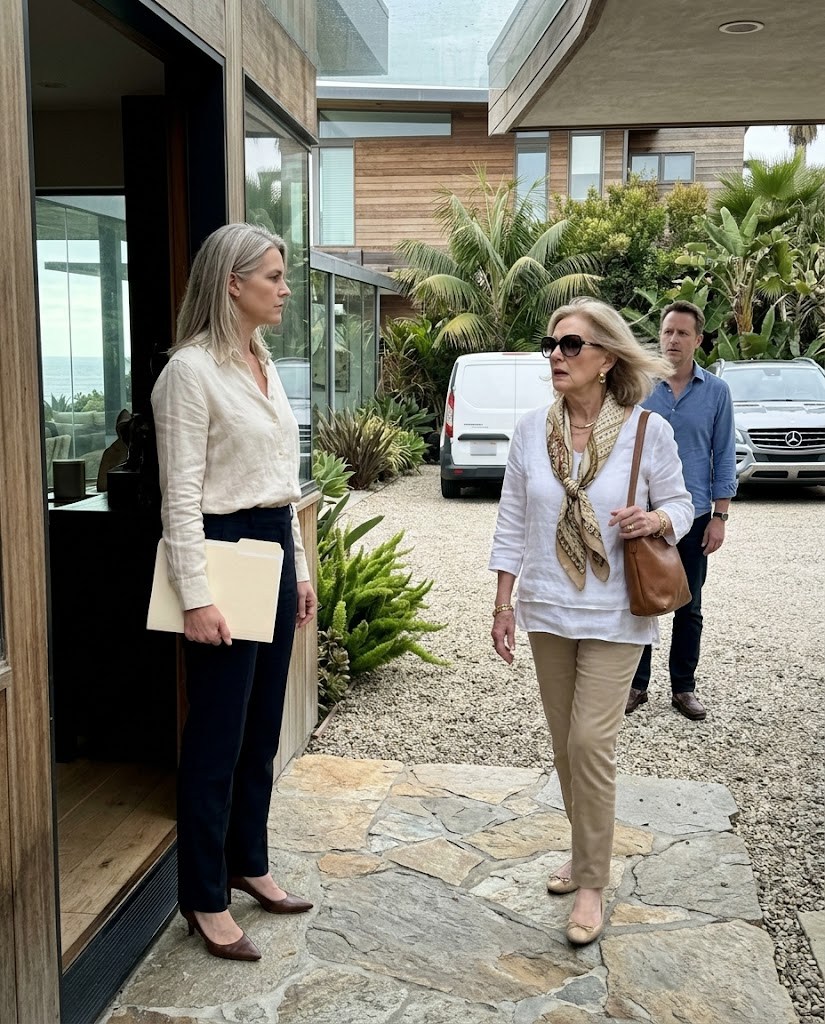
When I opened the door to my Malibu beach house at seven twelve on a bright Saturday morning, my mother-in-law was standing on the front step in oversized sunglasses with a moving van behind her.
She smiled as though she had arrived at a hotel suite she had personally reserved.
“Good,” Eleanor Drexler said.
“You’re ready.”
I was.
Just not in the way she thought.
The day before had been my first full day in the house I had imagined for years, the one place I bought not to impress anyone but to survive myself again.
I had just left a fifteen-year executive career that had taken more from me than I had admitted while I was living it.
There had been planes, conference rooms, client dinners, endless presentations, quarterly goals, and a kind of polished exhaustion that becomes so normal you stop calling it pain.
By the end, I was succeeding publicly and disappearing privately.
The beach house was supposed to interrupt that pattern.
It sat on a quiet rise above the water, all pale wood, wide glass, and clean lines softened by ocean light.
Nothing about it shouted.
That was part of why I loved it.
The floors were limestone, cool under bare feet.
The windows pulled in the Pacific like a moving painting.
The office looked directly toward the horizon.
In the evenings, the whole place turned silver and blue, and for the first time in years I could hear my own thoughts without somebody else’s needs stepping on them.
I purchased it through my LLC, Pacific Current Holdings.
I did that for practical reasons, tax reasons, liability reasons, and one more reason I had learned the hard way during my marriage: if something belonged to me, it needed to belong to me clearly.
Marcus, my husband, had not objected when I bought it.
In fact, he had kissed my temple the day we closed and said, “You earned this, Jo.” At the time I wanted to believe him.
We had been married for fifteen years.
I knew he was passive, conflict-avoidant, too easily influenced by his mother, but I still believed passivity was different from betrayal.
I was wrong.
Eleanor had disliked me from the moment she realized I would never revolve around her son the way she did.
She was not openly explosive.
That would have been easier.
Instead she specialized in elegant injuries.
Compliments with poison hidden inside.
Smiles with hierarchy stitched into the edges.
At one Thanksgiving she praised the cranberry glaze I brought and then added, in front of twelve people, “Josephine may not know how to rest, but at least she knows how to follow instructions.” Everyone laughed because people often laugh when cruelty arrives dressed as wit.
At an anniversary dinner she raised her glass and said, “To Marcus, for supporting a wife with such… demanding ambitions.” The pause before the last two words was deliberate.
Marcus squeezed my knee under the table and told me later not to let his mother get under my skin.
He always said that.
Don’t let her get to you.
Don’t make a scene.
Let it go.
It’s easier.
Every time he said easier, what he meant was easier for him.
There had been one major financial crisis in our marriage three years earlier,
when Marcus invested in a boutique hospitality project with two friends and lost an amount of money he had never fully admitted aloud.
I helped contain the fallout.
I protected our primary accounts, covered legal fees, and insisted on a postnuptial agreement after that—not because I planned to leave, but because I had finally understood something essential about love: trust without structure is an invitation to be erased.
Marcus signed it.
He called it unnecessary.
Then he signed it anyway.
Under that agreement, properties acquired through my company were separate assets.
Occupancy required written authorization from the managing member.
There was nothing romantic about those clauses.
That was precisely why they mattered.
On my first night in the house, I had one glass of sparkling water on the kitchen counter, two half-opened boxes in the living room, and the rare sense that life might actually grow quieter from here.
The sky beyond the deck was black and silver.
Waves moved in slow bands under the moonlight.
I remember thinking that if peace made a sound, it was probably this.
Then Eleanor called.
She did not ask if it was a good time.
“We’re moving in tomorrow,” she said in the cheerful tone of someone announcing flowers had been delivered.
I thought I had misheard her.
“Excuse me?”
“The beach house,” she said.
“Marcus said it’s fine.
I’ll take the main suite.
The guest room gets poor morning light, and my decorator hates low ceilings.
We’ll make it beautiful.
It needs warmth.”
I looked across the room.
Marcus was standing near the island with one hand braced against the counter.
He did not look surprised.
That was the first answer.
“Moving in?” I repeated.
Eleanor let out a tiny laugh, as if I were being difficult for sport.
“Don’t make this awkward, Josephine.
Families share.
You’ll still have plenty of space.
And honestly, you work too much to appreciate a place like that by yourself.”
Marcus rubbed his forehead.
“Mom, maybe we should slow down.”
Eleanor turned to him with immediate command hidden under elegance.
“Marcus, let me handle this.”
He let her.
That silence hit me harder than anything she said.
Then came the sentence that changed my marriage in a way it could never come back from.
“If you don’t like it,” Eleanor added, “you can find somewhere else.”
My own living room.
My first night.
My house.
My hands shook, but only slightly.
Years in corporate negotiations had taught me that the first person to react emotionally usually loses the room.
So I smiled.
Not warmly.
Not weakly.
Just enough.
“Tomorrow will be interesting,” I said.
Eleanor laughed.
Marcus said nothing.
The call ended.
And the version of me who used to plead for decency did not return.
I walked straight to my desk.
The first thing I did was open the purchase file.
Deed, LLC registration, occupancy terms, insurance rider, digital access authorizations.
Everything was exactly as it should be.
The second thing I did was email my attorney, Nadine Ross, who had handled the acquisition and knew every layer of the ownership structure.
Her reply came nine minutes later.
Document everything.
Revoke access.
Do not permit entry.
If Marcus was given guest credentials, terminate them immediately.
I’ll draft notices.
I did.
I logged into the security
system and revoked every temporary access code connected to the property.
Marcus had been given limited guest credentials the week before.
Those were cancelled.
I changed the gate code.
I authorized the overnight locksmith to rekey the side entry and reset the mechanical backup locks.
I contacted the property management service attached to the community and informed them no move-in activity was authorized under my lot number.
Then, while printing the papers Nadine sent over, I noticed something on the wireless printer queue.
Additional pages had synced from Marcus’s tablet.
At first I thought it was an accident.
Then I saw my own address in the message preview.
There was an email thread between Marcus and Eleanor.
It was not new.
It had started more than a week earlier.
Mom, the main suite faces the water.
You’ll love it.
Jo is exhausted.
Once you’re settled, she’ll adjust.
If she resists, push early.
She hates conflict in front of other people.
And one line, written at 11:14 p.m.
the night before, after I had already said tomorrow would be interesting:
Don’t worry.
She always folds if you’re confident enough.
I read it twice, then once more, not because I needed confirmation but because part of me was still catching up to the insult of it.
My husband had not simply failed to protect me.
He had coached his mother on how to remove me from the center of my own life.
I printed the thread.
That became the third folder.
By midnight, the house was silent again.
I made tea.
I stood on the deck and listened to the surf.
There are moments when grief arrives not as tears, but as a hard new clarity.
Mine came under moonlight with salt in the air.
I realized I was not defending a house from invasion.
I was defending myself from the final consequence of years of accommodation.
At dawn I made coffee, dressed in a cream linen blouse and white trousers, and placed three folders on the entry console.
One for Eleanor.
One for Marcus.
One for the truth.
At 6:58 a.m., Nadine texted to confirm all notices were finalized.
At 7:04, the locksmith sent a photo of the completed code reset.
At 7:09, community security confirmed that only my credentials remained active.
At 7:12, the moving van pulled into my driveway.
Eleanor stepped out first, dressed for command.
Marcus followed, looking like a man who had slept badly and hoped the morning might still rescue him.
Two relatives emerged from a second car and stayed near the curb in that particular posture people adopt when they know drama is coming and intend to pretend they hate it.
I opened the door before Eleanor could knock.
“Good,” she said.
“You’re ready.”
“Yes,” I replied.
“I am.”
She moved toward the threshold.
I did not move aside.
The smallest change in her expression was almost satisfying.
For the first time in all the years I had known her, her momentum hit a boundary that did not care what tone she used.
“Josephine,” she said more quietly, “don’t start this in front of everyone.”
“Start what?” I asked.
“Reality?”
Marcus exhaled.
“Jo, can we do this privately?”
I looked at him.
“You surrendered private when you let your mother schedule my displacement.”
Then I
picked up the first folder and handed it to Eleanor.
Her smile lasted until the second page.
The deed named Pacific Current Holdings, LLC.
The registration named me as sole managing member.
The occupancy clause stated, in plain language, that no person could reside on the property without written authorization from the managing member.
There was no written authorization.
“This is ridiculous,” Eleanor snapped.
“I’m family.”
“You’re uninvited,” I said.
Her head jerked up.
She was not accustomed to blunt answers.
Marcus tried again.
“Jo, enough.”
I handed him the second folder.
He looked down and went still.
On top was the postnuptial agreement he had signed.
Below that was a formal notice revoking his guest authorization and access rights to the property.
Below that was confirmation that the locks, gate code, and entry credentials had been changed at sunrise.
The moving van driver, who had been pretending not to listen, slowly closed the back door.
“Are you seriously locking me out?” Marcus asked.
“I already did,” I said.
Color drained from his face.
Eleanor turned on him.
“Marcus, what is this?”
He said the one thing weak men always say when the structure they relied on finally stops bending.
“Jo, you’re overreacting.”
I almost laughed.
Instead I picked up the third folder.
“This,” I said, handing it to Eleanor, “is why I am not.”
She opened it impatiently.
Then she read.
The first page was her own email to Marcus discussing the main suite and telling him I would “be more manageable” once she was established in the house.
The second page contained his replies.
The third included the line that changed her expression from outrage to something uglier.
If she resists, push early.
She folds when the room is against her.
Eleanor’s mouth parted.
Marcus stepped forward.
“Mom, give me that.”
She didn’t.
She kept reading until she reached the line where he had written:
Once you’re in, she’ll either adapt or leave.
That place is too big for one woman anyway.
For one suspended second, nobody spoke.
The ocean moved behind them.
A gull cried somewhere over the bluff.
One of the relatives looked down at her shoes.
Eleanor lowered the papers slowly.
“You told me,” she said to Marcus, “that she invited us to discuss a family arrangement.”
“I said we could make it happen,” he snapped.
“That is not what you told me.”
And there it was—the tiny crack inside the alliance that had arrived so confidently at my front door.
Marcus turned back to me.
“You printed private messages?”
“They stopped being private when they became a plan to remove me from my own home.”
He took a step closer.
“This is still my marriage.”
“No,” I said.
“This is the end of the part where you benefit from my patience.”
Nadine had prepared one more document in case the morning became exactly what it had become.
I set it on top of Marcus’s folder.
A notice of intent to file for legal separation, effective immediately, based on attempted unlawful occupancy, financial misrepresentation, and breach of the postnuptial agreement.
He stared at it.
“You talked to a lawyer?”
“I talked to one years ago,” I said.
“I just finally stopped hoping I would never need her.”
Eleanor recovered enough to reach for superiority again.
“This is disgusting.
Families do not treat each other this way.”
I held her gaze.
“Families do not arrive with movers to take a widow’s posture around a living woman’s life.”
“I am not a widow.”
“No,” I said.
“You’re a guest who mistook herself for an owner.”
The van driver cleared his throat softly and looked toward Marcus.
“Sir, should we unload or not?”
“No,” I answered before Marcus could.
“Nothing is entering this property.
Any attempt to unload will be documented as trespass.”
The driver nodded once.
He had no interest in becoming part of a family war wrapped in paperwork.
Eleanor’s relatives quietly began retreating toward their car.
She looked from the house to Marcus to the papers in her hand, and for the first time I saw something close to uncertainty in her face.
Not remorse.
Something more practical than that.
Embarrassment.
She had come expecting control.
Instead she had found evidence.
Marcus made one last attempt to salvage authority.
“Jo, don’t do this because of one misunderstanding.”
I looked at him and felt a kind of calm I had never felt in our marriage.
“Eleanor trying to move into my home is not the misunderstanding,” I said.
“Believing I would keep absorbing it is.”
Then I stepped back and held the door, not open in welcome, but just enough to show the quiet interior behind me.
No boxes in chaos.
No emotional scene.
No pleading.
Just light, space, and a woman who had finally stopped negotiating against herself.
“Please leave my property,” I said.
Eleanor was the first to turn.
She walked back toward the car with the third folder still in her hand.
Marcus stood there a moment longer, as though he could not understand why I was not giving him one final chance to talk his way into comfort.
That had always been his gift.
Not repair.
Delay.
“Josephine,” he said, softer now, “we can still figure this out.”
I shook my head.
“That sentence has cost me enough.”
He left.
The van followed.
When the driveway was empty again, I closed the door and leaned my hand against the cool wood.
I expected to cry.
I didn’t.
What I felt instead was unfamiliar and clean.
Relief.
Nadine filed the separation papers on Monday.
Marcus called thirteen times that afternoon and sent six messages by evening.
He said his mother had pushed too far.
He said he hadn’t meant it.
He said I was humiliating him.
He said we could talk once everyone calmed down.
I answered only once.
You were calm enough when you planned it.
After that, I let the lawyers do their work.
The postnuptial agreement held.
The house remained mine.
Marcus had no ownership interest in the property and no right to occupy it.
We began formal divorce proceedings within the month.
He moved into a furnished rental in Santa Monica and, according to mutual acquaintances, spent the first several weeks trying to explain the situation in ways that made him sound misunderstood instead of opportunistic.
Eleanor never apologized directly.
She sent one email that said, I regret that matters became unpleasant.
It was such a pure Eleanor sentence I almost admired it.
I did not reply.
The only unexpected moment came six weeks later, when Marcus asked to
meet me in a public café near the highway.
I almost declined, then decided I wanted to see his face when he could no longer hide inside his own vagueness.
He looked older.
Smaller somehow.
Not because divorce had punished him, but because consequences had finally given shape to things he had spent years avoiding.
“I didn’t think you’d actually end it,” he said.
I stirred my coffee once and set the spoon down.
“That was always your mistake.”
He stared at me.
“Over my mother?”
It was remarkable, even then, how badly he misunderstood the scale of what he had done.
“Not over your mother,” I said.
“Over the years you spent offering me up to keep yourself comfortable.”
He tried to argue.
He said everybody compromises in marriage.
He said his mother was difficult, not dangerous.
He said I was making one ugly incident stand in for fifteen good years.
I almost answered each point.
Then I realized I no longer needed to defend my own memory.
“The ugliest part,” I told him, “was not that Eleanor believed she could move in.
It was that you believed I would accept it if you stayed quiet long enough.”
He looked away first.
That was the last time I met him alone.
The divorce was finalized eight months later.
It was orderly, expensive, and emotionally unremarkable by the end.
The drama had happened on the front step of my house.
Everything afterward was administration.
Winter came to Malibu in a softer way than it came anywhere else I had ever lived.
The mornings turned cool.
The light sharpened.
I worked from the desk facing the water and relearned the rhythm of a day that belonged to me.
I cooked when I wanted.
I left dishes in the sink without guilt.
I took long walks at dusk.
I stopped reaching for my phone to prepare myself for somebody else’s demand.
Sometimes people imagine freedom arrives in some cinematic rush.
Mine came as small restorations.
The first Sunday no one interrupted my breakfast.
The first evening I heard a car in the driveway and did not tense.
The first time I sat on the deck and realized I was no longer rehearsing arguments that might never happen.
Peace, it turned out, was not passive.
It was defended.
Months later, while reorganizing a cabinet, I found a spare copy of the third folder.
I read the pages once more and then fed them into the shredder.
Not because they didn’t matter, but because they had already done their work.
What stayed with me was not Eleanor’s entitlement.
Women like Eleanor exist in every polished corner of the world, certain that confidence can replace permission.
The part that still echoed was Marcus’s silence, and the message beneath it: that my boundaries were negotiable if enough pressure was applied.
That was the real betrayal.
People asked, carefully and sometimes with fascination, whether I regretted ending a fifteen-year marriage over a confrontation at a beach house.
I always told them the same thing.
The marriage did not end on the morning Eleanor arrived with a moving van.
It ended across all the years I kept mistaking my endurance for love.
And even now, when the house is full of evening light and the ocean goes dark
beyond the deck, I sometimes think about how easily that morning could have gone another way if I had been the woman I used to be.
The one who explained.
The one who softened.
The one who let other people write her role in her own life.
I am not her anymore.
The beach house is still quiet.
That was always the point.
But sometimes, when the wind comes in off the water and moves through the open doors, I still ask myself one last question—the kind that never fully leaves after betrayal: what was the biggest red flag of all?
Eleanor’s voice?
Marcus’s silence?
Or the number of years it took me to understand that peace bought without boundaries is not peace at all.