Part 2
The sirens grew louder, but somehow they still sounded far away.
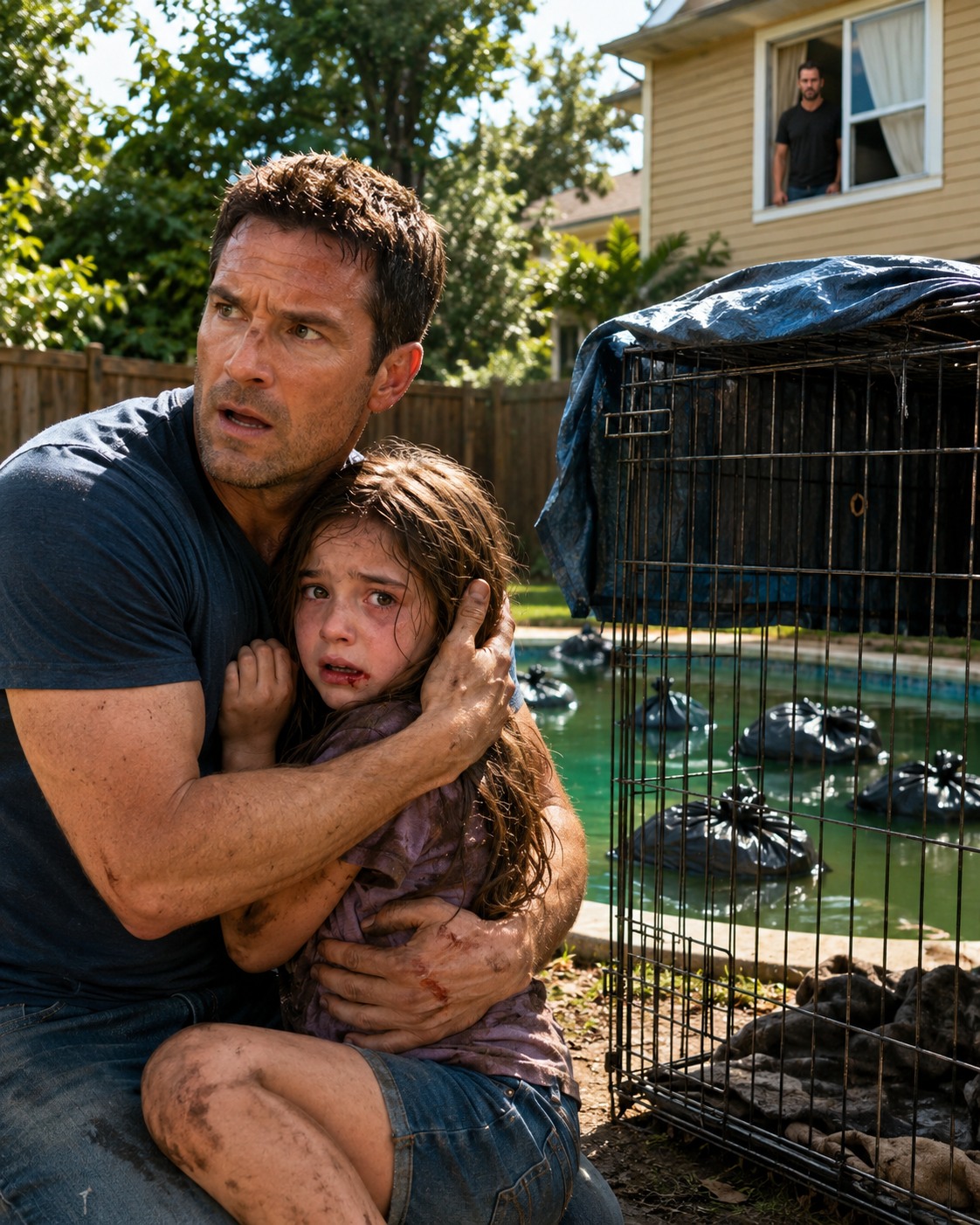
I had Emily in the back seat of my truck, wrapped in the emergency blanket I kept behind the driver’s seat. Her knees were pulled tight to her chest. Her hands gripped the edges of the silver fabric like it was the only thing keeping her from falling apart.
I kept looking at her through the rearview mirror.
Every time I blinked, I saw the cage again.
The rusted metal. The dirty blanket. The chain on the gate.
My daughter’s eyes.
“Daddy,” she whispered.
“I’m here.” My voice broke around the words. “I’m right here, sweetheart.”
She stared past me toward the house.
The upstairs curtain had stopped moving.
That scared me more.
When someone hides, you know where fear lives. When they stop hiding, it means they have decided something.
I locked the truck doors.
The dispatcher was still on the phone, asking me to stay calm, asking if the child was breathing normally, asking if the suspect was inside the home.
I answered like a machine.
“Yes.”
“Yes.”
“I don’t know.”
But inside, I was no longer Michael Turner, accountant, divorced father, man who paid bills on time and followed court orders and tried to be reasonable. Inside, I was something older and less civilized. I was a father staring at the house where his child had been broken.
And I wanted to tear it apart with my hands.
A police cruiser turned the corner first, tires screeching against the curb. Then another. Then an ambulance. Red and blue lights splashed across the dead windows of the house.
Two officers jumped out with hands near their weapons.
“Sir, step away from the vehicle.”
“That’s my daughter,” I said, pointing to the back seat. “She needs help.”
The younger officer looked through the window and his face changed.
The ambulance doors flew open. A paramedic rushed over with a medical bag, and the moment she saw Emily, her voice softened.
“Hi, honey. My name is Dana. I’m going to help you, okay?”
Emily shrank back.
I opened the rear door slowly. “She’s scared.”
Dana nodded. “I won’t touch her unless she says I can.”
Emily looked at me.
“It’s okay,” I told her. “I won’t leave.”
That was when Sarah came out of the house.
My ex-wife stepped onto the porch in a pale blue dress, barefoot, her hair messy like she had just woken up. For one insane second, she looked normal. Tired, maybe. Confused.
Then her eyes landed on the police cars.
Then on my truck.
Then on Emily.
And the mask cracked.
“What did you do?” she screamed.
I stared at her.
She came running down the porch steps, pointing at me like I was the monster. “He broke into my property! He took her! He kidnapped my daughter!”
Emily made a tiny sound behind me.
A sound I had never heard from her before.
Not crying.
Not screaming.
Something smaller. Something that sounded like her body remembering pain.
I stepped between Sarah and the truck.
“Don’t come near her.”
Sarah’s eyes were wild. “You don’t understand. She’s been impossible. She lies. She makes things up. Jason was trying to teach her—”
One of the officers grabbed Sarah’s arm before she could say more.
“Ma’am, stop right there.”
Sarah yanked against him. “That’s my child!”
“She was locked in a cage,” I said.
The words came out low. Deadly.
Sarah froze.
Everyone froze.
Even the sirens seemed to fade.
For one second, Sarah’s face told the truth.
She knew.
Then she cried.
Not the way a mother cries when her child has been hurt.
She cried the way guilty people cry when the room stops believing them.
“I didn’t know it was that bad,” she sobbed.
I felt something inside me snap clean in two.
“You didn’t know?”
She covered her mouth. “Jason said she needed discipline. He said she was becoming manipulative because of you.”
“Where is he?” the older officer demanded.
Sarah’s eyes flicked to the upstairs window.
A mistake.
The officer saw it.
He turned and shouted, “Inside. Upstairs.”
Three officers moved toward the house.
Sarah started screaming again, but I barely heard her because Emily suddenly grabbed my sleeve.
“Daddy,” she whispered. “The pool.”
I looked toward the backyard.
The black shapes beneath the green water moved slightly in the breeze.
The older officer followed my gaze.
“What’s in the pool?”
Emily squeezed my sleeve until her knuckles turned white.
“Don’t make her say it,” I said.
The officer’s expression hardened.
He spoke into his radio.
“Need crime scene and additional units. Possible evidence in backyard pool.”
Evidence.
That word made the world tilt.
Because evidence meant this was already bigger than bruises.
Bigger than Jason.
Bigger than Sarah’s silence.
Dana the paramedic gently examined Emily where she sat in the truck. She checked her pulse, her pupils, the cut on her lip, the bruises blooming across her thin arms. Every new injury made her face grow quieter.
“Hospital,” she said firmly.
“I’m going with her.”
“Of course.”
Sarah heard that and lurched forward. “No. I’m her mother. I’m riding with her.”
Emily screamed.
It was sudden and sharp and terrible.
She scrambled backward across the seat, pressing herself into the far door, shaking her head so hard her tangled hair whipped across her face.
“No. No. No. Please. Please, no.”
The entire street went silent.
Sarah stopped moving.
For the first time, everyone saw what I had been seeing.
Not a custody dispute.
Not a difficult child.
Not a bitter divorce.
A terrified little girl begging not to be handed back to her mother.
The officer holding Sarah tightened his grip.
“You’re not going anywhere near that child.”
Sarah’s face twisted. “Michael, tell them. Tell them she gets dramatic.”
I looked at the woman I had once loved. The woman whose hand I held in a hospital room the night Emily was born. The woman who cried when our baby wrapped tiny fingers around hers.
And I wondered where that woman had gone.
“You don’t get to say her name,” I said.
They put Sarah in the back of a cruiser a few minutes later.
Not officially arrested yet, they said. Detained. Questioned. Procedure. Words that felt too small for what had happened.
Then the front door burst open.
Two officers dragged Jason out.
His perfect hair was wet with sweat. His polo shirt was torn at the collar. One eye was already swelling, as if he had fought someone inside.
But he was smiling.
That was the worst part.
He looked at the police, at the neighbors gathering behind fences, at me standing beside the ambulance.
Then he saw Emily.
His smile widened.
“There she is,” he called. “The little actress.”
Emily curled into herself.
I moved before anyone could stop me.
One step.
Two.
The older officer caught me around the chest just as my hands reached for Jason’s throat.
“Don’t,” he barked in my ear. “Don’t give him anything he can use.”
Jason laughed.
“Always the hero, huh, Mike?”
I fought against the officer’s grip, shaking with rage.
Jason tilted his head, eyes cold and amused. “You should’ve come sooner.”
The words were a knife.
Because he knew.
He knew exactly where to cut.
I stopped fighting, but not because I was calm.
Because behind me, Emily was watching.
And I would not let Jason turn me into another thing she had to fear.
The paramedics loaded Emily into the ambulance. I climbed in beside her. She grabbed my hand and did not let go.
As the doors closed, I saw officers stringing yellow tape across the backyard.
I saw Mrs. Harris crying into her rosary.
I saw Sarah through the cruiser window, her face pale and empty.
And I saw Jason turn his head toward me one last time.
He mouthed two words.
Ask her.
Then the ambulance doors shut.
At the hospital, time became a blur of white lights and soft voices.
Doctors examined Emily. Nurses brought warm blankets. A child advocate arrived, then a detective, then a social worker with kind eyes and a folder full of forms.
They asked me to step out during parts of the exam.
Emily wouldn’t let go.
“She can decide,” the doctor said gently.
Emily’s fingers tightened around mine.
“I want Dad.”
So I stayed.
I stared at the wall when they checked injuries no father should ever have to know about. I kept my voice steady when she whimpered. I told her stories about our camping trip from the year before, about how the marshmallows caught fire and she laughed so hard she fell out of her chair.
She didn’t laugh this time.
But she listened.
That was enough.
Later, when she slept under a hospital blanket with an IV taped to her hand, Detective Ramirez pulled me into the hall.
He was in his fifties, broad-shouldered, with tired eyes that had seen too much and still refused to look away.
“Mr. Turner,” he said quietly, “we need to talk.”
My stomach hardened. “The pool.”
He nodded.
“What was in it?”
He looked toward Emily’s room, then back at me.
“Trash bags. Several. We’re still processing them.”
“What was inside?”
“Not human remains.”
For one second, my knees nearly gave out in relief.
Then Ramirez continued.
“But we found clothing. Children’s clothing. Some bloodstained. A backpack. School papers. And multiple disposable phones.”
I leaned against the wall.
Children’s clothing.
Not just Emily’s?
Ramirez seemed to read the question on my face.
“We don’t know yet.”
I looked through the glass at my sleeping daughter.
“What the hell was happening in that house?”
“That’s what we’re trying to find out.”
I wiped both hands over my face. My palms still stung from climbing the fence. There was dried blood under one fingernail. Mine. Hers. I didn’t know.
“Jason said something before they took him.”
“What?”
“He mouthed, ‘Ask her.’”
Ramirez’s eyes sharpened. “Ask who?”
I looked at Emily.
His expression changed.
“Did she tell you anything?”
“Only that Jason said little liars live like dogs.”
Ramirez wrote that down.
The pen looked too ordinary in his hand.
“What about Sarah?” I asked. “Did she know?”
Ramirez paused.
That pause told me more than any answer could have.
“She claims Jason controlled everything,” he said. “She says she was afraid.”
I laughed once. It came out hollow.
“She was afraid?”
“I’m not saying I believe her.”
“She let my daughter rot in a cage.”
His face stayed steady. “I know.”
“No, Detective. You don’t.”
For a moment, neither of us spoke.
Then he said, “We also found something in the basement.”
My chest tightened.
“What?”
“A locked room.”
I couldn’t breathe.
“Inside were notebooks. Video equipment. A cot. Restraints.”
The hallway lights buzzed above us.
I heard someone crying behind a curtain down the hall. A machine beeped steadily. Nurses moved past like ghosts.
“Was Emily kept there?”
“We’re still determining that.”
“Don’t talk to me like a press release.”
Ramirez’s jaw tightened. “Yes. We believe she was kept there at least part of the time.”
Something dark crossed my vision.
I closed my eyes.
I saw my daughter asking every Sunday if she could stay longer.
I saw myself smiling, saying, “Next weekend, kiddo.”
I saw myself sending her back.
Again.
And again.
And again.
Ramirez’s voice softened. “Mr. Turner, listen to me. This is not your fault.”
I opened my eyes.
“Don’t.”
He nodded once, accepting the boundary.
But the guilt had already moved in. It sat in my chest like stone.
That night, I didn’t sleep.
I sat beside Emily’s hospital bed while she drifted in and out, sometimes whimpering, sometimes waking in terror, sometimes asking if the doors were locked.
“They’re locked,” I told her every time.
Even when they weren’t.
At 3:17 a.m., she woke suddenly and whispered, “Where’s the blue notebook?”
I sat forward. “What blue notebook?”
Her eyes were glassy with fever and fear. “The one I hid.”
“Where did you hide it?”
She looked around the room, confused, as if she had forgotten where she was.
“Under Daisy.”
“Who’s Daisy?”
“My old rocking horse.”
I remembered it.
White wood. Pink mane. I had assembled it the Christmas she turned five. Sarah kept it after the divorce because Emily’s room stayed mostly at her house.
“What’s in the notebook, sweetheart?”
Her lower lip trembled.
“The names.”
My body went cold.
“What names?”
She squeezed her eyes shut.
“The girls who didn’t get dads.”
Then she drifted back to sleep.
I sat there until sunrise with those words echoing inside my skull.
The girls who didn’t get dads.
By morning, the story had broken.
Local news vans crowded outside Sarah’s neighborhood. Reporters stood in front of the chained gate, speaking in serious voices. Online headlines called it “Suburban Child Abuse Horror” and “Girl Found Locked in Cage Behind Family Home.”
They blurred Emily’s name at first.
Then someone leaked it.
By noon, my phone had hundreds of messages. Old coworkers. Family members. Parents from school. People who had ignored my concerns months earlier now wrote things like:
Praying for you.
So sorry.
Let us know what we can do.
I wanted to throw the phone through the hospital window.
Where had their concern been when Emily stopped showing up to birthday parties?
When she wore long sleeves in July?
When her teacher wrote “quiet lately” in an email and Sarah replied that Emily was adjusting to blended family life?
At ten in the morning, Ramirez returned with a warrant.
“We’re going back to the house,” he said. “You mentioned a blue notebook?”
I nodded. “Under a rocking horse named Daisy.”
His face revealed nothing, but I saw the way his hand tightened around the file.
“I’ll call you when we find it.”
“I’m coming.”
“No.”
“That’s my house too. I paid the mortgage for years. My daughter—”
“Your daughter needs you here.”
That stopped me.
Behind us, Emily stirred in her sleep.
Ramirez lowered his voice. “Let us do this part.”
So I stayed.
At noon, a judge granted me emergency temporary custody.
At one, Sarah’s attorney filed a statement claiming she was “a victim of coercive control.”
At two, Jason’s attorney claimed the cage was for “behavioral safety during violent episodes.”
At two-oh-seven, I punched the bathroom wall hard enough to split my knuckles.
At three-thirty, Emily woke and asked for apple juice.
It was the first normal thing she had asked for since I found her.
I nearly cried over the little plastic cup.
She took three sips, then looked at me.
“Are you mad?”
“No, sweetheart.”
“You look mad.”
“I am mad. But not at you.”
She watched me carefully. “Jason said you would be.”
“He lied.”
“Mom said you didn’t want me all the time.”
Pain moved through me so sharply I almost couldn’t speak.
“She lied too.”
Emily looked down at her blanket.
“She said you had a new family.”
“I don’t.”
“She said I was too much.”
“You are not too much.” I leaned closer. “Emily, look at me.”
Slowly, she did.
“You are my daughter. You are the best thing in my life. Nothing you say, nothing you feel, nothing that happened in that house will ever make me stop wanting you.”
Her face crumpled.
For the first time since I found her, Emily cried like a child.
Not silently. Not carefully. Not like someone afraid of being punished for making noise.
She sobbed.
I held her as gently as I could, afraid of every bruise, every hidden pain.
“I wanted you,” she cried. “I kept asking. I kept asking for you.”
“I know.”
“I thought you forgot.”
“I didn’t.”
But the words weren’t enough.
They would never be enough.
Because love could be real and still arrive too late.
That evening, Ramirez called.
“We found the notebook.”
I stepped into the hall.
“And?”
He was silent for a long moment.
“There are seven names.”
My hand went numb around the phone.
“Children?”
“Yes. Girls between eight and thirteen. All from neighboring counties. All connected to families Jason knew through church groups, youth programs, or counseling referrals.”
I stared through the hospital window at Emily, who was watching cartoons without really watching them.
“Are they alive?”
“We’re checking.”
“Detective.”
“I don’t know yet.”
My throat closed.
“What else was in the notebook?”
“Dates. Descriptions. Things Emily overheard. Some locations.”
“She documented it?”
“Yes.”
“She’s ten.”
“I know.”
I looked down the hall toward the vending machines, the nurses’ station, the exit signs glowing red.
My little girl had been living in a nightmare and leaving breadcrumbs because some part of her still believed someone would come looking.
“Why didn’t she tell me?” I whispered.
Ramirez’s voice was gentle but firm. “Because they probably made sure she thought telling you would get you killed.”
I closed my eyes.
Jason’s smiling face flashed in my mind.
Ask her.
He hadn’t been afraid of what Emily knew.
He had wanted me to know.
That meant the notebook was not hidden from him.
It had been left there for someone to find.
But why?
Two days later, Emily was released into my custody.
The hospital gave us instructions, medications, follow-up appointments, therapy referrals, and a folder so thick it felt like evidence from someone else’s life.
When we left through a side entrance to avoid reporters, Emily wore new clothes a nurse had bought from the gift shop: gray sweatpants, a yellow sweatshirt, and fuzzy socks inside sneakers one size too big.
She held my hand the entire way to the truck.
At home, she stopped on the porch.
My house was smaller than Sarah’s. A little old. A little creaky. The front steps needed repainting. The yard was uneven.
But Emily stared at it like it was a castle.
“Is my room still there?” she asked.
I swallowed hard.
“Of course.”
I had never changed it.
Sarah used to mock me for that.
“She visits every other weekend, Michael. You don’t need to keep a shrine.”
But I had kept it anyway.
The purple curtains. The glow-in-the-dark stars on the ceiling. The stuffed fox she named Captain Pancake. The bookshelf full of stories we never finished.
Emily walked into the room slowly and touched everything like she was making sure it was real.
Then she sat on the bed.
“Can I shut the door?”
My chest tightened.
“Sure.”
She looked nervous. “Not locked.”
“Never locked.”
I started to leave.
“Dad?”
I turned.
“Can you sit outside?”
So I sat in the hallway with my back against the wall while she slept for fourteen hours.
The investigation grew darker by the day.
Three of the names in Emily’s notebook belonged to girls who had gone missing in the past two years.
Two had been classified as runaways.
One had been returned to her family and then moved out of state.
One name belonged to a girl whose parents had died in a car accident six months earlier.
And one name made Detective Ramirez go quiet every time I asked about it.
Lily.
No last name.
Just Lily.
Written seven times in Emily’s shaky handwriting.
Lily basement.
Lily blue dress.
Lily said don’t cry loud.
Lily knows the red door.
I asked Emily about Lily once.
Only once.
Her face went blank in a way that terrified me.
“Lily doesn’t like questions,” she whispered.
Then she crawled under her blanket and did not speak for the rest of the night.
So I stopped asking.
The court granted a protection order.
Sarah was not allowed near Emily. Jason remained in custody without bond after police found enough evidence in the basement to bury him under charges that made news anchors lower their voices.
People called me brave.
They called me devoted.
They called me a hero.
But heroes do not send their daughters back into cages because a custody schedule says so.
Heroes do not ignore flinches because lawyers tell them fear is not evidence.
Heroes do not mistake survival for silence.
On the sixth night after Emily came home, I woke to a sound downstairs.
Not loud.
A soft thump.
Then another.
I sat up instantly.
The house was dark except for the night-light glowing in the hallway. I checked Emily’s room first. She was asleep, Captain Pancake tucked under one arm.
Another sound came from the kitchen.
I grabbed the baseball bat from my closet and moved barefoot down the stairs.
The back door was open.
Not broken.
Open.
Cold night air moved through the kitchen curtains.
On the floor sat a manila envelope.
My name was written across it in black marker.
MICHAEL TURNER.
I locked the door, checked every window, then called Ramirez.
While I waited, I stared at the envelope like it might breathe.
“Don’t touch it,” Ramirez said when he arrived twenty minutes later.
He wore jeans and a jacket, his hair flattened on one side like I had dragged him from bed.
Crime scene technicians dusted the back door. No prints. No obvious tool marks.
“Who has keys?” he asked.
“Me. My sister. Sarah used to.”
“Changed the locks after Emily came home?”
I looked at him.
His expression answered for me.
“Do it today,” he said.
They photographed the envelope before opening it.
Inside was a single flash drive and a photograph.
The photograph showed Emily asleep in her hospital bed.
Taken through the window from the hallway.
My blood turned to ice.
On the back, someone had written:
She remembered too much.
Ramirez’s face hardened. “Pack a bag.”
“What?”
“You and Emily are going into protective housing.”
“No. No one is moving her again.”
“This isn’t optional.”
I stepped closer. “My daughter just got home.”
“And someone got into your house without leaving a trace.”
I looked upstairs.
Emily’s door was open a crack.
She stood there in her pajamas, small and pale, clutching Captain Pancake.
Her eyes were fixed on the photograph in Ramirez’s hand.
Then she whispered, “That’s Lily’s writing.”
Ramirez turned very slowly.
“What did you say, sweetheart?”
Emily came down one step.
Then another.
Her bare feet made no sound on the stairs.
“That’s how Lily writes.”
I looked at the message again.
Black marker. Sharp letters. No curves.
“Emily,” I said carefully, “who is Lily?”
She stared at Ramirez.
Then at me.
Then toward the open kitchen, where cold air still lingered.
“She was there before me,” Emily whispered. “Jason said she was the first one who learned.”
Ramirez crouched slightly, keeping his voice gentle. “Learned what?”
Emily swallowed.
“How to make dads look guilty.”
The room went silent.
My hand tightened around the banister.
“What does that mean?” I asked.
Emily’s eyes filled with tears.
“He said if I didn’t behave, he would make everyone think you did bad things. Like Lily’s dad.”
Ramirez looked at me.
Something passed across his face. Recognition. Horror.
“Lily Harper,” he said under his breath.
I knew that name.
Everyone in Ohio knew that name.
Three years earlier, a father named Thomas Harper had been convicted of murdering his twelve-year-old daughter, Lily, after she disappeared from their home. Her body had never been found. The case had been everywhere: grieving mother, suspicious father, blood in the garage, a jury that convicted him in less than six hours.
I remembered thinking, like everyone else, how terrible it was.
Ramirez stood slowly.
“Lily Harper is dead,” he said.
Emily shook her head.
“No.”
My heart began to pound.
“She came to the basement sometimes,” Emily whispered. “When Jason was gone. She brought food. She told me not to trust the police because police believed the wrong story last time.”
Ramirez’s face had gone pale.
“Emily,” he said, “are you saying Lily Harper is alive?”
My daughter looked toward the open back door.
Then she said something that made every light in the house feel suddenly too weak.
“She was here tonight.”
At that exact moment, my phone buzzed on the kitchen table.
An unknown number.
A video message.
Ramirez told me not to open it.
But the preview had already loaded.
A girl stood beneath a red door in a dark hallway.
She looked older than twelve now. Thin. Hollow-eyed. Alive.
Beside her, barely visible in the shadows, stood Jason’s smiling face from a paused security camera.
The text beneath the video said:
Your daughter was never the target.
Then another message arrived.
Ask Sarah what she sold.
Upstairs, Emily began to cry.
Outside, somewhere beyond the dark yard, a car engine started and faded into the night.
Ramirez looked at me, and for the first time since I met him, I saw fear in his eyes.
Because the cage behind Sarah’s house had not been the beginning of the horror.
It had been the place where someone wanted us to start digging.
Part 3 — The Girl Who Was Supposed to Be Dead
The video played only once before Detective Ramirez snatched my phone from the table.
But once was enough.
Lily Harper was alive.
She stood in a dim hallway beneath a red-painted door, older than the school photo that had haunted Ohio news three years earlier, but unmistakably the same girl. The same wide-set eyes. The same pale hair. The same small birthmark below her left cheekbone.
Beside her, frozen in the corner of the frame, was Jason.
Not smiling for church.
Not smiling for neighbors.
Smiling like a man who had built a maze and enjoyed watching people discover there was no way out.
Emily stood halfway down my stairs, barefoot, shaking.
“She was here tonight,” she whispered again.
Detective Ramirez lifted his hand, signaling everyone in the room to stay still.
“Emily,” he said gently, “did Lily come inside?”
My daughter hugged Captain Pancake so tightly the stuffed fox bent at the middle.
“I don’t know,” she said. “I heard the door. Then I smelled her.”
Ramirez’s brows drew together. “Smelled her?”
Emily nodded. “Peppermint gum.”
A strange detail. Too specific to be invented.
“She always chewed it in the basement,” Emily said. “She said it helped her not cry.”
The words carved a hole through me.
I wanted to pick Emily up and carry her somewhere no one could ever touch her again. A mountain. An island. Another planet. But Ramirez’s face had shifted into something hard and alert.
“Michael,” he said, “pack only what Emily needs. Medication, clothes, comfort items. Nothing electronic except your phone, and you’re handing that to me before we leave.”
“Where are we going?”
“Somewhere not written in any custody document.”
Emily’s eyes snapped to mine. “We have to leave?”
I climbed the stairs slowly and crouched in front of her. “Just for a little while.”
Her chin trembled. “But this is my room.”
“I know.”
“I just got it back.”
That broke something in me.
The police could call it protective housing. The courts could call it safety protocol. But to Emily, it was another removal. Another night being told adults knew best.
I turned to Ramirez. “No.”
His eyes narrowed. “Michael—”
“No. Not unless she understands. Not unless she gets a choice in what comes with us.”
Ramirez looked at Emily.
Then, to his credit, he softened.
“Emily,” he said, “someone came here tonight who should not have been able to get inside. That means your dad’s house isn’t safe right now. But you can choose what you bring. Two bags. Anything you need.”
Emily looked at me.
“Can Daisy come?”
My throat tightened.
Daisy, the rocking horse.
The one still sitting in Sarah’s house. The one that had hidden the blue notebook.
“She’s evidence right now,” Ramirez said.
Emily flinched at the word.
I looked him dead in the eye. “Find a way.”
He paused, then nodded once.
“I’ll ask crime scene to photograph and release it as soon as possible.”
Emily whispered, “She gets scared alone.”
Ramirez said nothing.
Neither did I.
Because sometimes children tell you the truth sideways. Sometimes a rocking horse is not a toy. Sometimes it is a witness.
Twenty minutes later, we were in an unmarked police SUV cutting through the sleeping streets of Columbus while rain began to fall in thin silver lines.
Emily leaned against me in the back seat, wrapped in her yellow sweatshirt, her eyelids heavy but refusing to close.
“Dad?”
“Yeah, sweetheart?”
“Was Lily really dead?”
I looked at Ramirez in the front seat.
He didn’t answer.
So I did.
“People thought she was.”
“Her dad didn’t hurt her.”
The certainty in Emily’s voice made Ramirez turn slightly.
“How do you know?” he asked.
Emily’s face went blank.
Not afraid.
Remembering.
“Because Lily said dads don’t always get there in time, but that doesn’t make them bad.”
The SUV fell silent.
I stared out at the wet road until the streetlights blurred.
At the safe house, a female officer named Erin met us at the door. It was a small brick ranch with blackout curtains, plain furniture, and a refrigerator stocked with food no one had appetite for.
Emily chose the smallest bedroom because it had only one window.
I checked the lock twice.
Then she checked it three more times.
I sat on the floor beside her bed until she finally slept.
At dawn, Ramirez returned with coffee and the kind of face that told me the night had only gotten worse.
He waited until Emily was asleep before speaking.
“The flash drive had seven videos,” he said.
My stomach dropped.
“Of children?”
“Yes. But not what you’re thinking.”
I braced myself anyway.
“They were confession videos,” he said. “Each child was forced to say their father hurt them, abandoned them, or planned to hurt their mother.”
I gripped the kitchen counter.
“Why?”
“Custody cases. Insurance claims. Wrongful death suits. Protective order hearings. Every one of these girls had a father who either lost custody, went to prison, or died under suspicious circumstances.”
The room tilted.
“And Jason?”
“Jason appears in the background of three clips. Never speaking. Never touching anyone. Just present.”
“Like a signature.”
Ramirez nodded grimly.
“Sarah,” I said. “What did she sell?”
“We’re bringing her in again.”
“She’ll lie.”
“She already is.”
I looked toward Emily’s closed door.
“My daughter knows more than she can say.”
“Yes,” Ramirez said. “And so does Lily Harper.”
By noon, the story exploded.
Not publicly. The news still thought Jason was merely a suburban monster with a basement. But behind the scenes, phones rang across county lines. Old cases were reopened. Detectives who once believed they had solved tragedies suddenly found their evidence poisoned.
At two o’clock, Ramirez came back with an update.
“Thomas Harper is still in prison,” he said. “Lily’s father.”
My chest tightened.
“He was convicted without a body?”
“Blood evidence. Digital messages. Lily’s mother testified that he had been violent.”
“Was he?”
Ramirez’s jaw hardened. “His appeals said no. Nobody listened.”
The words landed like a curse.
Nobody listened.
How many fathers had said that?
How many children?
How many warnings had been folded neatly into court files and ignored?
That evening, Emily sat at the kitchen table drawing with crayons Erin had brought. For the first time since the hospital, she drew something other than locked doors.
She drew a red one.
Behind it, she drew stars.
I sat beside her carefully.
“Is that Lily’s red door?”
Emily nodded.
“Can you tell me about it?”
Her crayon paused.
“Lily said the red door was where bad stories ended.”
“Where is it?”
She shook her head. “I don’t know.”
“Is it in a house?”
“No.”
“A church?”
Her hand tightened around the crayon until it snapped.
I stopped.
Emily stared at the broken piece.
Then she whispered, “Jason said the church helps people become new.”
Ramirez, standing near the sink, went completely still.
“What church?” he asked.
Emily looked up at him.
“Bright Haven.”
The name was familiar.
Sarah had dragged Emily there after marrying Jason. A cheerful building outside town with banners about healing families, second chances, and community outreach.
Bright Haven Church.
The same church where Jason smiled in pressed polo shirts.
The same church where Sarah said Emily was “learning structure.”
Ramirez left the kitchen without another word.
Two hours later, he returned with a warrant request already in motion.
But by then, it was too late.
Bright Haven Church burned that night.
The fire started just after midnight. By the time firefighters arrived, flames had swallowed the fellowship hall and climbed the bell tower like a living thing. News helicopters caught the blaze from above, red and orange light pulsing against the black Ohio sky.
Ramirez watched the footage on his phone at the safe house table.
His face looked carved from stone.
“Evidence,” I said.
“Maybe.”
“You think Lily did it?”
“I think someone wants us to think Lily did it.”
Emily had appeared in the hallway behind us.
Her voice was tiny.
“Lily hates fire.”
Ramirez turned. “Why?”
Emily rubbed one eye. “Because that’s how they erased the first room.”
“The first room?”
She nodded.
“Before Jason’s basement,” she whispered, “there was another place.”
Ramirez crouched. “Where?”
Emily looked at me, then him.
And then she said the sentence that changed everything.
“Mom took me there once.”
My heartbeat stopped.
“Sarah?”
Emily nodded slowly.
“She said I had to meet people who could help me be a better daughter.”
My mouth went dry.
“When was this?”
“Before the cage. Before summer. When school still had snow days.”
February.
Months before I found her.
“Who was there?” Ramirez asked.
Emily’s eyes filled.
“Jason. Pastor Greg. A lady with silver bracelets. And Mom.”
I couldn’t move.
My ex-wife had not merely allowed Jason into our daughter’s nightmare.
Sarah had brought Emily to the door.
Part 4 — Ask Sarah What She Sold
Sarah Turner did not look like a monster when I saw her again.
That was the thing that made me feel sick.
She sat in an interview room behind thick glass, wearing a gray jail-issued sweatshirt, her hair limp around her face, no makeup, no jewelry, no polished suburban softness. She looked tired. Smaller. Almost human.
But when she lifted her eyes and saw me on the other side of the glass, she did not look ashamed.
She looked betrayed.
Like I had ruined her life.
Ramirez stood beside me. “You don’t have to do this.”
“Yes, I do.”
“She may try to manipulate you.”
I almost laughed.
“She already did for years.”
He opened the door.
Sarah’s wrists were cuffed to the table. She flinched when I entered, but I no longer knew if that flinch was fear or performance.
“Michael,” she whispered.
I sat across from her.
For a few seconds, we stared at each other, and I saw flashes of our old life like broken film.
Sarah laughing in the kitchen with flour on her cheek.
Sarah holding newborn Emily.
Sarah dancing barefoot in our living room to a song neither of us remembered.
Then I saw Emily in the cage.
The old film burned.
“What did you sell?” I asked.
Sarah’s lips parted.
Her eyes flicked to the mirror.
Ramirez was behind it. She knew.
“I don’t know what you mean.”
I leaned forward.
“Lily Harper is alive.”
Sarah’s face collapsed so quickly she couldn’t hide it.
“God,” she breathed.
“So you knew.”
“No.”
“You knew.”
“No, Michael. I suspected.”
“That’s your defense?”
Her eyes filled with tears.
“I was trapped.”
“Emily was trapped.”
Sarah recoiled as if I had slapped her.
“You think I don’t know that?”
“I think you knew exactly enough to keep pretending you didn’t.”
She began to cry.
I waited.
I had seen those tears before. During custody hearings. During arguments. During every moment she needed the room to bend toward her.
Not this time.
“What did you sell?” I asked again.
Sarah shut her eyes.
“My signature.”
I stared at her.
“What?”
“My signature,” she whispered. “That’s how it started.”
She swallowed hard.
“Jason knew people. Lawyers. Counselors. Pastors. Family court advocates. People who said the system was broken and mothers needed protection. They said fathers like you used money and charm to steal children.”
I said nothing.
“At first, it was just paperwork. Statements. Affidavits. I signed things saying you were emotionally unstable. That Emily was afraid of you sometimes.”
My hands curled into fists beneath the table.
“She was never afraid of me.”
“I know.”
The words were almost inaudible.
“I know that now.”
“No,” I said. “You knew then.”
Sarah looked away.
“They paid you?”
She nodded once.
“Who?”
“I never knew names. Jason handled everything. Cash sometimes. Transfers through nonprofits. Gift cards. Church assistance funds.”
“Bright Haven.”
Her eyes snapped up.
“You don’t understand. Bright Haven wasn’t just a church. It was a pipeline.”
Ramirez entered the room silently and sat beside me.
Sarah looked terrified now.
Good.
“What pipeline?” Ramirez asked.
Sarah pressed her cuffed hands together.
“Custody disputes. Vulnerable mothers. Angry fathers. Children in the middle. They would find families already cracked and push until something broke.”
“For money?” Ramirez asked.
“For control,” Sarah said. “For money too, yes. But mostly for leverage. Court outcomes. Settlements. Donations. Political favors. Some of the men they destroyed were fighting people much bigger than themselves.”
“Thomas Harper,” Ramirez said.
Sarah nodded, crying harder.
“Lily’s father found out Bright Haven was laundering money through child advocacy programs. He was going to expose them. Then Lily disappeared.”
“And they framed him.”
“I think so.”
“You think so?”
Her voice cracked. “I didn’t know then.”
I leaned forward, my voice low. “And Emily?”
Sarah sobbed.
“They wanted you.”
The room went cold.
“Me?”
“You audited Bright Haven’s grant accounts two years ago.”
I stared at her.
I worked as a forensic accountant for a firm that handled nonprofit reviews. Two years earlier, I had flagged irregularities in several organizations connected to church outreach programs. Nothing big enough to make headlines. Enough to irritate people.
I remembered the file.
I remembered my supervisor telling me the client had withdrawn cooperation.
I remembered moving on.
Ramirez looked at me sharply. “You never told me that.”
“I didn’t know it mattered.”
Sarah whispered, “Jason said you were dangerous because you noticed numbers no one else noticed.”
My mouth went dry.
Emily had not been chosen because she was vulnerable.
She had been chosen because she was mine.
“What was the plan?” Ramirez asked.
Sarah shook her head. “I don’t know.”
Ramirez slammed his palm on the table.
Sarah jumped.
“What was the plan?”
“They wanted Michael discredited,” she cried. “A restraining order. A breakdown. Maybe an assault. Jason kept saying fathers always write their own guilty endings if you press hard enough.”
Jason’s words came back.
You should’ve come sooner.
He had wanted me to break.
At the cage. At the ambulance. In front of police.
He had wanted me to become the story they had already written.
My daughter’s suffering had been bait.
I stood so fast the chair scraped backward.
Sarah reached for me despite the cuffs.
“Michael, I didn’t know they would hurt her like that.”
I looked at her.
For the first time, I saw the truth clearly.
Sarah had not planned every cruelty. She had not designed the cage. She had not invented the basement or the videos or the red door.
But she had opened the first gate.
“You sold our daughter for a story,” I said.
Her face crumpled.
“No.”
“Yes.”
I walked to the door.
Behind me, Sarah said, “Lily knows where they keep the originals.”
I stopped.
Ramirez stood.
“What originals?”
Sarah’s voice trembled.
“The real files. The recordings. The payments. The names. Jason said Lily stole a copy years ago, but she didn’t understand what she had.”
“Where?”
Sarah shook her head. “I don’t know.”
I turned around.
Her eyes met mine.
“But Emily does.”
When I returned to the safe house, Emily was sitting on the couch with Officer Erin, watching an animated movie at low volume. She smiled when she saw me, but the smile vanished when she read my face.
“Did Mom say something bad?”
I sat beside her.
“She said a lot of things.”
Emily looked down.
“She always does.”
That small sentence hurt more than shouting.
I took her hand.
“Sweetheart, do you know where Lily kept something important?”
Emily’s face changed.
Not fear this time.
Guilt.
“She told me not to tell.”
“Why?”
“Because grown-ups lose things on purpose.”
Ramirez, standing behind me, lowered his eyes.
I nodded slowly.
“She was right to be careful.”
Emily looked surprised.
“She was?”
“Yes.”
For the first time, I realized that forcing truth from Emily would only repeat what everyone else had done. So I said the only thing I could.
“You don’t have to tell us. But if what Lily hid can save people, we need to know.”
Emily pressed Captain Pancake to her chest.
“She said there’s a red door under the place where nobody sings.”
Ramirez and I exchanged a look.
“The church?” I asked.
Emily shook her head.
“Not Bright Haven. The old church.”
“What old church?”
She whispered, “The one under the bridge.”
Ramirez went still.
“There’s an abandoned chapel near the Scioto River,” he said. “Closed fifteen years ago. Homeless encampments nearby. No services. No choir.”
The place where nobody sings.
Within an hour, Ramirez had assembled a team.
Within two, they found the chapel.
Within three, they found the red door.
But it was open.
And inside, there was nothing but an empty metal cabinet, peppermint gum wrappers, and a note taped to the back wall.
Ramirez sent me a photo.
Four words.
SHE CHOSE THE FATHER.
Part 5 — The Red Door Under the Bridge
The next morning, Thomas Harper was released from prison.
Not officially exonerated. Not yet. The law moves slowly even when truth kicks the door open.
But emergency review, new evidence, and the possibility that his supposedly murdered daughter had appeared on video forced the state to act.
Ramirez warned me not to watch the footage.
I did anyway.
Thomas Harper stepped through the prison gate wearing clothes that hung from his frame like they belonged to a larger man. His hair had gone gray at the temples. He carried a cardboard box. No family waited.
Only reporters.
They shouted questions.
“Mr. Harper, did you kill your daughter?”
“Did you know Lily was alive?”
“What do you want to say to the people of Ohio?”
Thomas stopped walking.
For a moment, he looked directly into one of the cameras.
“I want my daughter,” he said.
Then his face twisted—not with rage, but with a grief so raw I had to turn away.
Emily watched from the hallway.
“Is that Lily’s dad?”
I nodded.
“He looks tired.”
“He’s been waiting a long time.”
She came closer.
“Can dads still love you if they think you’re dead?”
I pulled her into my arms.
“Yes,” I whispered. “Every second.”
That afternoon, Thomas Harper came to the safe house.
I did not want him there at first. Not because I feared him, but because his pain was too close to mine. He looked like a warning from a life I had almost lived.
Ramirez brought him in quietly.
Thomas stood in the living room, hands trembling at his sides. His eyes found Emily, and he immediately looked away, as if afraid of frightening her.
“Hello,” he said softly. “I’m Lily’s dad.”
Emily studied him.
Then she walked to her bedroom without a word.
Thomas’s face fell.
“She’s scared,” I said.
He nodded. “She should be.”
There was no self-pity in his voice. Only truth.
We sat at the kitchen table with coffee no one drank.
Thomas told us his story.
Lily had vanished after a school concert. Her mother, Claire, said Thomas picked her up. Thomas said he had been at work. Security footage disappeared. Witnesses changed stories. Blood appeared in his garage two days later.
“Not enough to prove death,” Ramirez said.
“Enough to prove theater,” Thomas replied.
His voice was quiet.
I understood that voice. It was the sound of a man who had screamed until screaming became useless.
“Claire testified against you,” I said.
Thomas looked at his hands.
“She was afraid. Or paid. Or both.”
“Do you hate her?”
He laughed once.
“I used to. In prison, hatred gives you something to chew on. Then one day you wake up and realize it has eaten more of you than it ever touched them.”
I looked away.
He saw too much.
Ramirez placed the red-door note between us.
SHE CHOSE THE FATHER.
Thomas stared at it.
His hand covered his mouth.
“What?” Ramirez asked.
Thomas whispered, “That’s Lily.”
“You recognize the handwriting?”
“No.” His eyes filled. “The phrase.”
He looked at me.
“When Lily was little, she had this thing. If her mother and I argued, she’d say, ‘I choose the dog,’ because she didn’t want to hurt either parent.”
A broken smile crossed his face.
“But the night before she vanished, she asked me what would happen if one day she had to choose between truth and family.”
“What did you tell her?” I asked.
“I told her truth is family. Anyone who makes you pick one is stealing the other.”
He touched the note.
“She chose the father.”
The room went silent.
“She’s not talking about me,” he said. “She’s talking about you.”
My chest tightened.
Before I could respond, Emily appeared in the doorway.
She was holding something behind her back.
“Lily said her dad had kind eyes,” she told Thomas.
Thomas stopped breathing.
Emily came closer, slowly, like approaching a wounded animal.
“She said if I ever saw you, I should tell you she didn’t forget the song.”
Thomas’s face broke.
“What song?”
Emily swallowed.
“The moon one.”
Thomas covered his eyes.
A sound came out of him that I will never forget. Not a sob. Not a cry. Something deeper. Something pulled from the bottom of three stolen years.
He began to sing in a shaking voice.
“You are my moon when the dark gets deep…”
Emily finished softly.
“You pull the stars where I can sleep.”
Thomas lowered his hands.
Emily held out what she had been hiding.
A peppermint gum wrapper.
“She put this in my pocket before she left the basement,” Emily said. “I forgot.”
Ramirez took it carefully with gloves.
There were numbers written inside.
Not a phone number.
Coordinates.
The coordinates led to a storage unit outside Dayton.
Unit 214.
Registered under the name Claire Harper.
Lily’s mother.
When police opened it that night, they found the originals.
Hard drives. Ledgers. Court documents. Adoption records. Insurance policies. Payment trails. Names of judges, counselors, pastors, lawyers, therapists, officers, and social workers who had either participated or looked away.
And in the back corner, folded inside a plastic garment bag, they found a blue dress.
The dress Lily had worn the day she disappeared.
Clean.
Preserved.
Proof she had not died in it.
But the most shocking discovery sat in a shoebox beneath the dress.
Seven letters.
One addressed to each father whose daughter had been stolen, framed, or silenced.
One addressed to me.
Ramirez gave it to me at midnight.
I opened it with shaking hands.
The letter was written in blocky black letters.
Mr. Turner,
If you are reading this, Emily survived. That means she was stronger than they expected, and you were faster than they planned. They chose her because of your audit. They chose you because you were ordinary. Ordinary men are easy to ruin because nobody believes ordinary men have enemies.
Jason is not the top. Sarah is not the top. Pastor Greg is not the top.
The person who built this is someone everyone trusts.
Do not believe the first confession.
Do not let them move Emily.
And do not trust Detective Ramirez until he remembers the red scarf.
I read the last line twice.
Then a third time.
My skin went cold.
Ramirez stood across from me.
“What does it say?” he asked.
I folded the letter slowly.
“Nothing.”
His eyes narrowed.
“Michael.”
I looked at him.
For the first time since the night I found Emily, I wondered whether the man helping us was another door in the maze.
“What is the red scarf?” I asked.
Ramirez went pale.
Not confused.
Not angry.
Pale.
Like a ghost had touched him.
“Where did you hear that?” he whispered.
I did not answer.
His chair scraped backward.
He walked to the window and gripped the sill with both hands.
For a long moment, he said nothing.
Then he spoke in a voice I barely recognized.
“My daughter had a red scarf.”
I stared at him.
“Had?”
Ramirez turned.
His eyes were wet.
“She died nineteen years ago.”
The room seemed to shrink around us.
“Her name was Sofia.”
Part 6 — The Detective’s Daughter
Ramirez had never told me he had a daughter.
Not once.
He had talked about procedure, evidence, warrants, jurisdiction. He had stood beside me in hospital halls and safe houses and interrogation rooms. He had carried the facts like armor.
But grief is the one weapon that can cut through armor from the inside.
“Sofia was nine,” he said.
We sat alone in the safe house kitchen while Emily slept behind a locked door and Officer Erin stood watch outside. The letter lay between us like a live wire.
“She disappeared from a summer program,” Ramirez continued. “A church camp. Not Bright Haven. This was before Bright Haven existed.”
My blood chilled.
“They found her scarf near the river.”
“Just the scarf?”
“And blood.”
He looked down.
“Enough to declare her dead. Not enough to explain anything.”
“Was anyone charged?”
“A teenage volunteer. Troubled kid. Bad home. Easy target.” His jaw tightened. “He confessed after eighteen hours of questioning.”
“Did he do it?”
Ramirez closed his eyes.
“I believed he did.”
The words were heavy with shame.
“For years, I believed it. I needed to. My wife needed to. The department needed to. The town needed a monster, and they gave us one.”
“What happened to him?”
“He killed himself in juvenile detention six months later.”
Silence pressed against the walls.
I thought of Lily’s warning.
Do not trust Detective Ramirez until he remembers the red scarf.
“She knew about Sofia,” I said.
Ramirez nodded slowly.
“Why?”
“Because Sofia may have been the first.”
My stomach turned.
“What are you saying?”
“I’m saying the pattern didn’t start with Lily Harper. It started earlier. Much earlier. Children used as leverage. Parents framed. Evidence planted. Confessions manufactured. And every time someone got close, a family destroyed itself before the truth could survive.”
He looked at the letter.
“If Lily knew about Sofia, she has access to records nobody should have.”
“Or someone told her.”
Ramirez’s eyes sharpened.
“Yes.”
At dawn, Thomas Harper returned.
When Ramirez told him about Sofia, Thomas listened without interrupting. Emily sat beside me on the couch, half-hidden under a blanket, refusing to go back to sleep.
When Ramirez finished, Thomas whispered, “Then Lily wasn’t only hiding.”
“What do you mean?” I asked.
“She was investigating.”
Emily nodded.
Everyone turned to her.
“Lily had papers,” she said. “Lots of papers. She said she was making a map of stolen girls.”
Ramirez crouched in front of her. “Did she ever say who helped her?”
Emily looked at Thomas.
“Your wife.”
Thomas went rigid.
“Claire?”
Emily nodded.
“She cried a lot. Lily said her mom did a terrible thing but then did one brave thing.”
Thomas looked shattered.
Later that morning, police found Claire Harper.
She was not in Ohio.
She was in a motel outside Indianapolis, under an assumed name, with a suitcase full of cash and a bullet wound in her shoulder.
Alive.
Barely.
Her first words when she woke after surgery were not about Lily.
They were about Sarah.
“Sarah Turner was supposed to run.”
Ramirez called me from the hospital.
I put him on speaker while Emily colored at the table, pretending not to listen.
“Claire says Sarah was recruited the same way she was,” he said. “Fear, money, custody pressure. But Sarah panicked after Emily got hurt.”
“She didn’t panic enough to call me.”
“No,” Ramirez said. “She tried to negotiate.”
“With Jason?”
“With the person above Jason.”
“And who is that?”
A pause.
Then Ramirez said, “Judge Evelyn Ward.”
The name hit me like a physical blow.
Judge Ward.
The family court judge who had handled every custody dispute between Sarah and me.
The judge who told me Sarah deserved the benefit of the doubt.
The judge who warned me that “hostile fathers often mistake maternal caution for alienation.”
The judge who denied my request for a welfare check two months before I found Emily.
I sat down slowly.
“She built it?” I asked.
“Claire says Ward didn’t build it alone. But she protected it. For decades.”
Emily’s crayon stopped moving.
“What is it?” I asked her.
She whispered, “The lady with silver bracelets.”
Judge Ward wore silver bracelets.
Always.
They chimed softly when she turned pages in court.
A delicate sound.
A harmless sound.
I remembered that sound when she ordered me to return Emily to Sarah.
My hands began to shake.
By afternoon, warrants were being prepared.
By evening, Judge Ward was gone.
Not fled.
Not hiding.
Gone.
Her house was empty. Her accounts drained. Her office files shredded. Her clerk claimed she had taken medical leave, but no hospital had admitted her. No airport cameras caught her. No vehicle crossed a toll booth in her name.
She had vanished like smoke.
But she left one thing behind.
On her desk, placed neatly over Emily’s custody file, was a red scarf.
Ramirez nearly collapsed when he saw the photo.
“That’s Sofia’s,” he whispered.
For nineteen years, he had kept the scarf in an evidence box.
Locked.
Logged.
Protected.
Except it had never been there.
The department had preserved a duplicate.
Judge Ward had kept the original.
A trophy.
A reminder.
A promise that the system belonged to her.
That night, Emily refused to sleep.
So did I.
Rain tapped against the safe house windows while Thomas sat in the kitchen with Ramirez, both men hollowed out by different versions of the same theft.
At 1:12 a.m., Officer Erin’s radio crackled.
Then went silent.
Ramirez stood immediately.
“Erin?”
No answer.
He drew his weapon.
Thomas rose too.
I moved toward Emily’s room.
She was already awake.
“Dad,” she whispered, “the lights.”
They flickered once.
Then died.
The safe house fell into darkness.
Outside, a woman’s voice called softly through the rain.
“Emily Turner.”
My daughter froze.
The voice came again.
Sweet.
Calm.
Familiar.
“Emily, sweetheart. It’s Judge Ward.”
A silver chime sounded in the dark.
Bracelets.
Then the front door unlocked from the outside.
Part 7 — The Woman Behind the Bench
Ramirez fired first.
Not at a person.
At the porch light.
The bulb shattered, throwing sparks into the rain and plunging the front windows into deeper darkness.
“Back room,” he ordered.
Thomas grabbed a kitchen chair and wedged it beneath the hall door as I lifted Emily into my arms. She was shaking but silent, her arms locked around my neck.
The front door opened an inch.
Then stopped against the chain.
Judge Ward laughed softly.
“Detective Ramirez,” she called. “Still theatrical after all these years.”
Ramirez stood in the hallway, weapon raised.
“You’re under arrest, Evelyn.”
“For what?” she asked. “Doing what frightened men begged me to do? Cleaning up families before they became disasters?”
“You took children.”
“I redirected outcomes.”
“You framed fathers.”
“I believed mothers.”
“You killed my daughter.”
Silence.
The rain hissed outside.
Then Ward said, almost gently, “Sofia was never yours to solve.”
Ramirez’s face changed.
I thought he might rush the door.
Instead, Emily lifted her head from my shoulder and whispered, “She wants him mad.”
My little girl, ten years old, bruised by monsters, still saw the trap faster than any of us.
I repeated it louder.
“She wants you mad.”
Ramirez breathed once.
Twice.
Then stepped back from the door.
Ward’s voice sharpened.
“Michael Turner, you’re disappointing me. Jason said you were impulsive.”
I held Emily tighter.
“You picked the wrong father.”
“No,” Ward said. “I picked the right daughter.”
The hallway went cold.
“What does that mean?” I asked.
Ward’s bracelets chimed.
“Emily remembered things. Names. Places. Sounds. She was supposed to break early. Instead, she became a collector.”
Emily trembled.
“You hurt children because they remember?” I asked.
“No. I hurt systems by using what they already believe.” Her voice remained calm, almost bored. “A bruised child, a crying mother, an angry father. Give people those pieces and they assemble the story themselves.”
Thomas spoke from the kitchen doorway.
“Where is Lily?”
For the first time, Ward hesitated.
A tiny silence.
Enough.
Thomas stepped forward.
“Where is my daughter?”
Ward’s voice lowered.
“Closer than you deserve.”
Then the back window shattered.
Glass exploded inward.
Officer Erin’s voice screamed from outside, “Move!”
Ramirez turned just as a canister rolled across the floor, hissing smoke.
Not police smoke.
Something chemical.
My eyes burned instantly. Emily coughed against my neck.
Ramirez shouted, “Basement!”
The safe house had a storm cellar beneath the kitchen. Thomas kicked open the door, and we stumbled down the stairs into damp darkness while smoke swallowed the rooms above.
Erin slammed the cellar door behind us from outside.
Blood ran down her forehead.
“Two men in the yard,” she gasped. “Maybe three. Ward’s at the front.”
Ramirez grabbed his radio.
Static.
“They jammed us,” Erin said.
Emily clung to me.
“Dad, I know where Lily is.”
Every head turned.
My voice shook. “What?”
“She told me if the lady with bracelets came, I should remember the song backward.”
Thomas stepped closer.
“The moon song?”
Emily nodded.
“You pull the stars where I can sleep,” she whispered. “Deep gets dark when the moon is you.”
Thomas frowned.
Ramirez said, “That doesn’t mean anything.”
But I understood.
Not because I was smarter.
Because fathers remember the ridiculous things children love.
“Moon,” I said. “Stars. Sleep. Dark. Deep.”
Emily nodded quickly.
“Places?”
“She said everything important has two names. The grown-up name and the scared name.”
Thomas grabbed a pen from Erin’s pocket and wrote on his palm.
Moon. Stars. Sleep. Dark. Deep.
Ramirez stared.
Then his eyes widened.
“Camp Luna.”
Luna. Moon.
“Starling House,” Erin said. “Old foster facility.”
“Sleepy Hollow Road,” Thomas added.
“Darke County,” I said.
Ramirez looked at the final word.
Deep.
Emily whispered, “Deep well.”
Thomas went pale.
“There’s an old well behind Camp Luna.”
Ramirez cursed under his breath.
Camp Luna was where Sofia disappeared nineteen years ago.
The first room.
The place before Bright Haven.
The place where nobody had looked because everyone thought the case was solved.
Above us, footsteps crossed the kitchen.
Slow.
Confident.
Ward’s voice floated down through the cellar door.
“Emily, dear, I know you’re frightened. But your father cannot protect you from a story already written.”
My daughter lifted her chin.
For the first time since I found her in that cage, her voice did not shake.
“You’re not the judge anymore.”
Silence.
Then Ward screamed, “Open the door.”
The cellar door rattled.
Erin checked her weapon. Ramirez checked his.
Thomas picked up a rusted shovel from the cellar wall.
I looked around the cramped room. Cement walls. Shelves. A narrow storm hatch at the far end, half-hidden behind old paint cans.
“Where does that go?” I asked.
Erin followed my gaze.
“Back yard drainage ditch.”
Ramirez nodded. “We crawl.”
One by one, we squeezed through the hatch into mud and rain.
I went first with Emily pressed ahead of me, whispering encouragement while my knees scraped concrete and my palms slid through filth. Behind us, the cellar door finally gave way.
Ward’s men came down too late.
By then, we were crawling through the drainage ditch behind the safe house, rain covering our movement, Emily’s small hand locked in mine.
At the end of the ditch, red and blue lights appeared.
Not police.
Ambulance lights.
A stolen ambulance waited under the trees.
The back doors opened.
Lily Harper stood inside.
Alive.
So thin she looked made of paper.
But alive.
Thomas stopped walking.
The rain poured between them.
For three years he had imagined a grave.
Instead, his daughter stood in front of him with peppermint gum in her pocket and terror in her eyes.
“Dad?” Lily whispered.
Thomas made a sound like his heart had finally reached air.
He stumbled forward, then stopped himself, hands raised, giving her the choice.
Lily stared at him.
Then she ran.
He caught her with a sob that broke everyone watching.
Emily buried her face into my side, crying too.
But there was no time.
Lily pulled away just enough to speak.
“She’s going to Camp Luna,” she said. “Ward kept Sofia there.”
Ramirez froze.
“What?”
Lily’s eyes filled.
“Sofia didn’t die that day.”
The rain stopped feeling cold.
Ramirez whispered, “No.”
Lily nodded.
“She lived six years after they took her.”
Ramirez staggered back as if shot.
“She left something for you.”
Part 8 — The Father Who Arrived in Time
Camp Luna had been closed for seventeen years.
By dawn, it looked less like a summer camp and more like a place the forest had tried to swallow out of shame. Cabins sagged beneath moss. The dining hall windows were boarded. A faded wooden sign creaked in the wind, the painted moon smiling over weeds and rot.
Ramirez should not have been there.
He was too compromised. Too wounded. Too close.
But no one tried to stop him.
Some truths belong to the people they destroyed.
State police surrounded the property. Federal agents arrived before sunrise. Judge Ward’s network had crossed county lines, state funds, nonprofit fraud, child endangerment, evidence tampering, and wrongful convictions. The quiet suburban horror had become something enormous.
But I barely saw the agents.
I saw Emily holding my hand.
I saw Lily standing beside Thomas, refusing to let go of his sleeve.
I saw Ramirez staring toward the old well behind the largest cabin.
Lily led us there.
“She made us memorize routes,” Lily said. “In case one of us got free.”
“One of us?” Ramirez asked.
Lily nodded.
“There were more before me.”
Nobody spoke.
Behind the well, under a collapsed toolshed, agents found the hatch.
Not a basement.
A bunker.
Cold air breathed from below when they opened it.
Ward had been hiding history underground.
Inside were rooms.
Not cages like Jason’s backyard. Something worse in its own way.
Rooms designed to look kind.
Painted walls. Child-sized beds. Shelves of toys. Cameras hidden behind vents. Recordings labeled by family name. Evidence staged, edited, filed.
A factory of stories.
And in the final room, behind a cabinet, Ramirez found the box.
It had his name on it.
DETECTIVE ELIAS RAMIREZ.
His hands shook so badly Lily opened it for him.
Inside was a red scarf, a cassette tape, and a stack of drawings.
The drawings were signed Sofia.
Ramirez dropped to his knees.
The first drawing showed a house with three people: a mother, a father, and a girl in a red scarf.
The second showed a camp.
The third showed a judge with silver bracelets.
The last showed a door with words written above it.
WHEN DAD FINDS THE TRUTH, I CAN GO HOME.
Ramirez pressed the paper to his chest.
He did not cry loudly.
He folded inward.
Like a building finally allowed to collapse.
The cassette tape was played inside an evidence van.
Sofia’s voice crackled through the speakers, small and brave and nineteen years gone.
“Daddy, if you hear this, I tried to remember everything like you taught me. The lady says you won’t come because police only find what she lets them find. But I know you. You find missing things. You found my turtle when he got behind the dryer.”
A broken laugh escaped Ramirez.
On the tape, Sofia continued.
“There are other girls. Some go home different. Some don’t go home. The lady says stories are stronger than truth, but I don’t think she knows about dads.”
Lily began to cry silently.
Emily leaned against me.
Then Sofia said the words that changed the case forever.
“The lady has a daughter too. Her name is Claire.”
Thomas went rigid.
Lily looked at him.
Claire Harper.
Lily’s mother.
Judge Ward’s daughter.
No one had known. Claire had used her married name. Her birth records had been sealed. Judge Ward had not merely recruited Lily’s mother.
She had controlled her.
The shocking truth unfolded over the next hours.
Judge Evelyn Ward had lost custody of Claire decades earlier after allegations of abuse—allegations she buried when she became powerful. She spent the rest of her life building a system that punished fathers, discredited children, and rewrote families under the mask of protection.
Bright Haven was not the beginning.
It was her empire’s newest face.
Jason was her favorite instrument.
Sarah was a paid participant who became trapped.
Claire was both victim and accomplice, forced for years to help maintain the machine that had stolen her own daughter.
And Lily?
Lily was the mistake.
The child who survived too long.
The child who learned the filing system.
The child who hid copies.
The child who came back for Emily because Emily had remembered the names.
By noon, Ward was found.
Not at Camp Luna.
Not across state lines.
At the courthouse.
Sitting in her own courtroom.
Wearing black robes and silver bracelets.
When officers entered, she was seated behind the bench, hands folded, as if waiting to hear a case.
Ramirez walked in with federal agents behind him.
She looked at him and smiled.
“You found your scarf,” she said.
Ramirez did not answer.
“You’re welcome.”
He stepped closer.
“You kept my daughter alive for six years.”
Ward tilted her head.
“Alive is such a generous word.”
Ramirez’s face twisted, but he held himself still.
“Where is she buried?”
Ward’s smile faded.
For the first time, she looked old.
“She isn’t.”
The room went silent.
“What?” Ramirez whispered.
Ward leaned back.
“Sofia was adopted.”
No one moved.
“Under a sealed emergency identity. I couldn’t keep her after she became too recognizable. She was placed out of state.”
Ramirez stared at her, unable to breathe.
“She’s alive?” Thomas asked.
Ward’s eyes flicked to him with irritation.
“Unfortunately sentimental, aren’t fathers?”
Ramirez gripped the table.
“Where?”
Ward smiled again.
“Convince me to confess.”
It was her final game.
Her final bench.
Her final chance to make desperate people beg.
But she had miscalculated.
Because Lily stepped into the courtroom.
Ward’s face changed.
Just slightly.
Enough.
Lily held up a hard drive.
“You always made copies,” Lily said. “So did I.”
Ward’s mouth tightened.
Lily looked at Ramirez.
“I found Sofia’s adoption file.”
Ramirez turned slowly toward her.
Lily’s voice trembled.
“Her name now is Anna Reyes. She lives in Oregon. She has two children. She teaches second grade.”
Ramirez’s knees nearly gave out.
Ward stood abruptly.
“That file is sealed.”
Lily looked at her grandmother without fear.
“So was my coffin.”
That was the moment Evelyn Ward lost.
Not when the agents cuffed her.
Not when cameras caught her being led from the courthouse.
Not when prosecutors announced charges that would bury her under the weight of decades.
She lost when the girls she had turned into evidence became witnesses.
Living witnesses.
Months passed.
Jason took a plea when he realized Ward would sacrifice him without blinking. Pastor Greg fled and was caught in Tennessee. Sarah testified in exchange for reduced charges, but no arrangement could return her to motherhood. She signed away her parental rights before trial.
She wrote Emily letters.
Emily did not open them.
Not yet.
Maybe not ever.
Thomas Harper was fully exonerated. The state apologized in a press conference that sounded too polished to hold real grief, but Thomas did not attend. He was at a park with Lily, teaching her how to ride a bicycle again because she said childhood had been interrupted and she wanted to restart somewhere simple.
Ramirez flew to Oregon.
He met Sofia—Anna—outside an elementary school under a maple tree.
I saw the video later.
He stood several feet away, trembling, holding the red scarf.
She recognized nothing at first.
Then he sang.
“You are my moon when the dark gets deep…”
Anna covered her mouth.
And finished.
“You pull the stars where I can sleep.”
She did not remember everything.
But the body remembers songs.
A year later, Emily and I moved into a yellow house near a lake.
Not because we were running.
Because Emily wanted a yard with flowers and a bedroom facing sunrise.
Daisy the rocking horse came home too, cleaned and repaired, placed in the corner beneath glow-in-the-dark stars.
Some nights were still hard.
Some doors still had to be checked.
Some dreams still brought Emily into the hallway, whispering, “Dad?”
Every time, I answered.
“I’m here.”
And every time, she believed me a little faster.
The happiest ending did not arrive like fireworks.
It arrived in pieces.
Emily laughing again at burnt marshmallows.
Lily sleeping through the night.
Thomas getting his first Father’s Day card in three years.
Ramirez holding his grandchildren.
Mrs. Harris coming to dinner with a pie and her rosary.
Sarah’s house being torn down, the pool filled with concrete, the backyard turned into a small memorial garden for every child whose voice had been ignored.
On the first anniversary of the day I found Emily, she asked to visit.
I didn’t want to go.
But she did.
So we stood together where the cage had been.
Grass had started growing there.
New. Uneven. Stubborn.
Emily held my hand.
“Dad?”
“Yeah?”
“I used to think you came late.”
My throat tightened.
“I know.”
She looked up at me.
“But Lily said sometimes late is still in time.”
I knelt in front of her.
Tears blurred her freckles.
“I wish I had come sooner,” I said.
She touched my face with both hands.
“I know.”
Then she smiled.
A real smile.
Small, trembling, alive.
“And next time,” she said, “we listen sooner.”
I nodded.
“Yes, sweetheart.”
From my pocket, my phone buzzed.
A message from Ramirez.
Ward confessed to one more location. We found records for eleven more children. Some may still be alive. Emily’s notebook helped identify them. Tell her she did what grown-ups couldn’t.
I showed Emily.
She read it twice.
Then she looked toward the garden.
For a long time, she said nothing.
Finally, she whispered, “Can we plant more flowers?”
So we did.
Not because flowers fix horror.
They don’t.
But because children deserve proof that soil can hold something besides secrets.
Years from now, people would talk about the Bright Haven scandal like a documentary, a headline, a case study in corruption. They would say Judge Ward was evil. They would say Jason was a monster. They would say Sarah was weak. They would say the system failed.
They would be right.
But they would not know the part that mattered most.
They would not know how a ten-year-old girl hid names in a blue notebook.
How a dead girl refused to stay dead.
How fathers broken by lies found one another in the ruins.
How the smallest voices became the loudest evidence.
And how my daughter, who once looked at me like she wasn’t sure I was real, finally leaned against my shoulder in the sunlight and asked the most ordinary question in the world.
“Dad?”
“Yeah?”
“Can we get pizza tonight?”
I laughed so hard I cried.
“Yes,” I said, pulling her close. “We can get pizza.”
Emily smiled at the flowers.
Then at me.
And for the first time in a very long time, when she took my hand, she didn’t hold it like she was afraid of being taken.
She held it like she knew she was home.