Part 2
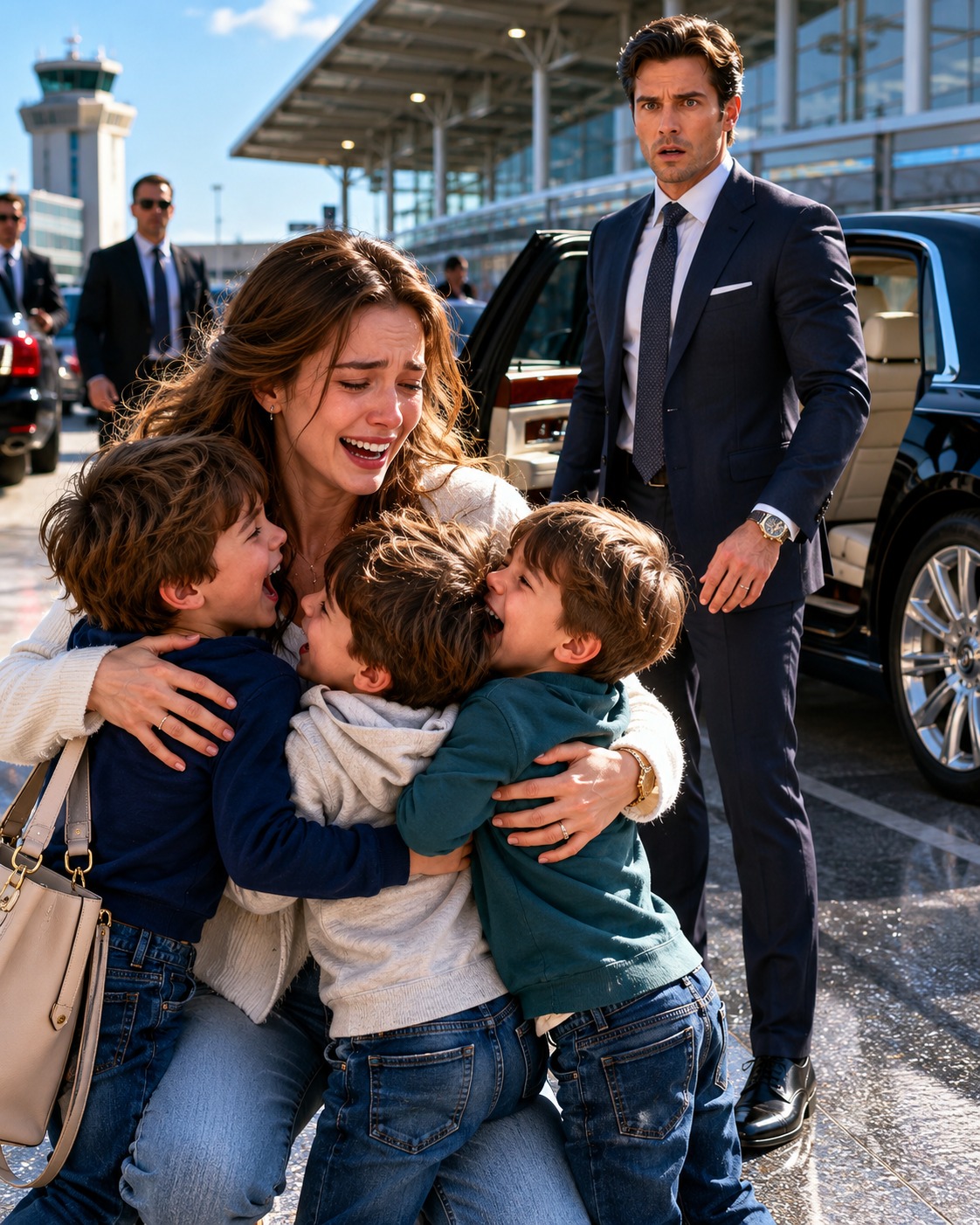
Ryan Calloway looked like a man watching the ground disappear beneath his feet.
All the color had drained from his face. The noise of the airport moved around us—engines growling, luggage wheels rattling, drivers calling names—but he seemed trapped in a silence only he could hear.
The boys didn’t notice at first.
Oliver, my oldest by nine minutes, clung to my waist and started talking at once. “Mom, Aunt Sophie let us have pancakes for dinner yesterday.”
“No, she didn’t,” said Noah, his twin, with all the seriousness of a tiny judge. “She said they were breakfast tacos.”
“They were pancakes,” Oliver insisted.
The youngest, Liam, looked up at me with his round cheeks and bright eyes. “I missed you the most.”
“You always say that,” Noah complained.
“Because it’s always true.”
I laughed, pressing a kiss to Liam’s hair. “I missed all of you the most.”
Then Oliver turned.
And saw Ryan.
His little body went still.
Noah followed his gaze.
Liam, still wrapped around my legs, tilted his head.
For a moment, the three boys stared at the stranger beside me, studying him with the intense curiosity only children have when they sense adults are hiding something.
Ryan tried to speak.
Nothing came out.
He swallowed hard, his eyes moving from one boy to another as if he were counting pieces of a life he had never known existed.
“They’re…” His voice broke. He tried again. “Emily, they’re yours?”
My arms tightened around my sons.
“Yes.”
Ryan’s eyes lifted to mine.
“And mine?”
The question was barely a whisper, but it landed between us like a verdict.
I didn’t answer immediately. Not because I doubted the truth, but because once I said it aloud, there would be no returning to the life I had built without him.
Oliver looked up at me. “Mom?”
I smoothed his hair. “Get in the car, sweetheart.”
“But—”
“Now, Oliver.”
He knew that voice. All three of them did. It was the voice that meant there would be no negotiation.
Sophie stepped out of the Bentley then, her red hair tucked under a cream scarf, her eyes already sharp with concern. She had been my closest friend since college, my emergency contact, my sons’ honorary aunt, and the only person who had stood beside me through every contraction, every fever, every silent night when the past tried to crawl back into bed with me.
Her gaze flicked from me to Ryan.
Then to his face.
Then back to mine.
“Oh,” she said softly. “So this is happening.”
“Take the boys home,” I told her.
Sophie’s expression hardened. “Emily—”
“Please.”
The boys protested, but Sophie moved quickly. She opened the door and guided them inside with the kind of cheerful command only she possessed.
“Come on, princes. Emergency cake situation at home.”
Liam gasped. “Cake?”
“Very serious cake.”
Noah narrowed his eyes. “Is Mom coming?”
“She’ll be right behind us.”
Ryan didn’t look away from the Bentley until the door closed.
Even then, he kept staring at the dark window where three small faces pressed close, watching us.
The driver pulled into traffic, and the Bentley disappeared into the stream of cars.
Only then did Ryan turn back to me.
His voice was different now. Gone was the old arrogance. Gone was the sharpness he used to wear like armor.
“How old are they?”
I inhaled slowly. “Four.”
His eyes closed for half a second.
“Four,” he repeated.
“Yes.”
His mouth parted as if he had been struck. “Emily.”
“Don’t.”
“They’re my sons.”
“They are my sons,” I said, colder than I intended. “I carried them. I raised them. I sat up through the fevers. I taught them to walk. I taught them to share. I held them when they cried for things they didn’t understand.”
His jaw tightened, but this time not from anger.
From pain.
“You kept them from me.”
I felt something inside me twist.
“I protected them from you.”
Ryan stared at me.
There it was.
The truth I had never said aloud to his face.
A security guard glanced our way, probably wondering if he needed to intervene. I grabbed the handle of my suitcase and stepped away from the curb.
“I’m leaving.”
Ryan followed immediately. “No. You don’t get to drop this in the middle of an airport and walk away.”
“I didn’t drop anything. They ran out of a car.”
“Emily.”
I turned on him so sharply he stopped.
“You signed divorce papers while I was pregnant,” I said.
His face changed.
“I didn’t know.”
“No. You didn’t ask.”
His eyes searched mine, desperate now. “You never told me.”
“I tried.”
The words came out quieter than I expected.
For a second, five years vanished.
I was back in our penthouse with the snow falling outside. Back with my hands shaking around a pregnancy test. Back with Ryan standing across from me, his eyes full of suspicion, his voice like ice.
“I tried to tell you,” I said. “Three times.”
Ryan’s brow furrowed. “What are you talking about?”
“The night after you found the messages, I came to your office. Your assistant said you were unavailable.”
“I was in London.”
“I know that now. I didn’t then.”
He went still.
“I left a note.”
His face tightened. “What note?”
I laughed once, but there was no humor in it. “Of course.”
“Emily, what note?”
I looked at him for a long moment. “It said I was pregnant.”
The airport seemed to fall away.
Ryan’s expression emptied.
“No,” he said.
“Yes.”
“No, I never got a note.”
“Then someone made sure you didn’t.”
His eyes flashed with something dangerous. The old Ryan was still there somewhere, but the anger wasn’t aimed at me now.
I didn’t let that soften me.
“Then I called you,” I continued. “You blocked my number.”
“I didn’t block you.”
“You did.”
“I didn’t.”
I took my phone from my coat pocket, though the old phone was long gone, and the evidence with it. “Your lawyer sent a message saying all communication had to go through legal counsel.”
Ryan looked genuinely confused. “That was standard during the divorce.”
“Standard,” I repeated. “I was pregnant, alone, accused of cheating, and your lawyer told me I was not to contact you directly.”
He dragged a hand over his face.
I could see him trying to rearrange the past, trying to force old memories into a new shape.
“And then?” he asked hoarsely.
“Then I went to your mother.”
His eyes snapped to mine.
I saw it the moment he understood.
“Victoria?”
I smiled bitterly. “Yes. Victoria Calloway. The woman who never thought I was good enough for you. The woman who smiled at our wedding as if she were attending a funeral.”
“What did she do?”
“She told me you knew.”
Ryan’s lips parted.
“She said you knew about the pregnancy, and that you wanted nothing to do with me or the baby. She told me if I tried to contact you again, she would make sure the divorce became public, ugly, and humiliating.”
Ryan stood completely still.
I kept going because now that the door had opened, I couldn’t stop the past from flooding out.
“She said you believed the child wasn’t yours. She said you would demand a paternity test, accuse me in court, destroy my career, and take the child from me if somehow it turned out to be yours.”
“Emily,” he whispered, horrified.
“I was twenty-eight. Pregnant. Sick every morning. Living out of boxes. The man I loved looked at me like I disgusted him. Your mother had lawyers, money, influence. I had a suitcase and a job offer in Chicago.”
I looked toward the road where Sophie’s Bentley had disappeared.
“So I left.”
Ryan’s eyes shone, but no tears fell. Ryan Calloway had always been too disciplined for visible collapse.
“I would never have taken them from you.”
“You threw me out of your life based on messages you didn’t understand.”
His face tightened.
“That was different.”
“No,” I said. “That was exactly the point.”
His voice dropped. “Then explain the messages now.”
I almost laughed.
After five years, after three children, after an airport reunion that had shattered everything, he still needed the explanation.
Maybe we both did.
I pulled my coat tighter around me. “His name was Daniel Mercer.”
Ryan’s eyes darkened immediately. The name still meant something to him. Good.
“He worked in battery storage compliance,” I said. “He was helping me investigate the safety flaw in the East River prototype.”
Ryan stared at me.
My voice lowered. “The flaw your board buried.”
He shook his head slowly. “No. That flaw was corrected.”
“It wasn’t. Not completely.”
“Emily—”
“I found falsified reports. I found altered thermal stress data. I found emails from executives pressuring the testing team to sign off before the gala launch.”
Ryan’s expression shifted from disbelief to something far more troubling.
Recognition.
“You knew?” I asked.
“No,” he said quickly. Too quickly. Then he exhaled. “I knew there were delays. I knew there were concerns. I was told they were resolved.”
“By whom?”
He didn’t answer.
I didn’t need him to.
“Your mother,” I said.
Ryan looked away.
Victoria Calloway had never held an official title at Calloway Energy, but everyone knew she moved through that company like a shadow queen. Investors listened when she spoke. Board members feared disappointing her. Ryan loved pretending he had built an empire alone, but Victoria had sharpened the knives behind every door he opened.
“Daniel was helping me gather enough proof to force an internal review,” I said. “Those messages you found weren’t romantic. They were coded because we were afraid someone inside the company was monitoring communications.”
Ryan’s voice was rough. “You should have told me.”
“I was going to.”
“When?”
“The night you found them.”
He flinched.
“I had planned to tell you everything,” I continued. “About the flaw. About Daniel. About the pregnancy. I thought you would stand with me.”
The silence between us hurt more than shouting would have.
Ryan looked at the ground. “Instead, I accused you.”
“Yes.”
“Why didn’t Daniel come forward?”
My stomach turned.
“He died.”
Ryan’s head lifted sharply.
“Two weeks after the divorce papers were filed,” I said. “Car accident in New Jersey. Officially.”
Ryan’s face went still in a way that frightened me.
“Officially?” he asked.
“I stopped asking questions after that.”
“You were afraid.”
“I was pregnant with triplets,” I said. “So yes. I was afraid.”
For a moment, something like rage passed across Ryan’s face, but it disappeared almost as quickly as it came.
“What happened to the prototype?” he asked.
“You postponed the launch three months later.”
He frowned. “Because the board recommended additional testing.”
“Did they?”
His eyes held mine.
I saw the pieces connecting in his mind. Slowly. Painfully.
The messages. The accusation. The divorce. My disappearance. Daniel’s death. The buried flaw. Victoria.
And three little boys who should have grown up knowing their father.
Ryan reached for my hand.
I stepped back.
His hand froze in the air.
“Don’t,” I said.
He lowered it.
“I need to see them,” he said.
“No.”
“They’re my children.”
“They don’t know you.”
His jaw clenched. “Whose fault is that?”
The words hit before he could stop them.
I saw regret flash across his face instantly, but it was too late.
“My fault?” I asked quietly.
“No. That’s not what I meant.”
“You should leave, Ryan.”
“Emily—”
“I mean it.”
A black SUV pulled up behind us. Ryan’s driver stepped out, cautious and silent.
Ryan ignored him.
“I’m not walking away from this.”
“You already did.”
“I didn’t know.”
“And now you do.” My voice shook despite my best effort. “But knowing doesn’t erase five years.”
His eyes searched mine. “What do you want from me?”
The question surprised me.
Because for years, I had imagined this moment. I had imagined screaming. I had imagined throwing the truth at him like shattered glass. I had imagined his remorse, his shock, his begging.
But standing there in the cold Chicago air, all I wanted was to go home and tuck my sons into bed.
“I want you not to scare them,” I said. “I want you not to storm into their lives because your pride is bleeding. I want you to understand that they are children, not evidence in a case.”
Ryan nodded slowly.
“I can do that.”
“I don’t know that.”
“You knew me once.”
“Yes,” I said. “That’s why I don’t know.”
He absorbed that like a blow.
I walked away before he could say anything else.
For the first time in five years, Ryan Calloway didn’t follow.
By the time I reached home, my hands had stopped shaking, but my heart had not.
Our house sat on a quiet street in Lincoln Park, all warm brick and ivy, with a blue front door the boys had picked because Liam said it looked “like a happy crayon.” It was not a penthouse. It did not have marble floors or a private elevator. But it had finger paintings on the fridge, tiny sneakers by the stairs, and a backyard full of muddy treasures.
It was mine.
It was ours.
Sophie was waiting in the kitchen with a glass of wine she knew I wouldn’t drink and a face full of questions she knew better than to ask in front of the boys.
They were at the table, eating cake.
Actual cake.
“Sophie,” I said.
She shrugged. “Emergency cake was promised. I am a woman of integrity.”
Oliver had chocolate on his chin. Noah was dissecting his slice with a fork. Liam had somehow gotten frosting in his hair.
“Mom,” Oliver said, “who was that man?”
The kitchen became very quiet.
Sophie looked at me.
I set down my bag.
There are moments in motherhood when you can feel childhood shifting beneath your hands. Moments when the soft world you built for your children must make room for harder truths.
I sat at the table.
“He’s someone I knew a long time ago.”
Noah studied me. “He looked like us.”
Oliver nodded. “A lot.”
Liam licked frosting from his thumb. “Is he a prince?”
Sophie made a choking sound and turned toward the sink.
I brushed a crumb from Liam’s sleeve. “No, sweetheart.”
“Then why did he have a driver?”
“Lots of people have drivers.”
“No, they don’t,” Noah said.
I sighed.
Oliver stared at me with those dark Calloway eyes, so serious it hurt. “Is he our dad?”
The word landed softly.
Dad.
Not father. Not biological parent. Dad.
A word that had been missing from our house not because I hated Ryan, but because I didn’t know how to explain a man who had both existed and vanished before they were born.
I reached across the table and took Oliver’s hand.
“Yes,” I said.
Sophie closed her eyes.
Noah’s fork stopped moving.
Liam blinked. “We have a dad?”
I forced myself to smile. “Everyone has a dad somewhere.”
“Where was he?” Noah asked.
There it was.
The question I had feared.
“He didn’t know about you.”
Oliver frowned. “How can someone not know about three kids?”
Sophie whispered, “Fair question.”
I gave her a look.
She lifted both hands and pretended to be fascinated by the kettle.
“There were grown-up problems,” I said carefully. “Big misunderstandings. Things that happened before you were born.”
Noah’s eyes narrowed. “Did he do something bad?”
I thought of Ryan in the penthouse, his voice full of ice. I thought of Victoria’s pearls gleaming under chandelier light while she told me my child would be taken from me. I thought of Daniel’s funeral, watched from across the street because I was too afraid to be seen.
I chose my words with care.
“He made mistakes.”
“Do we have to meet him?” Oliver asked.
“No,” I said immediately. “Not until you want to.”
Liam looked relieved. Noah looked suspicious. Oliver looked thoughtful.
Then Liam whispered, “Will he bring cake?”
Sophie burst out laughing.
And somehow, the world kept turning.
That night, after the boys were asleep, Sophie and I sat in the living room with the lights low.
She didn’t ask what happened.
She waited.
So I told her everything.
When I finished, she looked ready to commit several felonies.
“Victoria,” she said flatly.
“Yes.”
“I always hated that woman.”
“You hate most people.”
“Only when I’m right.”
I leaned back against the couch and closed my eyes. “Ryan says he never got the note.”
“Do you believe him?”
I hated how quickly the answer came.
“Yes.”
Sophie was silent for a moment.
“That doesn’t make him innocent,” she said.
“I know.”
“But it makes this uglier.”
“I know that too.”
My phone buzzed on the coffee table.
Unknown number.
Sophie and I stared at it.
It buzzed again.
I picked it up slowly.
A text message appeared.
Emily, it’s Ryan. Please don’t block me. I won’t come to your house. I won’t contact the boys. But there are things I need to know, and things you need to know. Victoria is in Chicago.
My blood ran cold.
Another message arrived.
She landed this afternoon.
Sophie leaned over and read the screen.
“Oh, hell no,” she whispered.
I stood so fast my knee hit the table.
Victoria Calloway had no reason to be in Chicago.
Unless she already knew.
Unless she had known before Ryan did.
Unless the airport scene had not been an accident at all.
My phone buzzed again.
Ryan: I need to see you tonight.
Sophie shook her head. “Absolutely not.”
But I was already moving toward the stairs.
“Emily.”
“I’m checking the boys.”
They were asleep in their room, all three in a tangle of blankets and stuffed animals. Oliver on his side, Noah flat on his back, Liam curled like a comma around a dinosaur.
Safe.
Still mine.
Still untouched by the storm gathering outside.
I stood there longer than necessary, listening to them breathe.
When I came back downstairs, Sophie had my coat in her hands.
“I’m going with you,” she said.
“No.”
“Emily.”
“You’ll stay with the boys.”
She hated it. I could see that. But she understood.
I texted Ryan only one sentence.
Where?
His answer came immediately.
The Peninsula. Private lounge. I’ll have security in the lobby.
I almost laughed at that.
Ryan always thought security solved everything.
Thirty minutes later, I walked into the Peninsula Chicago wearing jeans, boots, and the emotional exhaustion of a woman who had already survived too much.
Ryan was waiting near the lobby fireplace.
He had changed out of his travel suit into a dark sweater and coat, but nothing could hide how shaken he looked. His eyes found mine immediately.
“You came.”
“Victoria is here?”
“Yes.”
“Why?”
“I don’t know yet.”
“Then why tell me?”
“Because my head of security flagged something strange.” He glanced around, then lowered his voice. “One of my mother’s private investigators accessed your property records six weeks ago.”
A chill moved through me.
“Six weeks?”
Ryan nodded.
“She knew where I lived?”
“Yes.”
My fingers curled into my palms. “How long have you known?”
“I found out an hour ago.”
“Convenient.”
His face hardened, not with anger, but with restraint. “You can hate me later. Right now, I need you to understand that my mother may have been watching you.”
I looked toward the elevator.
“Did she know about the boys?”
“I don’t know.”
But his eyes told me he feared the answer.
We went upstairs to a private lounge with dark wood walls and a view of the glittering city. A security man stood outside the door. Inside, a folder waited on the table.
Ryan didn’t touch it immediately.
Instead, he looked at me.
“I called my former assistant.”
“The one who turned me away?”
“Yes.”
“And?”
“He remembers you coming to the office.”
My throat tightened.
“He said you left something in an envelope. Personal. Marked for me only.”
The room seemed to tilt.
Ryan opened the folder and pulled out a scanned copy of an old office log.
There it was.
My name.
Emily Carter Calloway.
Time of arrival.
Envelope received.
My handwriting described in a note.
I pressed a hand to my mouth.
Ryan’s voice was quiet. “He gave it to my mother.”
I looked up.
“She told him she would deliver it to me personally. He believed her.”
The anger that rose in me was so old and sharp it felt almost clean.
“She knew.”
Ryan nodded once.
“She knew I was pregnant.”
“Yes.”
“She lied to both of us.”
His face twisted. “Yes.”
I turned away, gripping the back of a chair.
For years, I had wondered if I had been weak. If I should have fought harder, shouted louder, forced myself through every locked door. But the door had never merely been locked.
Someone had been standing on the other side, holding it shut.
Ryan pulled another document from the folder.
“There’s more.”
I didn’t want more.
I wanted to go home.
But truth, once awakened, is merciless.
“What is that?”
“Daniel Mercer’s accident report.”
My heart stumbled.
Ryan placed it on the table. “I had someone pull it.”
“You did that in an hour?”
“I’m Ryan Calloway.”
For one second, the old arrogance returned.
Then it vanished.
“I mean,” he said quietly, “I still know people who answer when I call.”
I scanned the document, but the words blurred.
Single-vehicle collision.
Brake failure suspected.
Case closed.
Ryan pointed to a line near the bottom.
“The mechanic who inspected the vehicle was later hired by a subsidiary connected to my mother’s investment trust.”
I looked at him.
“No,” I whispered.
“I don’t know what it means yet.”
“You know exactly what it means.”
His face was grim. “I know what it might mean.”
A sound escaped me, small and broken.
Daniel had not been my lover. He had been my friend. Brilliant, nervous, idealistic Daniel, who believed companies could be forced to do the right thing if the evidence was strong enough.
And he had died while I was too busy trying to survive.
Ryan stepped closer, then stopped himself.
“I’m sorry,” he said.
The words were simple.
Too simple for what they had to carry.
I looked at him through tears I refused to let fall.
“You don’t get to be sorry once and call it redemption.”
“I know.”
“Do you?”
His eyes held mine. “I know I destroyed our marriage because I trusted my anger more than I trusted you.”
That silenced me.
He continued, voice rough. “I know I let my pride fill in every blank. I know I believed the worst because it was easier than admitting I was afraid of losing you. And I know that while I was drowning myself in work and telling the world I was fine, you were raising my sons alone.”
My lips trembled despite myself.
“I don’t want your pity.”
“It isn’t pity.”
“Then what is it?”
His answer came so quietly I almost missed it.
“Grief.”
The word settled between us.
For the marriage.
For the children.
For the years.
For the people we had been before suspicion and silence ruined us.
I looked out at Chicago. Lights glittered beyond the glass, a city alive with strangers who had no idea my world was being rewritten above them.
“What do you want, Ryan?”
He didn’t hesitate.
“To know them.”
My chest tightened.
“And me?”
The question escaped before I could stop it.
Ryan went very still.
His eyes searched my face. “I never stopped loving you.”
I almost hated him for saying it.
Because some buried, wounded part of me had waited five years to hear those exact words.
I stepped back.
“Love didn’t save me.”
“I know.”
“Love didn’t make you believe me.”
“I know.”
“Love didn’t protect our children.”
His face crumpled just slightly.
“No,” he said. “It didn’t.”
I wiped my cheek quickly. “Then don’t bring love into this yet.”
He nodded.
“All right.”
At that moment, the door opened.
Ryan turned sharply.
His security man stepped in, tense. “Sir. Your mother is downstairs.”
The room froze.
Ryan’s face hardened. “Did you tell her I was here?”
“No, sir.”
I felt cold all over.
The guard glanced at me. “She asked for Mrs. Calloway.”
I hadn’t used that name in five years.
Ryan looked at me.
I shook my head once.
“No.”
But the door was already opening wider.
Victoria Calloway entered as if she owned the hotel, the city, and every breath inside it.
She was elegant in a winter-white coat, silver hair swept into a flawless twist, diamonds at her ears. At sixty, she remained beautiful in the way expensive statues are beautiful—cold, polished, and impossible to comfort.
Her gaze moved over Ryan first.
Then me.
“Emily,” she said. “Still making scenes, I see.”
Ryan stepped in front of me. “Leave.”
Victoria’s eyebrows rose. “Is that any way to speak to your mother?”
“It is tonight.”
She smiled faintly. “Ah. So you know something.”
Ryan’s voice turned lethal. “I know enough.”
Victoria looked almost amused. “You always did confuse fragments with truth.”
I stepped around Ryan.
For five years, I had imagined seeing her again. I thought I would tremble. I thought she would make me feel small.
But she looked smaller than I remembered.
Not less dangerous.
Just more human.
“You knew I was pregnant,” I said.
Her eyes flickered.
There.
Proof.
Only for a second, but enough.
Ryan saw it too.
“You took the note,” he said.
Victoria removed her gloves slowly. “You were in no state to be a father.”
Ryan went pale with fury.
“You don’t get to decide that.”
“I decided many things while you were building that company.”
“My children,” he said, each word sharp. “You kept my children from me.”
Victoria’s mouth tightened. “I kept a scandal from destroying you.”
Emily laughed softly. “A scandal?”
“A disputed pregnancy during a corporate crisis?” Victoria said. “An unstable wife communicating secretly with a male employee who died under unfortunate circumstances? You have no idea what the press would have done.”
Ryan stared at her. “You mean what you would have fed them.”
Victoria’s silence was answer enough.
The room seemed to darken.
“What happened to Daniel?” I asked.
For the first time, Victoria looked directly at me.
“I don’t know.”
I didn’t believe her.
Neither did Ryan.
“But you’re asking the wrong question,” she continued. “The dead man is not your problem.”
Ryan stepped closer. “Then what is?”
Victoria’s eyes shifted between us.
“The living one.”
My stomach dropped.
“What does that mean?” I asked.
Victoria looked at Ryan. “Your father had a second family.”
The words struck the room so violently that even Ryan seemed unable to react.
His father, Charles Calloway, had died ten years earlier. Ryan rarely spoke of him except in polished sentences fit for interviews. Founder. Visionary. Difficult man. Complicated legacy.
“What are you talking about?” Ryan said.
Victoria’s smile disappeared.
“Your father had a son before you. Older. Illegitimate. Hidden. Paid off for decades.”
Ryan shook his head. “No.”
“Yes.”
“Why are you telling me this now?”
“Because he found Emily before I did.”
My breath stopped.
Ryan turned to me. “What?”
“I don’t know what she’s talking about.”
Victoria reached into her handbag and placed a photograph on the table.
It was grainy, taken from a distance.
My backyard.
The boys playing under the maple tree.
A man stood on the sidewalk beyond the fence, half turned away from the camera.
Dark coat.
Dark hair.
Familiar posture.
Ryan picked up the photograph slowly.
His face changed.
Not with recognition.
With horror.
Victoria spoke softly.
“His name is Adrian Vale. He believes your sons are the rightful heirs to something your father stole from him.”
“My sons?” I whispered.
Victoria’s eyes settled on me.
“Yes, Emily. That is why I came to Chicago.”
I looked at Ryan, but he looked as lost as I felt.
The photograph trembled slightly in his hand.
Victoria took one step toward the door.
“For once, Ryan, this is not about your wounded heart. It is not about your marriage. It is not even about the children you just discovered.”
She paused, and the faintest trace of fear crossed her perfect face.
“It is about what your father buried before he died.”
The door closed behind her.
No one moved.
Outside the window, Chicago glittered like nothing had changed.
But everything had.
Ryan stared down at the photograph of my sons, taken by a stranger who had been watching them.
Then he turned it over.
On the back, written in black ink, were six words.
The boys belong to Calloway blood.
My phone began to ring.
Sophie.
I answered with a shaking hand.
Her voice came through in a whisper.
“Emily… someone is outside the house.”
Ryan was already running for the door.
And I knew, with a terror deeper than anything I had felt in five years, that the truth about my sons had only just begun.
PART 3 — The Stranger at the Gate
Ryan reached the elevator before I did.
For a man who had spent half his life moving through the world as if doors opened because the universe owed him space, he suddenly looked like someone willing to tear the whole building apart with his bare hands.
“Ryan,” I called, struggling to keep up.
He stabbed the elevator button twice. “Call Sophie back.”
My fingers shook so badly I nearly dropped the phone.
Sophie answered on the first ring.
“Emily?”
“I’m here. Lock every door. Take the boys upstairs.”
“I already did. They’re in my room. I told them we’re playing flashlight pirates.”
“Is he still there?”
A pause.
Then Sophie whispered, “Yes.”
Ryan’s face hardened. “Ask her what he’s doing.”
“What is he doing?” I repeated.
“He’s standing across the street under the maple. Not hiding. Just… watching.”
The elevator doors slid open.
Ryan pulled me inside and pressed the lobby button.
His security man followed, speaking rapidly into an earpiece. “Two vehicles ready. Notify Chicago PD discreetly. No sirens unless necessary.”
“No police yet,” I said sharply.
Ryan looked at me as if I had lost my mind. “Emily.”
“We don’t know who he is.”
“We know he’s watching our sons.”
Our sons.
The words hit me in the chest, unexpected and painful.
Not because they were false.
Because they were true.
For five years, I had built an entire life around the idea that I was the only parent my children had. Then in less than one day, Ryan had stepped out of the past, Victoria had dragged a ghost from the Calloway family tree, and a stranger had appeared outside my home.
The elevator descended too slowly.
Sophie’s voice trembled in my ear. “Emily, he moved.”
My lungs stopped working.
“Where?”
“He’s walking toward the house.”
Ryan’s hand closed around my wrist. “Tell her to go to the safe room.”
“We don’t have a safe room,” I snapped.
His face changed, horror flashing through him.
Because of course we didn’t.
We had a pantry full of cereal, a hall closet overflowing with boots, a basement where the boys kept broken crayons and dinosaur costumes.
We did not have a billionaire’s panic room.
“Sophie,” I said, forcing my voice steady, “take the boys into the bathroom at the end of the hall. Lock it. Put the dresser in front of the door if you can.”
“Already moving.”
In the background, I heard Liam ask, “Aunt Sophie, why are we whispering?”
My heart cracked clean down the middle.
Sophie’s voice turned bright and false. “Because pirates are sneaky, honey.”
Then Noah said, serious and suspicious, “This is not normal pirate behavior.”
Ryan closed his eyes for one brief second.
Pain crossed his face.
Not the polished grief of a man regretting the past from a safe distance.
Real pain.
The kind that arrives when a father hears his child afraid and realizes he has never once been there to protect him.
The elevator doors opened.
We ran.
Outside the hotel, Chicago wind slapped my face. Ryan’s black SUV was already at the curb, engine running. He opened the door for me, then climbed in after me.
“To Lincoln Park,” he ordered. “Fast.”
The driver moved instantly.
Ryan took another phone from his coat pocket. “Marcus, I want two units to the rear alley and one on foot from the north side. No contact unless he attempts entry. I want him alive and talking.”
I stared at him.
“Alive?”
His eyes met mine. “You heard Victoria. This isn’t random.”
“You think Adrian Vale is dangerous?”
“I think anyone who watches four-year-olds through a fence is dangerous.”
I couldn’t argue.
Sophie stayed on the phone, breathing softly. The line crackled once.
Then she whispered, “Emily. He’s at the gate.”
I gripped the phone. “Don’t look out.”
“I’m not. The doorbell camera alerted my phone.”
Ryan held out his hand. “Let me hear.”
I put the call on speaker.
For a moment, there was only silence.
Then came three soft knocks.
Not on the front door.
On glass.
Sophie inhaled sharply. “He’s at the kitchen door.”
My stomach dropped.
The kitchen door faced the backyard.
The fenced backyard.
The locked backyard.
“He got inside the gate,” I whispered.
Ryan’s voice turned deadly calm. “Sophie, listen to me. Do not answer. Do not speak. Stay where you are.”
A new sound drifted through the phone.
A man’s voice.
Low. Controlled.
“Emily Carter. I know you’re not there.”
My blood turned cold.
Sophie stopped breathing.
The voice continued.
“I’m not here to hurt the children.”
Ryan’s jaw tightened so hard I thought it might crack.
The man at my kitchen door spoke again.
“But Victoria found you, and now others will too.”
Ryan leaned toward the phone. “Who are you?”
Silence.
Then the man laughed once.
Not cruelly.
Sadly.
“Ryan Calloway,” he said. “Your mother always was careless when frightened.”
Ryan went still.
“Adrian Vale?” he asked.
Another pause.
“Yes.”
The SUV sped through wet streets, lights smearing across the windows like broken stars.
“Step away from the house,” Ryan ordered. “Now.”
“I will,” Adrian replied. “But first, Emily needs to know something.”
“No,” Ryan said. “You don’t speak to her.”
I grabbed the phone closer. “What do I need to know?”
Ryan looked at me. “Emily—”
But I ignored him.
Adrian’s voice lowered.
“The boys are not in danger because they are Ryan’s sons.”
My pulse thudded in my ears.
“They’re in danger because one of them is not supposed to exist.”
The world narrowed to the sound of my own breathing.
“What does that mean?” I demanded.
Adrian didn’t answer immediately.
Then, from somewhere upstairs in my house, Liam began to cry.
That tiny sound ripped through every defense I had left.
“Stay away from my children,” I said.
“I have spent years staying away,” Adrian answered. “That mistake ends tonight.”
Ryan took the phone from my hand. “If you touch them, I will bury you.”
Adrian’s voice sharpened for the first time.
“Your father already buried enough people.”
Then the line went dead.
I stared at the phone.
Ryan redialed. No answer.
“Drive faster,” he said.
The driver did.
By the time we reached my street, Ryan’s security had arrived.
Three men in dark coats stood near the sidewalk, speaking into radios. Another moved along the side fence. The Bentley was still in the driveway, Sophie’s car behind it.
My house looked exactly as it always did.
Blue door.
Porch light glowing.
Curtains warm.
A child’s red scooter tipped on the lawn.
But everything felt changed.
A home is never more fragile than the moment danger knows its address.
I tried to jump out before the SUV fully stopped.
Ryan caught my arm. “Wait.”
“My boys are inside.”
“And we don’t know where he is.”
“I don’t care.”
“I do.”
The words were quiet, but something in them stopped me.
Ryan looked at the house, then back at me.
“I missed five years,” he said, voice rough. “Don’t make me lose them before I even know them.”
For half a second, we were not ex-husband and ex-wife.
We were two terrified parents on the same side of a locked door.
His security cleared the front entrance. Ryan and I went in together.
“Sophie!” I called.
“Upstairs!”
I ran so fast I nearly stumbled.
The bathroom door opened before I reached it. Sophie stood there with a lamp in one hand and terror in her eyes. Behind her, three boys huddled in a bathtub full of pillows and blankets.
Liam launched himself at me first.
“Mom!”
I sank to the floor and pulled all three into my arms.
Oliver tried not to cry and failed.
Noah whispered, “There was a man in the yard.”
“I know,” I said, kissing their hair, their cheeks, every inch I could reach. “You’re safe. You’re safe.”
Ryan stopped in the hallway.
He didn’t come closer.
The boys noticed him at once.
Liam’s tears slowed.
Noah’s eyes narrowed.
Oliver stared.
Ryan looked like he wanted to speak but didn’t trust himself.
Finally he crouched, keeping distance between them.
“Hi,” he said softly.
The word was so small it almost broke me.
Liam sniffed. “Are you the dad?”
Ryan’s face crumpled.
Just for a moment.
Then he nodded. “I think I am.”
Noah frowned. “You think?”
Ryan glanced at me, and I saw the pain there.
Then he looked back at the boys.
“No,” he corrected gently. “I am.”
Oliver stepped slightly in front of his brothers. “Where were you?”
Ryan’s throat moved.
I wanted to answer for him.
I wanted to protect my children from the ugly truth.
But Ryan surprised me.
“I didn’t know about you,” he said. “That is not your fault. It is not your mom’s fault. And I am very sorry I wasn’t here.”
Oliver studied him with the ruthless honesty of a child.
“Are you going to leave again?”
Ryan’s eyes shone.
“No,” he said. “Not unless your mom tells me to stand outside.”
Liam blinked. “Outside forever?”
Ryan almost smiled.
“If I deserve it.”
Noah tilted his head. “Do you?”
Ryan looked at me again.
Then he said, “Probably.”
Sophie made a strangled noise somewhere between a sob and a laugh.
But the fragile moment shattered when one of Ryan’s security men appeared in the hall.
“Sir,” he said. “You need to see this.”
Ryan stood immediately.
I held the boys closer. “What is it?”
The guard looked at the children and lowered his voice.
Ryan stepped into the hall.
I followed after telling Sophie to stay with the boys.
Downstairs, another guard stood in the kitchen holding a small white envelope sealed with black wax.
It had been slipped through the pet door.
We didn’t own a pet.
The boys used that little door to pass toy cars back and forth during backyard games.
My name was written on the front.
Emily.
Ryan reached for it.
“No,” I said.
He stopped.
“It’s addressed to me.”
His jaw tightened, but he let me take it.
Inside was a single folded page.
The handwriting was precise, elegant, old-fashioned.
Victoria lied. Ryan’s father lied first. Daniel Mercer died because he found the wrong archive. Your sons inherited more than a name. Bring Ryan to the place where your marriage ended. Midnight tomorrow. Come alone together, or the truth goes public in a way neither of you can control.
At the bottom was an address.
Our old penthouse building in Manhattan.
The home where Ryan had accused me.
The home where I had tried to tell him I was pregnant.
The home where our life had broken in half.
Ryan read the note over my shoulder.
His face went pale.
“Why there?” I whispered.
He didn’t answer.
But I already knew.
Because ghosts prefer familiar rooms.
And whatever Adrian Vale wanted, it began in the place where Ryan and I had lost everything.
PART 4 — The Penthouse Where Love Died
We flew to New York the next morning.
Not separately.
Together.
Ryan arranged a private jet, security teams, drivers, hotel rooms, backup cars, and enough encrypted communication to invade a small country.
I packed dinosaur pajamas, three toothbrushes, Liam’s stuffed penguin, Noah’s favorite puzzle book, and Oliver’s red hoodie because he said it made him feel “fast.”
The boys stayed in Chicago with Sophie and two security guards who looked deeply uncomfortable when Liam asked if they knew any pirate songs.
I hated leaving them.
Ryan knew it.
At the airport, just before boarding, he stood beside me near the jet stairs.
“I can send someone else,” he said.
“No.”
“Emily.”
“He asked for both of us.”
Ryan’s eyes darkened. “He threatened our family.”
Our family.
Again.
The phrase slipped out of him now like instinct.
I wondered how long it would take before I stopped flinching.
On the flight, neither of us slept.
Ryan sat across from me, studying documents on a tablet. I stared at clouds and tried not to remember another flight, another version of us.
Back then, Ryan used to take my hand during turbulence.
I used to pretend I wasn’t afraid.
He used to know anyway.
Now the jet was smooth as silk, and still my heart jolted at every silence.
“What did you find?” I asked finally.
Ryan looked up.
“My father created a private trust before I was born,” he said. “Not under Calloway. Under a shell name. Vale appears in three offshore transfers.”
“Adrian?”
“His mother, probably.”
“So Victoria told the truth about your father having another family.”
His mouth tightened. “Part of the truth.”
“That’s her favorite kind.”
Ryan gave a humorless laugh.
Then he turned the tablet toward me.
An old black-and-white photograph filled the screen.
Charles Calloway stood beside a young woman with dark hair and a shy smile. She was visibly pregnant.
My breath caught.
“Adrian’s mother?”
“Marisa Vale,” Ryan said. “She worked in my father’s first research lab.”
“Was she an engineer?”
“A physicist.”
I leaned closer. “She looks… young.”
“She was twenty-four. My father was already married to my mother.”
I sat back slowly.
“So Adrian grew up hidden.”
“Yes.”
“And Victoria knew.”
“Of course she knew,” Ryan said bitterly. “Victoria knows where every body is buried because she helped choose the graves.”
We landed under a gray New York sky.
Manhattan looked the same and not the same.
Towers of glass, yellow taxis, steam rising from street grates, people moving like the city would die if anyone slowed down.
Five years earlier, I had fled this place with one suitcase, one secret pregnancy, and a heart so ruined I thought it would never beat normally again.
Now I returned with the man who had broken it sitting inches away.
The penthouse building rose over Central Park like a monument to our old life.
I had not seen it since the night I left.
Ryan’s driver pulled into the private garage.
I stared at the elevator doors.
Ryan noticed.
“We don’t have to do this.”
“Yes, we do.”
The elevator took us up in silence.
I remembered standing in this same mirrored box wearing gala gowns, Ryan’s hand low on my back. I remembered laughing against his shoulder after too much champagne. I remembered us kissing here once while the elevator climbed, desperate and young and convinced nothing could touch us.
Then I remembered the last time.
Me alone.
Pregnant.
Carrying a suitcase.
Trying not to vomit from grief.
When the doors opened, the penthouse waited.
Ryan had kept it.
That shocked me more than it should have.
The furniture was covered in white sheets. The air smelled faintly of dust and sealed windows. Central Park stretched beyond the glass, winter-bare and silver.
“This place should be sold,” I said.
Ryan walked in slowly. “I couldn’t.”
“Why?”
He looked at the floor near the fireplace.
Because that was where it had happened.
Where he had held my phone.
Where I had stood barefoot in a blue sweater, asking him to listen.
Where he had not.
“I thought keeping it punished me,” he said. “Turns out punishment doesn’t become healing just because you decorate around it.”
I looked away.
Then the lights flickered.
A voice came from the far side of the room.
“You always did prefer suffering with a view.”
Ryan moved in front of me.
Adrian Vale stepped out of the shadows near the library doors.
He was older than Ryan by maybe six or seven years. Tall, lean, with dark hair touched by gray at the temples. His face held echoes of Charles Calloway, but sharper, more tired.
He carried no weapon.
That did not make him less dangerous.
Ryan’s voice was cold. “You watched my children.”
Adrian’s gaze shifted to me. “I watched them because Victoria did.”
“Why?” I demanded.
Adrian exhaled. “Because the Calloway inheritance was built on stolen work. Your sons may be the key to proving it.”
I laughed once in disbelief. “They’re four.”
“Exactly.”
Ryan’s eyes narrowed. “Explain.”
Adrian walked to the library shelves and touched a panel I had never noticed before.
A hidden door clicked open.
I stared.
Ryan froze.
“You didn’t know?” Adrian asked.
Ryan’s silence answered.
Inside was a narrow room.
Not a safe.
An archive.
Boxes lined the walls. Old drives. Ledgers. Lab notebooks. Photographs. Legal folders stamped confidential.
Ryan stepped inside first.
I followed, pulse racing.
Adrian stood at the doorway.
“Your father kept copies of everything,” he said. “Affairs. Patents. Bribes. Blackmail. He believed information was immortality.”
Ryan pulled a notebook from a shelf.
His face changed as he read.
“What is this?”
“My mother’s research,” Adrian said. “The original thermal stabilization design behind Calloway Energy.”
Ryan looked up sharply.
“That’s impossible.”
“No,” Adrian said. “It’s inconvenient.”
My stomach twisted.
I knew Calloway Energy’s origin story. Everyone did. Charles Calloway, brilliant entrepreneur, pioneering mind, early investor in renewable storage.
But the equations in that notebook…
I stepped closer.
Then closer.
My breath caught.
“This isn’t just early research,” I said. “This is the basis for the prototype I improved.”
Ryan stared at me.
I pointed to the margins. “These compensator models. This heat distribution structure. I used a variation of it years later because Calloway’s internal archive showed it as company-owned legacy work.”
Adrian’s mouth tightened. “Company-owned because Charles stole it from Marisa after she refused to abort me and disappear.”
Silence filled the room.
Ryan looked sick.
“My mother died before she could sue,” Adrian continued. “Cancer. No money. No recognition. Charles paid just enough to keep us quiet, then Victoria cut us off after his death.”
“Why come now?” Ryan asked.
“Because Daniel Mercer found this room.”
My hand went cold.
Adrian looked at me then.
“He contacted me two weeks before he died.”
The room seemed to tilt.
“Daniel knew about you?”
“He found Marisa’s name in an old patent trail. He was investigating more than the prototype flaw. He was investigating the company’s foundation.”
I gripped the shelf.
Adrian’s voice softened slightly. “He was trying to protect you, Emily.”
My eyes burned.
“I know.”
“No,” Adrian said. “You don’t. He discovered the flaw was not an accident. It was built into Charles’s stolen design because he never fully understood my mother’s failsafe system.”
Ryan whispered, “The missing variable.”
I turned to him. “What?”
“When I was twenty-six, I found references to a missing variable in my father’s notes. He called it the Vale Constant. I thought it was a joke. A placeholder.”
“It was not a joke,” Adrian said. “It was my mother’s final correction. The one thing Charles never stole.”
Ryan looked at the notebook again.
“And the boys?”
Adrian looked at me.
“Triplets run in Marisa Vale’s family.”
I stared at him. “What?”
“My mother was a triplet. So was her grandmother. It is rare, but in our family, it happened again and again.”
“That doesn’t mean—”
“The trust documents were written to identify direct Calloway descendants and Vale-line descendants in the event of contested ownership. Charles feared my mother had hidden proof. So he created a clause.”
Ryan flipped rapidly through the folder Adrian handed him.
His face drained.
“What clause?” I asked.
Ryan swallowed.
“If a child carries both Calloway blood and a genetic marker from the Vale maternal line, that child can trigger a legal review of all patents transferred from Marisa Vale to Charles Calloway.”
I stared at him.
“That’s insane.”
“It’s my father,” Ryan said. “So yes.”
Adrian’s eyes moved between us.
“Your sons are Charles Calloway’s legitimate grandsons through Ryan. If any of them also carry the Vale marker through Emily, they can reopen ownership of the original technology.”
I shook my head. “Through me? I’m not a Vale.”
Adrian’s expression changed.
That was when the penthouse door opened.
Slow applause echoed through the empty room.
Victoria Calloway stood in the main living room, smiling faintly.
“No, Emily,” she said. “You are not a Vale.”
She stepped closer.
“You are Marisa Vale’s granddaughter.”
The words did not make sense.
For one foolish second, I thought I had misheard.
Ryan turned toward me.
Adrian lowered his gaze.
And Victoria smiled like a woman finally placing the last knife on the table.
“My mother died when I was young,” I said slowly. “Her name was Helen Carter.”
Victoria nodded. “Helen Carter was born Helen Vale.”
“No.”
“Yes.”
“No,” I said again, louder.
“My dear, family secrets are rarely original. Your mother was Adrian’s half sister.”
Adrian looked at me then, and something like grief softened his face.
“I didn’t know until Daniel found the records,” he said. “I only knew Marisa had given up a daughter before she died.”
I stepped backward.
Ryan reached for me.
This time, I did not move away.
Because the room was spinning.
Because my entire life had suddenly become a hallway full of locked doors.
Because my sons were not only Ryan’s children.
They were the living intersection of two stolen bloodlines, two buried histories, and one empire built on betrayal.
Victoria looked almost bored. “Now you understand why I kept Ryan away from the pregnancy. One child would have been dangerous enough. Three were catastrophic.”
Ryan’s voice was deadly. “You knew Emily’s mother was a Vale?”
“I suspected.”
“You destroyed my family over a suspicion?”
Victoria’s eyes flashed. “I preserved yours.”
Ryan stepped toward her. “You don’t know what family means.”
For the first time, Victoria’s mask cracked.
“Everything I did, I did because your father would have destroyed us all.”
“No,” Adrian said quietly. “Everything you did was because you enjoyed holding the match after he lit the fire.”
Victoria turned on him. “You know nothing.”
“I know Daniel Mercer was murdered.”
The air froze.
Victoria’s face became stone.
Ryan stared at her.
I whispered, “Say something.”
Victoria did.
“He should not have opened the archive.”
The silence afterward felt like death entering the room.
Ryan’s voice was barely human.
“You had him killed?”
Victoria looked at her son.
Not with remorse.
With disappointment.
“You were always too sentimental for power.”
Ryan lunged.
Adrian caught him.
Security flooded the room seconds later, but Victoria did not run.
She simply lifted her chin.
“I did what Charles would have done.”
Ryan shook off Adrian’s hand and stared at his mother as if seeing her clearly for the first time.
“No,” he said. “You did what you wanted. And now you’re done.”
Victoria laughed softly. “With what proof?”
I looked at the archive.
Then at Ryan.
Then at Adrian.
And finally at the small black device tucked beneath the shelf, its red light blinking silently.
Adrian smiled.
“Daniel taught me one thing,” he said. “Always record the powerful when they think they are winning.”
Victoria’s face changed.
For the first time since I had known her, Victoria Calloway looked afraid.
PART 5 — The Trial of a Mother and a Son
Victoria was arrested quietly.
Not because she deserved quiet.
Because Ryan demanded the boys never see her face on a screaming television outside their home.
But scandals have their own appetite.
By dawn, the story broke.
Calloway matriarch accused in cover-up. Hidden archive discovered. Founder’s patents challenged. Long-buried death investigation reopened.
New York devoured it.
Then Chicago.
Then the world.
Reporters camped outside Ryan’s corporate headquarters. Investors panicked. Board members resigned with statements full of “shock” and “deep concern,” as if half of them had not spent years looking the other way whenever profit required blindness.
Ryan did not hide.
That surprised me.
He stood before cameras two days later, pale but steady, and said the words no billionaire ever wants to say.
“My company was built on truths I did not know and failures I should have questioned. I am cooperating fully with investigators. Calloway Energy will submit to independent review, compensate any stolen intellectual property, and disclose all safety findings related to past prototypes.”
A reporter shouted, “Mr. Calloway, did your ex-wife hide your children from you?”
Ryan’s face changed.
I watched from Sophie’s living room with my arms crossed tightly over my chest.
Ryan leaned toward the microphone.
“No,” he said clearly. “Emily Carter protected our children when my family and I failed to protect her.”
The room erupted.
Sophie looked at me.
I said nothing.
But inside, something old and frozen shifted.
Not healed.
Not forgiven.
But shifted.
The boys met Ryan properly one week later.
Not at his hotel.
Not at a restaurant.
At the Lincoln Park Zoo.
Neutral ground, Sophie declared. Public, child-friendly, and full of animals who would not judge adult foolishness unless they were peacocks.
Ryan arrived without a suit.
Dark jeans. Navy jacket. Hair ruffled by wind.
He looked younger.
Or maybe he looked less armored.
Oliver noticed him first.
“The dad is here,” he announced.
Noah corrected him. “Our dad.”
Liam whispered, “Does he know about snacks?”
Ryan heard that and immediately held up a paper bag.
“I brought pretzels.”
Liam gasped as if Ryan had performed a miracle.
Sophie muttered, “Manipulative. Effective, but manipulative.”
The first hour was awkward.
Painfully awkward.
Ryan asked questions too carefully. The boys answered too bluntly.
Oliver wanted to know why Ryan’s car had black windows.
Noah wanted to know if billionaires had to brush their teeth.
Liam wanted to know if Ryan had ever ridden a giraffe.
“No,” Ryan said.
Liam looked disappointed. “Then what is the point of being rich?”
For the first time, Ryan laughed.
A real laugh.
I had not heard it in five years.
It hurt more than I expected.
Near the lion habitat, Oliver tugged Ryan’s sleeve.
“Can I ask a hard question?”
Ryan crouched immediately. “Always.”
Oliver looked at me first.
I nodded.
“Did you love Mom?”
Ryan went very still.
Around us, families moved with strollers and hot chocolate and ordinary lives.
Ryan looked at Oliver.
“Yes,” he said. “Very much.”
“Then why did you hurt her?”
My breath caught.
Ryan closed his eyes briefly.
When he opened them, they were wet.
“Because I believed something that wasn’t true. And because I let anger speak before love could.”
Noah frowned. “That sounds dumb.”
Ryan nodded. “It was.”
“Super dumb,” Liam added through a mouthful of pretzel.
Ryan smiled sadly. “Super dumb.”
Oliver studied him. “Are you going to hurt her again?”
Ryan looked at me.
He didn’t answer quickly.
That mattered.
“I hope not,” he said. “But hoping is not enough. So I’m going to spend a long time proving I can be trusted.”
Oliver nodded once, like a judge granting probation.
“All right.”
It was not forgiveness.
It was a beginning.
Weeks passed.
Then months.
Ryan learned the boys slowly.
Oliver loved maps and wanted to know where every airplane was going.
Noah loved rules and enforced bedtime with more discipline than any adult.
Liam loved chaos, glitter, and asking billionaires if they were lonely.
Ryan bought them toys at first.
Too many.
I made him return half.
“They have enough,” I said.
“I missed birthdays.”
“You don’t get to replace time with boxes.”
He looked wounded but listened.
The next week, instead of gifts, he brought three library cards and spent an afternoon reading dinosaur books in terrible voices until Noah told him his T. rex sounded “emotionally confused.”
Ryan tried.
Not perfectly.
Sometimes he overstepped.
Sometimes he looked at the boys with such hunger for lost time that I had to remind him they were children, not medicine for his regret.
But he listened.
That was new.
Meanwhile, the investigation widened.
Adrian became both ally and complication.
He and I took a DNA test.
Victoria had told the truth.
My mother, Helen Carter, had been born Helen Vale, adopted by distant relatives after Marisa’s death. She had never told me, perhaps because she never knew enough to explain.
Adrian was my uncle.
The revelation should have felt absurd.
Instead, it felt strangely gentle.
He came to dinner one Sunday with a bouquet of sunflowers and stood awkwardly in my kitchen while the boys circled him like detectives.
“You’re Mom’s uncle?” Noah asked.
“Yes.”
“But you look like Dad.”
“I also find that unfortunate,” Adrian said.
Ryan, standing by the sink, muttered, “Feeling’s mutual.”
Liam looked delighted. “Do we have two dads?”
“No,” everyone said at once.
Adrian turned out to be quieter than I expected. Brilliant. Damaged. Careful around happiness, as if it might bite.
He told me stories about Marisa Vale.
How she wrote equations on napkins.
How she sang badly.
How she believed clean energy would either save the world or expose the greed of men trying to own sunlight.
“She would have liked you,” Adrian told me one evening.
I looked down at my tea.
“I wish I had known her.”
“She would have loved your boys.”
That one broke me.
The legal case became brutal.
Victoria refused a plea deal at first. She claimed age, influence, loyalty, and necessity should protect her.
They did not.
The recording from the penthouse was devastating.
So were the financial trails Ryan uncovered once he stopped protecting the family name and started hunting the truth.
A mechanic confessed to falsifying Daniel’s accident report under pressure.
A former Calloway executive turned over emails proving Victoria orchestrated threats against me during the divorce.
Ryan’s former assistant testified about the envelope.
And then came the trial.
I thought I was ready.
I was not.
The courtroom smelled of polished wood and cold air. Victoria sat at the defense table in a black suit, silver hair perfect, face unreadable.
Ryan sat beside me.
Not touching.
Just there.
When I took the stand, Victoria watched me like she still expected me to shrink.
I did not.
The prosecutor asked about the night I tried to tell Ryan I was pregnant.
My voice shook once.
Then steadied.
“I left a note in an envelope marked for my husband. I believed he would come to me. Instead, I was told he wanted nothing to do with me or the baby.”
“Were you afraid?”
“Yes.”
“Of whom?”
I looked at Victoria.
“Her.”
Victoria’s mouth tightened.
Ryan’s hands curled into fists beside him.
Then came the question I feared most.
“Ms. Carter, why did you not attempt further contact after leaving New York?”
I inhaled.
“Because I believed Ryan knew. Because I believed he had rejected our child. Because Victoria Calloway told me she would use the courts, the press, and her money to destroy me. And because when Daniel Mercer died, I understood people around that company could disappear.”
The courtroom was silent.
The prosecutor nodded.
“No further questions.”
Victoria’s attorney rose, smooth and predatory.
“Ms. Carter, isn’t it true you benefited from keeping your sons away from Mr. Calloway?”
I stared at him.
“Benefited?”
“You maintained full control.”
Ryan shifted beside me, but I lifted a hand slightly.
I could answer.
“I gave birth to triplets alone,” I said. “I worked while recovering from surgery. I slept in ninety-minute pieces for a year. I held three sick babies at once while wondering if I would lose my job. If that was control, counselor, it was a strange kind.”
A murmur moved through the courtroom.
The attorney tried again.
“Yet you never requested child support.”
“No.”
“Why?”
“Because I wanted nothing from a man I believed had abandoned me.”
“And now?”
My eyes moved to Ryan.
His face was full of pain.
Then I looked back.
“Now I know the truth is more complicated. But complicated does not mean painless.”
The attorney had no answer for that.
Weeks later, Victoria was convicted on charges related to obstruction, conspiracy, witness intimidation, and financial crimes connected to Daniel’s death cover-up. The murder charge remained under separate review, but the judge denied bail pending sentencing.
When they led her away, she finally looked at Ryan.
“My son,” she said.
Ryan stood.
For one terrible second, I thought he might go to her.
Instead, he said, “You stopped being my mother the day you stole my children.”
Victoria flinched.
Only once.
But I saw it.
So did he.
Outside the courthouse, snow began to fall.
Ryan and I stood beneath the stone steps, surrounded by cameras behind barricades.
He looked at me.
“Thank you,” he said.
“For what?”
“For surviving what I should have protected you from.”
I wanted to tell him survival was not noble when it was forced.
Instead, I said, “Don’t waste it.”
He nodded.
“I won’t.”
But neither of us knew then that the greatest shock was still waiting.
Not in a courtroom.
Not in an archive.
But inside a small envelope addressed to my son Oliver.
PART 6 — The Child Who Remembered the Code
Oliver found the envelope in a dinosaur book.
It happened on an ordinary Tuesday, which is how life prefers to deliver impossible things.
Ryan was at my house helping with dinner because Liam had declared he would only eat pasta shaped like wheels and Noah had declared wheels were “structurally suspicious.”
Sophie was slicing cucumbers with the intensity of someone imagining they were Victoria Calloway’s reputation.
Adrian sat at the kitchen table with Oliver, helping him build a paper airplane model from a library book about flight paths.
I was stirring sauce when Oliver said, “Mom, why is there a letter in my book?”
The spoon slipped from my hand.
Ryan turned.
Adrian stood so quickly his chair scraped the floor.
Oliver held up a cream envelope.
No stamp.
No name except his.
Oliver Calloway Carter.
Ryan crossed the kitchen in three steps.
“Don’t open it.”
Oliver froze.
Liam whispered, “Is it cursed?”
Noah said, “Statistically unlikely.”
I took the envelope gently.
Inside was a single photograph.
An old photograph.
A woman with dark hair smiled beside a laboratory bench, one hand resting on a notebook.
Marisa Vale.
Behind the photograph was a page of numbers.
Columns and symbols.
At the bottom, written in handwriting I recognized from the archive, were four words.
The third child solves it.
Adrian went pale.
Ryan took the page. “What is this?”
Adrian stared at the numbers.
Then he looked at Oliver.
“How did this get into your book?”
Oliver’s lower lip trembled. “I don’t know.”
I knelt immediately. “Sweetheart, you’re not in trouble.”
“But Dad looks scared.”
Ryan’s face softened instantly.
He crouched too.
“I’m not scared of you,” he said. “I’m scared because grown-ups keep putting hard things too close to you, and I don’t like it.”
Oliver nodded slowly.
Liam climbed onto Ryan’s back without warning.
Ryan nearly toppled.
“Protection dinosaur,” Liam announced.
For one ridiculous second, everyone stopped breathing.
Then Sophie burst out laughing.
The tension cracked just enough to keep us human.
Adrian spread the page flat on the table.
“It’s Marisa’s notation,” he said. “But incomplete.”
Ryan leaned over it. “The Vale Constant?”
“Maybe.”
I stared at the page.
Numbers.
Thermal models.
Repeating patterns in threes.
Triplet sequences.
“The third child solves it,” I murmured.
Noah looked offended. “I’m the second child.”
Liam raised a sauce-covered hand. “I am the third child.”
Everyone turned toward him.
He blinked. “What?”
I looked at Adrian. “No.”
“I didn’t say anything.”
“No,” I repeated. “Whatever this is, no one is using my child.”
Ryan’s voice was firm. “Agreed.”
But Liam slid off Ryan’s back and wandered to the table.
“That looks like my bedtime song.”
The room went silent.
“What?” I asked.
Liam pointed at the page. “The numbers. Mom sings it wrong.”
“I do not sing numbers at bedtime.”
“Yes, you do,” Oliver said. “The humming one.”
Noah nodded. “The one Grandma Helen used to sing when Mom gets sad.”
My skin prickled.
My mother had sung that melody to me when I was little.
No words.
Just a strange, looping tune.
I had sung it to the boys without thinking, especially when they were babies and all three cried at once.
Adrian’s voice was barely audible.
“Marisa sang when she worked.”
Ryan looked at him. “You think the constant was encoded in a lullaby?”
Adrian’s eyes shone with disbelief.
“My mother used rhythm to remember equations.”
Liam tapped the page again.
“This part goes up.”
Then he hummed.
Softly.
Perfectly.
Adrian grabbed a pencil.
Ryan went still.
I could only watch as Adrian marked the page according to Liam’s tune.
Not using him.
Not testing him.
Just following the pattern my child already knew because love had carried it through generations without any of us understanding.
When Adrian finished, he stared at the completed equation.
His hand shook.
Ryan whispered, “Is that it?”
Adrian’s eyes filled with tears.
“Yes.”
“What does it do?”
I already knew.
I could feel it before he said it.
Adrian looked at me.
“It fixes the flaw.”
The room became very quiet.
Daniel had died chasing proof.
Marisa had died erased.
My mother had carried a song without knowing its meaning.
I had sung it over cribs in the dark.
And Liam, my smallest, wildest, frosting-covered boy, had remembered what powerful people had failed to steal.
The missing piece of a billion-dollar empire had survived inside a lullaby.
Ryan sat down hard.
Then he covered his face with both hands.
Oliver whispered, “Did Liam do science?”
Adrian laughed through tears.
“Yes,” he said. “He did science.”
Liam beamed. “Can I have pasta now?”
The discovery changed everything.
Calloway Energy’s flawed prototype could be corrected.
Marisa Vale’s authorship could be proven.
Adrian’s claim became undeniable.
So did mine.
So did my sons’.
But Ryan made the decision before lawyers could turn the boys into assets.
He called a press conference three days later.
This time, he asked me to stand beside him.
I refused.
“This is your company.”
He looked at me across my kitchen table.
“No,” he said. “That’s the point. It was never only mine.”
I went.
Not for Ryan.
For Marisa.
For Daniel.
For my mother.
For every woman whose work had been renamed by a man with better lawyers.
The auditorium was packed.
Ryan stepped to the microphone.
“The technology at the heart of Calloway Energy was not created by Charles Calloway alone,” he said. “It was developed from stolen work by Dr. Marisa Vale. Today, that record changes.”
Cameras flashed.
Ryan continued.
“Effective immediately, Calloway Energy will be restructured. A controlling share will be transferred into the Vale-Carter Trust, dedicated to clean energy research, worker safety, and compensation for suppressed contributors. Emily Carter will lead the independent technical review. Adrian Vale will chair the restitution board.”
A murmur rolled through the room.
Then Ryan looked at me.
“And my sons will inherit no lie from me.”
My throat tightened.
A reporter shouted, “Mr. Calloway, are you giving away your empire?”
Ryan smiled faintly.
“No,” he said. “I’m returning what never belonged to us alone.”
That night, after the boys fell asleep, Ryan and I stood in my backyard under bare branches.
The same yard where Adrian had watched.
Now there were new lights along the fence and security cameras tucked discreetly near the gutters.
But the air felt calmer.
Ryan stared at the boys’ swing set.
“I missed their first steps,” he said.
I said nothing.
“Their first words.”
“Yes.”
“First birthdays.”
“Yes.”
His voice broke. “Did they ask for me?”
I closed my eyes.
“Sometimes. Not by name. They asked why other kids had dads.”
He nodded, swallowing pain.
“What did you say?”
“That families come in different shapes.”
He looked at me.
“And now?”
“Now I don’t know what shape we are.”
Ryan stepped closer but did not touch me.
“I know what I want.”
I laughed softly, sadly. “You always did.”
“I want to earn a place. Not take one.”
That stopped me.
He continued.
“I want to be their father in whatever way does not hurt them. I want to help rebuild what my family broke. And I want…” He exhaled shakily. “I want you. But I know wanting you is the least important part unless I become someone safe enough for you to choose.”
My eyes burned.
Five years ago, Ryan would have demanded.
Now he was asking without asking.
I looked toward the house.
Through the kitchen window, I could see three lunchboxes lined up for tomorrow.
Tiny shoes by the door.
Sophie’s scarf on a chair.
The life I had made.
“I don’t trust you yet,” I said.
“I know.”
“I still get angry.”
“You should.”
“I still remember what your face looked like when you thought I betrayed you.”
He flinched.
“I remember too.”
I wrapped my arms around myself.
“But when Oliver asks hard questions, you answer. When Noah corrects you, you listen. When Liam climbs you like furniture, you don’t look annoyed.”
His mouth curved faintly. “He is very committed to vertical travel.”
Despite myself, I smiled.
Ryan saw it.
The smile faded into something tender.
“Emily,” he whispered.
I shook my head.
“Not yet.”
He nodded, though disappointment flickered through him.
Then I surprised us both.
I reached for his hand.
Not forgiveness.
Not surrender.
Just contact.
His fingers closed around mine as if he had been drowning and had found the edge of shore.
We stood like that in the cold, two people surrounded by damage, holding one small piece of warmth between us.
Neither of us saw Sophie watching from the kitchen window.
But we heard her whisper through the cracked door.
“Finally, idiots.”
PART 7 — The Billionaire Who Chose the Blue Door
Ryan moved to Chicago in spring.
Not into my house.
Into a townhouse six blocks away.
The boys helped choose it because Liam liked the stairs, Noah approved of the smoke detectors, and Oliver said the roof had “good cloud visibility.”
Ryan sold the Manhattan penthouse.
Before closing, he asked me to go back one last time.
I almost refused.
But some rooms must be faced before they can stop haunting you.
The penthouse was empty when we arrived.
No sheets.
No furniture.
Only light and memory.
We stood near the fireplace where our marriage had broken.
Ryan held a small envelope.
“What’s that?” I asked.
“The note.”
My breath caught.
“The pregnancy note?”
He nodded.
“They found it in Victoria’s private files.”
I couldn’t speak.
He handed it to me.
The paper had yellowed slightly at the edges.
My handwriting stared back at me from five years ago.
Ryan,
I know you are angry. I know you think the worst of me. But I need you to hear this from me before anyone else.
I am pregnant.
I am scared, and I still love you, and I need my husband.
Please come home.
Emily.
The room blurred.
Ryan’s voice broke behind me.
“I’m sorry.”
I pressed the note to my chest.
For years, I had remembered myself as desperate, weak, begging for a man who didn’t want me.
But reading those words now, I saw something else.
I had been brave.
Heartbroken, yes.
Terrified, yes.
But brave enough to reach for love one more time.
Ryan stepped beside me.
“I wish I had come home.”
I looked at the empty floor.
“I waited that night.”
His face twisted.
“How long?”
“Until morning.”
A tear slid down his cheek.
Ryan Calloway, who had once treated tears like enemies, let it fall.
“I was in London,” he whispered. “At a board emergency meeting Victoria invented.”
I nodded.
“I know.”
He looked at me.
“I would have come home.”
For the first time, I believed him completely.
Not enough to erase the years.
But enough to loosen the knot around them.
I folded the note carefully.
“I want to keep this.”
“It’s yours.”
“No,” I said softly. “It’s ours. It proves there was a moment when everything could have been different.”
Ryan nodded.
“And it proves who stopped it.”
We left the penthouse without looking back.
That summer, life became strange in the most ordinary ways.
Ryan learned school pickup.
Badly at first.
He brought Oliver home wearing Noah’s backpack and did not notice until Noah informed him that “identity confusion is not a parenting style.”
He learned which stuffed animals were sacred.
He learned Liam hated peas unless they were renamed “dragon seeds.”
He learned that bedtime with triplets required strategy, patience, and occasionally surrender.
One night, he called me at 9:47 p.m.
“Is it normal for them to request separate existential conversations after lights out?”
I smiled into the phone. “Yes.”
“Noah asked where time goes after it passes.”
“What did you say?”
“That adults don’t know either.”
“Good answer.”
“Then Liam asked whether dinosaurs go to weddings.”
I laughed.
Ryan went quiet.
“What?” I asked.
“Nothing. I just like hearing you laugh.”
My smile faded into something softer.
“Goodnight, Ryan.”
“Goodnight, Emily.”
We did not rush.
That was the miracle.
The old Ryan would have wanted resolution, possession, certainty.
The new Ryan showed up with lunch boxes, apologized when wrong, sat through school plays, learned pediatrician forms, and stayed even when no one praised him for staying.
The boys began calling him Dad without hesitation by autumn.
The first time it happened, he cried in his car.
I knew because Oliver told me.
“Dad did weird breathing after we left soccer.”
Ryan was mortified.
“I had allergies,” he insisted.
Noah looked at him. “To feelings?”
Liam patted his arm. “It’s okay, Dad. I cry when pancakes end.”
Something healed between them in pieces.
Between Ryan and me, healing came slower.
It arrived in shared coffee during Saturday cartoons.
In his hand steadying my back when I nearly slipped on icy steps.
In the way he asked before entering my kitchen.
In the way he never spoke badly of me to the boys.
In the way he made space for my anger without defending himself from it.
Then came the night of the charity gala.
The Vale-Carter Foundation hosted its first public event in Chicago, raising funds for women in clean energy research and whistleblower protection.
I wore emerald green.
Ryan stared when he saw me.
Not with ownership.
With wonder.
“You look…” He stopped.
“Careful,” I said.
He smiled. “Like the woman who should have been on every magazine cover instead of standing beside me on them.”
My cheeks warmed.
“That was better.”
During the gala, Adrian gave a speech about Marisa.
Sophie charmed donors into writing checks so large they looked nervous afterward.
The boys attended for exactly forty minutes before Liam spilled sparkling cider on a senator and Noah corrected a CEO’s pronunciation of “photovoltaic.”
Ryan danced with me near the end of the night.
Slowly.
Carefully.
As if I were both memory and future.
The music was soft, the ballroom golden.
“I used to think the worst thing I lost was you,” he said.
I looked up.
“And now?”
“Now I know the worst thing I lost was the man I might have been if I had believed you.”
My throat tightened.
“Ryan…”
“I’m not saying it to make you forgive me.”
“I know.”
“I’m saying it because the boys ask me sometimes whether people can change.”
“What do you tell them?”
“That people can change if they stop making excuses for who they were.”
I rested my head against his shoulder.
His breath caught.
For a moment, we danced inside the life we had not gotten to have.
Then he whispered, “I love you.”
I closed my eyes.
The words no longer felt like a weapon.
They felt like a door.
“I know,” I said.
He did not ask for more.
That was why, months later, on a snowy December evening, I was the one who knocked on his blue-painted townhouse door.
Ryan opened it wearing a sweater dusted with flour.
Behind him, chaos roared.
Oliver yelled, “Dad burned the first cookies!”
Noah shouted, “Technically, carbonized!”
Liam screamed, “We made smoke bread!”
Ryan sighed. “I had ambitious plans.”
I laughed so hard I had to lean against the doorframe.
He watched me with that soft look I was still getting used to.
“What are you doing here?” he asked.
I held up a small wrapped box.
“Christmas came early.”
The boys thundered toward us.
I handed Ryan the box.
Inside was a key.
His face went still.
“To my house,” I said.
The boys gasped.
Sophie, who was somehow already inside and eating cookie dough, whispered, “Oh, thank God.”
Ryan stared at the key.
Then at me.
“Emily.”
“It doesn’t mean everything is fixed.”
“I know.”
“It doesn’t mean we’re going back to who we were.”
“I don’t want to go back.”
I smiled through sudden tears.
“Good. Because those people were terrible at communication.”
He laughed shakily.
Then I said the words I had been afraid of for months.
“But it means you can come home.”
Ryan covered his mouth.
Oliver hugged my waist.
Noah nodded in approval.
Liam shouted, “Dad lives with us sometimes!”
“Not exactly,” I began.
But Ryan looked at me.
And I knew.
Not exactly.
Not yet.
But someday.
Maybe soon.
For the first time in five years, someday did not feel like a threat.
It felt like a promise.
PART 8 — The Ending No One Saw Coming
One year after the airport, Ryan asked me to marry him again.
I said no.
He did not look shocked.
He looked disappointed, yes.
A little pale.
Definitely wounded.
But not shocked.
We were standing in my backyard under the maple tree, the boys asleep upstairs, fairy lights glowing along the fence.
Snow drifted softly around us.
He held the ring box open between his hands.
It was not the old ring.
That one had been sold years earlier to pay hospital bills after the triplets were born.
Ryan had found that out and gone silent for nearly an hour.
This ring was simple.
A sapphire set between two small diamonds.
Beautiful.
Thoughtful.
Dangerous.
Because I wanted to say yes.
That was the problem.
Ryan closed the box slowly.
“All right,” he said.
My heart squeezed.
“You’re not going to ask why?”
“I know why.”
“Do you?”
He nodded.
“Because marrying me again would make everyone think the story ended neatly. Betrayal, secret babies, evil mother, courtroom justice, billionaire redemption, wedding. Perfect headline.”
I stared at him.
He smiled sadly.
“But we’re not a headline.”
“No,” I whispered.
“We’re a family.”
My eyes filled.
“Yes.”
Ryan slipped the ring box into his coat pocket.
“Then I’ll keep loving you without an audience.”
That was when I kissed him.
Not softly.
Not cautiously.
I kissed him with five years of grief, one year of rebuilding, and the terrifying joy of choosing someone with my eyes open.
He froze for half a heartbeat.
Then his arms came around me, steady and warm.
When we pulled apart, he rested his forehead against mine.
“I’m confused,” he whispered.
I laughed through tears.
“I said no to the proposal, not to you.”
His eyes searched mine.
“Emily Carter, you are going to kill me.”
“Probably not. The boys need someone to burn cookies with.”
He smiled.
Then the back door flew open.
Three small figures stood in pajamas and snow boots.
Oliver held a flashlight.
Noah held a clipboard.
Liam held a stuffed penguin.
Oliver announced, “We heard romantic talking.”
Noah looked at the clipboard. “And possible crying.”
Liam gasped at the ring box visible in Ryan’s pocket. “Did Dad ask the sparkly question?”
Ryan closed his eyes.
I bit my lip.
“Yes,” he said.
The boys stared.
Noah asked, “Did Mom say yes?”
I crouched in front of them.
“I said not yet.”
Liam frowned. “That is a terrible answer.”
Oliver looked thoughtful. “Is it because weddings are expensive?”
Ryan muttered, “Not the issue.”
Noah tapped his clipboard. “I propose a family vote.”
“No,” I said.
“Yes,” Liam said.
Oliver raised his hand. “I vote cake.”
“That’s not a vote,” Noah objected.
“It is always a vote,” Liam said.
Ryan started laughing.
And just like that, the proposal that could have been dramatic became ours instead.
Messy.
Funny.
Unfinished.
Real.
Spring came again.
The boys turned six.
Ryan moved in fully three months later, after Noah drafted a “household integration agreement” that included clauses about cereal, bathroom turns, and emotional honesty.
Sophie signed as witness.
Adrian refused to sign until Liam added a dinosaur sticker.
The Vale-Carter Foundation flourished.
Marisa Vale’s name appeared in textbooks.
Daniel Mercer’s family received a public apology, compensation, and something money could never equal but still mattered: the truth.
Victoria was sentenced to prison.
At the hearing, she looked smaller.
Older.
When given the chance to speak, she stood slowly and turned toward Ryan.
“I loved you,” she said.
Ryan’s expression did not change.
“No,” he answered quietly. “You loved control and called it love.”
Victoria’s eyes flickered toward me.
For a moment, I thought she might spit one final cruelty.
Instead, she said nothing.
That silence was the closest thing to defeat she could give.
Afterward, Ryan drove home with me in quiet.
The boys were in the backseat arguing over whether worms had emotions.
Ryan reached across the console and took my hand.
I let him.
That summer, we did something no one expected.
We did not hold a grand wedding in Manhattan.
We did not invite politicians, CEOs, or magazine photographers.
We did not turn our family into spectacle.
Instead, on a warm August morning, we gathered in the backyard of the blue-door house in Chicago.
Sophie wore yellow and cried before anything even started.
Adrian stood beside Ryan, pretending not to cry and failing completely.
The boys wore tiny navy suits with sneakers.
Oliver carried the rings.
Noah carried the vows because he did not trust adults with important paper.
Liam carried a basket of flower petals and threw them directly at Ryan’s face.
“Blessings!” he shouted.
Ryan coughed through petals.
I laughed so hard my veil slipped.
There were only twelve guests.
A judge.
A few friends.
Daniel Mercer’s sister.
My mother’s oldest friend.
And three little boys who had once run out of a Bentley screaming “Mom” and accidentally forced the truth into daylight.
Ryan’s vows were not polished.
That made them perfect.
“I once thought love was something you could possess,” he said, voice trembling. “Then I lost you, lost our sons, and learned love is something you protect by telling the truth even when it destroys the version of yourself you wanted to keep.”
He looked at the boys.
“I promise to show up.”
Then at me.
“I promise to listen before fear becomes anger. I promise never to make silence do the work of love. And I promise that the family we build now will not be a restoration of the past, but something braver.”
My hands shook around my bouquet.
Then it was my turn.
I looked at Ryan Calloway, the man I had loved, hated, mourned, feared, and chosen again.
“I thought our story ended five years ago,” I said. “I thought the worst thing that happened to me was losing you. But I was wrong. The worst thing was losing my own belief that love could be safe.”
Ryan’s eyes filled.
I continued.
“You did not give that belief back to me all at once. You gave it back in school pickups, bedtime stories, hard apologies, and every moment you stayed when leaving would have been easier.”
I looked at our sons.
“They were never the secret that ruined us. They were the truth that saved us.”
Sophie sobbed loudly.
Noah whispered, “Acceptable emotional volume.”
Liam whispered back, “Aunt Sophie is leaking.”
I smiled through tears.
Then I said the words I had once thought impossible.
“Ryan, I choose you. Not because the past disappeared. Because the future is finally honest.”
We exchanged rings.
The judge pronounced us married.
Ryan kissed me under the maple tree.
And our sons cheered like we had won a championship.
For one perfect moment, the whole world felt golden.
But the shocking ending—the part no one could have predicted—came during the reception.
It was Liam.
Of course it was Liam.
He climbed onto a chair with a spoon and tapped a glass.
“Excuse me,” he announced.
Everyone turned.
Ryan whispered, “This can’t be good.”
Liam pulled a folded paper from his pocket.
Noah gasped. “That is my backup itinerary.”
Liam ignored him.
“I have a wedding surprise.”
My stomach tightened.
“Liam,” I said carefully, “what surprise?”
He pointed toward the side gate.
It opened.
A woman stepped into the yard.
For one impossible second, I thought I was seeing a ghost.
She was elderly, thin, with silver-white hair and eyes I knew from childhood photographs.
Adrian stood so fast his chair fell backward.
His face went white.
“No,” he whispered.
The woman looked at him with tears in her eyes.
“Hello, Adrian.”
I gripped Ryan’s hand.
“Who is that?”
Adrian could barely speak.
“My mother.”
Silence exploded across the yard.
Marisa Vale was alive.
Not dead.
Not buried.
Not erased by history.
Alive.
Adrian staggered toward her like a boy walking through a dream.
“But they told me you died.”
Marisa touched his face with shaking hands.
“I was told you died too.”
The truth came out in fragments over the next hours.
Charles Calloway had not merely stolen Marisa’s work.
When she threatened exposure, he had arranged to have her declared mentally unstable, confined under a false identity, and hidden in a private facility funded through one of his trusts.
Victoria discovered it after Charles died.
And kept it buried.
But when the Calloway archives became public, an old nurse saw Marisa’s photograph in the news.
She contacted the Vale-Carter Foundation.
Adrian had been unreachable that morning.
So the nurse called the house.
Liam answered.
Because of course he did.
And instead of interrupting the wedding, he arranged what he called “a dramatic grandma entrance.”
Sophie looked ready to faint.
Noah was furious about the unscheduled agenda change.
Oliver whispered, “This is better than cake.”
Marisa held Adrian for a long time.
Then she held me.
“My Helen’s daughter,” she whispered.
I cried into the shoulder of a grandmother I had never known existed.
Then she saw the boys.
Her eyes widened.
“Triplets,” she breathed.
Liam stepped forward proudly. “I solved science.”
Marisa laughed.
It was the same melody as the lullaby.
The same rise and fall.
The sound moved through me like a key turning in a lock.
Ryan stood beside me, stunned.
Marisa looked at him.
For a moment, the yard went still.
He was Charles Calloway’s grandson.
The grandson of the man who had stolen her life.
Ryan bowed his head.
“I am sorry,” he said.
Marisa studied him.
Then she looked at me, at our sons, at Adrian, at the blue door, the backyard, the messy tables, the half-collapsed wedding cake Liam had already tasted with one finger.
Finally, she said, “Then build better.”
Ryan nodded, tears in his eyes.
“We will.”
And we did.
Years later, people still told the story wrong.
They called it a scandal.
A dynasty collapse.
A billionaire redemption.
A secret-baby reunion.
But they missed the truth.
The truth was not that Ryan Calloway discovered three sons outside O’Hare Airport.
The truth was that three little boys ran toward their mother and accidentally pulled an entire empire into the light.
The truth was that a stolen equation survived as a lullaby.
That a dead woman came home.
That a broken marriage did not return as it was, but became something stronger because every lie around it had burned away.
And every August, under the maple tree, Ryan and I celebrated two anniversaries.
The day we remarried.
And the day Marisa Vale walked through the gate.
Liam always insisted on making a toast.
Oliver always checked the sky for planes.
Noah always corrected the timeline.
Sophie always cried too loudly.
Adrian always pretended he had dust in his eyes.
Marisa always hummed the song.
And Ryan always found my hand before the melody ended.
One evening, years later, Liam asked, “Mom, did Dad really not know about us?”
Ryan went quiet.
I looked at him.
Then at our sons, older now but still carrying the faces that had once frozen a billionaire in the middle of an airport.
“No,” I said gently. “He didn’t know.”
Liam considered that.
“But he came back.”
Ryan’s grip tightened around mine.
I smiled.
“Yes,” I said. “And this time, he stayed.”