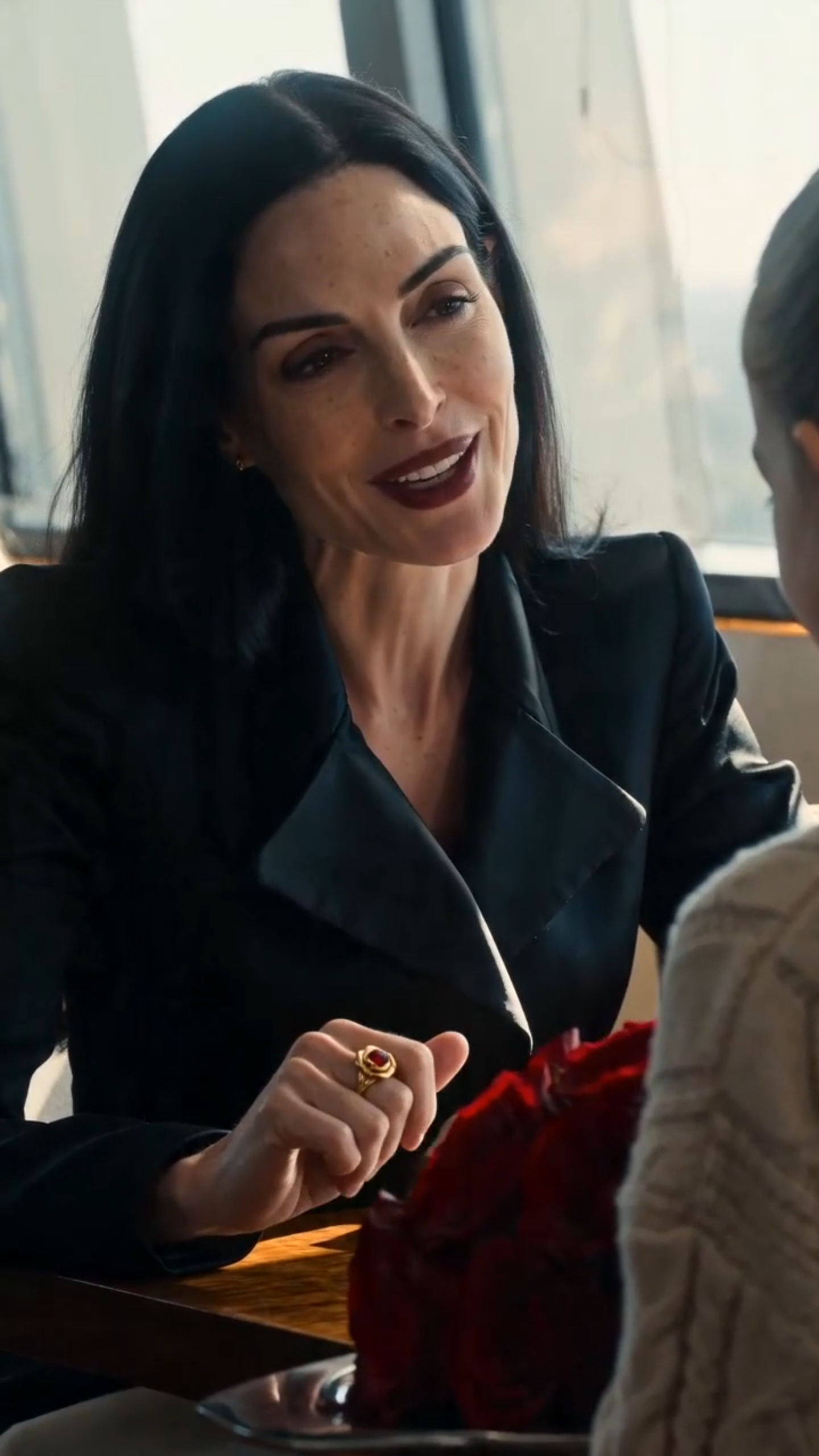
PART I: THE ARCHITECT OF SHADOWS
The city never slept, but tonight it felt chillingly stagnant. In the penthouse of the Vance Global tower, Julian stared out at the sprawling tapestry of lights below. A decade ago, he had been a man with nothing, swearing to conquer the heights at any cost. He had succeeded, transforming his father-in-law’s firm into a ten-billion-dollar empire, manipulating markets with the cold precision of a machine.
Yet, power is a hungry beast. Julian knew he was being hunted. Funds were disappearing from offshore accounts, confidential contracts were leaking, and a lingering shadow haunted his board meetings—a woman in a burgundy gown with eyes as sharp as razors. She was Victoria Vance, the competitor he had systematically destroyed to secure his own rise. He believed he had erased her, until today. During the most critical merger ceremony of his career, a server delivered a small box. Inside lay not a fountain pen, but an antique key and a photograph of a blue-tiled house in East Nashville—his mother’s home, the relic of a past he had discarded to manufacture the persona of “Julian Vance.” His chest tightened; the cat-and-mouse game had reached its conclusion. Victoria was not here to reclaim the company; she was here to collect the debt of his greed.
PART II: THE VERDICT OF THE PAST
The ballroom of the Beaumont Hotel was a symphony of crystal and gold, yet the air was thick with tension. Julian entered with his new mistress, his charcoal-grey suit a shield of arrogance. He was confident he could crush any doubt with the historic contract he intended to sign. But among the wealthy elite, he spotted her. Victoria stood motionless, dressed in deep burgundy, her gaze devoid of hatred, possessing only a terrifying, icy indifference.
As Julian approached, intending to use his influence to silence her, he realized the tide had turned. The guests weren’t looking at him with admiration; they were looking away in discomfort. He glanced at the main table to see the antique key from the morning resting alongside the centerpiece. Suddenly, every light in the ballroom dimmed. A voice, resonant and authoritative, seized the sound system:
“Julian Vance. You built a ten-billion-dollar empire on the betrayal of those who raised you.”
On the massive screen behind the altar, evidence of his financial fraud and the abandonment of his family flashed before the crowd. Victoria did not need to lift a finger; her mere presence had caused the walls of his kingdom to collapse. Julian saw his career incinerated, his mistress vanishing into the crowd, and finally, he saw his mother—the woman he had once callously turned away—standing beside Victoria.
The lights returned, exposing not a titan of industry, but a broken man. Julian knelt on the cold marble, realizing for the first time in ten years that while money can build castles, only integrity provides the foundation to keep them standing. He had lost everything, and the only person watching him with a calm, steady gaze was the woman he had spent a decade trying to forget.
PART III: THE KEY THAT OPENS RECORDS
Julian didn’t understand how she had found the details—how Victoria Vance had turned rumors into documents, into timestamps, into names that matched ledgers that didn’t exist yesterday.
But the truth didn’t need his understanding. It needed his signature.
When the last screen faded to black, Victoria stepped forward—not fast, not dramatic. Just certain.
“My apologies,” she said, voice smooth enough to pass for kindness. “I didn’t come to ruin you publicly.”
Julian tried to stand, but his knees betrayed him.
“You came to collect,” he managed.
Victoria’s eyes never softened. “I came to finish what you started.”
A solicitor approached the altar with a folder thick as a sentence. He held it out to Julian like the world itself demanded payment.
“First,” the solicitor said, “the contract is void. Your offshore transfer violations trigger immediate disclosure.”
Guests murmured—sharp whispers that traveled like sparks. Someone in the back actually laughed, then stopped when they realized no one else was laughing with them.
Victoria lifted her hand once, and the system chimed again. The ballroom screens—every one of them—lit with a different set of images.
Not money.
A woman’s face.
Julian’s mother.
Not in glamour photos. Not in curated charity appearances.
In hospital records. In civil filings. In a stack of correspondence dated years ago—letters Julian had never opened because he’d had “better things to do.”
Victoria turned those pages like they were scripture.
“You didn’t just take,” she said. “You erased.”
Julian’s mouth went dry.
He remembered the way his mother had looked when he stopped answering calls—how she’d sat across from him once at a kitchen table, trying to speak gently through disappointment.
He’d called it weakness then.
Now he realized it had been a plea.
Victoria continued, “You abandoned her when you had the power to protect her. And you abandoned the life of the person you used to become.”
Julian swallowed hard. “What do you want?”
Victoria’s answer was quiet, devastating.
“I want you to see the damage clearly. And then I want you to choose.”
A beat of silence.
“Choose,” she repeated, “between being punished… or becoming useful.”
PART IV: THE COST OF A CLEAN FACE
His mistress—still close enough to hear the name Victoria had spoken—finally moved. She threaded through guests with the desperation of someone who understood: the moment a villain becomes a victim, the room stops protecting you.
She stopped beside Julian and touched his sleeve, as if she could pull him back into the story where he was powerful.
“Julian,” she whispered, “this isn’t—”
He flinched away.
Not because he didn’t care what she thought.
Because he realized she’d never been a person to him—only another prop he could use to hide the parts he feared.
Julian looked up at Victoria. “I didn’t know about the… other filings.”
Victoria didn’t argue. She didn’t need to.
“You did,” she said. “You just convinced yourself you couldn’t.”
She gestured toward the evidence table. “Your mother wasn’t a ghost. Your family wasn’t a secret. You turned away because turning away was easier than facing what you’d done.”
Then Victoria addressed the crowd again, voice carrying without shouting.
“Anyone here who benefited from Vance Global’s illegal concealment has a choice now: cooperate with disclosure, or explain why they stood beside a man who built his empire on abandonment.”
A few people shifted uncomfortably.
Others looked at the floor like the marble could swallow guilt.
Julian felt his future closing like a door he’d spent years leaning against.
He could see it: investigations, hearings, bankruptcy, lawsuits from families he’d written off as collateral. He could see prison as a headline.
But what struck him hardest wasn’t the punishment.
It was the inevitability of consequences reaching the people he’d tried to leave behind.
Victoria approached him again. “Your mother offered you mercy,” she said, almost softly. “She didn’t deserve what you did to her. But she kept proof. She kept records.”
Julian’s brow furrowed. “She’s—”
Victoria nodded once. “She’s alive. For now.”
The air in the ballroom seemed to tighten.
Julian’s voice cracked. “Why tell me that?”
Victoria’s gaze held him like a verdict held back until the last word.
“Because if you truly regret what you did,” she replied, “you’ll act before you’re only left with remorse.”
PART V: THE SIGNATURE AND THE SECOND CHANCE
They brought Julian a pen—simple, unmarked, no branding. No spectacle.
Victoria stood at his side, not touching him, but close enough for him to feel that she’d never truly left the room.
A court officer read the final terms:
- Disclosure to regulators.
- Full restitution proposals to victims tied to the offshore fraud.
- A formal acknowledgment and withdrawal of a false legal narrative used to isolate Julian’s mother.
- Cooperation to identify accomplices and finalize the settlement.
The crowd watched like people witnessing a collapse they’d paid admission for.
Julian stared at the paper as if it were a mirror.
He thought of the years he’d spent building his image—polished, untouchable, untethered from anyone else’s pain.
And he thought of his mother’s quiet face in the documents.
He imagined her waiting—waiting for calls that never came, waiting for truth that arrived only when it couldn’t be delayed anymore.
He picked up the pen.
His hand trembled.
Victoria didn’t stop him.
She didn’t push.
She simply waited for him to choose what kind of man he would be when power was gone.
Julian signed.
The sound was small. But the decision was enormous.
A murmur rippled through the ballroom—some stunned, some furious, some relieved they hadn’t been the one holding the pen.
Victoria looked at him then—just once—with something so rare it almost looked like mercy.
“You’ll still pay,” she said. “But you’ll pay as a man, not as an excuse.”
Julian bowed his head, exhausted.
He looked up at his mother’s photo on the screen, and for the first time in years he didn’t feel defensive.
He felt accountable.
Outside, the city kept shining like it always did. But inside the ballroom, Julian Vance learned what integrity actually cost:
Not comfort.
Not reputation.
Just truth.
And the courage to live with it.
THE END