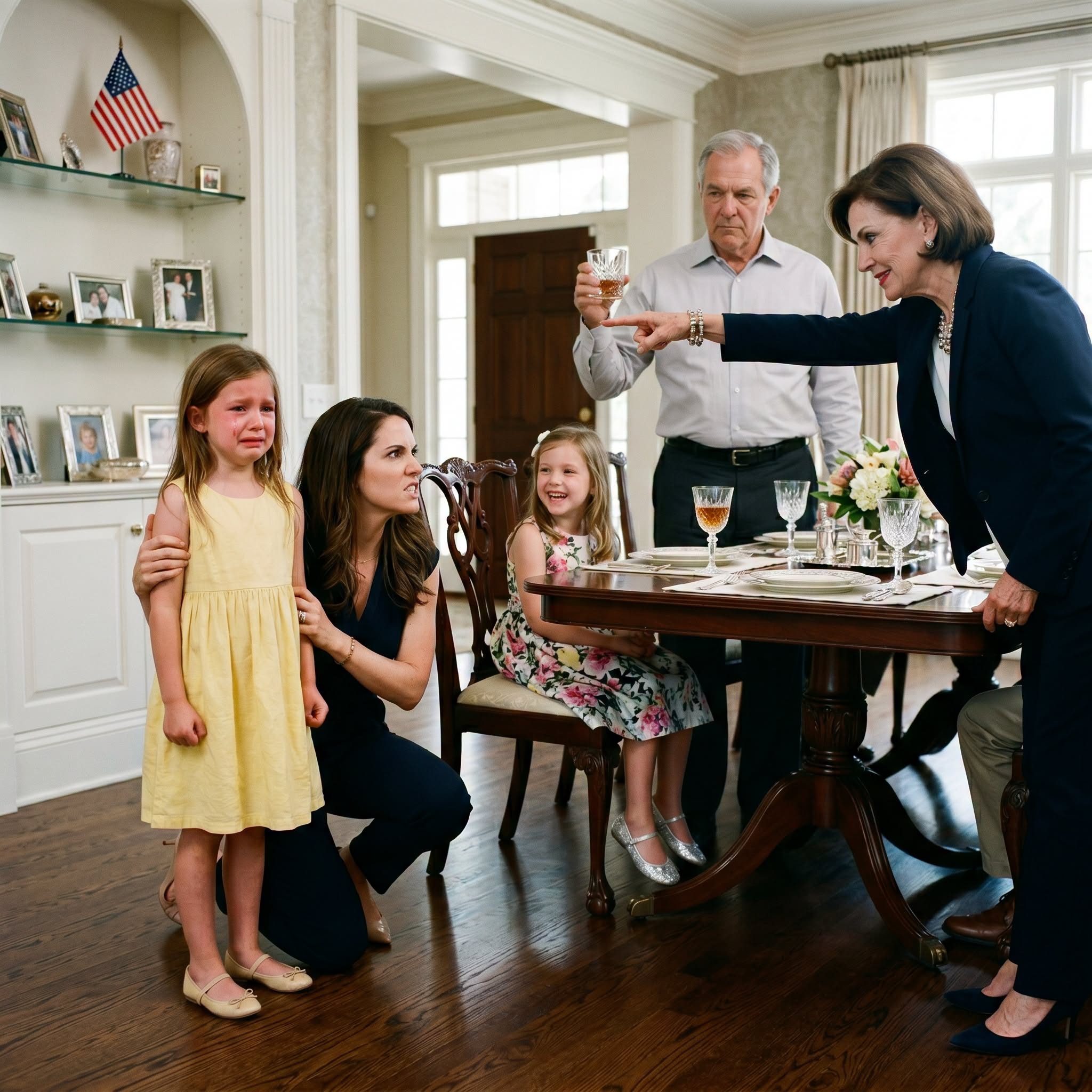
My in-laws threw away all my 8-year-old’s favorite clothes because “they looked cheap.” “They were embarrassing,” her cousin laughed. My daughter burst into tears. I didn’t cry. I did this. Two weeks later, they received a letter — and almost fainted…
I was setting the table when my daughter ran into the dining room like the floor behind her was on fire.
“Mom.”
Her voice broke.
“They’re gone.”
I turned.
“What’s gone?”
“All my clothes.”
Her breath hitched.
“My favorite ones. The yellow dress, the sweater with the flowers, my jeans, everything. It’s all gone.”
The room went silent.
Not the innocent kind of silence.
The kind that tells you other people already know something you don’t.
My in-laws looked up from their plates with the kind of smiles you only see on people who think they’ve done something noble.
And sitting next to them, swinging her sparkly shoes under the table, was the girl who had been trained since birth to believe she was the sun, my niece, the golden grandchild.
I wiped my hands on a dish towel and knelt beside my daughter.
“What do you mean everything?” I asked quietly.
“They cleaned my room,” she whispered.
Her lower lip trembled.
“And now all the things I love are gone.”
Behind her, my mother-in-law let out a theatrical sigh.
“Oh, sweetheart,” she cooed. “You should thank us.”
My stomach dropped.
“We just did a little organizing,” she continued. “Some of those clothes you kept were not appropriate for someone in this family.”
Someone in this family.
There it was, the sentence she’d been dying to say out loud for years.
My daughter wiped her face.
“Where’s my yellow dress?”
My father-in-law waved a hand like he was shooing away a fly.
“Oh, that thing. It made you look poor.”
My daughter blinked hard, as if the words physically hit her.
Then the cousin, perfect little Vivien in her designer dress, burst into laughter.
“Finally,” she said. “Someone threw that trash out. She always looked so cheap.”
My daughter folded inward, shoulders curling like she was trying to make herself disappear.
I didn’t move.
Not yet.
And my mother-in-law added cheerfully, “If she wants her old things, she can go look for them where they belong.”
She pointed toward the door.
“The trash.”
Vivien clapped.
“Oh my God, Grandma. Yes, she should totally wear trash. It suits her.”
The room tilted.
My daughter made a small sound.
Half gasp, half sob, and that was it.
She broke.
Not loud, not dramatic, just silent tears rolling down her cheeks like she was ashamed to let them fall.
I put a hand on her back, steady, calm.
Inside, something sharp shifted.
“Come on,” I told her softly. “Let’s go.”
I stood, took her hand, and walked out.
I didn’t look at the people who called themselves family.
Not when they murmured fake sympathy.
Not when they called after me, acting confused.
Not when the cousin giggled, “Oops.”
Back in her room, Nah sobbed into my shirt.
“Maybe they’re right,” she whispered. “Maybe I looked bad. Maybe I don’t fit here.”
I felt something cold settle in my chest.
“No,” I said. “You looked perfect, and you fit exactly where you belong.”
“With me,” she sniffed, trying to breathe.
I brushed her hair back.
“Do you want us to stay in this house?” I asked softly. “Or do you want us to leave?”
She didn’t hesitate.
“Leave?”
So we did.
We packed quickly.
Whatever clothes they hadn’t touched, whatever belongings mattered to her, whatever dignity we had left.
Her father wasn’t home.
He wasn’t even in the state, so it was just us.
We walked down the hallway with our bags, past the polished floors and the expensive furniture, and the people who’d spent years reminding us neither of us belonged there.
My mother-in-law was waiting in the foyer, lips pulled into a smile that didn’t reach her eyes.
“Where will you go, darling?” she asked. “You don’t have money for this kind of drama.”
My father-in-law chuckled.
“Without us, you’re nothing.”
Vivien smirked.
“Bye, cheap girl.”
I didn’t answer.
Not one word.
I opened the door, stepped out into the night, and let it slam behind me.
The air outside felt like freedom.
They thought they knew who I was.
They thought they knew what I had.
They thought I was powerless.
They had no idea.
Two weeks later, they received a letter and almost fainted.
When people ask how I ended up living with my in-laws, I always want to tell them the truth, one bad decision at a time.
But it started long before that.
It started with me, Natalie, the girl who grew up with big dreams and a bank account so small it could have doubled as a rounding error.
I wasn’t raised in a bad family, just a tired one.
My mom worked in a clinic.
My dad worked nights.
Bills always showed up faster than the paychecks did.
So I learned early that if I wanted anything in this world, not even the big things, just textbooks that didn’t smell like mildew, I had to get it myself.
I studied like my life depended on it.
Maybe it did.
I worked evenings, weekends, every holiday shift no one else wanted.
I lived on coffee, cheap notebooks, and the kind of blind determination you only have when you’re young and too stubborn to quit.
And somehow, after scraping pennies and skipping sleep, I got into a good university.
Not a fancy one, just good.
But good was enough.
Good meant possibility.
And then came the student loans, the endless jobs, the moment I realized adulthood is basically sprinting with a backpack full of bricks while pretending you’re not sweating.
Still, I made it through.
I graduated, exhausted, hopeful, and one late fee away from a mental breakdown.
That’s when I got my first job at their company, my future in-laws’ empire, built generations ago, polished to look like old money, even though there were cracks under every marble tile.
And my future husband, Elliot, was my boss.
Not in a sleazy way.
He barely noticed me the first few weeks.
He was busy doing that rich kid thing where they pretend they hate being part of the family business, but also don’t know how to leave it.
But he was kind, quiet, thoughtful in a way that didn’t match the rest of them.
And I was ambitious, hungry, tired of being broke.
We were an unlikely pair, the kind people whispered about.
And oh, did they whisper.
The first time his mother, Sylvia, heard about me, she apparently said, “You sleep with the secretary. You don’t marry her.”
I wasn’t even his secretary, but accuracy was never really her thing.
When Elliot and I did start dating, the tension in the office was so thick HR could have charged rent for walking through it.
Eventually, it became too awkward, too.
So they moved me to a different department.
I wasn’t fired, just shifted, like a stain someone tries to rub out but can’t quite get rid of.
Still, Elliot didn’t care.
We got married anyway, and that’s when I made the worst decision of my adult life.
I moved into his parents’ house.
Look, I had reasons.
Real ones.
Saving money before starting our own place, trying to build a family connection, believing people would warm up to me.
I was adorable back then in the way naive people always are, because from the moment I carried my suitcase across their threshold, I stopped being a person.
I became an inconvenience, a reminder that their son had married down.
They commented on everything.
My clothes.
Cheap.
My food.
Strange.
My background.
Well, she did come from nothing.
My voice.
Loud.
Every day was a new reminder that I wasn’t truly part of their family.
Not really.
Not in the way that counted to them.
And when Nah was born, things got worse.
She became the second-class child the moment she took her first breath because there was already a chosen one.
Vivien, my sister-in-law Monique’s daughter.
Designer dresses, private dance lessons, teeth so white they practically glowed in the dark.
If Vivien wanted something, she got it.
If Nah wanted something, she was spoiled or asking too much.
Vivien had a princess bedroom with a chandelier.
Nah was given the old maid’s room, tiny, plain, tucked behind the laundry with a single shelf Sylvia approved.
Vivien had birthday parties that looked like movie sets.
Nah got a cake Sylvia selected with half the candles because sugar is unhealthy.
Everything was twisted.
Everything.
And throughout all this, I worked not in their company because apparently me being seen might embarrass the family name, but on a side project.
A small idea I’d nursed through long nights and early mornings.
A business.
My business.
They called it my little hobby.
Sylvia actually once patted my head and said, “It’s cute that you’re playing entrepreneur.”
My little hobby started making real money.
Not billionaire money, not mansion money, but real, steady, grown-up money.
The kind of money you get when you build something that actually works one exhausted day at a time.
My business wasn’t huge.
It wasn’t glamorous, but it was stable, healthy, growing.
I wasn’t rich, not in the way my in-laws worshiped wealth, but for the first time, I felt financially independent.
Not connected to their charity or their approval.
And that mattered more than I can explain.
Meanwhile, their company, the proud old family empire, had been quietly sinking.
Not that they knew.
They never saw the late invoices or empty accounts.
Their CEO handled all that.
They walked through life assuming everything was fine because it always had been.
So when the CEO started calling Elliot with small problems, temporary cash gaps, delayed payments, payroll issues, my husband asked me to help just once.
Then again and again.
A temporary favor became a pattern.
A pattern became a habit.
A habit became the only thing keeping them from collapsing.
I didn’t rescue them.
I simply kept them from crashing that month.
And still, they looked at me like I was one inconvenience away from falling apart.
When I drove away from that house with Nah in the back seat, she kept looking out the window like she expected someone to chase us.
No one did.
Of course, they didn’t.
People like my in-laws don’t run after you.
They wait for you to crawl back.
And they were going to be waiting a very, very long time.
I took Nah somewhere neither of us had set foot before.
A luxury hotel with a kids club, a spa, and the kind of front desk where they say your name like it’s a brand.
Nah stared at the lobby chandelier like she’d discovered the lost city of gold.
“Are we allowed to be here?” she whispered.
It hit me like a punch.
The in-laws had drilled that mindset into her so deeply she didn’t even know she was allowed in nice places.
“Yes,” I said. “We belong here.”
Her shoulders loosened a little.
Just a little, but it was enough.
We spent the afternoon in soft robes eating room service pasta that cost more than my old weekly grocery budget.
Nah kept whispering, “Is this real?” like she was afraid it would disappear.
I didn’t have the heart to tell her that real life would be messier again soon, but for right now, she deserved this.
Elliot didn’t arrive until the evening.
He’d been out of state on business.
When he finally walked into our hotel room, he looked exhausted, confused, and already guilty.
“Natalie,” he said. “What happened?”
I stared at him.
At the man who somehow thought what happened could possibly fit in one sentence.
“What happened?” I said carefully. “Is that your parents threw away our daughter’s clothes?”
He blinked.
“Why would they?”
“Because,” I said, “they decided she looked poor.”
Even saying the word made me want to punch something.
He sat down heavily on the edge of the bed, running a hand through his hair.
“My parents are…”
He exhaled.
“They’re difficult.”
“Difficult?”
I laughed once.
It didn’t sound like a laugh.
“They emotionally destroyed an 8-year-old because they didn’t like her outfits.”
He winced.
“Look, Nat, I’m not defending them. I just… I know how they are. They don’t think before they…”
“I can’t live there anymore,” I said.
Not yelled.
Not dramatic.
Just final.
He looked at me, soft and pleading.
“Okay,” he said. “If you want to move out, we’ll move out. We’ll get a place. I just… I don’t want a war.”
A war?
Cute that he thought we weren’t already in one.
We ate dinner quietly.
Nah fell asleep in a mountain of hotel pillows, finally looking peaceful.
When Elliot and I were alone, I opened my laptop.
There was no sugarcoating it.
It was time.
“I’m done supporting your parents’ company,” I said.
His head snapped up.
“What do you mean?”
I turned the screen toward him.
“They’re drowning, Elliot. They have been for years. Your CEO’s been calling you for help so often I could practically set it to a calendar. And every time, you asked me to help.”
“And I did.”
He looked like he’d swallowed a glass shard.
“I didn’t realize it was that much,” he whispered.
“Of course you didn’t,” I said. “Because they never tell you the truth. But this…”
I tapped the screen.
“This is the truth. Without the loans we’ve been giving them, they won’t last 30 days.”
He stared, stunned, silent.
“My parents,” he finally began.
“They’re your parents,” I said. “I know. And mine? They treated like trash. Me? Disposable. Nah? Embarrassing. That’s who I’ve been helping. That’s who I’ve been keeping afloat.”
He scrubbed his face with both hands.
“Let’s just cool off,” he said. “Let’s not make big decisions tonight.”
I didn’t answer, not because I didn’t have one, but because he wasn’t ready to hear it.
We tucked Nah into the big hotel bed.
We turned off the lights in the suite.
We sat on opposite ends of the couch, pretending to watch something neither of us saw.
We listened to the hum of the air conditioner like it was counting down to something.
The quiet felt heavy, like a verdict waiting to be delivered.
Then his phone buzzed on the table.
He didn’t look at it.
It buzzed again and again.
Relentless.
He flipped it face down, then pushed it farther away, but it wouldn’t stop.
Ten minutes.
Fifteen.
Twenty.
Finally, he stood abruptly, grabbed the phone, and walked out onto the balcony.
“I’ll be right back,” he said, voice tight.
He slid the balcony door shut, and I watched him through the glass.
He lifted the phone to his ear, listened.
Not just once.
A long message, then another.
His shoulders tensed.
His jaw locked.
At one point, he pressed his hand to his forehead like the words were physically hitting him.
It felt like years.
When he came back inside, he didn’t sit down.
He didn’t speak.
His face was different.
Not tired.
Not conflicted.
Not unsure.
Something inside him had broken cleanly, decisively.
He stood there for a moment, breathing hard.
“Let’s do it,” he said.
My heart kicked.
“Do what?” I whispered.
He swallowed.
His voice was low, certain, almost dangerous.
“Pull the plug.”
I blinked.
I hadn’t expected that.
“Elliot, what happened?”
He turned the phone around.
It was a long voice message from his family group chat.
A message they never meant for me to hear.
His parents.
His sister.
Vivien’s laughter in the background, talking about me.
About how I married up, how I should be grateful they ever tolerated me, how I was pathetic and using Elliot’s money, how Nah was weak like her mother, how they let us live in their house, how they allowed Nah to attend their family school, how I was lucky to have access to real money at all.
And then the final blow.
“She thinks she can leave. She’ll come crawling back. She’s nothing without us.”
Something inside Elliot cracked clean in half.
He handed me the phone like it burned him.
“No more,” he said, voice steady, jaw clenched. “We’re done.”
So we sat down at the desk, opened emails, opened accounts, opened every quiet little avenue through which we had been supporting them, and closed them one by one.
Cancelled financial extensions.
Ended agreements.
Refused new loans.
Pulled the safety nets they’d mistaken for entitlement.
We didn’t yell.
We didn’t rant.
We didn’t smear their names.
We just stopped.
And the silence of that choice was louder than anything we could have said.
Elliot leaned back, exhaling like he’d finally surfaced after years underwater.
“I should have stood up sooner,” he said quietly.
I put a hand over his.
He nodded, eyes dark.
“They’re going to lose it,” he said.
“Oh,” I replied. “I’m counting on it.”
But we had no idea.
No idea how fast the fallout would hit.
No idea how ugly they would get.
No idea what they were prepared to do next.
All we knew was this.
We’d lit the match, and the fire was coming.
It’s funny how silence can feel like a threat.
For months, that’s all we got from Sylvia and Charles.
Silence so heavy it felt like it had a pulse.
Not a single call to ask where Nah was.
Not a text to check whether we were still alive.
Not a message to Elliot saying they missed us.
Just nothing.
Which would have been peaceful if I didn’t know them so well.
Silence from people like them isn’t peace.
It’s plotting.
And right around the time I started to think they’d maybe crawled into a hole made of their own bitterness, Elliot got a call.
Not from his parents.
From Mr. Kesler, a man who had been their family friend, lawyer, and unofficial emotional janitor for at least two generations.
He never called us.
That alone set my alarm bells off.
Elliot put the phone on speaker, and the man’s voice boomed through the kitchen like he was announcing a funeral.
“Elliot, Natalie, we need to talk.”
I looked up from the sink.
Elliot mouthed, “Told you.”
“What about?” Elliot asked.
A long sigh on the other end.
“I’m hoping we can meet today,” Mr. Kesler said. “In person.”
In person means bad.
Lawyer in person means catastrophic.
Nah was coloring at the table, humming softly to herself.
A sound that still made my heart ache because it used to be so rare.
“Can you tell us what’s going on?” Elliot pressed.
Another long pause.
“It’s your parents,” Mr. Kesler said. “You should hear this from me, not from outside sources.”
Outside sources?
What were they?
A political scandal?
“Can we talk at your place?” he added. “I’d prefer that.”
Elliot hung up and looked at me.
“They’re in trouble,” I said.
He nodded.
“Big trouble.”
By the time Mr. Kesler arrived, clipboard in hand, sweat on his forehead, he looked ten years older.
He sat down, tugged at his collar like it was trying to strangle him, and said, “They’re going to lose the company.”
Elliot inhaled sharply.
I stayed quiet.
“The debts, the unpaid invoices, the outstanding loans.”
His voice shook.
“The CEO has been doing everything he can,” Mr. Kesler continued. “But without the financial support…”
He stopped, shifted uncomfortably, then glanced at me.
“The financial support you were providing. They simply can’t cover basic operating expenses.”
Nah looked up from her coloring book.
“Operating what?”
“Bills,” I said. “Meaning payroll, suppliers, the electric bill, their fancy office with the espresso machine.”
“Within the next few weeks,” Mr. Kesler said, “they will be forced to declare bankruptcy. And because of the structure of the company, it’s possible they’ll lose personal assets as well.”
He looked at Elliot.
“I don’t believe your parents fully understand that.”
Of course, they didn’t.
They never understood anything unless it sparkled.
“I’m here,” Mr. Kesler said, “because they asked me to speak on their behalf.”
Of course they did.
“What do they want?” I asked.
“To restore your arrangement,” he said.
I raised a brow.
“My arrangement?”
He winced.
“Your financial support?”
Ah, so that’s what the sweet tone was for.
They didn’t disappear out of heartbreak.
They disappeared because they needed time to rehearse their performance.
Elliot folded his arms.
“They treated my wife and daughter horribly,” he said. “Why would we help them?”
Mr. Kesler closed his eyes briefly, like the headache was spreading.
“Because this company has been in your family for generations,” he said. “It was built by your great-grandfather. Your parents believe it would be a tragedy to see it end.”
“Then they should have treated it better,” I said.
His eyes flicked to me, surprised, then resigned.
“I understand,” he said quietly. “Truly. But I’m asking you to consider them as family.”
I almost laughed.
Elliot answered first.
“She is my family,” he said. “And Nah is my family. The rest, I’m not sure anymore.”
Mr. Kesler sighed the sigh of a man who knows he’s lost before the battle even starts.
“They will never ask you directly,” he said. “They are too proud. They sent me instead.”
He stood.
“I’ve delivered the message. The decision is yours.”
We showed him to the door, and by the look on his face, he already knew the answer.
A few days passed.
Rainy, gray, nothing special days.
Until it happened.
A loud, enthusiastic knock on our front door.
The kind of knock people use when they want to seem friendly instead of desperate.
Elliot and I exchanged a look.
“Brace yourself,” he murmured.
He opened the door.
There they were.
Sylvia smiling like she’d never insulted anyone in her life.
Charles puffing his chest like a wounded rooster.
Monique wearing a scarf worth more than my car.
And Vivien dressed like she was attending a fashion show for spoiled 8-year-olds.
And they had a cake.
A homemade cake.
If anything deserves a horror soundtrack, it’s in-laws holding baked goods.
“Natalie, dear,” Sylvia gushed. “We just had to come see you.”
I almost asked her if someone dared her at gunpoint.
“We’ve missed you,” she continued. “Oh, and our sweet Nina. We miss her so much.”
They poured into our living room like a well-dressed tsunami.
Monique did the fake tear voice.
“We were all just talking about how important family is.”
Vivien stood in the middle of the room and announced, “I’m sorry.”
Then added, without blinking, “Mommy told me I had to say that.”
Beautiful apology straight from the heart.
Sylvia nodded approvingly like she’d just orchestrated world peace.
“And we would love,” she said sweetly, “for us all to start fresh.”
Monique clasped her hands.
“Put the past behind us.”
Charles smiled thinly.
“We’re willing to move on.”
Elliot didn’t even pretend to smile back.
“So,” Sylvia said lightly. “Do you think you’ll be able to continue helping the company?”
There it was.
The real reason they came.
Not for Nina.
Not for Elliot.
And definitely not for me.
Elliot said, “We need a moment to discuss it.”
We stepped outside onto the porch.
The moment the door closed, we looked at each other and said the exact same thing.
“No.”
It wasn’t even a question.
We walked back inside.
Elliot spoke first.
“No,” he said.
The shift on their faces was instant.
Sugar turned to salt.
Honey turned to venom.
Politeness collapsed into betrayal.
Sylvia’s smile cracked.
“What?” she snapped. “Do you mean no?”
Monique’s voice sharpened.
“We apologized.”
“You owe us!” Charles shouted.
“We humiliated ourselves for you,” Sylvia hissed. “And you’re still refusing to act like family?”
Elliot stepped between them and me.
“You treated my wife like garbage,” he said. “You treated my daughter like she didn’t belong in your home. You never meant any apology you gave. This was all about money.”
They stared at him as if he’d stabbed them.
“We’ll disinherit you,” Charles spat.
Elliot actually laughed.
“Disinherit what?” he said. “Your debt?”
Silence.
The kind that told me they realized we knew.
“We’re done,” Elliot said. “Please leave.”
They left in a storm of expensive perfume and collapsing pride.
And though the house went quiet afterward, it wasn’t peaceful.
It was the quiet before impact.
Because what we’d done wasn’t just cutting ties.
It was removing the last thread holding their world together.
And when that thread snapped, everything would fall.
Six months later, their world finally collapsed.
Sylvia and Charles declared bankruptcy.
The kind that doesn’t just take your business, it shakes the bones of your identity.
They had to sell the second house, the lake cabin, the antique furniture Sylvia used to brag about.
And because of the debts they’d piled up, the court forced them to repay what they could, including the money they’d borrowed from me.
Sylvia cried when she handed over the check.
Not because she was sorry.
Because it hurt.
Vivien now goes to public school.
Last I heard, she hates it.
Apparently, no one there cares who her grandparents are or were.
Monique works part-time at a candle store, a far cry from her socialite era, but she tells people she’s finding herself.
Sure.
And Charles, he’s a junior manager at a logistics firm.
A junior manager.
The man who once told me I was lucky to be in his home now reports to someone half his age.
He ruined his company.
So honestly, it’s surprising anyone hired him at all.
As for us, Elliot and I are just living our quiet, peaceful, thriving life now.
Our business is booming.
Nah laughs more these days, sleeps better, dresses exactly the way she wants.
We’ve been no contact with Sylvia and Charles since that day.
And that silence, for once, it feels like freedom.
So tell me, did we go too far or not far enough?
If you came here from Facebook because of this story, please go back to the Facebook post, hit like, and comment exactly: Powerful. That small action means more than it seems. It supports the storyteller and gives them real motivation to keep bringing more stories like this to readers who care.