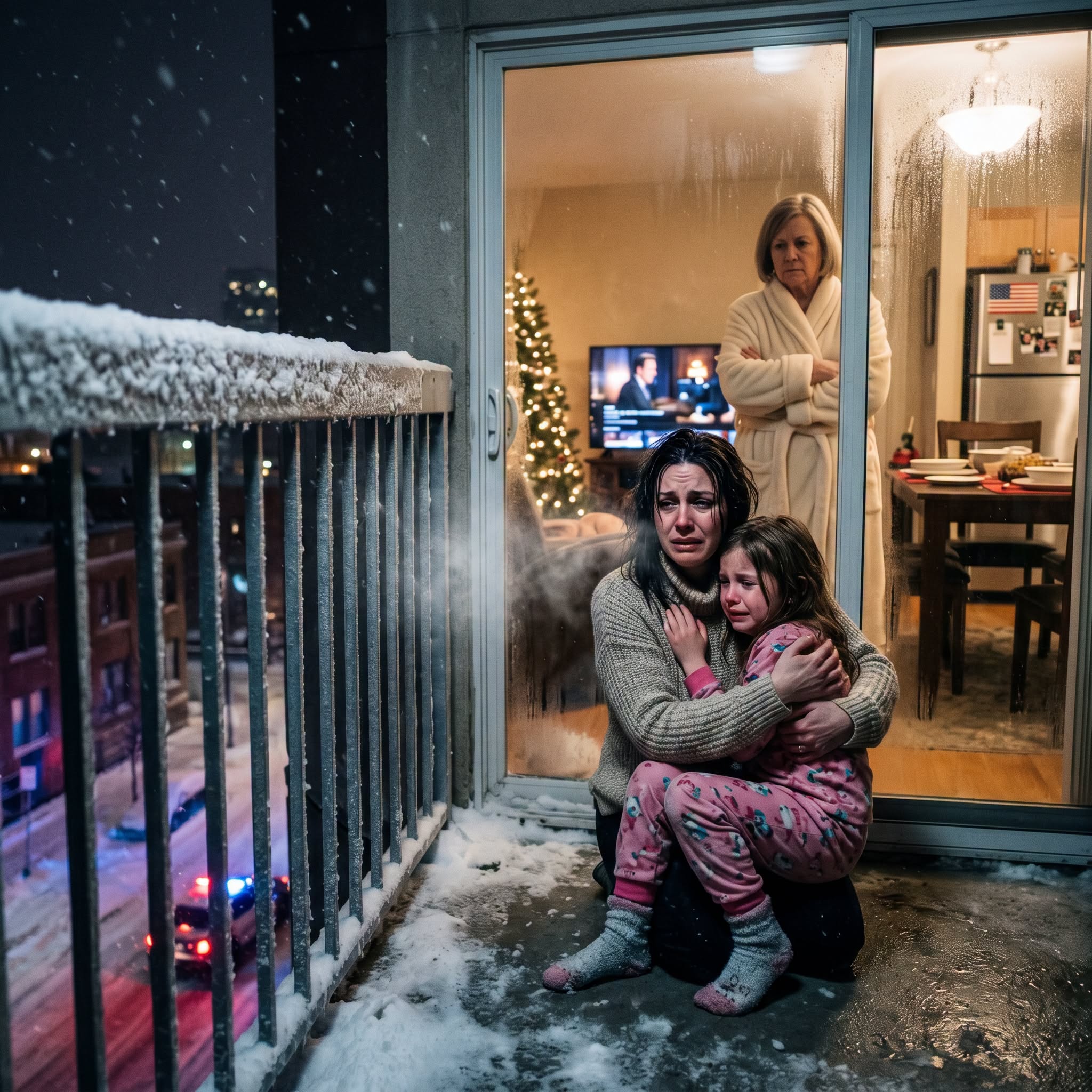
My mother-in-law locked me and my 8-year-old daughter on the balcony in zero-degree Fahrenheit without proper clothing. “You two should learn some respect,” she said. I didn’t cry. I moved. Forty-five minutes later, someone knocked on the front door, and her life started to unravel.
We were living in my mother-in-law Samantha’s condo in Milwaukee because my husband Max promised it would be temporary.
If you’ve ever heard a grown man say temporary while standing next to a woman who thinks she’s the Supreme Court of everyone else’s life, you already know where this is going.
Max drove long-haul routes, weeks on, days off.
He lived in a truck cab more than he lived with us.
When he was home, he was exhausted and hopeful, like love could make up for absence.
When he was gone, the house settled into its real shape.
Me, my eight-year-old daughter Mia, and Samantha, who ran her home like a small kingdom and treated me like a guest who forgot to bow.
Samantha loved two things more than anything.
Being right.
Being obeyed.
She called it respect.
She said it like a prayer, like oxygen, like the whole world owed her a full-time apology.
She controlled the thermostat, always too cold for me. Always fine for her.
She controlled the kitchen, where items lived, how pans were stacked, the exact angle of a dish towel.
She controlled the entryway, where shoes had assigned parking spots like they were employees, and she treated food like a weapon.
Mia was eight, smart, funny, and picky in the normal kid way.
Textures, smells, phases.
She’d eat apples and yogurt like it was her job. She’d turn into a tiny attorney if you tried to negotiate peas.
Her pediatrician wasn’t worried.
I wasn’t worried.
Samantha was worried enough for all of us.
Every meal turned into a test.
Not for Mia, for me.
Because Samantha didn’t just want Mia to eat.
She wanted Mia to eat because Samantha said so.
And she wanted me to step aside and watch it happen.
That night was chicken, mashed potatoes, green beans, and Samantha’s favorite garnish, commentary.
The snow outside was coming down in thin lines.
Milwaukee winter had that Lake Michigan wind that doesn’t just feel cold, it feels personal, like it has opinions about you.
The condo was warm enough to function, not warm enough to relax.
Samantha believed comfort made people lazy.
Mia ate half her chicken, took a few bites of potatoes, poked a green bean like it had insulted her family.
Samantha watched the plate like it was evidence.
“Finish,” she said.
Mia hesitated.
“I’m full.”
Samantha tilted her head.
“No, you’re not.”
Mia glanced at me, quick, hopeful.
That look kids give when they’re trying to ask for permission without making anyone mad.
I kept my voice calm.
“If you’re full, you’re full. Drink some water.”
Samantha’s eyes snapped to mine.
“This is why she’s picky,” she said loud enough to make Mia’s shoulders tense. “Because you let her run the show.”
Mia’s lips pressed together, her fingers tightened around her fork.
She wasn’t just hearing Samantha’s words, she was hearing the message underneath them.
Your body isn’t yours.
I took a slow breath.
“Nobody’s running anything. She’s done.”
Samantha reached across the table anyway, speared a chunk of chicken, and held it out toward Mia like an order.
“Open,” she said.
Mia shook her head.
“I don’t want it.”
Samantha smiled, thin and certain.
“You don’t get to decide.”
And then she leaned in and tried to push the bite into my child’s mouth.
Not coaxing, not grandma being pushy.
Force.
Mia turned her head, started crying, gagged a little.
Panic flashing fast and hot.
The kind of panic that shows up when a child realizes an adult is bigger and intends to win.
My chair scraped back so hard it squealed.
“Stop!” I said.
Not screamed. Not performed.
Just final.
Samantha froze with the fork midair like I’d interrupted a ceremony.
“She needs to eat,” she hissed.
“She needs to feel safe,” I said. “And you are not going to force-feed my kid.”
Mia’s cheeks were wet.
She stared at her plate like it was dangerous now.
Samantha’s face hardened.
“You don’t talk to me like that in my house.”
Her voice rose. That sharp, proud volume she used when she wanted an audience, even if the only audience was a trembling child.
Mia flinched.
I kept my tone flat.
“Don’t yell in front of her.”
That boundary hit Samantha like a direct insult.
Her jaw tightened. Her eyes went bright.
“Oh,” she said. “So now I’m the villain.”
I didn’t blink.
“Right now? Yes.”
Mia slid off her chair, trying to disappear.
“Can I go?”
“Go wash your hands,” I told her quickly. “Go take a minute.”
Mia hurried toward the bathroom like the hallway was an escape route.
Samantha stood up slowly like she was deciding something.
Then she smiled.
Not a warm smile.
A decision.
“Fine,” she said softly. “Come with me.”
I should have grabbed Mia and left right then.
But my brain still believed in rules.
Like adults don’t do truly unhinged things over green beans.
Like there was a ceiling to this behavior.
Like there were lines people didn’t cross because society existed.
Samantha marched down the hall to the sliding glass door.
She yanked it open.
The cold hit the hallway like a slap.
“Mia,” Samantha snapped.
Mia came out of the bathroom, hands damp, eyes wide.
She looked from Samantha to me like she was waiting for the grown-ups to decide what reality was.
Samantha grabbed her wrist.
“Don’t touch her,” I said, stepping in fast.
Samantha tightened her grip and pulled Mia toward the balcony.
I grabbed Mia’s other hand and pulled her close to me.
Samantha turned on me.
“You want to disrespect me? You want to undermine me in my own home?”
“I want you to stop hurting my kid,” I said.
That smile stayed.
“Then you can both cool off.”
And before my mind could catch up, she shoved the door wider and pushed.
Mia stumbled onto the concrete in pajamas and socks.
I stepped out after her automatically because my body has one job.
Keep my child alive.
Samantha stayed inside.
Then she closed the door.
Click.
A tiny latch sound, sharp in the silence.
Mia spun, palms against the glass.
“Grandma, stop.”
Samantha looked at her like Mia was a lesson, not a person.
“You two should learn some respect,” she said, calm as if she’d said, “Take out the trash.”
Then she walked away.
Of course she did.
Because in Samantha’s mind, this wasn’t cruelty.
It was discipline.
The balcony was uncovered.
Wind, concrete, snow crust along the rail.
No coats, no shoes, no phone.
My phone was inside on the kitchen counter next to Samantha’s dish towel that said, “Bless this home,” like a threat.
Mia started shivering almost immediately.
Not cute shivers.
Survival shivers.
I pulled her into my arms, turned my back to the wind, and rubbed her arms hard.
Then I tugged the neckline of my sweatshirt down and tucked her hands inside against my skin.
Her fingers were cold little sticks.
“I’m cold,” she whispered, voice shaking.
“I know, baby,” I said, keeping my voice steady on purpose. “We’re going to stay moving. Stomp your feet.”
She tried, socks sliding on frozen concrete.
I banged once on the glass.
“Samantha, open the door.”
Nothing.
Again.
“Open it.”
Still nothing.
And then, because Samantha is who she is, I heard the TV turn on.
The muffled sound of a sitcom laugh track, like the universe was mocking us.
My mind did that clinical split nurses do.
One part of me was mom panicking.
The other part was running a checklist.
Hypothermia risk.
Exposure time.
Child body mass.
Wind.
My hands started burning at the fingertips.
Then they went numb in little patches.
My ears felt like someone was twisting them.
I scanned the parking lot below.
A few cars, snow falling in thin lines, a lit window across the way.
I waved both arms and shouted, “Help, please.”
My breath came out in white bursts.
The wind stole half my words.
“Mia,” I said close to her ear. “We’re going to play games, okay? No sleeping. Talk to me.”
She nodded, teeth chattering.
“Name every kid in your class.”
Her voice shook.
“Ethan, Ava, Jordan, Kayla, Miss Paris.”
“Good,” I said. “Now the alphabet backwards.”
“Z, Y, X.”
She frowned, trying.
“D.”
“Perfect,” I lied. “You’re doing perfect.”
I kept talking because silence on that balcony felt like giving up.
I told her stupid little stories about when she was a toddler and insisted on wearing rain boots in July.
I promised hot cocoa.
I promised the biggest blanket fort in history.
I promised things I didn’t even care about as long as she kept responding.
Time didn’t pass.
It crawled.
Mia’s lips were going pale at the edges.
Then I saw movement below.
A woman in a robe stepped onto a neighboring balcony, squinting up like she wasn’t sure she was awake.
“Are you okay?” she called.
My throat felt raw.
“We’re locked out. Call 911.”
Her face changed instantly, confusion to alarm.
She vanished inside.
Bless that woman forever.
A few minutes later, sirens, red and blue lights, painted the snow.
Two Milwaukee PD officers stepped into the lot, heads tilted up toward us.
One stayed where he could see Mia, talking into his radio, eyes locked on her like he’d already decided what this was.
The other officer shouted, “Ma’am, can you get back inside?”
“The door’s locked,” I yelled. “My mother-in-law locked us out.”
They moved fast.
One to the entrance, one staying in the lot.
I watched the officer at the entrance pound on the building door like he was personally offended by it.
From the balcony, I couldn’t hear Samantha’s first words, but I could imagine the tone, irritated, dismissive, like the police were an unnecessary inconvenience.
Finally, the curtain shifted.
Samantha appeared behind the glass, her face tight with annoyance.
She unlocked the door and slid it open a few inches like warmth was something we had to earn.
Mia stumbled inside first.
The moment her feet hit carpet, she collapsed against me and sobbed.
The kind of sob that comes from your body finally believing you might survive.
I carried her into the living room and wrapped her in the nearest blanket.
Checked her fingers, her ears, her face.
Samantha stood in the hallway with her arms crossed like she was waiting for someone to apologize to her for the scene.
One officer stepped in behind us, mid-40s, tired eyes, controlled voice.
“Ma’am,” he said to Samantha, “what happened?”
Samantha lifted her chin.
“They went outside to calm down.”
“At 0°?” he asked.
“It was only for a minute,” she snapped.
The younger officer, quieter, sharper, looked past Samantha toward the balcony.
There were sock prints in the snow.
A child’s sock prints.
The kind of detail that doesn’t argue, doesn’t negotiate, doesn’t care about anyone’s feelings.
His jaw tightened.
The older officer crouched in front of Mia.
“Hey, sweetheart. What’s your name?”
“Mia,” she whispered, barely audible.
“Are you hurt?”
Mia shook her head, eyes fixed on my shirt like looking up might make it happen again.
The officer stood and looked at me.
“Do you have somewhere else you can go tonight?”
“Yes,” I said.
No hesitation.
“A friend.”
“Good,” he said like he meant it.
He radioed for paramedics.
Samantha scoffed.
“This is ridiculous.”
The officer stared at her.
“A child was locked outside in freezing weather.”
Samantha waved a hand.
“She’s fine.”
“Ma’am,” he said, voice flat. “You don’t get to decide that.”
“For the record,” he added, “this is a criminal matter.”
Paramedics arrived.
Blankets, warm packs, vitals, gentle hands.
Mia’s temperature was low, but not dangerous.
No frostbite.
Thank God.
They looked at my hands next.
My fingertips were white.
My left pinky had a waxy look that made the paramedic’s mouth tighten.
“You need to get checked tonight,” she told me.
I nodded.
Because I’m a nurse.
I know what cold does when it decides to keep a receipt.
The officer asked for IDs.
I handed over my driver’s license with fingers that didn’t want to work.
Samantha handed hers over like she was being inconvenienced.
The younger officer stepped into the kitchen, typed something in, then paused.
I watched his posture shift.
A quiet, professional stillness.
He murmured to his partner.
His partner’s face tightened.
The older officer turned to Samantha.
“Ms. Hayes, sit down on the couch.”
Samantha blinked.
“Why?”
“Sit,” he repeated.
Samantha sat like it was insulting.
The older officer positioned himself between her and the hallway like he’d done it a thousand times.
The younger officer spoke quietly into his radio.
I didn’t hear every word, but I heard enough to feel the air change.
“Confirming same name, same DOB. Hits active.”
The older officer’s tone changed.
“Ms. Hayes, listen carefully. You are being detained. You are not free to leave. Stay seated. Keep your hands where I can see them, and do not make this worse.”
My phone buzzed on the counter.
Max calling.
Of course.
I answered.
Max’s voice came through tired and casual.
“Hey, how are my girls?”
“Your mother locked me and Mia outside,” I said.
Silence.
Then strained.
“She what?”
“Balcony. 0°. Police are here. Paramedics are here.”
Another silence.
The kind where someone tries to keep their favorite illusion alive.
“Lauren,” he said finally. “She wouldn’t.”
“She did,” I said. “And I’m done.”
“I’m turning around,” he said quickly. “I’m coming home.”
“No,” I said.
“What?”
“Don’t come here,” I said. “I’m leaving with Mia.”
“Lauren—”
“I’m not negotiating safety,” I said.
And hung up.
I set the phone down like it was a tool I’d used.
Then something in me clicked.
Not anger.
Clarity.
I didn’t cry.
I moved.
I grabbed a duffel bag and packed fast.
Mia’s clothes, my scrubs, documents, chargers, her school tablet, her stuffed dinosaur, real coats, real shoes, the folder with her insurance card, the winter boots Samantha had insisted on buying because she chose them, and I didn’t care where they came from as long as they were warm.
The officers finished their report.
They took photos.
They spoke to the neighbor who called 911.
Samantha stood there like she expected someone to apologize to her.
The younger officer leaned close to his partner.
“They’re on their way,” he murmured.
He kept his voice low.
No reason to tip Samantha off.
“Dispatch wanted the hit confirmed and the right unit on scene before anyone said another word.”
Samantha’s eyes flicked.
“Who’s on their way?”
Nobody answered her.
She finally looked nervous.
Forty-five minutes later, someone knocked on the front door.
Not a casual knock.
The official kind.
The older officer opened the door.
Two detectives stood there, heavy coats, badges out, snow on their shoulders.
“Detective Wolf,” the taller one said. “Milwaukee Police Cold Case Unit. This is Detective Harris.”
Samantha started to stand, indignation snapping back into place.
“Finally, someone with sense.”
Detective Wolf’s expression didn’t move.
“Ms. Samantha Hayes?”
“Yes,” she said, pleased with herself.
“We have an active warrant for your arrest,” he said.
Samantha’s smile froze.
“What?” she snapped. “For what? Because she’s dramatic?”
“Not for tonight,” Detective Wolf said. “For a case reopened this month.”
Detective Harris held up a folder.
“A child named Madison Price eight years ago.”
The room went silent.
Mia’s little hand grabbed my sleeve.
Samantha’s face drained in stages.
“I don’t know what you’re talking about,” she said too fast. “This is a mistake.”
Detective Wolf didn’t argue.
“Turn around. Hands behind your back.”
Samantha took a step back.
“No. This is my house.”
Detective Harris cuffed her with calm practice.
Detective Wolf read her Miranda rights in her own entryway like reality was finally explaining the rules.
Samantha’s eyes snapped to me, furious, accusing.
“Lauren,” she hissed. “What did you do?”
I shrugged, small and honest.
“I protected my kid.”
Samantha searched for a comeback.
There isn’t a good one for that.
As they led her out, she twisted and spat.
“You’ll regret this.”
I looked at her.
Perfect hair, expensive robe, hands in cuffs, and felt something surprising.
Relief.
“I regret trusting you,” I said quietly.
Then I picked up our bags, and I walked out with Mia.
We went to the ER across town, not the one I worked at.
I wasn’t about to walk into my own hospital with my child wrapped in emergency blankets and my mother-in-law getting arrested somewhere behind me like a headline.
The waiting room was the usual late-night mix.
A toddler with a fever, an older man holding his wrist, a woman scrolling on her phone like she was trying to disappear into it.
Mia sat on the bed when they finally took us back, holding her dinosaur like it was a life jacket.
Her cheeks flushed as she warmed up, her eyes heavy.
The doctor confirmed what I needed to hear.
Mild hypothermia.
No frostbite for Mia.
She’d be okay.
My hands were another story.
When they warmed my left pinky, the pain hit so sharp I saw spots.
The doctor’s face tightened.
“Sometimes tissue declares itself later,” he said.
Of course it does, because cold doesn’t always finish the job immediately.
Sometimes it waits.
Sometimes it collects interest.
A nurse asked the questions hospitals ask when a child is endangered.
Do you feel safe going back?
Has anyone harmed her before?
Do you have somewhere safe tonight?
Mandatory reporting isn’t personal.
It’s policy.
And in that moment, I was grateful for every system that would treat this like what it was instead of calling it family drama.
I told them the truth.
We were leaving.
We were safe elsewhere.
The police were involved.
They documented everything.
They took notes in that precise, careful way that turns into evidence later.
I watched them work and felt a strange comfort in the structure of it.
Forms, procedures, checkboxes, the world saying, “No, this isn’t normal. We will treat it like it matters.”
We stayed with my friend.
Spare bedroom, deadbolt, quiet.
Mia fell asleep fast, then jerked awake once at a car door outside and clung to me like her body still didn’t trust warmth.
I sat with her until her breathing evened out.
I didn’t scroll.
I didn’t distract myself.
I just watched her chest rise and fall like it was the only thing keeping me anchored.
Max called, texted, called again.
Lauren, please.
I’m coming home.
This is crazy.
She would never.
I didn’t respond because I knew the script.
He’d want to talk it out.
He’d want to smooth it over.
He’d want me to absorb the shock so he wouldn’t have to choose.
But Mia shouldn’t have to learn that safety is negotiable because family is complicated.
The next morning, my left pinky was swollen and purple at the tip.
That ugly in-between stage where your body is deciding what it can save.
Mia ate toast in my friend’s kitchen like she was afraid someone would comment on it.
I told her gently, “You can eat when you’re hungry. You can stop when you’re full. No one gets to make food scary.”
She nodded, small and serious, like she was filing the rule away somewhere deep.
That afternoon, Detective Wolf called me.
“I’ll need a formal statement about last night,” he said.
“Okay,” I told him.
He paused.
“And I want you to know your 911 call didn’t create this case. It just located her.”
My stomach dropped.
“She was already on your radar.”
“We reopened an old investigation,” he said. “A judge signed a warrant. We were confirming whereabouts last night. The responding officer ran her ID and got the hit.”
So that’s why the officer went quiet in the kitchen.
So that’s why the air changed.
At the station, I sat in a plain interview room with a paper cup of bad coffee and a pen that didn’t work unless you pressed too hard.
Detective Wolf was calm, professional, the kind of calm that comes from seeing too much and learning not to flinch.
He asked me to walk through the dinner scene from the beginning.
He asked about Samantha’s usual behavior.
He asked if she’d ever threatened Mia before.
I told him the truth.
Samantha loved humiliation.
Samantha loved control.
Samantha had never locked us outside before, but she’d said things.
Little warnings dressed up as jokes.
Careful or you’ll learn a lesson.
In my house, you do what I say.
I’d heard them and tried to ignore them the way people ignore a rattling sound in a car because admitting it means admitting something expensive is wrong.
Then Detective Wolf told me the basics.
Nothing graphic, nothing I didn’t need.
Eight years ago, Samantha had worked at a daycare.
Not as a teacher, an aide.
The kind of job with access and authority and just enough oversight to make a bully feel powerful.
A five-year-old named Madison Price died after being left in an unheated maintenance room during winter.
Back then, it had been called an accident.
Now, it wasn’t.
Detective Wolf slid a still image across the table.
Grainy camera footage. Timestamp in the corner.
Samantha dragging a small child by the wrist toward a door.
Another still.
The maintenance room.
Another.
Samantha walking away, expression neutral.
“They found Madison three hours later,” he said quietly. “Hypothermia.”
My mind flashed.
Mia pressed to the glass, crying.
Same method, different child.
“How did you get this footage?” I asked.
“Daycare upgraded their system,” he said. “Archived files surfaced. We subpoenaed backups. It took months.”
He leaned back.
“Last night gave us a fresh incident, a fresh victim statement, and a clearer pattern.”
“And a search warrant,” I said, because I knew where this went.
He nodded once.
“Yes.”
That evening, they searched Samantha’s condo.
I wasn’t there.
I didn’t want to see strangers in the space where my child had tried to be small and quiet.
I didn’t want to watch drawers open and close like the house itself was being interrogated.
Max was there, though.
He’d come home, too late to stop anything.
Right on time to watch the foundation crack.
He called me, voice tight.
“They’re tearing the place apart.”
“What are they looking for?” I asked.
“They said records, notes, something she kept.”
Of course.
People like Samantha don’t just do things.
They justify them, document them, relive them.
They build a private museum of their own righteousness.
Detective Wolf called later.
“We found a box and a notebook.”
“A journal,” I said.
“Yes.”
Of course it was.
Max showed up at my friend’s house two days later with Mia’s backpack and boots and the exhausted look of someone who’d spent forty-eight hours arguing with reality.
He stood in the doorway like he didn’t know whether he was allowed inside.
I nodded once.
He stepped in.
He sat on the couch like he didn’t deserve the cushions.
“I didn’t know,” he said.
I held his gaze.
“You knew she was cruel.”
His throat worked.
“I didn’t know she’d do that to Mia.”
I nodded slowly.
“That’s the problem. You thought there was a line. She doesn’t have one.”
Max ran a hand over his face.
“She kept saying it was a timeout, like she was disciplining a dog.”
I said nothing because if I spoke in that moment, I would have said something unfixable.
He swallowed.
“They showed me the footage.”
My stomach tightened.
“And the journal?”
Max’s face twisted.
“Yes.”
He stared at his hands.
“She wrote about Madison like she was a nuisance. Like punishment was routine. Like locking a kid in the cold was a teaching technique.”
I pictured Samantha turning up the TV while Mia shivered outside.
Habit, not impulse.
Max’s phone buzzed.
A voicemail transcription from Samantha.
He played it without thinking.
Her voice came through sharp and offended.
“You better fix this. Call a lawyer. This is ridiculous. And tell Lauren she’s not taking my granddaughter from me.”
Max stared at the screen, then deleted it.
No speech.
No performance.
Just deletion.
He looked up at me, eyes red.
“What do you want to do?”
It was a strange question after years of Samantha deciding what was appropriate.
“I’m filing for a protective order,” I said. “And I’m not going back.”
Max nodded.
“Okay.”
We didn’t resolve our marriage in that moment.
We just acknowledged reality.
He tried briefly to talk about therapy and time, and maybe she’ll apologize.
I cut him off gently.
“Max, I don’t care what she says. I care what she did. Mia doesn’t need an apology. She needs safety.”
He nodded again, smaller this time.
“You’re right.”
The next day, a CPS case worker visited.
Ms. Daniels, kind, blunt, professional, the kind of person who’s seen too many family incidents and knows the difference between an accident and a pattern.
She spoke to Mia gently at the kitchen table while Mia held her dinosaur like it was a witness.
“How do you feel at grandma’s house?” she asked.
Mia hesitated, then whispered, “Cold.”
Ms. Daniels wrote it down without flinching.
Then she asked me, “Are you willing to keep Mia away from Samantha?”
“Yes.”
“Do you have stable housing?”
“I’m signing a lease this week.”
“Good,” she said. “We’ll want the address once it’s final and a safety plan. Who watches Mia? Who she calls if she’s scared?”
I nodded.
Structure again.
The world putting guardrails around my child.
Before she left, Ms. Daniels looked at me and said quietly, “You’re doing the right thing.”
I almost cried.
Not because I needed permission, but because hearing it out loud felt like my lungs could finally expand.
Samantha’s bail hearing happened a few days later.
I didn’t attend.
Detective Wolf told me the result.
Bail denied because when you’re facing charges tied to a child’s death and there’s a fresh incident involving another child, judges don’t get sentimental.
The DA’s office moved fast.
They had footage, a journal, witnesses, police reports, my statement, the neighbor’s call, paramedic documentation, and one more thing.
Detective Wolf told me in a careful voice.
Madison had recorded herself.
A cheap kids’ voice recorder, a toy, the kind of thing you buy because it’s cute.
When Samantha locked her in, Madison hit record.
Not because she understood evidence, but because she was five and scared and wanted her mom.
The audio was short, crackly, breathless, but it existed.
And once it existed, Samantha’s story had nowhere to hide.
I testified, not because I wanted to relive it, because I wanted the record to say it plainly.
She did this.
I sat in court in my best I’m fine blazer, hands tucked low.
My left pinky was bandaged.
A week after the balcony, the surgeon told me the tip was gone.
Not dramatic, not cinematic, just tissue that didn’t survive.
Cruelty leaves receipts.
Samantha sat at the defense table in a conservative sweater, hair perfect, face offended, like she was the victim of rudeness.
The prosecutor, Assistant District Attorney Kim, didn’t perform.
She laid out facts like a diagnosis.
“This is a pattern,” she told the jury. “Not a misunderstanding.”
She called the neighbor, the officers, the paramedics.
Then me.
I told the story.
The fork, Mia gagging, Samantha yelling, the balcony, the lock clicking, the TV turning up, the snow, the shivering, the sirens.
Samantha’s attorney tried to make it sound like no big deal.
“She opened the door eventually. Correct?”
“Yes,” I said.
“So, she didn’t intend harm.”
I looked at him.
“She intended fear.”
He blinked like he wasn’t used to witnesses answering without trembling.
“Fear is harm,” I said. “Especially to a child.”
The attorney tried again.
“Isn’t it true you and Ms. Hayes were arguing? Emotions were high.”
“Yes,” I said, “and I asked her not to yell in front of my daughter. Her response was to lock my daughter outside in the cold.”
He had nowhere to go with that.
Then Detective Wolf testified about Madison.
The footage played on the screen.
Samantha dragging Madison down a hallway toward the maintenance room door.
What haunted me wasn’t anger on Samantha’s face.
It was neutrality.
No rage, no panic, just that blank certainty of someone who thinks they’re allowed.
The journal pages came in next.
Just what was relevant.
Samantha’s handwriting, calling a child a brat, describing punishment like it was routine.
A few lines about teaching respect, the same word she’d used on my balcony.
The jury sat very still, and then the audio played.
The judge warned everyone it would be difficult.
It was a small trembling voice.
“Mama, come get me. It’s cold.”
A pause.
Faint crying.
Then, “Miss Samantha locked me in.”
Then silence.
No Hollywood moment.
Just the cold doing what it does.
Samantha stared straight ahead like the sound was an inconvenience.
Her attorney put a hand on her arm.
She shrugged it off because Samantha didn’t do comfort unless she was receiving it.
The verdict came a week later.
Guilty for Madison.
Guilty for what she did to me and Mia.
False imprisonment.
Child endangerment.
Reckless endangerment.
The sentence was long enough that Samantha wouldn’t be teaching respect to anyone outside a state prison for a very long time.
She didn’t cry.
She looked furious, like the court had disrespected her.
The judge called her what she was.
Dangerous.
And she was led away.
After the trial, Max found me outside the courthouse.
He looked older, not by time, but by reality.
“I’m sorry,” he said.
I nodded.
“I know.”
“I should have protected you,” he added, voice cracking.
“Yes,” I said. “You should have.”
We didn’t stay married.
Some things don’t recover.
Not fully.
Not when your child is involved.
But he did the one thing that mattered most.
He didn’t fight me for Mia.
He didn’t try to force family holidays.
He signed what needed to be signed.
He let our daughter be safe.
A few months later, Mia and I moved to Chicago.
Not because I needed a dramatic new skyline, because I needed space to breathe.
We got a small apartment with radiators that clanged like they were alive.
Neighbors who waved, a building that smelled like laundry detergent and someone’s dinner.
Mia started sleeping through the night again.
She stopped flinching when voices rose.
She ate when she was hungry and left food when she was full, and no one turned it into a moral failing.
I kept nursing.
I picked up shifts.
I found a support group that understood what family discipline can look like when it’s really control wearing a nice outfit.
And every winter when the temperature drops and the wind turns sharp, I remember that latch clicking, not with fear, with clarity.
My mother-in-law tried to teach us respect.
Instead, she taught me something better.
You don’t negotiate with cold.
You don’t negotiate with cruelty.
You move.
And sometimes, if you’re lucky, the universe knocks back.
So, tell me, did I go too far or not far enough?
Let me know in the comments.
And if you’re new here, subscribe for…
If you came here from Facebook because of this story, please go back to the Facebook post, tap like, and comment exactly “Powerful” to support the storyteller. That small action means a lot. It helps the writer stay motivated and keep bringing more stories like this to readers who connect with them.