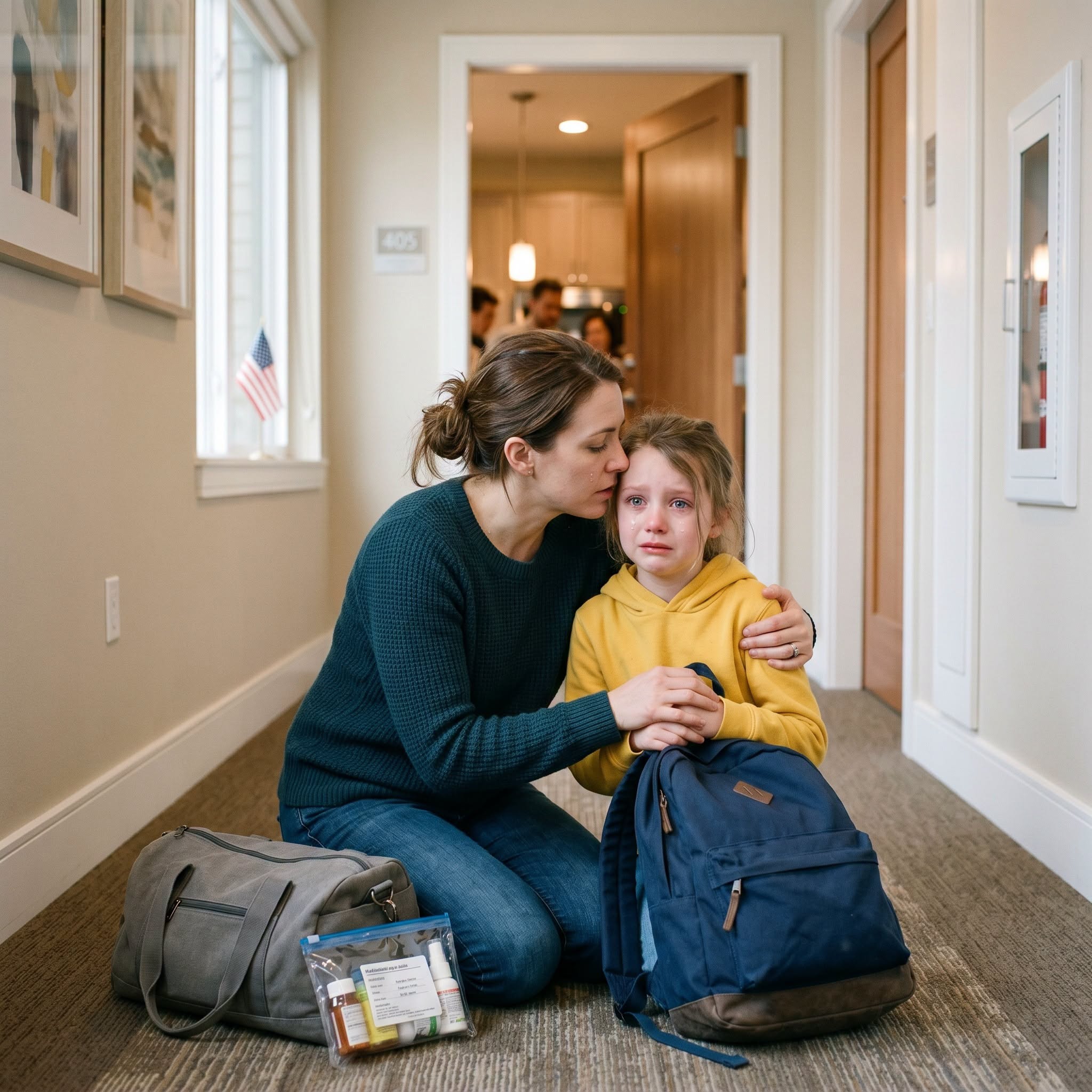
My husband said about our 7-year-old, “I’m so tired of her. I wish we didn’t have kids.” His mother added, “Just be nice for a few more weeks.” My daughter overheard it and went pale. I stayed quiet and did this. Ten days later, police were involved…
If you’ve never tried to get a 7-year-old through an airport while carrying a medication bag that looks like a travel-sized ICU, congratulations. Your life is probably full of hobbies and peace.
My daughter Katie has asthma and allergic rhinitis, which is a fancy way of saying her lungs and her nose have personal grudges against the entire Pacific Northwest.
Not dramatic, not tragic, just constant.
Asthma is a routine. Allergies are a routine. Together, they’re a routine that comes with props.
Rescue inhaler, controller inhaler, spacer with a mask, saline spray, nasal steroid, antihistamines, a laminated asthma action plan the school nurse treats like sacred scripture.
When you parent a kid like Katie, you don’t pack, you inventory.
That morning, I was doing my usual checklist while trying not to be late for our flight out of Seattle.
We had an appointment at a pediatric allergy pulmonology center in another city. Not an emergency, not a heart-stopping rush to the hospital thing. Just a big, annoying, important specialist visit where you answer the same 50 questions and then leave with a new stack of forms.
The kind of appointment you wait months for.
Katie sat at the kitchen table swinging her legs, eating cereal like she wasn’t the reason my calendar looked like a medical conference schedule.
“Mom,” she said, nasal voice thick with allergies. “Do I have to do the spray again?”
“Yes,” I said in my calm mom tone, even though my calm mom tone has been held together with caffeine and sheer willpower since 2018.
Two sprays, one in each nostril.
She frowned like I was offering her broccoli dipped in sadness.
I handed her the nasal spray, then glanced at the time.
We were okay. We were okay. We were.
Andrew walked into the kitchen, freshly showered, clean-shirted, looking like a man who had no idea what was in our medication pouch or what it cost or why the school nurse had my number saved under Asthma Mom.
He kissed the top of Katie’s head.
Then he looked at me and said, “You sure you need to fly out for this? Seems like a lot.”
I didn’t bite.
I didn’t even blink.
“It’s the specialist,” I said. “And we need updated documentation for school, and her meds have been inconsistent.”
Andrew made a face like I’d said, “We need to pay taxes.”
“Okay,” he said too quickly. “Whatever you think.”
My husband used to say that like it was supportive.
Lately, it sounded like someone agreeing to a movie they didn’t want to watch.
I zipped Katie’s backpack. I grabbed the snack bag. I grabbed my laptop.
Because I own a small chain of coffee shops, and the universe does not care if you’re flying for your kid’s lungs. There are still invoices.
There is still payroll.
Oat milk does not order itself.
Then I grabbed the medication pouch and set it right next to my purse, right there, right in front of me, which is important because apparently my brain has a feature where, if I’m stressed, it will temporarily uninstall common sense.
We got a rideshare to SeaTac.
Katie chatted about cartoons. I answered two work calls. I remembered to breathe.
We got into the terminal. We had boarding passes. We even had time to hit the bathroom.
And then, as we sat near our gate, I opened my tote bag to do my usual “I’m a responsible parent” check.
Snacks? Yes.
Water? Yes.
Tablet? Yes.
Headphones? Yes.
Medication pouch?
No.
I stared into my bag like the inhalers were going to materialize out of guilt.
Nothing.
No spacer, no nasal spray, no antihistamines, no folder with the referral and her last notes.
Just me, a growing sense of doom, and a child whose lungs occasionally decide to get creative.
At least I always kept her rescue inhaler in my purse, my non-negotiable rule.
But without the rest of her meds and paperwork, the appointment was pointless.
So yes, I turned around.
I closed my eyes for one second.
Then I stood up.
Katie looked up at me.
“Mom?”
“We forgot your med pouch and your paperwork,” I said.
She went wide-eyed, not because she was scared, but because kids can sense when adults are about to speedrun a mistake.
“Oh,” she whispered.
“Yeah,” I said. “So, we’re turning around.”
We took a rideshare back to our condo building downtown like we were escaping a situation, which turns out we were.
The elevator ride to the seventh floor felt like it took a thousand years.
Katie leaned against me. I could feel her little heartbeat through her jacket.
“Are you mad?” she asked quietly.
“I’m not mad at you,” I said. “I’m mad at my own brain. Different.”
She nodded like that made sense because kids accept your chaos as long as you label it.
When we got to our floor, the hallway was too quiet.
I slid my key into the lock and turned it slowly.
I wasn’t trying to sneak. I just didn’t want to startle anyone because Andrew should have been at work.
But when the door opened a crack, I heard voices.
Two voices.
Andrew’s and Carol’s.
Carol is Andrew’s mother. She’s the kind of woman who says, “I’m just being honest,” right after she’s been cruel. The kind of woman who considers boundaries a personal insult.
I paused, hand still on the door, and listened without meaning to.
Katie stood beside me, clutching her backpack strap.
Inside, Carol said, “Just be nice for a few more weeks. That’s all you have to do.”
Andrew sighed.
“I am being nice.”
Carol made a small disbelieving sound.
“You’re sulking.”
Andrew’s voice sharpened.
“I’m not sulking. I’m tired.”
“Good,” Carol said. “Stay tired. It means you’ll actually do something.”
There was a clink like a mug being set down.
Andrew said lower, “I’m so tired of her. I wish we didn’t have kids.”
Time stopped.
Katie’s body went stiff beside me. My stomach dropped so hard I swear it hit the lobby.
Carol didn’t gasp. Carol didn’t say that was horrible.
Carol said, “Well, we can’t change that now, so we change everything else.”
Andrew muttered, “I didn’t sign up for this. The inhalers, the school nurse calling, the rules, the—”
He exhaled.
“The whole house smells like medicine half the time.”
“Stop whining,” Carol said. “Focus. The HELOC is approved.”
My blood turned to ice.
Andrew said, “And the closing? Are you sure it’s scheduled?”
Carol said, “Yes. Title company on Maple Street next week. You’ll go in with the power of attorney and sign what needs signing.”
Andrew said, “What if they call Emily?”
Carol said, “They won’t if you do it correctly. And she’s distracted anyway. She’s always distracted. She’s living in a cloud of tissues and prescriptions.”
Andrew said, “I don’t want her to find out.”
Carol laughed.
“Oh, Andrew. She’ll find out eventually. That’s why we do it fast. Get the money out. Then you can feel terrible, and she can cry into her artisanal coffee.”
Andrew snapped, “It’s not funny.”
Carol’s voice went syrupy.
“It’s survival. You deserve a life, a normal life, not this asthma schedule.”
Andrew said, “And this is the line that burned itself into my brain. I’m done. I don’t want to deal with her. I don’t want to deal with any of it.”
Katie made a tiny noise like a swallowed sob.
I didn’t burst in. I didn’t slam the door open. I didn’t scream because my daughter was right there.
And because stress is not great for asthma, like at all.
So I bent down, covered her hand with mine, and whispered, “Eyes on me. Okay, we’re going to leave quietly.”
Katie’s eyes were huge.
“Mom.”
“I know,” I murmured. “We’ll talk. Not here.”
We backed away from the door like we were defusing a bomb.
Then we walked down the hallway with the calm, casual pace of two people who definitely weren’t falling apart.
The elevator dinged.
The doors opened.
We stepped in.
The doors closed.
Only then did I let myself breathe.
Katie’s lips trembled.
“Did Dad mean that?”
I crouched down so I was eye level with her.
“Dad said something cruel,” I said. “And people say cruel things when they’re selfish and angry.”
“Is it because I’m sick?” she whispered.
“No,” I said it fast. Too fast.
Then I softened.
“No, sweetheart. Your asthma isn’t your fault. Your body just needs extra help sometimes. That’s all.”
She stared at the elevator floor.
I put two fingers under her chin gently.
“Look at me. You are not a burden. You are a kid. And kids deserve to be loved and protected always.”
Katie blinked hard.
“I don’t want him to hate me.”
My chest tightened like I was the one with asthma.
“He doesn’t get to put that on you,” I said. “That’s adult stuff. That’s his mess, not yours.”
She nodded like she was trying to understand something way too big for seven.
I took a breath and said, “Do you feel tight in your chest?”
She shook her head, but her breathing was shallow.
“Okay,” I said. “We’re going to go somewhere safe, and I’m going to handle everything.”
And then, because life loves timing, my phone buzzed with a work notification about a supplier issue.
I looked at it, then at Katie’s pale face, and I thought, “No, not today. Not ever again.”
We went straight to my friend Lisa’s place.
Lisa is one of those rare adults who can hear something happened in your voice and immediately pivot into action without asking for a full PowerPoint.
She opened the door, saw Katie’s face, and said, “Shoes off, kiddo. Couch blanket. Do you want apple slices or Goldfish?”
Katie managed a tiny nod.
Then Lisa looked at me. Not dramatic, just steady.
“What happened?” she asked.
I swallowed.
My throat felt scraped raw.
“I need you to watch Katie for a while,” I said. “And I need you not to panic.”
Lisa’s eyebrows rose.
“Okay, those are two things I can do. Try me.”
I took a breath.
“Andrew and Carol are planning something. Something financial. With my condo.”
Lisa’s face changed immediately.
“Like scammy financial?”
“Yes.”
“Like felony financial?”
“Yes.”
Lisa exhaled.
“Okay,” she said. “That is not great.”
“No,” I agreed. “It’s not great.”
Katie’s little voice floated over from the couch.
“Mom?”
I walked over, sat beside her, and smoothed her hair back.
“Hey,” I said softly.
She whispered, “Are we going to the doctor?”
“We’re going to reschedule,” I said. “I promise the doctor isn’t going anywhere.”
She nodded, then said, “Is Dad going to take our house?”
My heart cracked.
“No,” I said firmly. “No one is taking our home.”
She studied me like she was searching for a lie.
“You swear?”
I looked straight at her.
“I swear.”
She relaxed a fraction. Not all the way. Just enough to breathe.
Lisa made tea for Katie. She found a juice box for me. She handed me coffee like she understood that caffeine is a legal coping mechanism.
“Tell me,” Lisa said, sitting across from me.
So I did in short bursts, like I was afraid if I spoke in full paragraphs I’d start crying.
HELOC, power of attorney, title company. Just be nice for a few more weeks. I wish we didn’t have kids.
Lisa’s jaw tightened.
“I’m going to say something,” she said. “And you’re not going to like it.”
“I’ve had a pretty rough morning,” I said. “Go for it.”
“You need to assume Andrew is capable of more than you think,” Lisa said. “If he’s willing to say that about Katie, he’s willing to do other things, too.”
I stared into my coffee because she was right.
Andrew and I had been together for 11 years, married for eight.
When we met, he was charming, funny, low drama, and I’m not an idiot. I don’t fall for every smile.
I was building my business, even back then, one little cafe at a time, starting with a cramped spot and a secondhand espresso machine that sounded like a dying lawn mower.
Andrew liked the idea of me being ambitious, as long as it didn’t inconvenience him.
The first cafe did well. The second cafe did better than a third.
Suddenly, I wasn’t Emily with a cute hobby. I was Emily with payroll.
Andrew liked that, too, until he didn’t.
Around the time Katie was diagnosed with asthma, around the time our house turned into a cycle of meds, appointments, and “please call the nurse” emails, Andrew started changing.
He wasn’t cruel at first, just absent, then irritable, then weirdly interested in my finances.
He’d ask about my business checking account like he was just curious. He’d ask about the condo title like it was just conversation. He’d look at my laptop screen over my shoulder and say, “Wow, those numbers are big.”
I thought it was awkward support.
Turns out it was reconnaissance.
Lisa said, “Okay, step one, you call the lender.”
“I don’t even know where to start,” I said.
Lisa looked at me like I’d forgotten my own name.
“Emily,” she said. “You own multiple businesses. You can absolutely do this.”
“Thanks,” I muttered. “It’s nice to know my panic is not convincing.”
“Your panic is very convincing,” Lisa said. “It’s just not helpful.”
Katie coughed softly from the couch.
I froze like every mom of an asthmatic child freezes.
“Baby?” I called gently.
“I’m okay,” she whispered.
I watched her breathing for a beat. She was okay. Just allergies.
Still, my nerves were stretched tight.
I pulled out my phone and called my lender.
The lender’s automated system was a masterpiece of modern cruelty.
Press one for mortgages. Press two for home equity products. Press three if you enjoy suffering.
I made it through, did the verification dance, and finally got a loan officer named Michael.
Michael sounded like a normal human being, which in customer service is basically a miracle.
“Hi,” I said. “I need to know if there are any recent loan applications tied to my property.”
There was a pause. Keyboard clicking.
“Yes,” Michael said carefully. “There’s an active HELOC application.”
My grip tightened on the phone.
“Active how?”
“It’s approved,” he said. “Closing is scheduled.”
I looked at the wall like it was going to explain how my life got here.
“I didn’t apply for it,” I said.
Silence.
Then Michael’s voice changed. Less cheerful, more professional.
“Okay,” he said. “Do you recognize the co-applicant?”
“There shouldn’t be a co-applicant,” I said.
Another pause.
“There isn’t,” he said slowly. “But there is a power of attorney on file.”
My blood ran cold.
“That’s fake,” I said. “My husband and his mother are doing something.”
Michael didn’t argue. He didn’t tell me I was overreacting. He didn’t ask if I was sure.
He said, “I’m escalating this to our fraud team right now. You need to file a police report for identity theft and forgery.”
“Okay,” I said. “How do I stop the closing?”
“We can place a hold,” he said. “But we need documentation, police report number, statement, and you’ll likely need to speak to the title company.”
I exhaled.
“Okay,” I said, because okay is what you say when your entire marriage collapses into a crime investigation.
Michael added, “And Miss Parker?”
“Yes?”
“If your husband has access to your accounts or documents, you should secure everything. Passwords, two-factor authentication, everything.”
“I will,” I said.
Then I hung up and stared at my phone like it had insulted me.
Lisa’s eyes were locked on my face.
“It’s real,” she said.
“It’s real,” I confirmed.
Katie’s little voice again.
“Mom.”
I walked to the couch and sat beside her.
“Hey,” I said, smiling like my face wasn’t aching from holding it together.
She whispered, “Are we staying here for a little while?”
“I said, a sleepover with Lisa.”
Her eyes widened.
“Can we have pancakes?”
Lisa snorted.
“Absolutely.”
I kissed Katie’s forehead.
“Go pick a movie,” I told her.
When she hopped off the couch, Lisa leaned toward me.
“Police report,” she said. “Now.”
So I did.
The precinct on Jefferson Avenue smelled like old coffee and fluorescent lighting, which felt fitting because my life had become a bad office breakroom.
I met Detective Peterson, who looked like a man who had heard every variation of, “My spouse did something terrible,” and had long ago stopped being surprised.
He listened while I explained the HELOC, the power of attorney, the title company, and the fact that my husband and his mother were discussing it like it was a grocery list.
Detective Peterson asked, “Do you have any evidence?”
I hesitated.
Then I said, “I recorded a little.”
Lisa had told me earlier, quietly, firmly, if you ever hear them talking again, record it. Don’t be noble. Be smart.
So yes, back at the door after the first shock, I’d hit record.
My hands were shaking.
The audio was muffled, but it caught key words.
HELOC.
Power of attorney.
Closing.
Be nice for a few more weeks.
Detective Peterson listened, expression unreadable, then nodded.
“That helps,” he said. “A lot.”
He asked about the power of attorney. Did I ever sign one? Did Andrew ever mention one? Did I trust Carol with paperwork?
“No,” I said. “God, no.”
He wrote things down, then said, “We’re going to request the loan file and the notarization record.”
“The notarization record?” I repeated.
Detective Peterson’s mouth twitched.
“This is where it gets interesting,” he said. “A lot of these closings use remote online notarization. Now, if that’s the case, there’s a video record.”
“A video record?”
My stomach flipped.
Because if there was video, there was proof.
And if there was proof, there was no way Andrew could gaslight his way out.
Detective Peterson gave me the case number and said, “Don’t confront him. Don’t tip them off. Let the fraud team and us do our jobs.”
Lisa’s voice echoed in my head.
“Assume he’s capable of more than you think.”
I nodded.
“Okay,” I said.
Then I walked out of the precinct and sat in my car, hands on the steering wheel, breathing slowly.
I thought of Katie’s face in the hallway, how pale she’d gone. How she’d tried not to cry because she didn’t want to make things worse.
And I felt something inside me go still.
Not numb.
Focused.
If Andrew wanted a plan, fine.
I could plan, too.
2 days later, Michael called me back.
“I have an update,” he said.
“Please tell me it’s good,” I said.
“It’s clear,” he corrected gently. “Our fraud team pulled the documents. The power of attorney is notarized through an online notary platform.”
“Meaning there’s video,” I said.
“Yes,” Michael replied. “Detective Peterson requested it. We’re coordinating with the title company.”
My heart hammered.
Later that afternoon, Detective Peterson called.
“We got the recording,” he said.
“And?” My voice shook.
“It’s not you,” he said.
I closed my eyes. Relief and rage crashed together in my chest.
Detective Peterson continued.
“The signer is a woman. Similar build, similar hair color, but it’s not you. The ID she held up was questionable.”
“Questionable,” I repeated, because I needed him to say it again like it would make it less real.
He said, “We also have your husband’s involvement in scheduling. The appointment is set for 8 days from now at the title company on Maple Street.”
10 days.
My brain latched on to the number like it was a lifeline.
10 days meant I could prepare.
10 days meant I could protect Katie.
10 days meant I could make sure Andrew didn’t walk away with money and a story about how I was crazy.
Detective Peterson asked, “Do you want us to arrest him now, or do you want us to catch him at closing?”
I pictured Andrew’s face.
Not the face from our wedding photos. The face from the kitchen heard through the door.
Tired, annoyed, indifferent.
“I want it clean,” I said. “Catch him.”
Detective Peterson paused.
“Okay,” he said. “Then you’re going to have to keep acting normal.”
I laughed once.
It wasn’t funny.
“Oh,” I said. “I can act normal because mothers are actresses by default. We smile through fevers and tantrums and sleep deprivation. We host birthdays while running on fumes. We answer emails while cleaning up vomit. Acting normal while my husband plotted against me? Honestly, not even my hardest role.”
For the next 8 days, I lived two lives.
In one life, I was a business owner, a mom, and a normal wife.
In the other life, I was quietly locking down everything Andrew could touch.
Step one, Katie.
I called her school and updated the pickup list.
Only me and Lisa.
No Andrew, no family friend, no Carol.
The school secretary didn’t ask questions because this is America and every school has seen at least one divorce situation that made them regret choosing education as a career.
I met with the school nurse and handed her an updated asthma action plan.
“I also need to make sure,” I said carefully, “that no one can change Katie’s emergency contacts without my permission.”
The nurse gave me a look that said, “Oh, that kind of situation.”
“Got it,” she said. “We’ll note it.”
Step two, my money.
I changed passwords. Every password.
Banking, payroll, vendor accounts, email, even the streaming services because I was not about to let Andrew keep watching my Hulu with my dignity.
Two-factor authentication on everything.
I moved important documents, birth certificates, property paperwork, insurance policies, into a safe deposit box.
Lisa helped because Lisa doesn’t believe in doing scary things alone.
“Do you feel like a spy?” she asked as we walked out of the bank.
“I feel like a woman who learned her husband is an idiot,” I said.
“That’s most spies,” she replied.
Step three, Andrew.
Andrew came home every night and performed husband theater.
“How was your day?” he’d ask.
“Busy,” I’d say.
“How’s Katie?” he’d ask with the soft voice.
The voice that almost sounded real.
“She’s okay,” I’d reply, watching him like he was a puzzle made of snakes.
One evening, he said, “You know, if you ever needed extra cash, like for medical stuff, we could look at a line of credit.”
I almost dropped my fork.
I smiled instead.
“Oh,” I said, like this was casual conversation and not a confession.
He shrugged.
“Just thinking out loud.”
“Interesting,” I said, and took another bite of salad like my mouth wasn’t full of nails.
Carol texted me during those 10 days, too.
Always something nice.
How sweet, Katie. I saw this article about air purifiers. You should take better care of yourself, Emily. Stress isn’t good for the immune system.
Carol’s kindness was like perfume sprayed over trash.
I ignored most of it.
But on day six, Carol called.
I didn’t want to answer.
Lisa said, “Answer it. Let her think everything’s fine.”
So, I did.
“Hi, Carol,” I said bright.
“Oh, Emily,” Carol said, warm as a knife. “How’s our little Katie doing?”
I forced myself to stay calm.
“She’s okay,” I said. “We’re managing.”
“Good,” Carol purred. “You know, Andrew worries.”
I almost laughed.
“He does?” I asked.
“Oh yes,” she said. “He just wants what’s best for the family.”
I stared at the wall.
“The family,” I repeated.
Carol continued.
“And you’ve been so busy with the shops, with appointments, with everything. You must be exhausted.”
“Yes,” I said truthfully.
“Well,” she said, “if you ever need help, you know I’m here.”
I pictured her in my kitchen plotting my financial destruction.
“You’re so kind,” I said.
My voice didn’t crack.
I was proud of myself.
After I hung up, I went into the bathroom and stared at myself in the mirror.
My face looked normal, but my eyes looked different, like someone who had stopped believing in excuses.
Katie, meanwhile, was doing what kids do.
She drew pictures. She watched cartoons. She asked for pancakes.
And sometimes, when she thought I wasn’t looking, she watched me like she was checking if I was still there.
One night, as I tucked her into bed, she whispered, “Mom.”
“Yes, baby.”
“Do you still love Dad?” she asked.
My throat tightened.
“I love the part of him I thought was real,” I said carefully.
Katie frowned.
“But he said he didn’t want kids.”
I sat on the edge of her bed and smoothed her blanket.
“Sometimes adults say things they don’t understand,” I said. “Sometimes adults are wrong.”
“Is he wrong about me?” she whispered.
“No,” I said fiercely. “He’s wrong about you. You are wonderful.”
She stared at her stuffed animal.
“Okay,” she said softly, like she was trying to accept it.
I kissed her forehead.
“You and me,” I whispered. “We’re a team.”
She nodded.
And in that moment, any lingering hesitation I had about what I was doing disappeared because this wasn’t just about money or property.
This was about safety.
This was about showing my daughter that when someone tries to hurt you emotionally, financially, any way, you don’t shrink.
You act.
On day eight, something happened that made the whole thing even uglier.
I was at my flagship cafe, the one with the long line and the baristas who can spell Siobhan correctly on the first try, when a woman walked in looking like she hadn’t slept in a year.
She hovered near the counter, then finally said, “Are you Emily Parker?”
“Yes,” I said cautiously.
She swallowed.
“My name is Megan,” she said. “I think your husband might be… I don’t know how to say this.”
My stomach sank.
Megan glanced down at the stroller beside her.
A toddler, Timothy, sat inside, chewing on a toy, oblivious.
Megan’s hands shook as she continued.
“Andrew told me you were separated,” she said. “He said he was moving out soon. He said you were unstable.”
Lisa’s words echoed again.
“Assume he’s capable of more than you think.”
I motioned Megan to a quiet table.
She sat, gripping her coffee like it was an anchor.
“I didn’t come to ruin your life,” she said quickly. “I didn’t even know. I just… He asked me for money. He said he needed help because you were draining him with medical bills and he couldn’t access his accounts.”
My jaw clenched.
“He asked you for money?” I repeated.
Megan nodded, eyes shining.
“He said once he got this loan sorted, he’d pay me back. He made it sound temporary.”
Timothy babbled happy.
Megan looked at him, then at me.
“I feel stupid,” she whispered.
I took a slow breath.
“You’re not stupid,” I said. “You were manipulated.”
She hesitated.
“Is he dangerous?”
I thought of the hallway, the voice, the plan.
“I don’t know,” I said honestly. “But I know he’s willing to do illegal things, and I know he’s willing to lie to your face while doing them.”
Megan’s shoulders sagged.
“I have messages,” she said. “Screenshots, if you need them.”
“I do,” I said.
Because if Andrew was running multiple scams, this wasn’t just family drama.
This was a pattern.
When Megan left, I sat alone for a moment in my office behind the cafe and stared at the wall.
I felt numb.
Then I felt furious.
Then I felt strangely clear because the story I’d been clinging to, maybe this is just Carol, maybe Andrew is being pressured, fell apart completely.
Andrew wasn’t a weak man being led.
Andrew was an adult making choices, and those choices were going to meet consequences.
Day 10 arrived like a storm you can see coming from miles away.
Andrew woke up early.
He showered.
He put on a nice sweater, the “I’m about to sign fraudulent documents” sweater.
He whistled while making coffee.
Whistled like this was a normal day.
“Big day?” I asked lightly because I deserve an Oscar.
He blinked, then smiled too fast.
“Just work stuff,” he said. “Meeting.”
“Have fun,” I said, sipping my coffee like I wasn’t counting down to his downfall.
Carol texted me at 9:12 a.m.
Today’s the day. Stay calm.
Which honestly was hilarious because Carol didn’t realize I was calm.
I was calm like a locked door.
At 10:30 a.m., I walked into the title company on Maple Street.
The office looked exactly like every office where people sign their souls away.
Beige walls, polite receptionist, a bowl of mints that tasted like regret.
Michael was there.
Two security officers.
Detective Peterson, wearing plain clothes, sitting in a corner like a man waiting for a bus.
He nodded at me.
“You okay?” he asked quietly.
I nodded.
“I’ve had worse mornings,” I said.
“From what I’ve seen,” he said, “I believe you.”
We sat in a small conference room. My hands were folded in my lap. I forced myself not to fidget.
This part was the hardest.
Not the confrontation, not the paperwork.
The waiting.
Because waiting gives your brain time to replay every moment and try to convince you you’re overreacting.
Then the door opened.
Andrew walked in first.
Carol followed right behind him, chin up, handbag clutched like she was arriving at a gala.
Andrew froze when he saw me.
For half a second, his face went blank.
Then it rearranged itself into confusion.
“Emily,” he said, like I was the one who’d done something shocking.
Carol’s eyes narrowed.
“What is this?” she snapped.
Michael stood calmly.
“Mr. Parker,” he said. “We need to discuss irregularities in your HELOC file.”
Andrew’s throat bobbed.
“Irregularities?”
Detective Peterson stood.
“Andrew Parker?”
Andrew’s eyes flicked to him, then to me.
“What is this?”
“It’s a fraud investigation,” Detective Peterson said evenly.
Carol’s mouth tightened.
“This is ridiculous,” she hissed. “We have a notarized power of attorney.”
Michael lifted a folder.
“We’ve reviewed the notarization,” he said, “including the video record.”
Andrew’s face drained of color.
Carol snapped, “That video proves nothing.”
Detective Peterson looked at her.
“Ma’am,” he said. “The video shows a woman who is not Emily Parker signing as Emily Parker.”
Carol’s jaw clenched.
Andrew turned to me, eyes wide, a mix of panic and rage.
“You set me up,” he whispered.
I tilted my head.
“No,” I said. “You set yourself up. I just stopped you from finishing.”
Carol lunged forward, pointing at me like I was a disobedient employee.
“How dare you do this to your family?”
Detective Peterson’s voice sharpened.
“Ma’am, step back.”
Andrew started talking fast. The way guilty people talk when they think speed can replace truth.
“It’s a misunderstanding,” he said. “I was trying to help us. Emily’s been overwhelmed and I—”
Michael cut him off.
“Sir,” he said calmly. “You attempted to borrow against a property without authorization using a forged document. That is not help. That is fraud.”
Andrew’s lips parted.
No sound came out.
Carol hissed, “Emily, you ungrateful—”
I looked at her and smiled slightly.
“Carol,” I said, “you told him to be nice for a few more weeks.”
Her eyes widened just a fraction.
Detective Peterson reached into his pocket.
“Andrew Parker,” he said, “you are being detained pending further investigation into identity theft and loan fraud.”
Andrew’s face twisted.
“Emily.”
I held up a hand.
“Don’t,” I said softly. “Not here.”
Carol’s voice rose.
“You can’t do this.”
Detective Peterson motioned, and the two officers stepped forward.
Andrew stumbled backward.
Then the cuffs clicked.
The sound was small, but it landed like thunder.
10 days after my daughter heard her father wish she didn’t exist, he was being led out of an office by police.
Carol tried to follow, yelling.
Security blocked her.
And suddenly, for the first time in a long time, the air in my chest felt lighter.
Not happy, not triumphant, just free of the illusion that love would fix someone who preferred convenience over character.
That afternoon, I picked Katie up from Lisa’s.
She looked at my face like she could read it.
Kids can’t read words, but they can read energy.
“Is Dad mad?” she asked quietly.
I crouched down and brushed her hair behind her ear.
“Dad made choices,” I said. “And now grown-ups are handling it.”
“Is he coming home?” she asked.
I took a breath.
“Not right now.”
Her eyes filled.
“Did I do something?”
“No,” I said, firm but gentle. “You didn’t do anything. You are not too much. You are not a problem. You are a kid who deserves to feel safe.”
She nodded, then buried her face into my shoulder.
Lisa stepped aside, giving us space, but her eyes were soft.
“You’re doing good,” she murmured.
I hugged Katie until her breathing slowed, until her little shoulders relaxed, until I could hear the normal rhythm of her breath and not the fear behind it.
The next weeks were paperwork, locks changed, accounts secured, temporary custody filed.
Detective Peterson called a few times with updates using words like investigation and evidence and prosecutor’s office in a tone that made it clear this wasn’t going away quietly.
Andrew hired a lawyer, attorney Morgan, who left me a voicemail about amicable resolution.
I listened once, then deleted it because there is nothing amicable about forging documents and emotionally gutting a seven-year-old.
Megan sent me screenshots of Andrew’s messages. Detective Peterson took them.
It added weight to the case.
Carol tried calling. She tried texting. She tried showing up at my cafe like she had a right to the space.
She didn’t.
I told my staff, “If Carol Parker walks in, call me. And if she causes a scene, call security.”
One barista asked, wide-eyed, “Is she, like, banned?”
“She’s emotionally banned,” I said. “Legally, we’re working on it.”
Katie asked about her grandma one night.
I didn’t lie.
“Grandma Carol made some bad choices,” I said.
Katie frowned.
“Why?”
I tucked her blanket around her.
“Some people want control more than they want peace,” I said. “And sometimes they confuse those things.”
Katie thought about that, then said, “I want pancakes.”
I laughed once.
“Me, too, baby.”
Because here’s the truth.
Parenting teaches you how to live through chaos. You don’t get the luxury of falling apart for a week.
You get 5 minutes in the bathroom, maybe, and then you make dinner.
You make the appointment.
And yes, we rescheduled the specialist visit.
A few weeks later, Katie and I flew out again. This time, I triple-checked the medication pouch like it was my passport to sanity.
At the clinic, the doctor was kind and blunt.
We updated Katie’s action plan, adjusted her controller medication, talked triggers, talked school accommodations, talked about how anxiety can mimic asthma symptoms and how to handle that gently.
Katie got a sticker that said, “Brave patient.”
She held it up proudly.
“Mom,” she said. “I did it.”
“You did,” I said, and I meant it in every possible way.
On the way out, she asked, “Can we get ice cream?”
I looked at her little face, still soft, still hopeful, still mine to protect.
“Yes,” I said. “We can get ice cream.”
And as we walked into the bright afternoon air, I realized something simple.
Asthma is a routine.
Paperwork is a routine.
Raising a kid is a routine.
But I will never ever build my routine around a man who thinks my daughter is an inconvenience.
Not again.
If you came here from Facebook because of this story, please go back to the Facebook post, tap like, and leave exactly “Powerful” in the comments to support the storyteller. That small action means a lot and helps give the writer more motivation to keep bringing you stories like this.