Chapter 1
I’ve owned dogs my entire life, but absolutely nothing in my 42 years on this earth could have prepared me for the horrifying, sickening secret hidden inside my new dog’s heavy plaster cast.
My name is David. Two years ago, I lost my wife to a sudden illness, and ever since then, my house in the quiet suburbs of Ohio has felt like a tomb. The silence was deafening. I needed companionship. I needed a reason to get up in the morning.
That’s when I started looking online for a rescue dog. I didn’t want a puppy; I wanted an older dog, one that had been through a rough patch and just needed a quiet place to heal.
Late one Thursday night, I was scrolling through a local community board when I saw a blurry, poorly lit photo of a Golden Retriever.
The title of the ad read: “Special Needs Dog. Needs Home TODAY. $50 Cash Only.”
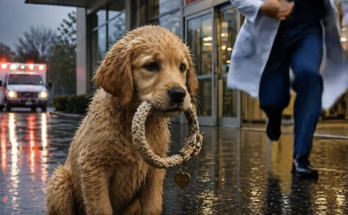
The picture broke my heart. The dog was looking at the camera with the saddest, most soulful brown eyes I had ever seen. But what caught my attention was his front left leg. It was encased in a massive, thick, dirty white cast that looked entirely too big for his body.
The description was brief. It simply stated the dog, named Buster, had fallen off a porch and suffered a minor fracture. The owner claimed he couldn’t afford the vet bills anymore and needed to rehome him immediately.
I called the number at the bottom of the ad. A man answered on the second ring. His voice was gruff, hurried, and strange.
“You want the dog or not?” he asked before I could even introduce myself.
“I do,” I said, a little taken aback. “I’d love to come see him. Can I ask about his leg? Does he need follow-up care at a vet?”
The man’s tone instantly turned sharp. “No. No vets. I already paid a guy to set the bone. It’s a simple fracture. You just leave the cast on for exactly four weeks. Don’t touch it. Don’t get it wet. And do not take him to a clinic, they’ll just scam you for more money. If you can’t follow that rule, you can’t have the dog.”
It sounded like a massive red flag. Every instinct in my body told me to hang up the phone. But then I remembered the look in that dog’s eyes. I couldn’t just leave him with this aggressive, shady guy.
“I’ll take him,” I said. “Send me the address.”
The address he texted me was over an hour away, deep in the rural, wooded outskirts of the county. I drove out there the very next morning. The weather was miserable—a cold, relentless rain turning the dirt roads into thick mud.
When I finally pulled up to the location, my stomach tied itself into a knot.
It wasn’t a house. It was an abandoned, rotting barn sitting at the end of a long, overgrown driveway. There was an old rusted pickup truck parked out front.
I stepped out of my car, the cold rain hitting my face. A man walked out of the barn. He was tall, wearing a dirty heavy coat, and he looked incredibly nervous. He kept checking his phone and looking down the road.
“You the guy from the phone?” he asked, walking toward me.
“Yes, I’m David.”
He didn’t shake my hand. He just whistled sharply.
From the dark shadows of the barn, a Golden Retriever slowly limped out. It was Buster. He was soaking wet, shivering violently, and his coat was matted with dirt.
But it was the cast that made my breath catch in my throat.
It was enormous. It went from his paw all the way up to his shoulder. It didn’t look like a clean, medical-grade fiberglass cast you’d see at a normal vet clinic. It looked like industrial plaster—rough, thick, and sloppily applied.
When Buster tried to walk, he dragged the heavy cast through the mud. It looked agonizing.
I dropped to my knees in the wet dirt and held out my hand. Buster slowly hobbled over to me and pressed his cold, wet nose into my palm. He let out a soft, heartbreaking whimper.
“I’ll take him,” I said, standing up and pulling a fifty-dollar bill from my wallet.
The man snatched the cash from my hand.
“Remember what I told you,” the man said, his eyes darting around nervously. “Do not take him to a vet. The bone is healing. Four weeks. Just let him rest.”
Before I could ask for any medical records or even his name, the man turned, got into his rusted truck, and sped off down the muddy road, leaving me alone in the rain with the dog.
I gently lifted Buster into the backseat of my SUV. He was surprisingly heavy, and I realized most of that weight was coming from the massive plaster cast on his leg.
The drive home was quiet. Buster just lay on the backseat, staring out the window. But as the car heater warmed up the cabin, I started to notice something strange.
A smell.
It wasn’t the typical smell of a wet, dirty dog. It was a sharp, metallic odor mixed with something deeply foul. It smelled like chemicals and… something rotting.
I glanced in the rearview mirror. Buster was obsessively licking the top edge of the cast, whining softly in the back of his throat.
“It’s okay, buddy,” I whispered, trying to comfort him. “We’re going home. You’re safe now.”
For the first three days, things were relatively peaceful. Buster was the sweetest, gentlest dog I had ever met. He followed me from room to room, his heavy cast thudding against the hardwood floors.
But by the fourth night, everything changed.
I woke up at 2:00 AM to a sound that made my blood run cold. Buster was screaming. Not barking, not whining—he was letting out high-pitched, agonizing yelps of sheer pain.
I rushed into the living room and found him frantically tearing at the plaster cast with his teeth. His gums were bleeding from biting the hard plaster, but he wouldn’t stop. He was in absolute agony, desperate to get the cast off.
I knelt beside him, trying to gently pull his head away.
That’s when I touched the cast with my bare hands.
It was incredibly hot.
Normally, a cast feels room temperature or slightly warm from body heat. But this plaster felt like it was burning from the inside out. And that foul, metallic smell I had noticed in the car was now so strong it made my eyes water.
I remembered the strange man’s strict warning: “Do not take him to a vet.”
I looked down at Buster. He was looking at me, his chest heaving, tears literally forming in his eyes. He raised his heavy, plastered leg and rested it gently on my knee, begging for help.
I didn’t care what that sketchy seller had told me. I didn’t care about his warnings. Something was horribly, terribly wrong inside that cast, and I wasn’t going to let this dog suffer for another second.
I grabbed my car keys.
At 8:00 AM sharp the next morning, I was standing in the lobby of my local veterinary clinic, holding Buster by his leash.
My regular vet, Dr. Aris, a kind older man who had taken care of all my previous pets, called us into examination room 3.
I lifted Buster onto the stainless steel table.
“Well, who do we have here?” Dr. Aris asked warmly, adjusting his glasses.
“His name is Buster,” I explained, my voice shaking with exhaustion. “I rescued him four days ago. The guy I got him from said it’s a minor fracture. But Dr. Aris… he’s in agony. The cast is hot. And it smells horrible.”
Dr. Aris stepped closer and frowned. He put on a pair of blue latex gloves and gently touched the massive white structure on Buster’s leg.
Instantly, Dr. Aris’s friendly demeanor vanished.
His face went pale. He leaned in, sniffing the top of the cast, and then ran his fingers along the thick, sloppy edges of the plaster.
He slowly looked up at me, his eyes wide behind his glasses.
“David,” Dr. Aris said, his voice dropping to a low, serious whisper. “Where exactly did you say you got this dog?”
“A guy off an internet ad,” I stammered, my heart starting to pound against my ribs. “Why? What’s wrong? Is it infected?”
Dr. Aris didn’t answer right away. He walked over to a cabinet, unlocked it, and pulled out a heavy-duty, vibrating medical saw used for cutting fiberglass.
“David, I need you to hold him steady,” Dr. Aris said, his jaw clenched tight. “This isn’t a medical cast. No veterinarian in the world put this on him.”
My breath caught in my throat. “What do you mean?”
“I mean,” Dr. Aris said, turning on the loud, buzzing saw, “we need to get this off him right now. Prepare yourself.”
As the blade sliced into the thick plaster, the horrific smell filled the entire room. And what we found hidden inside that cast the moment it finally cracked open… will haunt my nightmares for the rest of my life.
CHAPTER 2
The high-pitched, mechanical whine of the oscillating medical saw shattered the sterile silence of the examination room.
It was a sound that instantly set my teeth on edge. I tightened my grip around Buster, pulling his heavy, trembling body closer to my chest. He pressed his head into the crook of my arm, his breathing shallow and rapid. I could feel his heart hammering against his ribs like a trapped bird.
“It’s okay, buddy,” I whispered into his ear, my voice shaking. “You’re safe. We’re going to get this awful thing off you. Just hold on.”
Dr. Aris stood over the stainless steel table, his face a mask of intense concentration. The friendly, grandfatherly demeanor he usually carried had completely vanished, replaced by a grim, clinical focus.
He gripped the saw with both hands, the blade spinning so fast it looked like a blur of solid metal. Carefully, he pressed the edge of the blade against the top of the massive, filthy plaster cast.
A cloud of thick, gray dust erupted into the air the moment the saw made contact.
Immediately, that horrific smell I had noticed in my car—the smell of rotting chemicals and old copper—multiplied by a hundred. It hit me like a physical blow to the chest.
It was so foul, so deeply unnatural, that my eyes began to water. Dr. Aris visibly recoiled for a split second, turning his head to cough into his shoulder, before forcing himself to lean back in.
“Breathe through your mouth, David,” Dr. Aris instructed, his voice muffled behind the surgical mask he had quickly pulled over his face. “This isn’t standard fiberglass. It’s industrial plaster. The kind you buy at a hardware store to patch walls. It has absolutely no business being on a living creature.”
I watched in horror as the blade slowly chewed its way down the length of Buster’s leg.
The plaster was unbelievably thick. Dr. Aris had to apply significant pressure just to break through the first layer. Beneath the plaster, the saw caught on something tough and fibrous.
“Duct tape,” Dr. Aris muttered, his eyes narrowing in anger. “Whoever did this wrapped his leg in layers of duct tape before applying the plaster. They essentially suffocated the limb. No air flow. No padding. Nothing.”
My stomach churned. The image of that nervous, aggressive man in the rain—the man who had snatched my fifty dollars and sped away—flashed in my mind. He hadn’t been trying to heal this dog. He had been trying to hide something.
But what?
“Keep him perfectly still,” Dr. Aris warned as he reached the bottom of the cast, near Buster’s paw. “I’m almost through the primary shell. The blade won’t cut skin, but the vibration is going to scare him.”
Buster let out a low, miserable whimper, but to his credit, he didn’t fight. It was as if the dog knew we were trying to help him. He just squeezed his eyes shut and buried his face deeper into my jacket.
Dr. Aris turned off the saw. The sudden silence in the room was deafening, broken only by the sound of my own ragged breathing and Buster’s soft pants.
The vet set the saw down on a metal tray with a loud clatter. He reached into a drawer and pulled out a pair of heavy metal cast spreaders. They looked like reverse pliers, designed to pry open the rigid shell of a cast once a cut had been made.
“Alright,” Dr. Aris said, taking a deep breath. “Let’s see the damage.”
He inserted the metal jaws of the spreaders into the long groove he had just cut. With a grunt of effort, he squeezed the handles together.
The thick industrial plaster fought back for a moment, refusing to yield. Then, with a loud, sickening CRACK that echoed off the tiled walls, the cast split wide open.
What I saw inside made my blood run instantly cold.
There was no medical cotton. There was no sterile padding.
Instead, the hollow space between the hard plaster and Buster’s skin was tightly packed with dark, heavy fabric.
But the fabric wasn’t just dark. It was soaked through with dried, crusty brown stains.
It was blood.
A massive amount of it.
“Dear God,” Dr. Aris whispered, his hands freezing in mid-air.
He didn’t move. I didn’t move. We just stared at the horrifying mess exposed on the examination table.
My mind raced, trying to make sense of the nightmare unfolding in front of me. I had lost my wife to a quiet, invisible disease. Her passing had been a fade into silence. This… this was something entirely different. This was violent. This was intentional.
“What is that?” I finally choked out, my voice sounding foreign and distant to my own ears. “Dr. Aris, what is packed inside there?”
The vet didn’t answer me. He grabbed a pair of long, sterile tweezers from the tray. His hands, which had been perfectly steady while operating the dangerous saw, were now trembling slightly.
He reached into the cracked shell of the cast and gripped a piece of the blood-soaked fabric.
Slowly, carefully, he pulled it out.
It wasn’t a rag.
It was a piece of clothing.
As Dr. Aris laid the fabric flat on the stainless steel table, the sickening reality of the situation began to settle over the room like a suffocating blanket.
It was a child’s t-shirt.
A small, light pink t-shirt, completely saturated with dried blood and dirt. It was so small it couldn’t have belonged to anyone older than eight or nine years old.
The breath caught in my throat. I felt physically dizzy, the edges of my vision starting to blur.
“Why…” I stammered, gripping the edge of the table to keep myself upright. “Why would a child’s bloody shirt be stuffed inside a dog’s cast?”
Dr. Aris’s face was completely drained of color. He looked like he was going to be sick. He didn’t say a word as he reached back into the cast with his tweezers, pulling out another piece of fabric.
This time, it was a small, torn piece of denim. Part of a pair of child’s jeans.
They had used the bloody clothes as padding. They had shoved the evidence of something unspeakably horrific against this poor animal’s skin, encased it in concrete-thick plaster, and sold the dog to a stranger to get rid of it.
Buster whimpered again, licking my hand frantically. He wasn’t crying because of the saw anymore. He was crying because his wound was finally exposed to the air.
I forced myself to look at Buster’s leg.
It was a nightmare.
The flesh was raw, weeping, and severely infected. But it wasn’t a fracture. Even to my untrained eye, I could see that the bone wasn’t broken from a fall off a porch.
There was a deep, jagged laceration slicing across his forearm. It looked like he had been struck with something incredibly sharp and heavy. A machete, maybe. Or an axe.
“This is a defensive wound,” Dr. Aris said, his voice dropping to an absolute whisper. He was staring at the laceration with wide, terrified eyes. “David… this dog didn’t fall. He blocked a blow. He was protecting someone.”
The silence in the room became heavy, thick with a terror I had never experienced in my entire life.
I looked at the bloody pink t-shirt on the table. I looked at the defensive wound on the gentle Golden Retriever who was currently hiding his face in my chest.
He was protecting someone. My mind flashed back to the isolated, rotting barn. The pouring rain. The nervous, aggressive man constantly checking down the road.
He had been trying to get rid of the dog. He had to hide the evidence. “Dr. Aris,” I said, my voice rising in panic. “We need to call the police. Right now. That man… that man did something to a child.”
But Dr. Aris wasn’t listening to me.
His eyes were locked on the heavy, broken halves of the plaster cast resting on the table.
“Wait,” the vet said softly.
He leaned closer to the hollowed-out center of the cast. Deep inside, trapped in the dried blood and industrial adhesive, something else was lodged.
It wasn’t fabric.
It was a small, tightly folded square of paper.
Dr. Aris used his tweezers to gently pry the paper loose from the hardened plaster. It made a soft, scraping sound as it came free.
The paper was stained with dark brown spots, the edges crumpled and torn.
The entire room went dead silent. The only sound was the hum of the fluorescent lights overhead and the pounding of the blood in my ears.
Dr. Aris set the tweezers down. He stripped off his heavy blue latex gloves, his hands shaking violently now. With bare, trembling fingers, he picked up the small square of paper.
It was folded over three times, tightly compressed into a tiny pellet so it could be hidden deep inside the bloody clothing before the plaster was poured over it.
Slowly, agonizingly, Dr. Aris unfolded the first crease.
Then the second.
Then the third.
It was a piece of lined notebook paper, the kind you buy for elementary school students.
I stepped closer, my heart in my throat, peering over the vet’s shoulder.
Written on the paper, in shaky, terrified, dark pencil strokes, were words that completely shattered my reality.
The handwriting was messy, erratic, completely desperate. The letters varied in size, some pressing so hard into the paper that the pencil lead had broken through the thin sheet.
I read the words out loud, my voice breaking on every single syllable.
“Please help me. He locked me in the storm cellar under the barn floor. He hit Buster with the metal pipe because Buster bit him when he was dragging me down the stairs. He says he is coming back for me tonight. Please. Don’t let him know I wrote this. He will kill me. My name is Lily. I am 9.”
The air completely left my lungs.
I felt like I had been shoved out of an airplane without a parachute. The room began to spin.
Lily. Nine years old. Locked in a storm cellar beneath the very barn I had stood in less than a week ago.
I had been there.
I had stood in the pouring rain, handing fifty dollars to a monster, completely unaware that a little girl was trapped just a few feet below the muddy earth, praying for a miracle.
Buster hadn’t just been abused. He was a survivor. He was a hero who had taken a devastating blow from a metal pipe to save a child’s life. And when the attacker realized the dog was a liability, he used the dog as a trash can to hide the bloody clothes, casting him in plaster and selling him off to make him disappear forever.
But Lily had been smart.
In her absolute darkest moment, right before the monster took her dog away, she had managed to write that note. She had managed to stuff it into the bloody clothes being packed against her protector’s leg.
She had sent a message in a bottle. And that bottle had somehow, miraculously, found its way into my living room.
I stared at the note, the pencil lead smeared with dried blood.
He says he is coming back for me tonight. My eyes shot to the clock on the clinic wall.
It was 8:45 AM.
I had bought the dog four days ago.
“Four days,” I whispered, the sheer horror of the timeline washing over me. “Dr. Aris… I bought this dog four days ago.”
Dr. Aris dropped the note onto the metal table as if it had burned his fingers. His face was the color of ash.
“My God, David,” the vet gasped, stumbling backward and hitting the counter. “Is she… is she still down there?”
I didn’t know. The thought was too terrifying to process. The man had said he was coming back for her that night. Had he? Or was she still sitting in the freezing dark, waiting for a rescue that hadn’t come for almost a hundred hours?
Adrenaline, pure and unadulterated, suddenly flooded my veins.
The grief and emptiness that had consumed my life since my wife’s death instantly evaporated, replaced by a burning, furious fire. I wasn’t just a grieving widower anymore. I was the only person on the planet who knew where Lily was.
“Watch my dog,” I ordered, my voice suddenly hard and steady.
I turned on my heel and sprinted out of the examination room.
“David! Wait!” Dr. Aris yelled after me, grabbing the clinic phone. “I’m calling 911! Don’t do anything stupid!”
I didn’t stop. I burst through the lobby doors of the veterinary clinic, ignoring the startled gasps of the receptionists and other pet owners.
I hit the morning air at a full sprint, my keys already in my hand.
I knew I should wait for the police. I knew the logical, safe thing to do was to sit in the clinic, hand over the note, and let the authorities handle it.
But I also knew the county police response time to that specific rural area was over forty-five minutes.
And if that monster was still there, if he was watching the road, a caravan of screaming police sirens would give him all the warning he needed to do something unspeakable before they ever reached the driveway.
I threw myself into the driver’s seat of my SUV, slamming the door shut.
My hands shook violently as I jammed the key into the ignition. The engine roared to life.
I threw the car into reverse, the tires squealing against the asphalt of the clinic parking lot.
I remembered the route perfectly. I remembered the twisted dirt roads, the heavy woods, the rusted mailbox at the end of the long driveway.
I had forty miles of open highway between me and that abandoned barn.
I gripped the steering wheel so hard my knuckles turned white. I looked down at my hands and saw that there was still dried plaster dust and a smear of old blood on my fingers from holding Buster.
“Hold on, Lily,” I whispered to the empty car, slamming my foot down on the gas pedal. “I’m coming.”
I merged onto the highway, pushing the speedometer past eighty, then ninety. The trees blurred past my windows as I raced back toward the nightmare I had unknowingly walked away from.
I didn’t have a weapon. I didn’t have a plan.
All I had was the memory of a little girl’s terrified handwriting, and the absolute certainty that I was not going to let her die in the dark.
CHAPTER 3
The needle on the dashboard of my SUV hovered past ninety miles an hour, the engine screaming as I tore down the two-lane highway.
My knuckles were completely white gripping the leather steering wheel. My heart wasn’t just beating; it was slamming against my ribs like a hammer. Every single breath I took felt like I was inhaling broken glass.
Lily. Nine years old. Locked in a storm cellar under that rotting barn.
I hit a button on my steering wheel, pulling up my phone’s voice command.
“Call 911,” I yelled into the empty car.
The dial tone rang through the car’s speakers for what felt like an eternity. Finally, a woman’s voice cut through the silence.
“911 dispatch, what is your emergency?”
“My name is David,” I said, my voice cracking, struggling to keep the car steady as I took a sharp curve. “I need police sent to an address in the county right now. A little girl has been kidnapped. She’s being held hostage in a storm cellar under a barn.”
I rattled off the rural address the strange man had texted me four days ago.
There was a sharp intake of breath on the other end of the line. I could hear the rapid clicking of a keyboard as the dispatcher typed the information.
“Sir, where are you right now?” the dispatcher asked, her tone instantly shifting to a rigid, professional urgency. “Are you at the location?”
“I’m driving there now,” I said, the tires of my SUV squealing as I swerved around a slow-moving logging truck. “I’m maybe twenty minutes away. You have to hurry. He said he was going to kill her.”
“Sir, listen to me very carefully,” the dispatcher said, her voice rising in command. “I am dispatching county sheriffs to that location immediately. But they are coming from the opposite side of the district. It will take them at least forty minutes to arrive. Do not approach the property. Do you understand me? If this suspect is violent, you cannot go in there alone.”
“I don’t have forty minutes,” I yelled, tears of absolute frustration blurring my vision. “She’s been down there for four days! I’m not waiting!”
“Sir, do not—”
I reached out and violently hit the red button on my dashboard, cutting the call off. The car fell back into a deafening silence, save for the roar of the engine and the wind whipping against the windows.
I knew the dispatcher was right. Going to an isolated rural property to confront a violent kidnapper with zero weapons, zero backup, and zero training was practically suicide.
But I didn’t care.
Since my wife died, my life had been a hollow, meaningless gray routine. I had nothing to lose. But that little girl huddled in the freezing dark? She had everything to lose.
The paved highway finally gave way to the rough, jagged gravel of the county roads.
The sky overhead was a thick, oppressive blanket of dark gray clouds. The rain from earlier in the week had stopped, leaving the rural landscape soaked, muddy, and deadly quiet.
I slowed the car down as I approached the final turn.
If I drove my large, loud SUV right up to the barn, the man would hear me coming from a mile away. He would have all the time in the world to grab a weapon, or worse, do something to Lily and run.
I had to catch him completely by surprise.
About half a mile down the road from the property, I pulled my car off the gravel and drove straight into a thick patch of overgrown pine trees. I threw the car into park, killed the engine, and shoved my keys deep into my pocket.
I stepped out of the car. The cold Ohio air hit me like a slap to the face.
It was utterly silent out here. No traffic, no voices, just the eerie rustling of wind through the dead branches.
I started walking.
I didn’t walk on the road. Instead, I moved parallel to it, forcing my way through the thick, wet woods. Brambles and thorns tore at my jeans, and my boots sank deep into the freezing mud with every step, but I didn’t slow down.
My breathing was heavy and ragged. I tried to force myself to take quiet, controlled breaths, but the adrenaline pumping through my veins made it nearly impossible.
After ten agonizing minutes of pushing through the brush, I finally saw it.
Through a break in the tree line, sitting at the end of a long, overgrown driveway, was the rotting wooden barn.
Next to the barn sat a small, equally dilapidated farmhouse with peeling white paint and sheets of plastic stapled over the broken windows.
And parked right in the middle of the muddy yard was the rusted Ford pickup truck.
He was here.
I crouched down low behind a massive oak tree, my chest heaving, scanning the property.
There was no movement. The front door of the farmhouse was shut tight. The large, sliding wooden doors of the barn were pulled closed, held together by a thick metal chain.
I carefully stepped out of the tree line and began moving across the tall, dead grass toward the barn. Every single snap of a twig under my boots sounded like a gunshot in the quiet air. I froze every few seconds, waiting for a dog to bark or a door to fly open, but nothing happened.
I reached the rusted pickup truck.
I reached out with a trembling hand and pressed my palm flat against the metal hood of the truck.
It was warm.
My stomach plummeted. He hadn’t been parked here all day. He had just gotten back from somewhere. He was awake, he was active, and he was inside one of those two buildings right now.
I crept past the truck and pressed my back flat against the rough, splintering wood of the barn.
The main doors were chained shut, but I remembered from my visit four days ago that there was a small side door near the back, half-hidden by overgrown weeds.
I slowly edged my way along the side of the barn, holding my breath.
I reached the side door. The handle was rusted metal. I grabbed it, prayed it wasn’t locked, and slowly pressed the latch down.
With a soft, agonizing creak, the door opened.
I slipped inside the barn and pulled the door shut behind me, plunging myself into heavy shadows.
The smell hit me instantly.
It wasn’t the metallic, rotting smell of Buster’s cast. This was the smell of damp earth, old motor oil, and decaying hay. The air inside the barn was stale and freezing cold.
Very little light filtered in through the dirty, cracked skylights above. The massive interior was cluttered with junk—piles of old tires, broken farming equipment, and towering stacks of moldy wooden pallets.
“He locked me in the storm cellar under the barn floor.”
Lily’s terrifying words echoed in my mind.
I stayed crouched low, keeping behind a stack of rusted oil drums, and scanned the dirt floor of the barn.
Where would a cellar door be? Usually, they were in the center, or near a supporting wall.
I began to creep forward, placing my feet carefully to avoid stepping on loose boards or scattered tools. The silence in the barn was so heavy it felt suffocating. I could hear the blood rushing in my ears.
Then, I saw it.
Over in the far corner of the barn, near a pile of old, rotting horse tack, the dirt floor looked different. It was cleaner. Someone had swept the dirt away, revealing a large, heavy sheet of thick black rubber.
I quickly moved toward the corner, dropping to my knees.
I grabbed the edge of the heavy rubber mat and pulled it back.
Beneath it lay a pair of heavy wooden trapdoors, set flush into the ground.
My heart leapt into my throat. I found it. She was right down there. Only a few inches of wood separated me from a terrified nine-year-old girl.
I reached for the iron handles to pull the doors open, but my hands slammed into cold, hard steel.
A thick metal chain was threaded through the two iron handles, secured tightly with a massive, heavy-duty brass padlock.
I pulled on the padlock in a panic. It didn’t budge an inch. It was brand new, thick, and completely unbreakable by hand.
“Damn it,” I whispered, panic rising hot and fast in my chest.
I couldn’t call out to Lily. If I made noise, the man in the farmhouse next door would hear me. I needed a tool. Fast.
I frantically scanned the dark corners of the barn. On a dusty workbench a few feet away, I spotted a clutter of rusted tools.
I rushed over, knocking a glass jar of screws onto the floor. It shattered with a sharp, terrifying crash.
I froze, squeezing my eyes shut, waiting for the barn doors to fly open.
Ten seconds passed. Nothing. The man hadn’t heard.
I opened my eyes and grabbed the heaviest thing on the workbench—a massive, solid iron crowbar, easily three feet long and weighing at least ten pounds.
I hurried back to the cellar doors and knelt down.
I wedged the forked end of the heavy iron crowbar into the thick brass loop of the padlock. I braced my boots against the wooden floorboards, gripping the cold iron with both hands.
If I did this, it was going to make noise. A lot of noise. It would be a point of no return.
But I didn’t have a choice.
I took a deep breath, clenched my jaw, and threw my entire body weight backward, pulling fiercely on the crowbar.
The metal groaned. The muscles in my back and arms burned with the strain. I pulled harder, leveraging every ounce of strength I had left in my body.
With a deafening, violent CRACK that sounded like an explosion in the quiet barn, the brass latch snapped.
The padlock broke, the heavy chain sliding loose and hitting the wooden doors with a heavy clatter.
I didn’t waste a single second. I threw the crowbar aside, grabbed the iron handles, and hauled the heavy wooden trapdoors open.
A wave of air hit my face. It was freezing, damp, and smelled strongly of dirt and urine.
A set of steep, rotting wooden stairs led down into absolute, pitch-black darkness.
“Lily?” I whispered into the dark hole, my voice trembling.
No answer.
I pulled my phone out of my pocket and turned on the flashlight. The bright white beam cut through the darkness, illuminating the steep stairs and the hard dirt floor below.
I started down the stairs, moving as fast as I could. The wooden steps groaned under my weight.
At the bottom of the stairs, the cellar opened up into a small, windowless underground room. The air down here was incredibly thin and cold. The dirt walls were lined with old, empty glass mason jars.
I swept my phone flashlight around the terrifyingly dark room.
My breath caught in my throat.
Tucked into the farthest, darkest corner of the cellar, huddled beneath a filthy, torn sleeping bag, was a small shape.
I rushed over, dropping to my knees in the dirt.
“Lily?” I said softly.
I gently reached out and pulled the sleeping bag back.
It was her.
She was tiny, far too small for nine years old. She was wearing dirty jeans and a thin gray long-sleeve shirt. Her face was smudged with dirt and tears, her blonde hair matted against her pale cheeks.
She wasn’t moving.
“Oh my God,” I choked out, a wave of sheer, paralyzing terror washing over me.
I reached out and pressed two trembling fingers against her cold neck, searching frantically for a pulse.
For a terrifying second, I felt nothing.
Then, a faint, rapid thump-thump against my fingertips.
She was alive. She was unconscious, breathing very shallowly, likely suffering from extreme dehydration and hypothermia, but she was alive.
“Lily, wake up,” I whispered, gently shaking her shoulders. “Sweetheart, you have to wake up. I’m here to help you. I have your dog. I have Buster.”
At the sound of the dog’s name, her eyes fluttered.
Slowly, heavily, her eyelids opened. Her wide, terrified blue eyes stared up at the bright light of my phone flashlight. She recoiled instantly, pushing herself back against the cold dirt wall in a panic, trying to make herself as small as possible.
“No, no, no,” she whimpered, her voice raspy and broken from crying. “Please don’t. I didn’t make any noise. I promise I was quiet.”
The sheer terror in her voice broke my heart into a million pieces.
“I’m not him,” I said quickly, keeping my voice as soft and gentle as humanly possible. I lowered the flashlight so it wouldn’t blind her. “My name is David. I’m a friend. Buster sent me to find you. We have to go right now.”
Lily stared at me, her chest heaving, trying to process my words in the dark.
“Buster?” she whispered, a tear slipping down her dirty cheek. “Is he… is he alive? He hit him so hard.”
“He’s alive,” I promised, reaching out my hand. “He’s safe. And he wants you to come home with me. Can you stand up?”
Lily nodded weakly. She reached out and grabbed my hand. Her fingers were like ice.
I pulled her to her feet, but her legs instantly buckled beneath her. She had been sitting in the freezing dark without food or water for four days. She had absolutely no strength left.
“It’s okay, I’ve got you,” I said, scooping her small, fragile body up into my arms. She weighed practically nothing.
She wrapped her thin arms tightly around my neck and buried her face into my shoulder. She was shivering so violently that my own teeth began to chatter.
“Hold on tight, Lily,” I whispered, turning back toward the wooden stairs.
I took the first step up.
Then, the second.
I was almost halfway up the stairs, the faint gray light of the barn visible through the open trapdoors above me. We were almost out. We were going to make it.
Suddenly, a massive shadow fell over the opening above.
The light was blocked out completely.
I froze on the steps, my blood turning to absolute ice in my veins.
I slowly looked up.
Standing at the top of the stairs, framed in the dark opening of the trapdoors, was the man.
He was wearing the same heavy, dirty coat from four days ago. But this time, he wasn’t looking nervously down the road.
He was staring straight down into the cellar, directly at me.
And in his right hand, gripped tightly, was a long, heavy, rusted steel pipe.
“I told you,” the man said, his voice a low, terrifying rumble that echoed off the dirt walls. “No vets.”
CHAPTER 4
The rusted steel pipe in the man’s hand scraped against the wooden frame of the trapdoor. The sound was like a blade grinding against a sharpening stone, echoing violently down into the dark cellar.
I was completely trapped.
I was standing on narrow, rotting wooden stairs, holding a severely malnourished nine-year-old girl in my arms. I had no weapon, no backup, and no way out. The heavy iron crowbar I had used to break the padlock was lying on the dirt floor of the barn, ten feet away from the trapdoor opening. It might as well have been on the moon.
“I knew I shouldn’t have sold that dog to you,” the man sneered. His eyes were wide, unblinking, and filled with a cold, hollow rage. “You suburban guys always think you’re so smart. Always trying to play the hero.”
He took his first step down the wooden stairs. The wood groaned under his heavy boots.
Lily let out a muffled, terrified scream and buried her face into my neck. Her small fingers dug into my jacket with a strength I didn’t know she had left. She was shaking so hard her teeth were chattering against my collarbone.
“Put the kid down, David,” the man commanded, taking another step. He tapped the heavy steel pipe against his open palm. “Put her down, walk back up these stairs, and get in your car. You drive away, and we forget this ever happened. If you don’t… neither of you are leaving this barn.”
My heart was slamming against my ribs so hard I thought it was going to break my chest open.
My mind raced through a million different scenarios in a fraction of a second. If I tried to push past him, he would swing the pipe. In these narrow stairs, he wouldn’t miss. Even a glancing blow to Lily’s fragile head could kill her instantly.
I couldn’t go up.
So, I had to go down.
“Hold on tight, Lily,” I whispered into her ear.
I didn’t turn my back to him. I took a rapid step backward, descending the stairs while keeping my eyes locked on the man.
He realized what I was doing immediately. He let out a furious roar and lunged downward, swinging the heavy steel pipe directly at my head.
I ducked hard, dropping to my knees on the wooden steps.
The pipe missed my skull by an inch. It slammed violently into the wooden handrail right next to my ear. The impact shattered the ancient wood, sending a spray of sharp splinters across my face. One of the splinters sliced across my cheek, and I felt a sudden rush of warm blood trail down my jaw.
But the missed swing threw the man off balance. For one split second, his momentum carried him forward, his chest exposed.
I didn’t hesitate.
Still holding Lily tightly against my chest with my left arm, I drove my right boot upward with every single ounce of strength I had in my body.
My heavy work boot connected perfectly with the man’s kneecap.
I heard a sickening pop, followed instantly by a guttural scream of absolute agony.
The man’s leg buckled beneath him. He pitched forward, tumbling past me down the steep stairs. His massive body slammed into the hard dirt floor of the cellar with a heavy, breathless thud. The steel pipe clattered out of his hand, rolling away into the pitch-black darkness of the room.
I didn’t wait to see if he was getting up.
I scrambled the rest of the way down the stairs, ignoring the burning pain in my scraped knees. As soon as my boots hit the dirt floor, I ran to the farthest corner of the cellar, ducking behind a heavy wooden support beam.
I set Lily down gently on the cold dirt.
“Stay here,” I commanded, my voice barely a whisper. “Do not make a sound. Do not come out until I tell you to. Understand?”
She nodded rapidly, tears streaming down her dirty face. She pulled her knees to her chest, curling into a tiny ball in the dark.
I turned around to face the center of the cellar.
My phone had fallen from my pocket during the scramble. It was lying on the dirt floor about ten feet away, its bright flashlight beam cutting a sharp white line across the dark room.
In the harsh glare of the flashlight, I saw the man slowly pushing himself up off the floor.
He was breathing heavily, coughing up dirt. He clutched his knee, his face twisted in a mask of pure, murderous hatred.
“You’re dead,” he spat, blood dripping from his lip. “You hear me? You’re a dead man.”
He started limping toward me.
I realized then that my wife’s death had broken something deep inside me. For two years, I had walked around feeling empty, helpless, and completely defeated by a disease I couldn’t fight. I had sat in hospital rooms watching the person I loved fade away, unable to throw a punch, unable to do anything but watch.
But this? This was different.
This was a monster made of flesh and bone. This was a threat I could actually touch.
The grief, the anger, the helplessness that had been building inside my chest for two years finally found a target. It erupted out of me like gasoline hitting a bonfire.
I didn’t retreat. I charged.
I closed the distance between us before he could fully stand upright. I slammed my shoulder directly into his chest.
He was heavier than me, but I had momentum. The impact knocked the wind out of him, and we both went crashing backward into the dirt wall of the cellar.
The wooden shelves behind us shattered. Dozens of heavy glass mason jars came raining down, exploding against the floor and covering the dirt in sharp shards of glass.
The man grunted, wrapping his massive hands around my throat.
His grip was terrifyingly strong. His thick fingers dug into my windpipe, cutting off my air supply instantly. The edges of my vision began to blur with dark, fuzzy spots. Panic flared in my chest as my lungs desperately fought for oxygen.
He shoved me hard against the dirt wall, his horrible, rotting breath washing over my face.
“I’m going to snap your neck,” he growled, squeezing harder.
I couldn’t breathe. I couldn’t speak. But my hands were free.
I reached blindly into the dirt floor next to my leg, my fingers desperately searching the debris. I felt the cold, sharp edge of a broken mason jar.
I grabbed the jagged piece of thick glass. Without aiming, without thinking, I swung my arm upward and drove the broken glass deep into the side of the man’s ribs.
He shrieked. It wasn’t a roar of anger this time; it was a high-pitched scream of genuine pain.
His hands instantly released my throat.
I gasped, sucking in a massive breath of cold, dusty air. Before he could recover, I drove my fist square into his jaw. The crack of bone on bone echoed in the small room.
The man stumbled backward, clutching his bleeding side, his eyes wide with shock. He tripped over his own injured leg and fell hard onto his back.
He didn’t get back up immediately. He lay there, groaning, rolling in the dirt.
I stood over him, my chest heaving, my knuckles bleeding. I wanted to hit him again. I wanted to make sure he never got up again.
But then I heard a soft, terrified whimper from the corner of the room.
Lily.
I wasn’t a killer. I was a rescuer. My priority wasn’t revenge; it was getting that little girl out of this nightmare.
I turned away from the man on the floor. I grabbed my phone, scooped Lily up into my arms in one fluid motion, and sprinted for the wooden stairs.
I took the steps two at a time, my boots pounding against the wood. My muscles screamed in protest, but adrenaline completely masked the pain.
I breached the top of the stairs, bursting back into the dim, gray light of the barn.
I set Lily down on the wooden floorboards. “Run to the side door,” I yelled, pointing across the barn. “Go!”
She didn’t hesitate. She scrambled away, running toward the small door I had entered through.
I turned back to the trapdoor.
Down in the dark, I heard the man screaming my name. I heard his heavy boots hitting the bottom of the wooden stairs. He was coming up.
I grabbed the heavy iron handles of the twin wooden doors and violently slammed them shut.
The doors hit the frame with a massive BANG. A second later, something heavy slammed into the bottom of the doors from the inside, nearly knocking me off my feet. He was throwing his shoulder against the wood, trying to bust it open.
I needed to secure it. The padlock was broken.
I looked around frantically. Sitting five feet away was a towering stack of heavy wooden shipping pallets loaded with rusted engine parts.
I grabbed the edge of the bottom pallet, planted my feet, and pulled with everything I had.
The wood groaned and scraped loudly against the dirt floor. Slowly, agonizingly, I dragged the massive pile of junk directly over the closed trapdoors.
BANG. BANG. BANG. The man hit the doors from below, but the weight of the engine parts held them firmly shut. He was trapped.
I didn’t wait to see if it would hold forever. I spun around and ran toward the side door.
Lily was standing there, pushing the rusted metal door open. The cold, wet Ohio air rushed in, smelling like rain and pine needles. It was the greatest thing I had ever smelled in my life.
I grabbed her hand, and we bolted out into the gray daylight.
We didn’t run down the long, open driveway. That would make us easy targets if he somehow broke out. Instead, we plunged straight back into the thick, overgrown woods where I had parked my car.
Thorns tore at my clothes. Branches whipped against my face. My lungs burned like fire, but I refused to stop. I practically dragged Lily through the brush, my grip on her small hand tight and unrelenting.
“Keep going, Lily,” I rasped, my voice completely hoarse. “We’re almost there. Just a little further.”
She was sobbing quietly, her little legs stumbling over roots and rocks, but she pushed through the pain. She was the bravest kid I had ever met.
Finally, I saw the metallic gleam of my SUV hidden in the pine trees.
I grabbed my keys from my pocket, my hands shaking violently. I hit the unlock button.
I yanked the passenger door open, lifted Lily, and set her gently into the leather seat. I slammed the door shut, ran around the hood, and threw myself into the driver’s seat.
I jammed the key into the ignition. The engine roared to life. I cranked the heat to maximum, aiming the vents directly at Lily’s shivering body.
I threw the car into reverse and slammed on the gas. The tires spun in the mud for a terrifying second before catching traction. We shot backward out of the trees and onto the gravel road.
I shifted into drive and floored it.
We were a mile down the county road before I finally let out a breath.
I looked over at Lily. She was huddled in the passenger seat, staring blankly out the window, her tiny body slowly warming up in the hot air blowing from the vents.
“You’re safe,” I told her, my voice cracking with emotion. I reached over and gently squeezed her shoulder. “He can’t hurt you anymore. It’s over.”
She looked at me, her blue eyes wide and filled with tears.
“Is Buster really okay?” she whispered.
“He’s going to be fine,” I promised, a tear finally escaping my own eye and rolling down my cheek. “We’re going to see him right now.”
Suddenly, the silence of the county road was shattered by a sound that made my entire body go weak with relief.
Sirens.
Coming over the crest of the hill ahead of us were three county sheriff cruisers, their red and blue lights flashing brilliantly against the gloomy gray sky.
I slammed on the brakes, pulling my SUV to the side of the narrow road.
The lead cruiser screeched to a halt right in front of me. The doors flew open, and two deputies jumped out, their hands resting on their holstered weapons.
I practically fell out of the driver’s seat, holding my hands up in the air.
“It’s me!” I yelled, my voice breaking. “I’m David! I’m the one who called! She’s in the car! I got her!”
The deputies rushed over. One of them immediately radioed for an ambulance, while the other gently opened the passenger door to check on Lily.
“Where is the suspect?” the taller deputy asked me, his eyes taking in my bleeding throat, scraped face, and torn clothes.
“He’s in the barn at the end of the road,” I said, pointing a shaking finger back the way we had come. “I locked him in the cellar. The trapdoor is covered with heavy pallets. You need to hurry.”
The deputies didn’t waste a second. They left one officer with us and immediately sped off toward the property.
Twenty minutes later, an ambulance arrived. The EMTs wrapped Lily in thick, heated blankets and started an IV line to get her hydrated. They checked my throat and cleaned the deep cut on my cheek, telling me I was incredibly lucky the man hadn’t crushed my windpipe completely.
As I sat on the bumper of the ambulance, watching the EMTs gently tend to Lily, a county detective approached me.
He took my full statement. He told me the man in the barn was a drifter who had broken into Lily’s family home three counties over. When the family dog, Buster, had aggressively defended her, the man had beaten the dog, taken the girl for ransom, and used the dog to dispose of the bloody evidence before trying to make a quick fifty bucks to fund his escape.
“You shouldn’t have gone in there alone, David,” the detective said, closing his notebook. “You could have easily been killed. It was reckless.”
“I know,” I replied softly, looking over at Lily. She was holding a small teddy bear an EMT had given her, finally looking calm. “But I’d do it again in a heartbeat.”
The detective sighed, a small, respectful smile touching his lips. “Well. You saved her life today. There’s no debating that. The parents are on their way to the hospital right now. They’ve been out of their minds with grief.”
“I need to go somewhere first,” I told him, standing up. “I have a promise to keep.”
An hour later, I walked through the double doors of the veterinary clinic.
Dr. Aris was standing behind the reception desk. When he saw me walk in, covered in mud, bandages, and dried blood, his jaw dropped.
“David?” he gasped, rushing around the counter. “My god, I’ve been watching the local news. They said there was a rescue in the county. Did you… did you find her?”
I didn’t answer right away. I stepped aside, holding the heavy glass door open.
Behind me, accompanied by a police officer and her frantic, weeping parents, walked Lily.
She was still wrapped in the hospital blanket, but she was walking on her own.
Dr. Aris covered his mouth with his hands, tears instantly welling up in his eyes.
“Where is he?” Lily asked, her voice quiet but firm.
Dr. Aris didn’t say a word. He just turned and led us down the hallway toward the recovery rooms.
He opened the door to the large recovery ward.
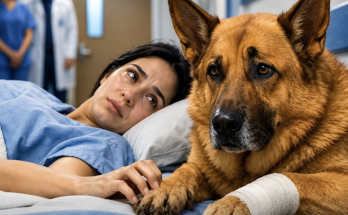
Laying on a thick, comfortable bed in the center of the room was Buster. His massive, horrible plaster cast was gone. His leg was carefully wrapped in clean, white medical bandages, heavily padded and properly treated.
He looked exhausted, heavily medicated with painkillers.
But the moment the door opened, Buster’s head snapped up.
His ears perked forward. He let out a sharp, questioning bark.
Lily dropped her blanket. She ran across the tile floor and dropped to her knees beside the dog bed.
“Buster!” she cried, burying her face into the thick, golden fur of his neck.
Buster didn’t care about his injured leg. He didn’t care about the pain. He let out a loud, joyous howl, his tail thumping furiously against the floor. He licked her face, her tears, her hands, whining and crying with absolute, pure joy.
He knew he had done his job. He had protected his girl, and she had come back for him.
I stood in the doorway, watching the little girl and her brave dog reunite. My throat was tight, and tears were freely streaming down my face.
For the first time in two entire years, the heavy, suffocating silence in my heart was finally broken.
The world wasn’t just a dark, empty place where bad things happened to good people. It was a place where courage existed. Where a loyal dog would take a metal pipe for a child. Where a little girl could be brave enough to write a note in the dark.
I didn’t keep Buster. He belonged to Lily. He was her guardian angel, and they needed each other.
But I didn’t lose them, either.
Lily’s parents invited me over for dinner the very next week. That dinner turned into Sunday barbecues, holidays, and eventually, a lifelong bond. I became “Uncle David.” Buster would always greet me at the door, limping slightly on his bad leg, but wagging his tail so hard his entire body shook.
That massive, horrifying plaster cast had been designed to hide a terrible, dark secret. It was supposed to be the end of a little girl’s story.
Instead, it was exactly what brought us all back to life.