My father told me my grandfather was dead while Grandpa sat three feet away from me, drinking coffee from my chipped blue mug. It was 7:12 on a Tuesday morning, and I had answered the phone on speaker because my hands were wet. Dad did not say hello or ask how I was. He simply said, “Grandpa died last night. Funeral Friday. He left us everything. You get nothing.”
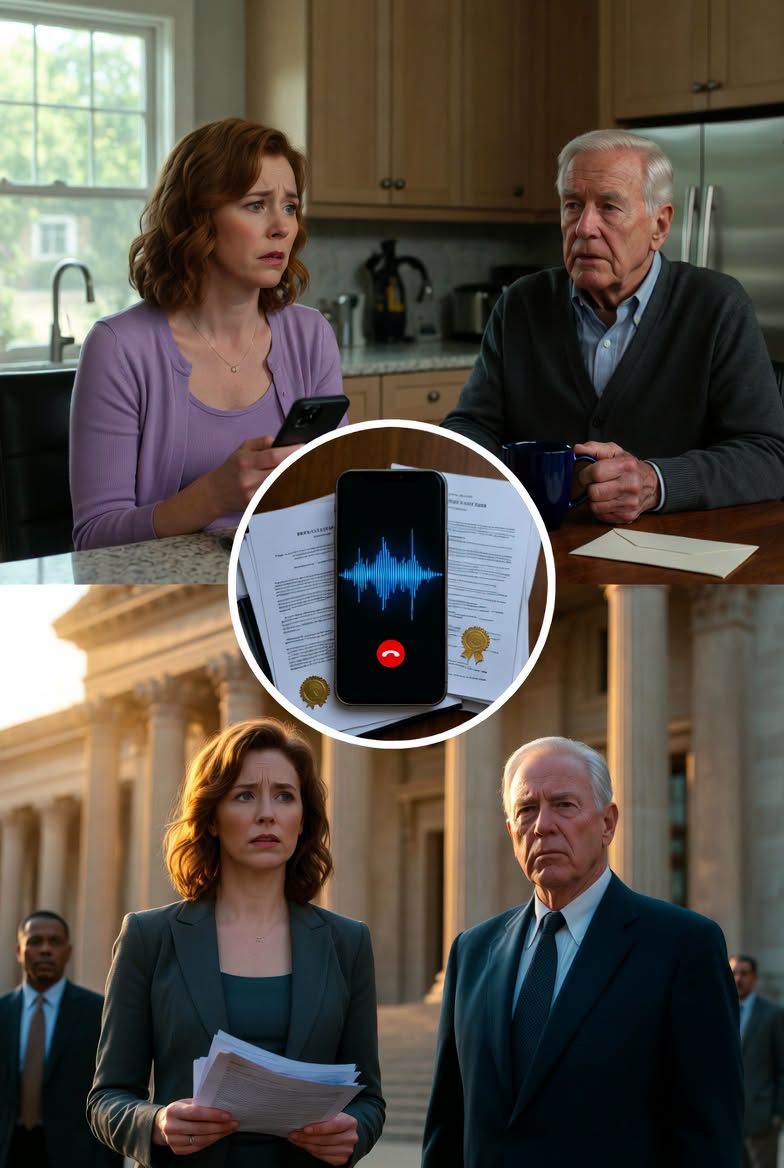
Then I heard my mother laugh in the background. “Finally,” she said. “You’re out.” I did not cry, argue, or accuse them of lying. I just looked across the kitchen table at Walter Bennett, my very-much-alive grandfather, and slid the phone toward him.
Grandpa was wearing his navy cardigan and reading glasses, and beside his coffee sat a sealed envelope from his attorney. He had spent the night at my house after I picked him up from a cardiology observation stay. He had refused to return to his own home because he believed my father had been watching the driveway. Until that moment, I had thought he was being overly cautious.
My father kept talking because he mistook my silence for shock. He told me not to come over and “make a scene,” claimed the lawyer had already called, and said I had never been in the will. Yet he gave no hospital name, no cause of death, and no explanation for how funeral plans had been made before breakfast. The first thing he cared about was not Grandpa’s body—it was Grandpa’s money.
For six months, Grandpa had been quietly collecting bank statements after discovering nearly one hundred and eighty thousand dollars missing from his accounts. My father first called the money a loan, then a gift, then repayment for years of “care.” Grandpa had also revoked a power of attorney Dad pressured him to sign after Grandma died. That afternoon, he was supposed to meet attorney Dana Harper to secure a revised will and trust.
The envelope on my table contained notarized copies of those changes, a written account of the missing funds, and instructions in case something happened before the meeting. Dad was not supposed to know the appointment existed. But when Grandpa mentioned Dana’s name, my father inhaled sharply. That tiny sound told us he knew far more than he should.
Grandpa leaned toward my phone and said one word. “Richard.” The line went so silent that I could hear my mother stop breathing. Then Dad whispered, “Dad?” as if the dead man had just answered from the grave.
“Yes,” Grandpa said. “Your dead father.” His voice was calm, but his fingers tightened around the sealed envelope. Dad immediately claimed there had been a misunderstanding and that someone from the hospital had told them Grandpa was gone. My mother called from the background, “Hang up,” but Grandpa would not let them escape that easily.
He asked who had called, from what number, and why they had discussed inheritance before learning any details about his death. Neither of them could answer. Instead, Mom said Grandpa had been confused since Grandma died, and Dad said I was not equipped to care for him. Their story changed so quickly that I understood the lie was only one piece of something larger.
Then Dad asked where Grandpa was. He did not ask whether he felt well or whether he needed help. He wanted the address, even though he already knew mine. I covered Grandpa’s phone with my hand before he could answer, and Dad’s voice turned cold.
“You shouldn’t be alone,” he said. “Claire is manipulating you.” Grandpa told him not to come, not to contact his doctors, and not to speak to his bank or lawyer. Dad replied, “Listen to yourself. You sound paranoid.”
That word frightened me more than the fake death announcement. It was not an insult tossed out in anger. It sounded practiced, almost legal. Grandpa had spent months worrying that my father would challenge his money decisions, but now I saw the real danger—Dad was preparing to challenge his mind.
After Grandpa ended the call, my phone lit up with message after message. Dad wrote that Grandpa was not competent to make decisions and that I would be responsible if anything happened. Then another text appeared: Do not take him to Dana. The final one was only five words long.
We’re on our way.
I locked the front door and called Dana. She told us not to wait for the scheduled appointment, not to let my parents inside, and to save every call and message. When I told her Dad had claimed someone from her office contacted him, she said no one had permission to discuss Grandpa’s affairs. Then she warned us that he might be trying to create a record showing I had isolated an elderly man.
The doorbell rang before I could ask another question. Dad began pounding on the door, demanding that we hand Grandpa over. Mom stood behind him while he announced that I was holding a medically unstable man and taking him to change legal documents. I started recording because every accusation sounded too polished to be spontaneous.
Grandpa told them to leave. Dad pulled several papers from his jacket and called them a medical authorization, but he refused to show them through the glass. Mom insisted the document allowed Dad to speak for Grandpa because he was “obviously having an episode.” Grandpa’s face went pale, but he did not unlock the door.
Then Mom made a mistake. While defending everything they had supposedly done for Grandpa, she mentioned repairs billed to his account and errands paid with his card. Dad ordered her to stop talking, and I saw fear flash between them. They were not just worried about a will—they were worried about records.
Before leaving, Dad turned toward my security camera and repeated the same threat he had made on the phone. “We have witnesses,” he said. Grandpa watched their car disappear, then admitted he thought he knew who those witnesses were. One was his longtime doctor.
The other was the neighbor who had signed the original power of attorney.
PART 2:
Dana arranged for security to meet us in the parking garage beneath her office. The moment we arrived, she separated concern from evidence. She asked Grandpa detailed questions about his doctors, assets, family, and the legal changes he wanted to make. He answered every one clearly, including the exact amount missing from his accounts.
When she asked whether I had pressured him, asked for money, or even requested to know what I would inherit, he said no. I told her I did not need to hear the contents of the will. That mattered because Dad’s entire plan depended on making me look greedy. Dana documented my answer and called the hospital with Grandpa’s permission.
The hospital’s compliance office confirmed that no one had reported Grandpa dead. More importantly, Dad had called three times asking about Grandpa’s condition. On the final call, he asked whether Grandpa had been discharged and whether he was capable of signing legal documents. He knew Grandpa was alive before he called me.
Dana finally explained why Dad had told me not to come over and “make a scene.” He had wanted me to panic, threaten them, demand to see the will, or rush to Grandpa’s house in anger. Any emotional reaction could be recorded and used to claim I cared only about money. The false death announcement had been bait.
Grandpa looked devastated. “My own son staged my death to trap my granddaughter,” he said. Dana did not soften the truth, but she gave him a way to fight back. She completed the revised trust, updated his medical directives, and arranged an independent capacity examination that same afternoon.
Grandpa passed every part of the evaluation. I became his healthcare proxy and successor trustee, while Dana’s firm remained co-trustee to prevent anyone from claiming I had seized control. The new plan did not completely erase Dad; it left him a fixed amount reduced by any money proven to have been taken. Grandpa wanted protection, not revenge.
For a few hours, it seemed we had moved faster than Dad. Then Dana’s assistant entered carrying an envelope with no return address. Inside was a photocopy of an emergency guardianship petition naming my father as the person who should control Grandpa’s home, money, and medical decisions. Attached were two statements claiming Grandpa was confused and vulnerable to manipulation by a younger relative.
The younger relative was clearly me. One statement was attributed to Martin Shaw, Grandpa’s neighbor and the witness on the old power of attorney. The second carried the name of Dr. Charles Kendall, Grandpa’s physician of more than twenty years. Both appeared to support Dad’s claim that I had isolated Grandpa after a medical crisis.
Until that moment, Grandpa had still spoken about my father as if some explanation might save him. He kept calling the theft a dispute and the lies a panic-driven mistake. But a guardianship petition was different: it would strip him of the right to decide where he lived, who treated him, and what happened to everything he had built. Dad was not merely chasing an inheritance anymore; he was trying to make Grandpa legally disappear while he was alive.
Grandpa studied the doctor’s statement and immediately shook his head. “That is not Charles’s signature,” he said. Dana looked closer, then told us someone might be trying to make the petition appear stronger than it really was. Before she could say more, a folded note slipped from behind the final page.
It contained three commands: Cancel today’s changes. Return home alone. Or this gets filed before the courthouse closes. Grandpa read it twice, and the trembling in his hands suddenly stopped.
I expected fear. Instead, he smiled without warmth and said, “Good.” When I asked how any of this could possibly be good, he looked at Dana and tapped the threat with one finger.
“They finally put it in writing.”
PART 3:
Dana told Grandpa not to return home, but he refused to let Dad control the setting. We went to the house with Dana, a private security officer, and two police officers who met us after we found the front door standing open. My parents were already inside. They had covered the dining table with papers and opened Grandpa’s locked document box.
Dad immediately called it a private family matter. Grandpa told the officers that neither of them had permission to enter, and the officers ordered them to leave. Mom insisted they had come because they were frightened for him. Yet an open desk drawer and scattered files showed exactly what they had been searching for.
Grandpa asked why a photograph of Grandma holding me as a baby had been turned facedown. Mom finally admitted they were looking for the original will because Dad told her I had convinced Grandpa to replace it. Dana explained that an old will could not cancel a properly executed new one. Mom looked at Dad and realized he had misled her too.
Then Grandpa asked why they had told me he was dead. Mom’s answer confirmed Dana’s theory. “Richard said Claire would expose herself,” she admitted. Dad had expected me to cry about the inheritance, threaten a lawsuit, or rush to the house, and he planned to use that reaction as proof that I was manipulating Grandpa.
Dad still refused to admit wrongdoing. He claimed he had spent two years caring for Grandpa while I visited only when convenient. Grandpa reminded him that the groceries, repairs, car, and household expenses had all been paid with Grandpa’s money. Dad snapped that Grandpa had resources he was not using while his own business was drowning.
That was the closest he came to confessing. He believed being Grandpa’s son entitled him to take whatever he needed. When Grandpa asked him to open the leather briefcase beside Mom’s chair, Dad refused. He carried it out under police supervision, even after Dana warned him not to destroy anything relevant.
After my parents left, we discovered that the best copies of the disputed bank transfer authorizations were missing. Those forms could show whether Grandpa’s signature had been copied and whether Dad’s claim of “gifts” was false. For the first time that day, Grandpa looked defeated. Dad had taken the documents that might prove the theft.
Then I remembered the printer I had installed in Grandpa’s study. It automatically saved recent scans to a cloud folder unless someone manually disabled the setting. We opened the application and found twelve scanned files, including four transfer authorizations. Dad had taken the paper copies, but the machine had quietly preserved the evidence.
The signatures resembled Grandpa’s, yet the dates were written in another hand. One form claimed the transfer had been verbally authorized for family support. Another carried the witness signature of Martin Shaw. Grandpa stared at it and said Martin had always denied witnessing any financial paperwork.
Before Dana could call him, my phone rang from an unknown number. It was Martin, and he sounded frightened. Dad had just told him that police had taken Grandpa away and that I was forcing legal changes. Martin said he now knew that story was false.
Grandpa asked whether Martin had witnessed him sign any bank transfer. Martin said no. When Grandpa told him his name appeared on the forms, there was a long silence. Then Martin admitted Dad had asked him to sign a statement about Grandpa’s mental condition without letting him read the entire document.
That admission damaged the guardianship case, but it did not explain the signature on the money transfers. Grandpa asked one final question: “How did Richard get a sample of your signature?” Martin began to cry.
“Last winter,” he said, “Richard asked me to give him one.”
PART 4:
The next morning, Dad filed the emergency guardianship petition anyway. He removed the questionable statement from Dr. Kendall but kept Martin’s declaration and described me as an estranged granddaughter who had taken advantage of Grandpa’s medical emergency. He claimed Grandpa was obsessed with imaginary theft and no longer understood the consequences of changing his estate. If the judge believed him, Dad could control where Grandpa lived before we had time to expose everything.
The petition frightened me because it mixed lies with facts. Grandpa had been in the hospital, I had taken him to my home, and we had gone directly to an attorney. Dad knew that a believable accusation did not need to be completely true. It only needed enough truth around the edges to make people hesitate.
Dana moved quickly. Martin signed a corrected statement explaining that Dad had misrepresented the paper he was asked to sign. Dr. Kendall confirmed he had never declared Grandpa incompetent, and the hospital preserved records proving Dad knew Grandpa was alive before calling me. Still, the court had not yet heard the case, and Dad’s attorney argued that every witness supporting us had been influenced after I took control.
For several hours, it felt as if Dad might succeed simply by repeating the same story louder. He called relatives and said I was stealing the family home. An aunt left me a message accusing me of turning father against son, while two cousins demanded to know whether I planned to sell the property. Dad was building a public judgment before the judge could make a legal one.
Grandpa listened to those messages without responding. He told me the hardest part was not hearing people doubt him; it was realizing how many of them preferred a convenient lie because the truth might cost them access to his money. Then he asked Dana to play the porch recording again. Mom’s accidental comments about using Grandpa’s credit card and searching for documents sounded even worse the second time.
Dana also sent a formal demand requiring Dad to preserve and return everything taken from the house. His attorney denied that the briefcase contained Grandpa’s papers. But the police report documented the open files, the searched desk, and Mom’s admission that they had entered to find the old will. Destroying evidence now would create another problem Dad could not easily explain.
Hours before the hearing, the briefcase was finally surrendered. Inside were the missing transfer authorizations, my unopened birthday card, and Dad’s phone. The forms matched the scans from Grandpa’s printer, including signatures Grandpa said were copied and the witness mark Martin denied providing. Yet Dad’s attorney still insisted the transfers were gifts and the family dispute was being exaggerated.
The phone appeared almost useless. Dad had deleted the recording of the call in which he announced Grandpa’s death, and most of the recent audio files were gone. A technician retained by Dana found that the device had backed up automatically to an account Dad apparently forgot existed. One recovered file began several minutes before he called me.
Dana warned Grandpa that listening might cause more pain than the evidence was worth. He said he needed to know whether his son had acted in panic or planned every word. We sat around the conference table while Dad’s voice came through the speaker, calm and organized. He rehearsed the funeral line, the inheritance claim, and the warning that I should not come over.
Then Mom asked, “What if she cries?” Dad answered, “Let her.” She asked what they would do if I demanded to see the will, and he replied that my reaction would give them exactly what they needed. Finally, Mom whispered that the plan seemed cruel.
Dad’s answer made Grandpa reach for the recorder and stop it.
“Cruelty is irrelevant,” my father said, “if it protects what belongs to us.”
PART 5: THE TRUTH THAT BROKE THE FAMILY
For the first time since this nightmare began, Grandpa did not look angry.
He looked heartbroken.
Not because he had lost money. Not because his son had betrayed him. But because he finally understood that Richard had not made one terrible mistake.
He had made a plan.
A plan that began months before the fake death announcement.
Dana looked around the conference room and spoke quietly.
“Walter, this recording changes everything. This is no longer a disagreement over inheritance. This is evidence of intentional deception, financial exploitation, and an attempt to manipulate the court.”
Grandpa nodded slowly.
“Then let the court hear all of it.”
The hearing began two days later.
Richard arrived wearing the same confident expression he had carried all week. He walked into the courtroom holding a folder filled with documents, believing paper could defeat the truth.
His attorney painted a familiar picture.
An elderly man.
A confused mind.
A granddaughter who suddenly appeared during a medical crisis.
A family disagreement exaggerated into a legal battle.
Richard even had the courage to look directly at Grandpa and say:
“Dad, I never wanted this. I only wanted to protect you.”
That sentence almost made me laugh.
Not because it was funny.
Because it was unbelievable.
Dana stood up calmly.
“Your Honor, before any decision is made regarding guardianship, we would like to present evidence that the petitioner knowingly misrepresented facts about Mr. Bennett’s condition and financial affairs.”
The first witness was Dr. Kendall.
Richard’s face changed immediately.
The doctor explained that he had never declared Grandpa mentally incapable. He had never signed the statement submitted with the original petition. He had never told Richard that Grandpa could not make his own decisions.
Then came Martin Shaw.
The neighbor who had trusted Richard.
The man whose name had been used as a weapon.
Martin admitted everything.
He admitted Richard asked for his signature. He admitted he never witnessed Grandpa signing financial documents. He admitted Richard told him Grandpa was becoming unstable and needed protection.
Then Dana played the recording.
The courtroom became completely silent.
Richard’s own voice filled the room.
His own words.
His own plan.
The fake funeral.
The inheritance announcement.
The trap designed to make me look greedy.
Every lie he had carefully created collapsed in less than five minutes.
Richard’s attorney tried to object, claiming the recording was private.
Dana responded:
“A person cannot claim privacy protection for conversations proving an attempt to deceive a court and financially exploit a vulnerable adult.”
The judge allowed the evidence.
Richard looked at his father.
Not at the judge.
Not at the lawyer.
At Grandpa.
And for the first time, he looked afraid.
“Dad, you’re really going to do this?” Richard whispered.
Grandpa stared at him for several seconds.
“I spent my entire life protecting you.”
His voice cracked.
“I defended you when people said you were irresponsible. I helped you when your business failed. I gave you chances when you made mistakes.”
He paused.
“But you did not make a mistake.”
Richard looked away.
“You decided I was an obstacle between you and my money.”
The judge ruled immediately.
The emergency guardianship petition was denied.
Richard was removed from any authority over Grandpa’s affairs. The financial transfers were ordered to be investigated. The court referred the evidence regarding fraud and elder exploitation for further review.
But Grandpa was not finished.
A week later, he called a family meeting.
Everyone expected anger.
A dramatic confrontation.
A final punishment.
Instead, Grandpa placed a new document on the table.
His updated estate plan.
Richard’s inheritance had not been erased completely.
That surprised everyone.
Even me.
Grandpa looked at me and said:
“Forgiveness and trust are not the same thing.”
Then he turned to Richard.
“I forgive you because carrying hatred would only hurt me.”
He pushed the document forward.
“But forgiveness does not mean I pretend you are someone you are not.”
Richard received a small fixed inheritance, protected from any future control. The rest of Grandpa’s estate was placed into a family foundation supporting elderly people who had been financially abused by relatives.
The house where Grandpa raised his family was transferred into the foundation.
A place that would become a symbol of protection instead of betrayal.
Months passed.
The investigation revealed exactly what we suspected.
Richard had used Grandpa’s money to cover personal debts. He had manipulated documents, hidden transactions, and created a false story about Grandpa’s mental state because he believed an elderly man’s voice would not be trusted.
But he was wrong.
Because Grandpa had one thing Richard never expected.
People who believed him.
And evidence that survived every lie.
One evening, I sat with Grandpa on the porch.
The same porch where Richard once stood demanding to take him away.
Grandpa held his blue coffee mug and watched the sunset.
“You know what hurts the most?” he asked.
I looked at him.
“What?”
“That I spent years wondering whether I had failed as a father.”
I reached over and held his hand.
“You didn’t fail.”
He smiled sadly.
“No. I just loved someone who chose not to love me back.”
A year later, the foundation opened its first center.
Grandpa cut the ribbon himself.
Reporters asked him about Richard.
They asked if he regretted exposing his own son.
Grandpa simply answered:
“I did not destroy my family.”
He looked toward the building behind him.
“I protected what was left of it.”
As for Richard, he disappeared from our lives.
Not because Grandpa hated him.
Because Grandpa finally learned that love without boundaries becomes permission for someone to hurt you.
And I learned something too.
The morning my father told me my grandfather was dead, I thought I was hearing the beginning of the worst day of my life.
I was wrong.
It was the day the truth finally woke up.
Because Richard thought he had buried an old man.
But all he really did…
was wake up the one person who could expose him.
And in the end, the man everyone thought was powerless became the person nobody could silence.