### Part 1
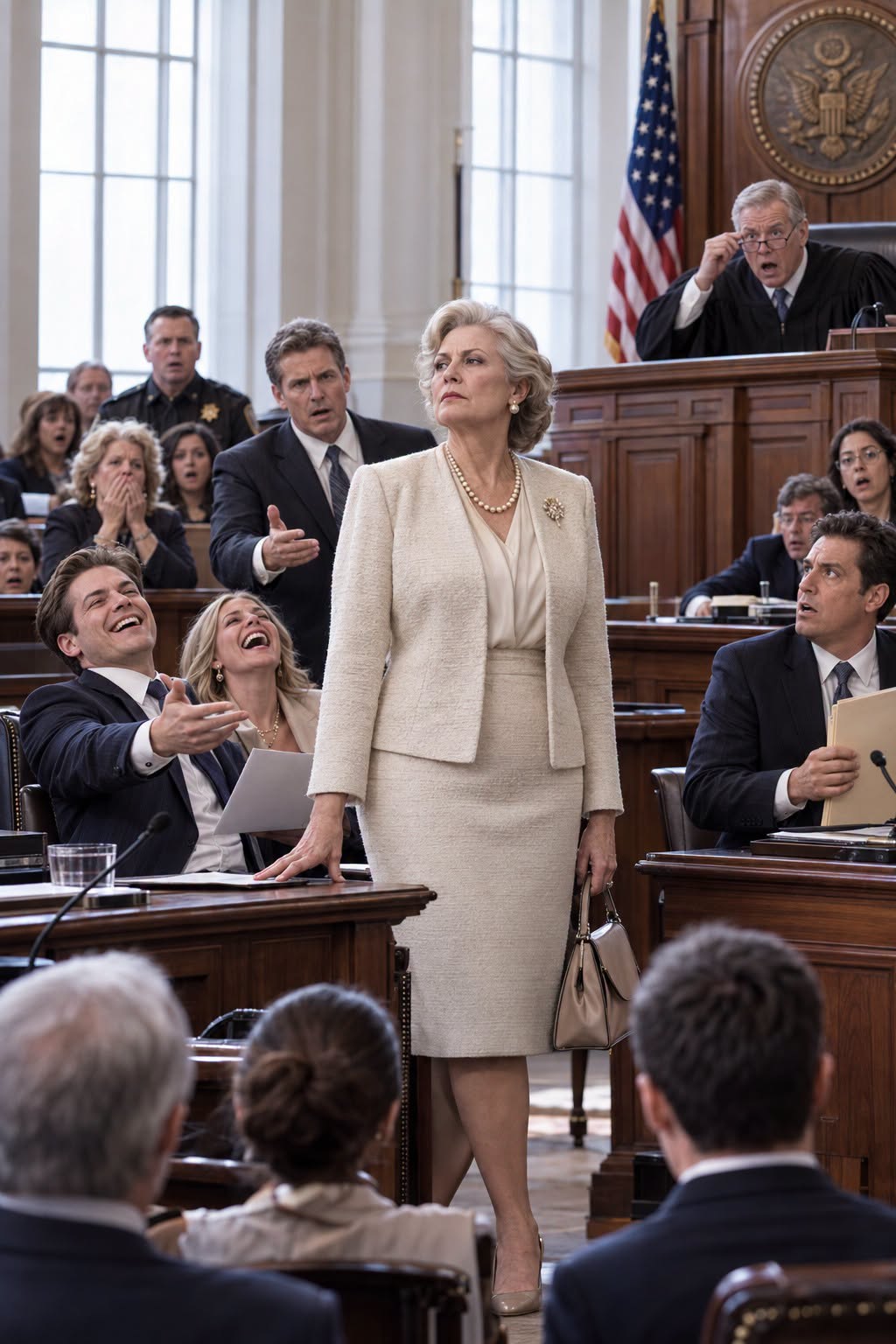
My son laughed when I walked into the courtroom.
Not a nervous laugh. Not one of those uncomfortable little sounds people make when they don’t know where to put their hands.
Evan actually leaned toward his wife, Claire, covered his mouth badly enough that I could still see his grin, and whispered, “Look at her.”
Claire didn’t bother whispering.
“After today, she won’t have anything left to fight us with.”
I heard every word.
I was seventy-one years old, wearing a plain navy cardigan, sensible shoes, and the expression of a woman who had supposedly become too confused to manage her own life. That was precisely how Evan wanted me to look.
For three weeks, I had let him believe it.
The courtroom smelled like old carpet, printer toner, and coffee that had been sitting on a warmer since sunrise. Fluorescent lights hummed overhead. Evan sat beside Claire at the petitioner’s table, his expensive charcoal suit perfectly pressed, while their attorney arranged documents in neat little stacks.
His name was Tyler Grant.
He looked young enough that I wondered whether his law school diploma was still warm.
Their petition asked the court to declare me incapable of managing my property and finances. If granted, Evan would control my investment accounts, my house, and practically every meaningful decision involving my money.
According to the paperwork, I had become forgetful after my husband Thomas died.
According to Claire, I left appliances running.
According to Evan, I signed documents without understanding them.
According to both of them, they were frightened for me.
That was my favorite part.
“Frightened.”
Three weeks earlier, I had come downstairs and found Claire drinking coffee in my kitchen while Evan went through mail addressed to me.
When I asked what he was doing, he smiled.
“Helping.”
A few days later, the password to one of my investment accounts stopped working.
Then my tablet disappeared from the side table where I always kept it.
Then Claire’s brother Lucas moved into my guest house without asking because, according to Evan, “Mom shouldn’t be alone right now.”
Two mornings later, my front-door key no longer worked.
Evan had changed the locks on my own house.
He stood behind the glass while I tried the key twice, then opened the door just far enough to look at me.
“You’re getting confused, Mom.”
I remember the cold metal of the useless key in my palm.
I also remember thinking: That was your mistake.
Not changing the locks.
Assuming confusion was the only reason I might stay quiet.
I checked into a motel and told no one what I was doing.
For three weeks, I asked harmless questions. I repeated myself when Evan expected me to. I pretended not to understand financial statements Claire left on the dining table.
And every night, alone under the motel’s ugly white ceiling, I built a file.
Now that file sat inside my canvas handbag beside my chair.
Tyler Grant rose when Judge Malcolm Reed entered.
“All rise.”
I stood more slowly than everyone else.
Evan glanced at me and smiled.
He thought the performance was mine.
He had no idea it was his.
Judge Reed began with the petition, reviewing the claims about my memory, judgment, and supposed vulnerability. He had silver hair, narrow reading glasses, and the habit of pausing before turning each page.
I watched him instead of my son.
Something about his face bothered me.
Not fear.
Recognition.
I had seen him somewhere before.
Or perhaps he had seen me.
Tyler began describing me as “an elderly widow experiencing rapid cognitive decline.”
That phrase nearly made me smile.
“Mrs. Hale has demonstrated an inability to understand increasingly complex financial matters—”
Judge Reed stopped reading.
His eyes had landed on my full legal name.
Margaret Elaine Hale.
He looked at the document.
Then at me.
Then back at the document.
The courtroom suddenly seemed colder.
“Mrs. Hale?”
“Yes, Your Honor.”
He removed his glasses.
“Margaret Hale?”
Evan frowned.
Judge Reed leaned forward slightly.
“Were you associated with Whitfield Hale Forensic Associates?”
Nobody moved.
Claire’s smile disappeared first.
I felt something old awaken inside me, something I had deliberately kept folded away for three weeks.
I straightened my back.
“I was one of its founders, Your Honor.”
Judge Reed stared at me.
Then he said the words that changed everything.
“Mrs. Hale… is that really you?”
And beside me, my son stopped laughing.
### Part 2
Judge Reed kept staring at me as if twenty years had suddenly walked through his courtroom wearing orthopedic shoes.
“I attended a judicial training seminar where your work was required reading,” he said.
Tyler Grant slowly lowered the papers in his hand.
Judge Reed continued.
“You developed the Hale authentication protocol for identifying forged signatures in conservatorship and guardianship disputes.”
“I helped develop it,” I said. “There were several very good people involved.”
“You wrote the principal monograph.”
“I did.”
Claire turned toward Evan.
Her lips moved without sound.
Evan looked at me as though I had just stepped out of a disguise.
That hurt more than I expected.
Not because he had forgotten my career.
Because he had never bothered to understand it.
I spent thirty years examining forged signatures, altered financial records, falsified authorizations, hidden transfers, and families who convinced themselves theft became acceptable when the victim was old enough.
Evan knew I “used to work in accounting.”
That was how he described it at dinner parties.
Apparently, it had never occurred to him to ask what kind.
Judge Reed’s expression changed completely.
“Counselor,” he said to Tyler, “did you investigate the respondent’s professional history before filing a petition alleging she cannot understand complex financial documentation?”
Tyler swallowed.
“I relied upon information supplied by my clients, Your Honor.”
“That was not my question.”
Silence.
“No, Your Honor.”
Judge Reed looked back at the folder attached to my response.
I had submitted it that morning without explaining its contents to Evan or Claire.
He opened it.
The first section contained account statements.
The second contained device access records.
The third contained copies of documents supposedly signed by me.
The fourth contained a timeline.
The fifth was the reason Evan’s face was about to lose whatever color remained in it.
Judge Reed read for several moments.
Then he looked toward the court reporter.
“We’re taking a recess.”
Tyler immediately stood.
“Your Honor—”
“Sit down, counselor.”
His voice wasn’t loud.
It didn’t need to be.
“When we return, I want a court reporter present for every word spoken in this room. I also want these documents preserved exactly as submitted.”
The bailiff, Ben Collins, moved toward the doors.
Evan finally looked at me.
“Mom.”
I picked up my handbag.
“What?”
“What did you do?”
The question was so perfectly Evan that I nearly laughed.
Even now, with his petition collapsing around him, he still imagined the dangerous action must have been mine.
“I didn’t do anything to you,” I said.
His eyes flicked toward the folder.
“I documented what you did.”
Claire shot out of her chair.
“This is ridiculous. You don’t know what you’re talking about.”
I looked at her.
For weeks, she had spoken to me slowly, carefully, stretching simple words as though volume might cure senility.
Now she sounded afraid.
“You should probably save that argument for your attorney.”
She turned on Tyler immediately.
“You told us this was straightforward.”
Tyler glanced toward the bailiff.
“Please lower your voice.”
“You said guardianship cases like this were routine.”
“I said uncontested guardianships can be routine.”
“She wasn’t supposed to contest it!”
That sentence hung in the room.
Even Claire seemed to realize what she had admitted.
Judge Reed, halfway to his chambers, stopped.
He turned.
The court reporter looked up.
Tyler closed his eyes.
Judge Reed said, “Mrs. Hale, did you hear that?”
“Yes, Your Honor.”
“So did I.”
Then he disappeared through the chamber door.
Claire sat down.
Evan whispered something ugly under his breath.
I took my seat again.
For three weeks, they had treated my silence like an empty room.
Now they were discovering silence could have excellent acoustics.
The recess lasted long enough for the coffee smell to turn sour.
When Judge Reed returned, he wasn’t alone.
A woman in a gray blazer entered behind him carrying a legal pad and a badge wallet.
She sat in the gallery.
Evan noticed the badge.
His hand stopped moving.
Judge Reed took his seat.
“This is Detective Lena Ortiz with the county sheriff’s financial crimes unit.”
I heard Claire inhale.
Detective Ortiz stood.
“Your Honor, I’ve been asked to review materials supplied by Mrs. Hale.”
Judge Reed nodded.
“Proceed.”
She opened my folder.
The courtroom became so quiet I could hear the ventilation system cycling above us.
Ortiz read the first page.
Then another.
Then another.
Her expression didn’t change much.
Professionals learn not to advertise conclusions too early.
I respected that.
Eventually, she lifted her head.
“Mrs. Hale, did you prepare this yourself?”
“Yes.”
“You traced these transfers independently?”
“Yes.”
“Did anyone assist you?”
“No.”
Evan stared at the table.
Ortiz turned toward Judge Reed.
“Your Honor, I believe these records may document unauthorized transfers exceeding four hundred thousand dollars.”
Claire’s chair creaked beneath her.
But Ortiz wasn’t finished.
“And there is another problem.”
She tapped one page with her finger.
“The destination account is already connected to an active financial-crimes investigation.”
That was the first thing she said that surprised me.
And when I looked at my son, I knew instantly it did not surprise him.
### Part 3
Detective Ortiz said the name slowly.
“Meridian Point Holdings.”
I had seen it dozens of times by then.
The first transfer from my account disappeared into Meridian Point six months earlier. The next followed weeks later. Four transfers in total.
Four hundred twelve thousand dollars.
My money.
My husband’s money.
Years of work reduced to neat electronic lines moving somewhere I had never authorized.
Until that morning, I had assumed Meridian Point was simply a shell company Evan had created.
Detective Ortiz corrected me.
“Meridian Point Holdings has appeared repeatedly in an investigation involving an illegal gambling operation spanning multiple states.”
She turned one page.
“The operation is believed to be controlled by a man named Grant Mercer.”
I knew nothing about Grant Mercer.
Evan did.
I saw the name hit him physically.
His shoulders contracted.
His fingers clamped around the edge of the table.
Judge Reed saw it too.
“Mr. Hale.”
Evan didn’t look up.
“Do you know Grant Mercer?”
Tyler leaned close to him.
Their whispering lasted only a moment.
Then Evan finally said, “On advice of counsel, I decline to answer.”
I had watched witnesses make that calculation hundreds of times.
How much does silence protect me?
How much does silence reveal?
Judge Reed removed his glasses.
“Very well.”
He turned toward me.
“Mrs. Hale, based on the evidence currently before this court, I find no credible basis for concluding that you lack the capacity to manage your own affairs.”
Claire shifted.
Judge Reed’s gaze sharpened.
“In fact, the evidence suggests the opposite.”
My hands were folded in my lap.
Only I knew how tightly.
“The guardianship petition is dismissed with prejudice.”
Evan looked up.
Claire whispered, “No.”
Judge Reed continued.
“I also find substantial reason to believe this petition may have been filed in bad faith as part of an effort to obtain control over Mrs. Hale’s finances.”
Tyler’s face had become painfully still.
“I am issuing an emergency protective order prohibiting Evan Hale and Claire Hale from entering Mrs. Hale’s residence, accessing her accounts, or contacting her except through counsel while Detective Ortiz’s investigation proceeds.”
That was when Claire started crying.
Not loudly.
Just enough for tears to spill down her face as she stared at the judge.
“This is a misunderstanding.”
Judge Reed did not answer her.
He looked at Tyler.
“Counselor, I strongly recommend your clients retain separate criminal attorneys.”
Evan turned toward me one more time.
There was anger in his face now.
Fear underneath it.
And beneath both, something I still cannot name.
“Mom.”
I stood.
“No.”
It was the first time in his life I had stopped him with that word and nothing else.
He looked stunned.
Judge Reed struck the gavel.
The case that had begun with my son trying to take away my independence ended with a detective carrying away copies of the evidence.
I should have felt victorious.
Instead, when I stepped outside, sunlight hit the courthouse steps so brightly I had to close my eyes.
My chest felt hollow.
Thirty years of forensic work taught me how satisfying truth could be when it belonged to somebody else.
It taught me nothing about discovering that your own child had tried to steal from you.
Ben Collins walked me to my car.
“You okay, ma’am?”
“No.”
He nodded as though that was the correct answer.
Then he said, “You already did the hard part. The rest is paperwork.”
I almost told him he was wrong.
Instead, I thanked him.
I didn’t drive home.
Home no longer felt like mine.
I returned to the motel where I had been staying since Evan changed my locks.
My room smelled faintly of bleach and whatever floral cleaner the staff sprayed on the curtains. I sat on the edge of the bed without turning on the television.
On the small desk beside me sat a photograph of Thomas that I had taken from the house before the locks changed.
He was laughing in the picture.
I suddenly remembered finding Evan drinking Thomas’s scotch in my kitchen days before I was locked out.
Thomas had saved that bottle for anniversaries.
Evan knew that.
Claire knew that.
And neither of them cared.
That detail broke me more than the money.
I cried until my throat hurt.
Then I washed my face, made one cup of terrible motel coffee, and called Simone Patel.
Simone had worked beside me for eleven years at Whitfield Hale Forensic Associates before I retired.
She answered with, “Margaret Hale, you never call after dinner unless something has gone catastrophically wrong.”
“Something has.”
I told her everything.
The missing tablet.
The changed passwords.
Lucas living in my guest house.
The locks.
The petition.
The money.
Grant Mercer.
She listened without interrupting.
When I finished, she said, “You built the trace yourself?”
“Yes.”
“You’re seventy-one.”
“I’m aware.”
“I was going to say impressive, not impossible.”
That made me laugh for the first time in weeks.
Then her voice changed.
“Margaret, if Meridian Point is connected to organized gambling, this is bigger than a guardianship scam.”
“I know.”
“No. I don’t think you do yet.”
I heard papers moving on her end.
“I want to help.”
“You’re retired from active cases.”
“So are you.”
“Apparently retirement has become flexible.”
“Good. Then we agree.”
I looked at Thomas’s photograph.
“Simone.”
“Yes?”
“What if Evan wasn’t stealing just because he wanted my money?”
She went quiet.
That question had bothered me since Detective Ortiz mentioned Grant Mercer.
And the answer arrived two days later.
Evan wasn’t stealing because he wanted to be rich.
He was stealing because someone was waiting to be paid.
### Part 4
Detective Ortiz called me twice during the following week.
She never treated my folder as gospel simply because Judge Reed had been impressed by it.
That made me trust her.
She rebuilt the financial trail independently, subpoenaed records, verified access logs, and compared every transfer against my original work.
When her numbers matched mine, our conversations changed.
She stopped explaining basic forensic procedure to me.
I stopped pretending I needed it explained.
Then she called one rainy afternoon.
“Margaret, we know why Evan needed your money.”
I stood at the motel window watching water streak down the glass.
“Tell me.”
“He owes Grant Mercer approximately one hundred eighty thousand dollars.”
I closed my eyes.
“How?”
“Sports betting. It accumulated for more than a year.”
The rain tapped steadily against the air-conditioning unit beneath the window.
Ortiz continued.
“Mercer runs an illegal betting operation handling millions across several states. Your son was extended credit. When he couldn’t repay it, pressure started.”
“And four hundred twelve thousand dollars left my accounts.”
“Yes.”
“That’s more than the debt.”
“We noticed.”
That word chilled me.
“Why?”
“We’re still tracing the rest.”
I sat down.
Then Ortiz told me the part that made the motel room feel suddenly too small.
“Claire’s brother Lucas Bennett is connected to Mercer.”
I didn’t speak.
“He isn’t simply a relative staying in your guest house.”
“What is he?”
“One of Mercer’s collectors.”
For a moment all I could see was Lucas standing in my driveway carrying grocery bags.
“Let me help you with those, Mrs. Hale.”
He had smiled every time.
He had offered to change a light bulb in my hallway.
He once brought the newspaper to my kitchen because the driveway was wet and told me he didn’t want me slipping.
A man assigned to collect debts had been sleeping yards from my bedroom.
Watching.
Waiting.
“What was I to them?” I asked.
Ortiz hesitated.
“Financially?”
“Yes.”
“Collateral.”
I had spent my career warning people never to reduce victims to numbers.
Now someone had turned me into one.
House equity.
Investment accounts.
Retirement funds.
Collateral.
“Does Claire know who her brother works for?”
“We believe she does.”
Another pause.
“And we’re investigating her boutique.”
Ivory and Wren.
Claire talked about that boutique constantly. Fabric shipments. Seasonal inventory. Vendor delays. She complained about customers while eating food from my refrigerator.
“What about it?”
“The numbers don’t make sense.”
Nine days later, I sat in a county conference room across from forensic accountant Henry Walsh.
He arranged three years of Claire’s business records across a long table.
The room smelled like burnt coffee and old carpet.
I liked him immediately.
He didn’t rush.
People who understand complicated numbers rarely do.
“Ivory and Wren reported four hundred thirty thousand dollars in inventory purchases from Select Textile Group last year,” he said.
“So?”
“Select Textile Group doesn’t appear to exist.”
He slid a page toward me.
“No legitimate registration. No proper tax trail. The listed business address leads to a mail drop.”
“Fake invoices.”
“That’s what it appears to be.”
I studied the records.
“She was moving cash out of the boutique.”
“Yes.”
“And some of my money went through it.”
Henry nodded.
“We believe portions of the money removed from your accounts were routed through Claire’s business before being transferred onward.”
“So Evan and Claire did this together.”
“Possibly.”
He chose the word carefully.
“Or they were cooperating on some transactions while hiding others from each other. We’re still separating those strands.”
That surprised me.
For weeks I had pictured them as a unit.
Evan and Claire against me.
But fraud has a way of creating alliances built entirely on distrust.
Maybe Evan had lied to Claire.
Maybe Claire had lied to Evan.
Maybe both believed they were smarter than the other.
Before I left, Ortiz asked me to stay.
“There’s something else.”
Her tone had changed.
I knew that tone.
Professionals use it when they don’t want the person across from them to panic.
“What?”
“Lucas knows we’re investigating.”
I waited.
“So does Mercer.”
My stomach tightened.
“We intercepted enough communication to believe people inside the operation are discussing you and the documentation you provided.”
“Discussing me how?”
“We don’t know yet.”
Her eyes held mine.
“But I don’t want you staying at that motel much longer.”
“Why?”
“Because they know where you are.”
That evening, I locked the motel door, slid the chain into place, and checked it twice.
Then I checked it again.
For the first time since the courtroom, I wished Thomas were still alive badly enough that the feeling became physical.
The phone on the nightstand rang.
Unknown number.
I stared at it.
Then I answered.
A man said, “Mrs. Hale, I think we need to talk about your son’s debt.”
And every light in that cheap motel room suddenly seemed far too bright.
### Part 5
The man never gave me his name.
He didn’t need to.
His voice was calm, polished, almost friendly.
That made it worse.
“There’s a version of this where everybody goes back to living normally,” he said.
I sat on the edge of the motel bed.
“And what version is that?”
“The money gets handled. The investigation loses momentum. People stop making unnecessary problems for one another.”
I looked at the chain on the door.
“Are you threatening me?”
“I’m suggesting that you’re an intelligent woman.”
“That wasn’t my question.”
A short silence.
“You spent your career understanding consequences, Mrs. Hale. I’d think carefully about them now.”
The call ended.
My hand shook after the line went dead.
I hated that.
Fear always feels like betrayal when you’re used to being competent.
I called Detective Ortiz.
She answered quickly.
“He contacted me,” I said.
I repeated everything.
Ortiz’s voice became sharper with every sentence.
“That was intimidation.”
“I assumed.”
“This is useful.”
I almost laughed.
“Useful?”
“A man running an operation like Mercer’s doesn’t risk directly frightening a seventy-one-year-old witness unless something is hurting him.”
“I’m delighted to be professionally useful.”
“Margaret.”
Her voice softened.
“You’re allowed to be scared.”
“I know.”
I had said those words to frightened clients for decades.
Knowing them did not make the fear smaller.
The next day, Ortiz moved me out of the motel.
I was taken to a small rental house in another part of town. Only Ortiz, Henry, Simone, and prosecutors assigned to the case knew where I was staying.
The kitchen had green cabinets.
I hated them immediately.
There was an oak tree outside the bedroom window and a neighbor who put out birdseed every morning.
That became my world for a while.
Green cabinets.
Birds.
Phone calls.
Evidence.
Then Assistant District Attorney Rachel Kim entered the case.
She called me personally.
“Mrs. Hale, I’ve reviewed your documentation, Detective Ortiz’s investigation, and Mr. Walsh’s findings concerning Ivory and Wren.”
“What are we looking at?”
“The uncomfortable version?”
“The only useful one.”
She exhaled.
“Your son is exposed to charges involving financial exploitation, forgery, wire fraud, and potentially conspiracy, depending on what we establish about his relationship with Mercer’s organization.”
I leaned against the kitchen counter.
“Claire?”
“Fraud and possible money laundering through the boutique.”
“Lucas?”
“He’s the bridge we want.”
“Meaning?”
“If Lucas cooperates, he may give us Mercer.”
I understood.
“You’re considering a reduced sentence.”
“Yes.”
I disliked it immediately.
I also knew Rachel was right.
Justice in real cases rarely arrives clean.
“What gets the most people stopped?” I asked.
“Cooperation from someone inside Mercer’s structure.”
“Then do that.”
“You’re comfortable with Lucas receiving consideration?”
“No.”
That seemed to surprise her.
“I’m not comfortable with any of this. But comfort isn’t the standard.”
She was quiet.
I continued.
“I don’t need everyone destroyed. I need the operation dismantled so the next widow doesn’t have a stranger sleeping in her guest house while her son empties her accounts.”
Rachel said softly, “Understood.”
The following weeks blurred.
Claire stopped trying to contact me after the protective order.
Evan’s lawyer sent formal notices.
Lucas disappeared from the guest house before investigators could question him, though Ortiz assured me they were watching him.
Simone worked from her own office tracing connections the county might overlook.
And I waited.
Waiting is unnatural for forensic people.
We are built to inspect, compare, document, conclude.
Waiting gives the imagination room.
I imagined Evan being arrested.
I imagined Claire blaming him.
I imagined Grant Mercer sending someone to the rental house.
Worst of all, I imagined Evan as a little boy.
Freckles across his nose.
Training wheels rattling against asphalt.
Thomas running behind him shouting, “Don’t look down!”
That memory made me furious.
Because criminals are easier when you cannot remember teaching them how to tie their shoes.
Then one evening my phone lit up.
EVAN.
I had never changed his contact name.
For fifteen years, it had actually said Danny, because mothers preserve ridiculous things long after sons become grown men.
I watched the screen until it nearly stopped ringing.
Then I answered.
“Mom.”
His voice sounded wrecked.
Not manipulative.
Not angry.
Terrified.
“I need your help.”
I said nothing.
“Mercer’s people came to my apartment.”
I closed my eyes.
“They hurt me.”
My hand tightened around the phone.
“Go to the police.”
“I can’t.”
“Yes, you can.”
“If I cooperate, Mercer comes after me.”
“And if you don’t?”
Silence.
When Evan finally spoke again, he sounded like the boy who used to call me when nightmares woke him.
“I think they come after me anyway.”
For one terrible moment, I wanted to tell him I would fix it.
That instinct came from somewhere older than betrayal.
Then I remembered my locked front door.
My stolen money.
Claire laughing in court.
And I understood that helping him could not mean rescuing him from consequences.
“Listen carefully, Evan.”
He went quiet.
“There is one door left open.”
And I was going to show it to him.
But I was not going to walk through it for him.
### Part 6
“You call Detective Lena Ortiz,” I told him. “You tell her everything.”
Evan breathed hard on the other end.
“Mom—”
“Everything means everything. Not the version where Claire is responsible. Not the version where Lucas forced you. Not the version that makes you look less guilty.”
“I know.”
“No, Evan. I need to know that you understand this.”
He went quiet.
I stared through the rental-house window at the oak branches moving against the streetlight.
“You stole from me.”
His breath caught.
“You tried to have me declared incapable so you could control what remained.”
“I know.”
“You changed the locks on my home.”
“I know.”
“You let Claire and Lucas treat me like I was an asset waiting to be liquidated.”
His voice became smaller.
“Yes.”
I had imagined this conversation many times.
In none of those versions had I sounded so calm.
“You don’t get rescued from that because you’re frightened now.”
“I’m not asking you to forgive me.”
“Good.”
Silence.
Then he said, “I just don’t know where else to go.”
I closed my eyes.
“Detective Ortiz. That’s where you go.”
“What happens if I cooperate?”
“You accept whatever protection the prosecutor can arrange. You tell the truth. You plead to what you did. You stop bargaining with reality.”
“And you?”
“What about me?”
“Will you talk to me again?”
There it was.
The question he actually wanted answered.
I could have comforted him.
I didn’t.
“I don’t know.”
He began crying.
Quietly.
I felt my own eyes burn.
“I can help you find the door,” I said. “That does not mean you get to come back into my house.”
“I understand.”
“I hope someday you do.”
He contacted Ortiz that night.
She called afterward.
“He’s cooperating.”
I sat at the little rental kitchen table.
“All of it?”
“So far, yes.”
Evan entered protective custody under an agreement requiring complete testimony concerning Grant Mercer’s operation, disclosure of every transaction involving Meridian Point Holdings, and a guilty plea relating to what he had done to me.
Rachel Kim made one thing clear.
Cooperation could reduce his sentence.
It would not erase it.
That mattered to me.
Two days later, coordinated raids were carried out on several properties connected to Mercer.
Ortiz called me afterward.
“We found records.”
“What kind?”
“The kind people spend years trying not to leave behind.”
One property registered to Lucas Bennett contained documentation connecting money, debts, clients, and payments across Mercer’s operation.
Grant Mercer was arrested.
Lucas was arrested.
Several others followed.
For the first time in weeks, I slept through the night.
Then Claire was arrested.
I should have expected it.
Still, seeing her photograph on the local news made my stomach twist.
She wore a cream coat and kept her head high while walking into the county building.
The same woman who had laughed when I entered the courtroom now had an attorney telling reporters she had been completely unaware of her husband’s financial activity.
Henry Walsh called me the next morning.
“She’s blaming Evan.”
“Of course she is.”
“The evidence doesn’t support that.”
He eventually traced years of false invoices through Ivory and Wren.
Claire had generated payments to nonexistent suppliers, disguised cash movements, and helped route money through the boutique.
Some transactions benefited Evan.
Others appeared designed to protect Claire herself.
Their marriage, I realized, had not been two criminals trusting each other.
It had been two frightened people sharing a secret while quietly building separate exits.
Lucas eventually took a cooperation agreement.
His testimony gave prosecutors a clearer map of Mercer’s organization.
Evan testified too.
I did not attend his hearings.
That decision surprised Simone.
“You’re sure?”
“Yes.”
“You spent your career sitting inside courtrooms.”
“That’s exactly why I’m sure.”
I had no desire to turn my son’s consequences into theater.
Months later, Claire’s case went to trial.
Henry dismantled her defense invoice by invoice.
I attended only one day.
Not because I wanted revenge.
Because my documentation was part of the case and I wanted to understand how it was being used.
Claire saw me during a recess.
For a second, nobody stood between us.
Her face looked thinner.
Older.
“Margaret.”
I continued walking.
“Please.”
I stopped.
She swallowed.
“Evan ruined everything.”
There had been a time when those words might have made me doubt myself.
Not anymore.
“You helped him.”
“He lied to me.”
“And you lied to me.”
“I was scared.”
“So was I.”
Her eyes filled.
“I never wanted it to become this.”
I looked at her carefully.
“That’s what people say when they wanted every step except the consequences.”
She flinched.
“I’m sorry.”
“I believe you’re sorry now.”
Hope appeared in her face.
I finished the sentence.
“That doesn’t make us family.”
Then I walked away.
Claire was eventually convicted on multiple counts involving fraud and money laundering.
Evan received a substantially reduced sentence because of his cooperation.
He still served time.
He still owed restitution.
He still carried a felony record.
Simone attended his sentencing.
I stayed home.
Afterward, she came to see me.
“He asked the judge if he could say something addressed to you.”
I poured coffee without looking at her.
“What?”
Simone unfolded a page.
“I wrote it down.”
Then she read my son’s words.
And for the first time since the courtroom, I wondered whether consequences had finally taught Evan something love never could.
### Part 7
Simone read slowly.
“‘I spent too much of my life believing my mother was someone I needed to manage. I thought because she was grieving, she was weak. I thought because she trusted me, I was smarter than she was.’”
I stared into my coffee.
Simone continued.
“‘I was wrong about all of it. She was the only person paying attention while the rest of us were lying to ourselves. I am sorry it took losing everything before I finally saw her clearly.’”
Simone folded the page.
“That’s all.”
I expected to cry.
I didn’t.
Months earlier, alone in a house with green cabinets and an address I wasn’t allowed to share, I had cried enough for several versions of myself.
The woman sitting at my own kitchen table now was different.
Not harder.
Just clearer.
“Did he mean it?” Simone asked.
“I think he did.”
“That matters.”
“Yes.”
She waited.
“But?”
“But remorse does not rebuild trust automatically.”
Simone nodded.
She understood.
A year after the guardianship hearing, I finally moved completely back into my house.
The first thing I did was replace every lock.
Not because investigators told me to.
Because I wanted to.
I stood in the driveway beside a locksmith named Calvin Price and watched him test every key three times.
When he handed them to me, I closed my fingers around the new metal.
I remembered the day Evan’s key had replaced mine.
I remembered standing outside my own front door while my son told me I was confused.
Then I unlocked the door myself.
The house smelled dusty.
Still mine.
Thomas’s scotch cabinet remained empty.
I never refilled it.
Some absences deserved to remain visible.
I changed the guest house first.
Lucas had lived there while reporting my routines to Mercer’s people.
For months I couldn’t open the door without remembering his cheerful voice.
Eventually, I stripped the room down.
The bed went.
The furniture went.
The television went.
I turned the space into an office.
Simone walked in while workers were assembling shelves.
“You’re starting a firm again.”
“No.”
She raised an eyebrow.
“You’re standing inside an office surrounded by forensic manuals.”
“A nonprofit.”
“That sounds suspiciously like work.”
I smiled.
I called it the Hale Protocol.
We offered free forensic consultations to older people who suspected something inside their household had gone wrong.
Not proved.
Suspected.
That distinction mattered.
Most exploitation begins before anyone has enough evidence to explain it.
A daughter notices unexplained withdrawals.
A widower discovers a signature that doesn’t look like his.
A neighbor realizes a caregiver suddenly has access to accounts nobody discussed.
Sometimes the first clue is not financial.
Sometimes it is a changed lock.
A missing tablet.
A new person sleeping in a guest house.
A son suddenly insisting you are forgetful.
Within months, calls came faster than we could handle them.
Claire’s trial had received local news coverage, and my name appeared often enough that people started finding me.
I trained three younger analysts.
Simone volunteered so frequently that I eventually stopped pretending she was retired.
Henry Walsh taught occasional sessions.
Detective Ortiz referred cases when appropriate.
Judge Malcolm Reed once sent a handwritten note.
“Your work is apparently not finished.”
I pinned it above my desk.
He was right.
Grant Mercer was eventually convicted on numerous charges connected to his operation, including extortion and witness intimidation.
Lucas received a reduced sentence because of his cooperation.
Claire received several years in prison.
Evan served a shorter sentence due to substantial cooperation, followed by financial monitoring and strict restrictions.
None of those outcomes felt satisfying enough to call victory.
That surprised people.
They expected me to enjoy what happened.
I didn’t.
I enjoyed getting my house back.
I enjoyed helping strangers keep theirs.
Those were victories.
Watching my son enter custody was consequence.
There is a difference.
Evan began writing to me.
One letter each month.
The first started:
“Mom, I don’t know whether I deserve an answer.”
I read it.
I did not answer.
The second described a financial-literacy program he had joined.
The third contained no excuses at all.
That was new.
The fourth said:
“I spent years telling myself I was protecting you. I understand now that I was protecting myself from admitting what I had become.”
I answered that one.
Three sentences.
No love-you.
No promise.
No invitation home.
Just:
“I received your letter. Taking responsibility is better than explaining it away. Continue doing that whether I answer or not.”
His next letter thanked me.
I kept them all in a drawer.
Not with family photographs.
In my office.
Exactly where evidence belongs until you know what it means.
Then, nearly two years after the courtroom hearing, Evan wrote something different.
“I am being released soon.”
I sat with the letter for a long time.
Then I reached the final paragraph.
“I don’t expect to come home. I don’t expect you to call me your son the way you used to. But if you are willing, I would like to sit across from you somewhere public, buy you one cup of coffee with money I earned myself, and apologize without asking you for anything afterward.”
I read that sentence three times.
Then I put the letter down.
Because for the first time, Evan was not asking me to open the door.
He was asking whether he had earned the right to knock.
### Part 8
I met Evan six weeks after his release.
Not at my house.
That mattered.
We met at a small café across from a public park on a cold Saturday morning. The windows fogged where the heat inside met the winter air, and somebody behind the counter kept grinding coffee beans so loudly conversation came in waves.
I arrived first.
Old habits.
Evan came through the door wearing a plain gray coat.
No expensive suit.
No watch.
No polished shoes.
He looked older.
There were lines around his mouth that hadn’t been there before.
When he saw me, he stopped.
For one second, I saw the child again.
Then he approached.
“Hi, Mom.”
“Hello, Evan.”
He sat.
Neither of us pretended this was normal.
That helped.
He bought the coffee.
With his own money, as promised.
For several minutes, we discussed nothing important.
Weather.
Traffic.
The nonprofit.
Then he put both hands around his cup.
“I’m sorry.”
I watched him.
“I know you’ve heard that already.”
“Yes.”
“I don’t want to give you another explanation.”
“Good.”
“I used explanations to hide from what I did.”
He looked down.
“I blamed the debt. I blamed Mercer. I blamed Claire. I blamed panic. All of those things were real, but none of them made me forge your signature.”
I said nothing.
“None of them made me tell a court you were incompetent.”
His voice tightened.
“And none of them made me stand behind your locked front door and tell you that you were confused.”
That was the sentence that reached me.
Not because it was eloquent.
Because he finally understood which memory mattered.
“I remember that morning,” I said.
“So do I.”
“You looked directly at me while I tried my key.”
“I know.”
“And you knew exactly what you had done.”
“Yes.”
I stirred my coffee although there was nothing left to mix.
“People keep asking whether I forgive you.”
His eyes lifted.
“What do you tell them?”
“That it’s none of their business.”
A tiny smile crossed his face and vanished.
Then I said, “But if you’re asking whether forgiveness means we go back to what we were, the answer is no.”
He nodded slowly.
“I understand.”
“I will never give you access to my accounts again.”
“I wouldn’t ask.”
“You will never have a key to my house.”
His face tightened.
“I understand.”
“I will never sign anything you bring me without independent review.”
“Of course.”
“And if you ever try to use guilt, illness, age, or family obligation to control me again, whatever relationship we have ends that day.”
He held my gaze.
“Yes.”
There was no dramatic embrace.
No forgiveness speech.
No swelling music.
Real life is frequently less sentimental than people prefer.
We finished the coffee.
Before leaving, Evan said, “Can I write?”
“Yes.”
“Can I call occasionally?”
“You can call. I may not always answer.”
“That’s fair.”
He hesitated.
“I love you.”
That hurt.
I believed him.
That hurt more.
“I hope you learn to make that word mean something safer than it used to,” I said.
His eyes filled.
He nodded.
Then we walked outside and went in opposite directions.
I did not turn around.
That was not cruelty.
That was the boundary I had earned.
Today, I am seventy-three.
The Hale Protocol occupies both floors of a modest office near the courthouse now.
We have six analysts, two volunteer attorneys, and more cases than I ever imagined.
Every intake begins with one question.
“What changed?”
Not, “Who do you suspect?”
Not, “How much disappeared?”
What changed?
Because almost every person who comes to us begins with something tiny.
A password stops working.
A relative starts opening mail.
A new “helper” suddenly needs access.
Someone begins saying, “You don’t remember.”
I understand those clues differently now.
Sometimes I train our younger analysts using my own case.
I never tell them who it is at first.
I show the account activity.
The forged authorization.
The guardianship petition.
The changed locks.
Then I ask, “What mistake did the perpetrators make?”
Someone usually says the transfers were too large.
Someone else says the shell company was traceable.
Those are good answers.
But not the one I want.
Eventually, somebody understands.
“They underestimated the victim.”
Exactly.
I think about that first courtroom often.
Claire laughing.
Evan whispering.
Tyler Grant arranging his papers.
Me sitting alone in my navy cardigan with thirty years of experience hidden behind the expression everyone had already decided belonged to a helpless old widow.
And Judge Malcolm Reed looking down at my name.
“Mrs. Margaret Hale… is that really you?”
Yes.
It was.
It had always been me.
Grief had made me quiet after Thomas died.
Loneliness had made me tired.
Age had changed my face and slowed the way I climbed stairs.
None of those things had erased me.
Claire thought she could turn my silence into evidence of weakness.
Evan thought being my son entitled him to decide what I understood.
Lucas thought an elderly widow was simply collateral.
Grant Mercer thought fear would make me withdraw the evidence.
Every one of them made the same mistake.
They confused quiet with surrender.
My son and I have a relationship now, if that is the right word.
We speak occasionally.
He works.
He pays restitution.
He writes.
I listen when I choose to.
I care about what happens to him because somewhere underneath everything, I am still his mother.
But caring is not the same as trusting.
Love is not the same as access.
And forgiveness, when I can manage pieces of it, is something I do for my own peace.
It is not a key I hand back to the person who once locked me out.
My house remains mine.
My money remains mine.
My name remains mine.
And every morning when I unlock the office of the Hale Protocol and hear phones already ringing inside, I think of the woman Evan believed he had reduced to nothing.
He was wrong.
They all were.
I had not disappeared.
I had simply gone quiet long enough to count every lie, follow every dollar, preserve every document, and wait until the truth had somewhere safe to land.
So if there is one thing I learned after spending my career studying other people’s deception and nearly losing everything to deception inside my own family, it is this:
Never mistake an older person’s silence for ignorance.
Never mistake grief for incompetence.
And never assume someone has surrendered simply because they have stopped arguing with you.
Sometimes people stop arguing because they are exhausted.
Sometimes they stop because they are finished loving you enough to protect you from your own choices.
And sometimes they stop because, while you are laughing across the courtroom and congratulating yourself on how easy this is going to be, they are sitting quietly with a folder in their bag.
Counting.
Documenting.
Waiting for the judge to say their name.
THE END!