Mom RSVP’d No For All 88 Relatives, “Don’t Be The Only Fool Who Shows Up.” On My Wedding Day, My Whole Side Sat Empty. I Walked In Alone. Then The Side Doors Opened, And A Line Of People In Dark Suits Filled Every Chair. From Her Car, My Mother Grabbed Dad’s Arm And Pointed, “That’s… That’s Not—”
### Part 1
Three days before my wedding, my mother erased eighty-eight people from my guest list.
Not metaphorically.
She logged into my wedding website, changed every RSVP from yes to declined, then called relatives one by one and told each of them some personalized version of why I supposedly didn’t want them there.
By Wednesday, my phone wouldn’t stop lighting up.
Cousins I hadn’t spoken to in years. A great-aunt from Florida. My father’s old fishing buddy.
“So sorry, Claire.”
“Wish things were different.”
“Maybe another time.”
Another time?
I was getting married once.
I’d mailed those invitations myself at my kitchen table, cream envelopes stacked beside my grandfather’s brass pocket watch. Eighty-eight invitations. I knew the number because Grandpa taught me to count twice when something mattered.
And then, in less than a week, eighty-eight yeses became noes.
I called my mother.
“Oh, that,” Patricia said when I asked what was happening.
She sounded distracted, almost bored.
“I handled it for you.”
“You handled what?”
“The RSVPs. You had enough going on.”
My fingers closed around Grandpa’s watch.
“Mom, people are saying they’re not coming.”
“Because I let them off the hook.”
“The hook?”
She sighed.
“Claire, nobody wants to drive hours to watch a thirty-four-year-old woman play princess in a rented chapel.”
She said it gently.
That was what hurt most.
Not anger. Not shouting.
The soft voice of a mother calmly explaining that no one loved her daughter enough to attend her wedding.
“You told them not to come?”
“I told them the truth.”
“What truth?”
“That they didn’t need to humiliate themselves clapping for you.”
Then she hung up.
My name is Claire Bennett. I’m thirty-four years old, and until that week, some stupid, starving part of me still believed my mother might someday become the woman I’d spent my childhood waiting for.
My grandfather never asked me to wait.
Samuel Whitaker had built Whitaker Building Supply from one truck and a rented yard outside Millbrook, Ohio. By the time I was grown, contractors stood straighter when he walked into a room.
At home, though, he was simply Grandpa.
The man who always saved me the chair beside him.
My mother and her siblings, my aunt Denise and my uncle Raymond, treated every family dinner like an inheritance audition.
Who had called Grandpa most recently?
Who had visited?
Who deserved the farmhouse?
Who understood the company?
They thought he never noticed.
He noticed everything.
I never wanted the company.
I became a hospice nurse instead.
My mother called nursing “your little job.”
She kept calling it that even after Grandpa developed cancer and I rearranged my shifts so I could care for him at home.
For twenty-six months, I drove to his farmhouse.
I changed sheets. Helped him eat. Read him the sports section. Sat beside him during the hours when sleep wouldn’t come.
My mother visited when photographs were useful.
Denise sent cards.
Raymond mostly asked questions about company paperwork.
One afternoon, four months before Grandpa died, he asked me to help him into his study.
He hadn’t used the desk in months.
He sat there for nearly an hour writing something in his slow, shaky hand. When he finished, he sealed a cream envelope and handed it to me.
“Don’t open this until the morning after your wedding.”
I laughed.
“Grandpa, I’m not even engaged.”
“Caleb will fix that.”
My boyfriend Caleb hadn’t proposed yet.
Grandpa smiled.
“He looks at you like a man who’s already picked the ring.”
Then his expression changed.
“Promise me, Claire. Whatever happens between now and then—and something will—you keep this closed.”
Something in the way he said it chilled me.
“What’s going to happen?”
That old spark appeared in his eyes.
The look he got when he knew something no one else did.
“I’m making sure you land on your feet.”
I hid the envelope behind a row of shoe boxes and forgot about it.
Grandpa died four months later with my hand around his.
His last clear sentence was, “You were the one who stayed.”
Three days after the funeral, while neighbors were still carrying casserole dishes out of the house, I heard my mother corner Raymond near the coat closet.
“When is the will reading?”
“The attorney delayed it.”
“Why?”
“Some instruction Dad left.”
My mother went completely still.
Then she asked, “What kind of instruction?”
Raymond didn’t know.
But I saw something change in her face.
She stopped grieving.
She started calculating.
And months later, sitting at my kitchen table while eighty-eight people disappeared from my wedding, I finally began to wonder whether those two things were connected.
### Part 2
Caleb proposed in Grandpa’s old workshop.
There was sawdust on his knee when he knelt, cedar in the air, and Grandpa’s watch ticking in my jacket pocket.
I said yes before Caleb finished asking.
For several weeks, I was stupidly happy.
Then my mother volunteered to help with the wedding.
That should have warned me.
Patricia Bennett had never helped me with anything unless helping gave her control.
But when you’re raised hungry, even poisoned food can look like a meal.
“Let me handle the RSVPs,” she offered. “You’ve got that little job taking all your time.”
I gave her the login.
The first person who made me realize what was happening was my cousin Megan.
She called crying.
“Claire, I don’t understand. I already bought my dress.”
“What happened?”
“Your mom called. She said you didn’t want me there.”
My stomach dropped.
“What?”
“She said you were embarrassed about some of our relatives being poor in front of Caleb’s family.”
“Megan, I never said that.”
Silence.
Then, “I didn’t think you would.”
“You are invited. Please come.”
“I will.”
After we hung up, I drove straight to my mother’s house.
Her car was outside. Through the kitchen window, I could see her sitting beside Aunt Denise with a laptop between them and two glasses of wine.
I entered through the side door.
They didn’t hear me.
“Who’s next?” Denise asked.
“The Parkers.”
Mom clicked something.
“Declined.”
Denise laughed.
“You are awful.”
“I’m efficient.”
Another click.
“By Saturday that chapel will be the quietest room in Ohio.”
“What are you doing?”
Both women looked toward me.
Neither seemed surprised.
My mother calmly closed the laptop.
“Managing your wedding.”
“You’re uninviting my guests.”
“I’m sparing people from an obligation.”
“Why?”
She shrugged.
“You’re marrying a high school shop teacher in a rented chapel. It’s not exactly the royal wedding.”
Caleb loved teaching. He could build a cabinet so precisely the drawers whispered shut. My mother said “shop teacher” the way other people said unemployed.
“That’s not an answer.”
Denise stared into her wine.
I stepped closer.
“What do you get from making sure no one comes?”
My mother stood.
She walked toward me and did something so strange I can still feel it.
She placed her palm against my cheek.
Tenderly.
The woman had barely hugged me since childhood.
Then she said, “A daughter no one claims is a daughter no one protects.”
Her hand was cool.
Her eyes weren’t angry.
They were focused.
“Remember that, sweetheart.”
Then she turned me toward the door and told me to let myself out.
I sat in my car afterward with the engine off.
Protects me from what?
I had a wedding dress hanging in my apartment, a man who loved me, and a license I’d worked eleven years to earn.
What exactly did I need protection from?
That night, I checked the wedding website’s administrative history.
There it was.
One device.
One session.
Eighty-eight RSVPs manually changed.
My mother hadn’t merely called people.
She had impersonated me.
I saved screenshots.
Then I checked our family group chat, a noisy thread I’d muted years earlier.
I found months of messages from Mom.
“Please keep Claire in your prayers.”
“She hasn’t been herself since Dad died.”
“I’m concerned about the influence she had over him at the end.”
“The attorney won’t tell us anything. Claire won’t either.”
Denise added sympathetic comments.
Relatives responded with sad emojis.
Someone wrote, “I always wondered whether something strange was happening at that house.”
I sat there until nearly dawn reading my own character assassination.
My mother hadn’t spent a week emptying my wedding.
She had spent months preparing people to believe I deserved to be abandoned.
I called an older relative named Kathleen because I desperately needed one person to say, “I don’t believe her.”
Instead, Kathleen said, “Claire, I don’t want to get involved.”
“She’s lying.”
“Then you two need to work that out.”
Click.
The silence afterward felt physical.
Cold.
My phone rang again the next morning.
An unfamiliar woman said, “Claire Bennett? My name is Evelyn Mercer. I represented Samuel Whitaker’s estate.”
My back straightened.
“Yes?”
“I understand you’re getting married Saturday.”
“I am.”
“Your grandfather left instructions.”
My heart began beating faster.
“What kind?”
“I’m not permitted to discuss the will before Monday’s formal reading.”
She paused.
“But Samuel was explicit about one matter.”
I waited.
“He told me to make certain you did not stand alone on your wedding day.”
I forgot how to breathe.
Evelyn continued.
“His exact words were, ‘Whatever it takes.’”
### Part 3
“How could Grandpa possibly know—”
“You’ll understand Monday,” Evelyn interrupted.
Her voice was controlled, almost severe.
“And Claire?”
“Yes?”
“Bring the sealed envelope Samuel gave you. Do not open it early.”
I stared toward my bedroom closet.
“He told you about that?”
“He told me many things.”
Then her voice softened.
“He knew them very well, dear. Now go get married.”
The call ended.
I told no one except Caleb.
Not my mother.
Not Megan.
No one.
Two days later, Caleb came home from work looking furious.
“Your aunt cornered my mother at the grocery store.”
I set down the mug I was holding.
“What did Denise say?”
“That you’re being investigated for stealing from your grandfather. That the family thinks you manipulated him while he was dying.”
For a moment, everything inside me went quiet.
“That’s not true.”
“I know.”
“There is no investigation.”
“I know.”
Caleb took my hands.
“But why do they need people to think you’re a thief?”
That question stayed with me.
Why?
My mother had already damaged the wedding.
Why attack my career?
Why make relatives suspicious about Grandpa?
Why make me look dishonest before Monday?
The answer arrived in pieces.
First, the reception venue called.
A coordinator named Tessa sounded embarrassed.
“Claire, did you call this morning asking to cancel your reception?”
“No.”
“The woman had your booking number. She asked us to reduce catering to twelve guests.”
Twelve.
My mother had calculated exactly how small she wanted my life to look.
“Do not change anything,” I said. “No changes unless I appear with identification.”
Tessa was quiet.
Then she asked, “Are you safe?”
The question embarrassed me because I didn’t know the answer anymore.
That evening Uncle Raymond came to my apartment.
He didn’t bother pretending he cared about the wedding.
“Your grandfather wasn’t himself near the end.”
“He was clear.”
Raymond ignored me.
“Monday there’ll be paperwork. Probably a waiver.”
“What waiver?”
“Standard estate stuff.”
He slid a folded document partly from his jacket.
“You sign, take a reasonable amount, and avoid court.”
“I don’t know what Grandpa left.”
“But you’ll sign.”
“No.”
His smile disappeared.
“Don’t become greedy now, Claire.”
I almost laughed.
“I haven’t asked anyone for anything.”
“You’re a nurse. You’re not equipped for a legal war.”
Then he said the same thing my mother had, just in different words.
“You’ve got nobody in your corner anyway.”
After he left, I stood in my doorway thinking about that sentence.
They kept needing me to believe it.
The following morning, my hospice supervisor called me into her office.
Monica was a tired, gentle woman who had watched me hold more dying hands than I could count.
She closed the door.
“I need to show you something.”
She slid a printed complaint across the desk.
Someone had accused me of exploiting a terminal patient.
Samuel Whitaker.
My grandfather.
The letter suggested I had manipulated him financially while acting as his caregiver.
For eleven years, nursing had been the one part of my life nobody in my family had given me.
I’d earned every shift, every certification, every scar on my hands from sanitizer and winter dryness.
Now they were coming for that too.
“It’s false.”
“I know your work,” Monica said. “But whoever filed it knows complaints can create months of trouble before they’re disproved.”
I looked at her.
“They don’t need to win.”
“No.”
“They just need me occupied.”
Her expression told me she’d reached the same conclusion.
I drove to Grandpa’s farmhouse that afternoon.
A rented truck was parked outside.
Raymond and Denise were carrying furniture through the front door.
Grandpa’s desk.
His photographs.
Tools from the workshop.
“What are you doing?”
Raymond didn’t slow down.
“Protecting family assets.”
“The estate isn’t settled.”
“Exactly.”
Denise walked past carrying framed photographs.
“You’d understand if you’d ever cared about anything besides playing nurse.”
Something inside me changed then.
I didn’t scream.
I didn’t block the truck.
I simply watched them.
“You know Grandpa kept records of everything,” I said.
Raymond laughed.
“He’s dead, Claire.”
That evening, I drove to the cemetery.
I sat beside Grandpa’s stone and told him everything.
“I don’t know if I can walk into that chapel,” I whispered. “I don’t know if I can face eighty-eight empty chairs.”
When I stood to leave, I noticed fresh flowers.
I hadn’t brought them.
A small card was tucked between the stems.
Samuel,
The yard remembers.
We’ve got her.
—Hank, Walter, and the boys
I read it three times.
We’ve got her.
The next afternoon at the grocery store, an older man in a canvas jacket stopped beside my cart.
“You’re Sam Whitaker’s Claire.”
I nodded.
He looked at me for a long moment.
“He carried my account through two bad winters when my mill shut down. Never embarrassed me over it.”
Then he put one rough hand on my shopping cart.
“You won’t be standing alone Saturday.”
Before I could ask his name, he walked away.
And for the first time, I understood that something had been moving around me all week.
Something my mother couldn’t see.
Something Grandpa had set in motion before he died.
### Part 4
Friday night, Megan finally gave me the missing piece.
We were on the phone when I asked, “Why was the will reading delayed?”
There was a pause.
“You really don’t know?”
“No.”
“Claire, everyone thinks Grandpa left you something big.”
I sat down.
“Why?”
“Because your mom started telling people you manipulated him almost immediately after the funeral.”
My stomach tightened.
Megan continued.
“I think she needs everyone against you before Monday. If the will favors you, she wants the entire family already convinced you cheated.”
Suddenly every move fit.
The fake RSVPs.
The rumors.
The nursing complaint.
Raymond’s waiver.
My mother wasn’t humiliating me simply because she enjoyed it.
She was building a version of me no one would defend.
A daughter no one claims is a daughter no one protects.
“Is your brother still coming?” I asked.
Megan started crying.
“No. Your mom threatened to cut him off from the family if he took your side.”
My throat closed.
“So who’s coming?”
“Me. Daniel. Hank and Walter from the lumber yard.”
Four people.
My entire side of the wedding had become four people.
After the call, I sat on my kitchen floor and cried.
Not elegantly.
Not quietly.
I cried like a child who finally understood that the mother she’d spent decades trying to impress had never been confused about the damage she caused.
She had been deliberate.
Caleb found me there.
He sat beside me on the linoleum.
He didn’t tell me to calm down.
After a while, he said, “Here’s what we know.”
I wiped my face.
“Your grandfather told an attorney you weren’t going to stand alone.”
“Yes.”
“He was almost never wrong about people.”
“No.”
“So either Samuel Whitaker misjudged your mother for the first time in eighty-four years…”
Caleb squeezed my hand.
“…or Patricia is about to learn she wasn’t the only person planning this wedding.”
The rehearsal dinner was held at a restaurant on Millbrook’s main square.
Caleb’s side overflowed with parents, sisters, cousins, loud laughter and people who had started calling me “our Claire.”
My side had four guests.
Megan.
Her husband.
Hank.
Walter.
Mom arrived late in a red dress.
She saw the place card with my name on it at the head table.
She picked it up.
Turned it over.
Then raised her voice.
“Well, look at that.”
People glanced over.
She waved the card.
“Even paper knows better than to sit with you.”
A few relatives laughed.
Denise laughed loudest.
My face burned.
Caleb started to stand.
I touched his arm.
But Hank rose instead.
He was in his seventies, with shoulders still shaped by decades of carrying lumber.
He placed his water glass carefully on the table.
“Patricia.”
The restaurant quieted.
“Sit down and shut your mouth.”
My mother’s smile vanished.
“Your father would be ashamed of the woman you’ve become.”
A waiter froze beside us.
For half a second, I saw something in Mom’s eyes.
Not anger.
Fear.
Then she laughed.
“Sentimental old fool.”
But the fear had already shown itself.
That night Caleb offered to cancel everything.
“We can get married at the courthouse.”
“No.”
“You don’t owe anyone a public performance.”
“I know.”
I looked at Grandpa’s watch.
“But I’m done being managed.”
The next evening, we gathered at Caleb’s mother’s house.
Hank and Walter came straight from work.
Megan brought food nobody ate.
Caleb’s mother looked around the kitchen.
“If there are eight people on Claire’s side, then eight people will make enough noise for eighty.”
Walter muttered, “It won’t be eight.”
Hank elbowed him.
I noticed.
“What does that mean?”
Walter suddenly became fascinated with his coffee.
Hank leaned toward me.
“You just do your part.”
“My part?”
“Wind that watch tomorrow. Put on your dress. Walk into the chapel.”
He held my gaze.
“Your grandfather didn’t spend forty years earning this town’s respect for nothing.”
I thought he was comforting me.
Then, Friday afternoon, my mother came to my apartment alone.
No audience.
That frightened me more than anything she’d done yet.
“You will sign whatever Raymond puts in front of you Monday.”
“No.”
Her hands trembled.
“Do you understand what you’re sitting on?”
“No, actually. None of you will tell me.”
“You were always his favorite.”
Her voice broke.
“You didn’t even try.”
I stared at her.
“And now he’s reached out of the grave and handed you everything.”
There it was.
Not a confession exactly.
But close enough.
“A good daughter would share,” she whispered.
Then I finally understood.
My mother wasn’t terrified of an empty church.
She was terrified it might fill.
### Part 5
Saturday morning came bright and brutally clear.
The chapel stood white against the summer sky, its tall windows glowing with sunlight.
Caleb’s family packed the right side.
My side remained empty.
Eighty-eight white chairs.
Eighty-eight little name cards.
I had left them there on purpose.
Part of me wanted proof.
The wedding coordinator, Tessa, found me in the bridal room.
“There’s something strange I need to tell you.”
I looked at her reflection in the mirror.
“What?”
“I’ve been instructed not to let anyone sit on your side yet.”
“By my mother?”
“No.”
She checked her phone.
“By Evelyn Mercer. The estate attorney.”
My pulse jumped.
“She said the seats are spoken for.”
Spoken for.
Before I could ask anything else, my mother walked in.
She looked at my simple dress and my grandmother’s veil.
“Well,” she said, “at least the photographer will finish quickly.”
Caleb’s mother appeared behind her.
“Leave.”
Mom turned.
“This is family.”
“No. This is Claire’s bridal room.”
She opened the door.
“You gave up your place in it.”
My mother laughed, but when she reached the hallway, she looked back at me.
“Don’t embarrass us Monday.”
Then she hissed, “Sign what you’re told.”
Ten minutes before the ceremony, everything collapsed.
Tessa rushed back.
“Evelyn called. There’s a delay. She may not arrive before the ceremony.”
My stomach dropped.
“And your mother is out front telling people your side has been closed by family request. Some guests who came anyway are leaving.”
For one ugly moment, I almost gave my mother exactly what she wanted.
I sat on a velvet bench.
The cello was warming up beyond the door.
Eighty-eight empty chairs waited.
Caleb would have married me in the parking lot.
His mother would have driven the car.
Nobody would have blamed me.
I took Grandpa’s watch from my bag.
I wound it.
Click.
Click.
Click.
Then I heard his voice in my memory.
“You were the one who stayed.”
So I stood.
“I’m walking in.”
Tessa blinked.
“Even if the seats stay empty?”
“Especially then.”
My father, Martin, waited in the vestibule.
He had been silent through most of my mother’s cruelty.
That silence had hurt in ways I didn’t know how to explain.
Now he stood in his one good suit, staring at the floor.
“Your mother’s in the parking lot.”
I said nothing.
“Claire…”
He swallowed.
“I don’t understand her anymore.”
It wasn’t enough.
But it was the first honest thing he’d given me in years.
I linked my arm through his.
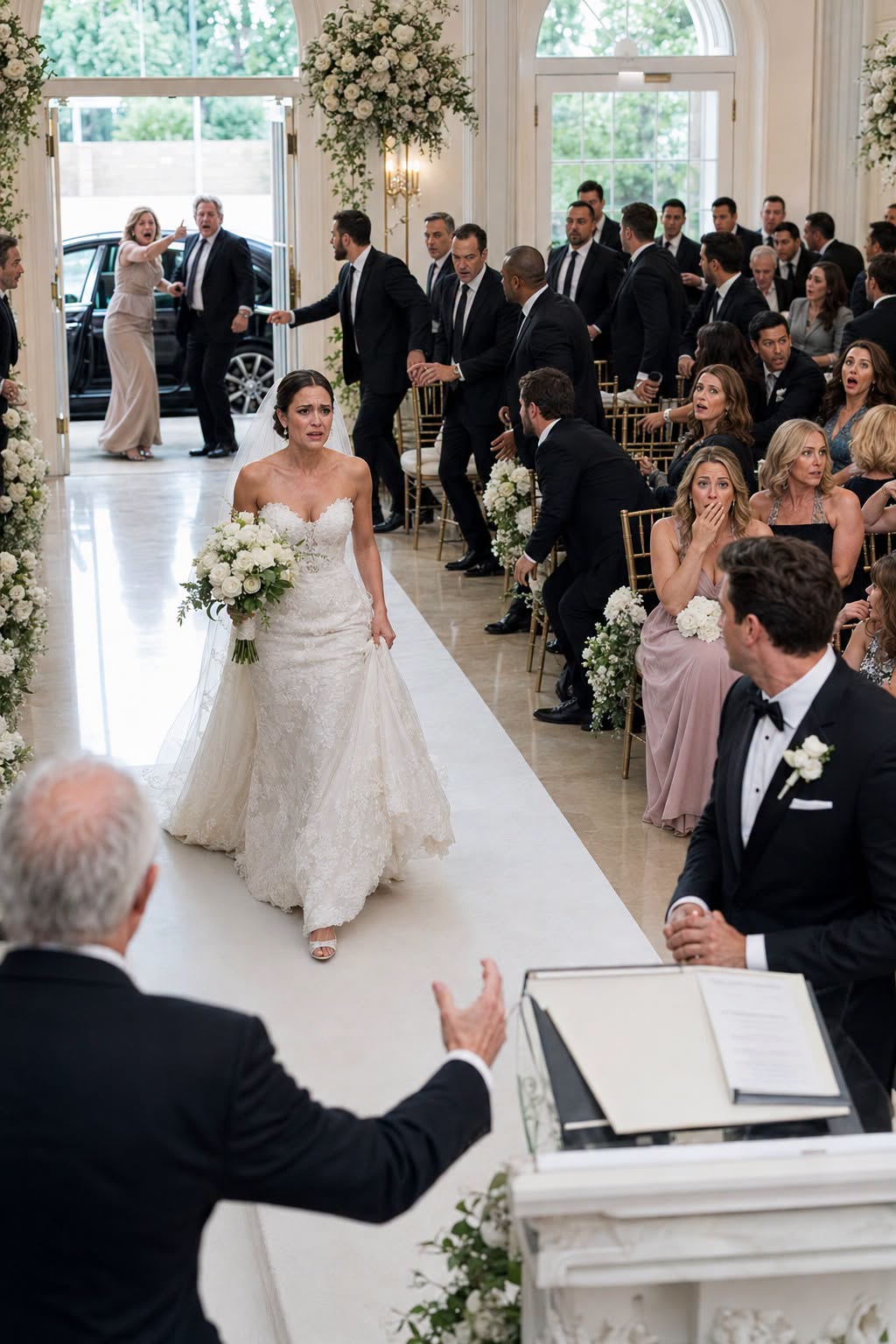
The chapel doors opened.
Caleb’s side rose.
My side looked like a field after harvest.
White chairs.
White cards.
Empty.
I began walking.
I kept my chin level.
I didn’t search the windows for my mother.
I looked at Caleb.
Halfway down the aisle, I heard a sound behind me.
Two side doors opening.
Everyone turned.
A silver-haired woman stepped inside wearing charcoal gray.
Evelyn Mercer.
She carried a leather portfolio.
Behind her came a line of men and women in dark suits.
Dozens.
They entered calmly.
No rushing.
No confusion.
They knew exactly where they were going.
Hank and Walter appeared near the front.
Then I recognized people from Grandpa’s world.
His former foreman.
His longtime bookkeeper.
Drivers.
Contractors.
Employees.
Retired employees.
People whose names I’d heard at his bedside.
People he’d helped when businesses failed, marriages broke, houses burned, children got sick.
Then came relatives.
Megan’s brother.
A great-aunt who’d been told I was ashamed of her.
A cousin who’d been told the wedding was canceled.
People my mother had personally lied to.
Chair by chair, they sat.
One after another.
The man from the grocery store walked past me in a suit that didn’t quite fit and gave me a tiny nod.
Told you.
Eighty-eight chairs.
They filled every one.
Through the front window, I saw my mother’s car.
Her head snapped toward the chapel.
Her mouth opened.
She grabbed my father’s sleeve through the window as if she could physically stop what was happening.
She had spent months manufacturing proof that no one would come for me.
Grandpa had spent months making sure they would.
My knees almost gave out.
Caleb stepped down from the altar.
He met me in the aisle.
And together we finished walking.
When we reached the front, every person on my side stood.
My mother had emptied a church to prove I wasn’t loved.
My grandfather filled it from the grave.
And I still didn’t know that the wedding itself was only the first half of his plan.
### Part 6
We married in front of a full chapel.
At the reception, Grandpa’s people stopped looking like solemn strangers and turned into exactly what they were: truck drivers, office managers, contractors and retired lumbermen who had loved a difficult old man for decades.
His bookkeeper, Marjorie, held both my hands.
“He talked about you constantly.”
My throat tightened.
“What did he say?”
She smiled.
“‘Claire came again.’ ‘Claire brought soup.’ ‘Claire sat up with me.’ Always Claire.”
Later I cornered Hank and Walter near the bar.
“You knew.”
Walter looked guilty.
Hank didn’t.
“Your grandfather came to the yard months before he died.”
Hank took a drink.
“Sat everybody down in the break room. Told us his children were circling and sooner or later they’d try to isolate you.”
“He knew about the wedding?”
“He knew about people.”
Hank’s eyes shone.
“He asked every one of us to promise that if your side ever emptied, we’d fill it.”
“Every chair?”
“Every damn chair.”
He smiled.
“Half this room shook your grandfather’s hand over you.”
Across the reception, relatives began comparing stories.
“I never declined.”
“Patricia told me Claire didn’t want me there.”
“She told me Claire was under investigation.”
“She said the ceremony had been postponed.”
Phones appeared.
Screenshots appeared.
The lie collapsed faster than it had been built.
My mother had made one major mistake.
She had assumed anyone she manipulated would be too embarrassed to compare notes afterward.
She underestimated how angry people become when they realize they’ve been used.
Mom never entered the reception.
That evening she texted me.
Whatever happens Monday, you owe this family.
A good daughter shares.
I stared at the word.
Shares.
There had never been a clearer confession.
Evelyn approached me near the cake.
“You walked in.”
“I almost didn’t.”
“But you did.”
“Why did that matter?”
She glanced toward the crowded room.
“Your grandfather needed you to show up to your own life.”
“What happens Monday?”
“Bring the envelope.”
“I’ve earned an answer.”
Evelyn almost smiled.
“Your grandfather thought you’d say that.”
That night, the envelope lay beside the watch on my nightstand.
I kept my promise.
I waited until Sunday morning.
Then I opened it.
Grandpa’s handwriting wobbled across three pages.
I read the letter once.
Then again.
Then I sat on the edge of the bed and cried without making a sound.
Monday morning, Caleb and I entered the offices of Mercer & Holt above Millbrook’s main square.
Dad came too.
He sat beside me without being asked.
Across the table sat Mom, Denise and Raymond.
Three siblings.
Three separate lawyers.
Three expressions built from different versions of fear.
Evelyn entered carrying her portfolio.
“Before I read Samuel Whitaker’s will,” she said, “he instructed me to explain something.”
My mother crossed her arms.
Evelyn continued.
“Samuel executed this will more than a year before his death. His physician documented his mental capacity. Independent witnesses signed it. Any challenge based on incapacity is unlikely to survive.”
Raymond shifted.
Evelyn looked directly at the three of them.
“Your father believed that once he was dead, his children would fight over what he left.”
No one spoke.
“He was particularly concerned that the fighting would be directed toward Claire.”
My mother’s jaw tightened.
“So Samuel constructed his estate plan in two parts.”
Evelyn opened the document.
“The farmhouse, surrounding land, and controlling interest in Whitaker Building Supply are left to Claire Bennett.”
Raymond half stood.
Denise gasped.
My mother didn’t move.
“The combined valuation is slightly above four million dollars.”
I held Grandpa’s watch inside my pocket.
I had suspected.
Still, hearing it felt unreal.
Evelyn continued.
“Samuel also left each of his three children one hundred thousand dollars.”
Mom finally breathed.
Then Evelyn added, “Subject to one condition.”
My mother closed her eyes.
She already knew.
I realized that immediately.
Evelyn began reading Grandpa’s words.
“How my children treat my granddaughter after I am gone and unable to protect her shall reveal more about their character than any promise made while I lived.”
My skin prickled.
“Any child of mine shown through clear evidence to have deliberately isolated, publicly humiliated, defrauded, intimidated, or sabotaged Claire shall forfeit that bequest.”
The room became completely still.
Evelyn looked toward my mother.
“Patricia, your bequest has been forfeited.”
Mom shot to her feet.
“This is insane.”
Evelyn calmly removed a sheet of paper.
My wedding website login history.
Eighty-eight RSVPs.
One device.
One session.
My mother’s account.
Then came signed statements.
The venue coordinator’s report.
Witness accounts from the rehearsal dinner.
Messages from relatives.
My mother’s own group-chat posts.
She had spent months building a case against me.
Without knowing it, she’d actually been building the case against herself.
### Part 7
My mother stared at the documents as though they had personally betrayed her.
“This is entrapment.”
“No,” Evelyn said. “Your father did not require you to do anything.”
“He knew!”
“He suspected.”
“He set me up to fail.”
Evelyn’s expression barely changed.
“He gave you one hundred thousand reasons not to torment your daughter.”
Mom turned toward me.
“You knew.”
“No.”
“You sat beside him for two years while he planned this.”
“I sat beside him because he was dying.”
“You poisoned him against us.”
That finally made me speak.
“I changed his sheets.”
My mother stopped.
“I cleaned him when he couldn’t clean himself. I read him baseball scores. I sat beside him when he was scared.”
My voice stayed surprisingly steady.
“You were in the kitchen asking what the farmhouse was worth.”
Raymond jumped in.
“Undue influence. She controlled his care.”
Evelyn didn’t even look surprised.
“Samuel predicted you would use those exact words.”
Raymond’s face reddened.
“His physician documented capacity. Two independent witnesses observed the signing. Claire did not know the contents of the will.”
She flipped another page.
“And for twenty-six months, Claire refused payment for nursing services that would have cost the estate a substantial amount through an agency.”
Raymond sank back into his chair.
Denise began crying.
“Patricia dragged me into this.”
I turned toward her.
“You were sitting beside her when she canceled the invitations.”
“I didn’t understand—”
“You laughed.”
Denise’s tears stopped.
“You told her she was terrible like it was a compliment.”
Evelyn added, “There is also the matter of the anonymous nursing-board complaint.”
Denise went pale.
“We have requested that the source be preserved. If the complaint proves deliberately false, you may want separate counsel.”
Denise stopped speaking entirely.
Interestingly, Grandpa’s conduct provision had not been triggered against Denise or Raymond based on the evidence Evelyn had formally verified by the reading.
Their individual bequests remained.
Only Mom lost hers.
I watched the realization spread between the three siblings.
It was almost surgical.
Raymond looked at Mom like she’d personally burned his inheritance.
Denise looked at Raymond.
Mom looked at both of them and understood that the alliance holding them together had always been made of money.
Then I removed Grandpa’s letter from my bag.
“I opened this yesterday.”
Mom stared at it.
“Grandpa told me I could after the wedding.”
I unfolded the pages.
“There’s something he wanted me to hear after I knew who everyone had chosen to be.”
Then I read.
Claire,
If you’re reading this, you’re married.
I hope the room was full. If it wasn’t, I hope you walked in anyway.
The money isn’t the gift.
Money is only money.
The gift is certainty.
You spent your life wondering whether you were difficult to love because the people who should have loved you easily made it feel difficult.
I want you finished with that question.
You stayed when there was nothing to gain.
You sat beside me when I could give you no good days back.
The others counted what I owned. You counted the hours I was comfortable.
That is why I chose you.
If my children failed the provision I wrote, do whatever you want with what they lost. Keep it. Give it away. Use it to build a bonfire.
But don’t become them.
Be kinder than they were, not because they deserve kindness, but because you deserve to leave this room without carrying them inside you.
You were the one who stayed.
Now leave when you need to.
Love,
Grandpa
Nobody spoke for several seconds.
Then I looked at my mother.
“Your hundred thousand dollars passes to me.”
Her face twisted.
“I don’t want your stolen money.”
“It’s not stolen.”
“Give it back.”
“No.”
For the first time, she looked hopeful.
Maybe she thought no meant I planned to keep it.
Instead, I said, “I’m putting it into a restricted trust.”
Her expression changed.
“It will pay necessary housing and medical expenses for you as long as you live.”
“What?”
“You won’t control the principal.”
Her mouth fell open.
“You’ll be safe. You’ll be provided for.”
I folded Grandpa’s letter.
“And you will never use money as a reason to contact me.”
Her face hardened.
“You think you’re better than me.”
“No.”
I stood.
“I think I’m finished with you.”
### Part 8
My mother didn’t apologize.
That matters.
People love stories where the cruel parent finally collapses, sees the truth, begs forgiveness and becomes the mother her child deserved thirty years too late.
That wasn’t my mother.
Patricia stood in Evelyn’s office furious because she had lost.
Not because she’d hurt me.
“You can’t cut me out.”
“I can.”
“I’m your mother.”
“That’s a biological fact. It isn’t permission.”
Dad stared at the table.
Mom pointed toward him.
“Martin, tell her.”
For most of my life, that would have worked.
My father had spent forty years surviving my mother by becoming quiet.
That morning he looked at her.
“No.”
One word.
His voice shook.
But he said it again.
“No, Patricia.”
She stared at him like he’d spoken another language.
Then she turned back to me.
“You’ll regret this when I’m old.”
“You’ll have the trust.”
“When I’m sick.”
“The trust covers care.”
“When I’m dying?”
That one hit me because she knew exactly where to aim.
I was a hospice nurse.
Dying people were my weakness.
But Grandpa’s letter was still in my hand.
Now leave when you need to.
“I won’t be your nurse.”
Her face went white.
“I’ll make sure you’re treated properly. I won’t be there.”
For the first time all morning, she had no reply.
I picked up my watch.
Caleb took my hand.
And I left.
I did not forgive my mother later.
I did not secretly reconcile with her over Christmas.
I did not decide that blood deserved one more chance.
Grandpa’s final gift wasn’t the company.
It was permission to stop auditioning for people who had already decided what role they wanted me to play.
Caleb and I moved into Grandpa’s farmhouse that autumn.
I kept working hospice.
People assumed inheriting millions would make me quit.
It did the opposite.
For the first time, I could work because the work mattered and not because I was terrified one bad month would ruin me.
We hired experienced leadership to operate Whitaker Building Supply rather than pretending I suddenly knew how to manage a company because I inherited one.
Hank and Walter advised us.
Marjorie stayed on.
The employees received better retirement contributions and a profit-sharing plan Grandpa had once mentioned wanting but never finished setting up.
I didn’t turn into him.
I simply tried to protect what he had spent his life building.
The nursing complaint was eventually dismissed.
Once investigators reviewed the records, there was nothing to support the accusation.
I had documented everything.
Hospice nurses live by documentation.
Dates. Visits. Care notes. Physician instructions.
Ironically, the profession my family mocked had taught me exactly how to survive people who depended on lies.
Denise stopped speaking to Mom.
Raymond stopped speaking to Denise.
Apparently each of them decided the others were responsible for losing something.
I hear about their arguments occasionally through distant relatives.
I never ask for details.
Some houses burn perfectly well after you stop feeding the fire.
Dad visits most Sundays.
Our relationship isn’t magically repaired.
There are decades of silence between us.
But sometimes he sits at Grandpa’s long oak table with a cup of coffee and says things he should have said years ago.
“I saw what she did.”
“I should have stopped it.”
“I was afraid of her.”
I don’t tell him it’s okay.
It wasn’t.
But I let him tell the truth.
That’s the only beginning I’m willing to offer.
My mother’s trust pays what it’s supposed to pay.
She has never thanked me.
I never expected her to.
She has tried sending messages through relatives.
I send them back unopened.
Once, she mailed a six-page letter explaining why everything she had done was actually Grandpa’s fault.
I gave it to Evelyn without reading past the first paragraph.
A late explanation is not the same thing as accountability.
And love that arrives only after consequences isn’t the kind of love I want anymore.
The brass watch still sits on my nightstand.
Every morning, I wind it.
Click.
Click.
Click.
Sometimes I remember sitting at my kitchen table addressing eighty-eight envelopes, imagining all the people I thought would fill those chairs.
Most of those exact people didn’t.
Not at first.
But every chair still filled.
That became important to me.
The people whose names you write on the seats are not always the people who belong in them.
Sometimes blood empties the room.
Sometimes a retired lumberman fills it.
Sometimes it’s a bookkeeper with a work glove in her purse.
A cousin who comes back ashamed.
A husband walking down the aisle to meet you halfway.
A lawyer keeping a promise to a dead man.
Family is not the person who can prove they share your blood.
Family is the person who sees an empty chair beside you and chooses to sit down.
My mother wanted me standing in that chapel surrounded by emptiness because she believed abandonment would make me weak enough to control.
Instead, she showed me exactly who I could live without.
Grandpa spent my entire childhood saving the seat beside him for me.
When he realized he wouldn’t live long enough to attend my wedding, he did something bigger.
He saved every seat in the room.
And the morning after everything was over, I finally understood what he’d meant years earlier when he told me I had no idea how rare it was to want nothing from him.
He wasn’t talking about money.
He was talking about love that doesn’t keep score.
That was the inheritance.
Everything else was paperwork.
And the church my mother emptied to break me became the exact place where I stopped waiting for her to love me.
I walked in as the daughter she believed no one would claim.
I walked out as a wife surrounded by people who had chosen me.
And I never went back.
THE END!