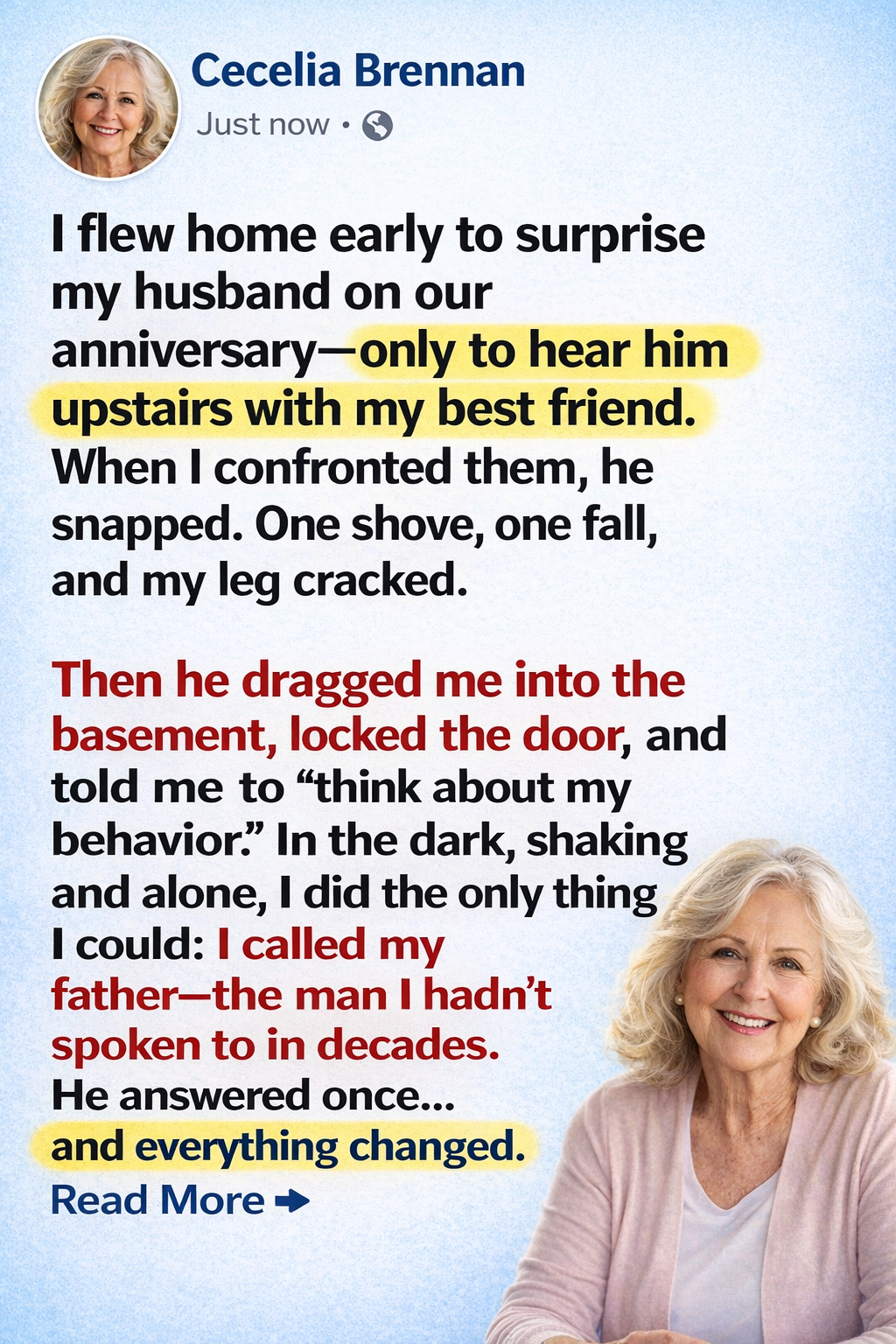
It was our third wedding anniversary, and I thought I was doing something romantic by coming home early.
New York Fashion Week had been a blur—backstage lights, frantic stylists, the constant hum of people pretending not to be tired. I slipped away a day ahead of schedule, imagining Ethan’s face when he saw me in the doorway. I pictured champagne. A quiet dinner. A reset. Marriage needed small surprises like that, I told myself. Proof that we still chose each other.
The house in Greenwich was too quiet when I walked in. My heels clicked against marble, the sound sharp in the open space. I called his name once—soft, playful—then stopped when my eyes caught the trail on the living room floor.
Stockings. Lace. A man’s belt tossed like someone didn’t bother to aim for a chair.
My first instinct was denial. Cleaning. A stylist. A prank. Anything that didn’t require the truth. But denial doesn’t last long when you can hear voices upstairs.
“What if your wife comes back early?” a woman asked, half-laughing, breathy and careless.
“She won’t,” Ethan replied, casual as a weather report. “And even if she does, what’s she going to do? I pay for everything.”
The sentence hit harder than the scene. Not just betrayal—ownership. Like love was a bill he covered and I was the thing he purchased.
I climbed the stairs slowly, my body moving before my mind caught up. Outside the bedroom door, I heard another laugh—familiar. Too familiar. My stomach tightened so hard it felt like my ribs were shrinking.
When I pushed the door open, the world snapped into focus with brutal clarity.
Ethan jerked upright, eyes wide, the sheet bunched at his waist. Beside him was Khloe—my closest friend from college. The woman who held my hand when I cried over my first real heartbreak. The woman I’d trusted to sit at my wedding, to toast us, to smile as if she wasn’t waiting for her turn.
Khloe screamed, pulling the sheet to her chest, but the expression on her face wasn’t pure panic. It was annoyance, like I’d walked in at the wrong time and ruined her fun.
“Sophia, wait—this isn’t what it looks like,” Ethan started.
“Don’t,” I said, and I barely recognized my own voice. It sounded distant, like it belonged to someone else.
Khloe’s mouth opened, maybe to apologize, maybe to blame me, maybe to say something small and poisonous. I didn’t wait to hear it. My hand moved faster than my thoughts, and I slapped her.
The sound cracked through the room like a snapped branch.
For one second, everything froze—Khloe’s shocked gasp, Ethan’s stiff posture, the air itself holding its breath. Then Ethan’s face changed.
Not fear. Not shame.
Anger.
He moved so fast my brain couldn’t label it. His hand came across my face with a force that knocked my head sideways. I stumbled, catching myself on the dresser, trying to breathe through the sudden sting.
“What the hell is wrong with you?” he shouted.
Khloe was crying now, but it sounded theatrical, like she’d practiced being the victim.
I tried to back away. “Ethan, stop—”
He grabbed my hair and yanked, hard enough that tears burst into my eyes instantly. I fought for balance, hands scrambling at his wrist, trying to get distance without escalating him further. He dragged me toward the hallway, shouting words I’d never heard from him before—about money, about “gratitude,” about how I should “remember my place.”
I didn’t even have time to scream before my foot slipped on the stairs.
The fall wasn’t graceful. It was fast and ugly and unstoppable. I remember the sensation of weight leaving my body, the sickening helplessness of knowing you’re about to hit something and being unable to stop it.
Pain exploded through my leg.
It was so immediate, so intense, my vision blurred. I heard a sound—sharp, wrong—then everything became noise and cold sweat and the taste of fear in the back of my throat.
When I came to, I was on the landing, my leg twisted at an angle that made my stomach flip. I tried to move and nearly blacked out again.
Ethan stood over me, breathing hard—not concerned, not horrified by what he’d done.
“Stop exaggerating,” he said coldly. “You brought this on yourself.”
Khloe’s voice floated from the top of the stairs, shaky. “Ethan, maybe we should call—”
He snapped at her without even looking. “Shut up.”
Then he looked back at me, eyes flat. “You’re not doing this to me. You’re not ruining my life because you can’t control yourself.”
Control. That word again.
He grabbed my arm and hauled me up with no care for my injury. I cried out. My hands clawed at the railing. He dragged me down the hall, past framed photos of our vacations, our wedding, the life we presented like a glossy magazine spread.
Then he opened the basement door and pulled me down the steps.
The air changed immediately—cooler, damp, smelling faintly of concrete and detergent. He shoved me onto the floor, hard enough that my injured leg screamed in protest. I choked back another cry.
Ethan slammed the door and turned the lock.
Through the wood, his voice came muffled, controlled again. “Think about your behavior,” he said. “Maybe when you calm down, you’ll learn something.”
Then footsteps. Then silence.
Time in a basement doesn’t move the way it does upstairs. It stretches. It warps. I lay on the floor shaking, my leg throbbing in violent waves. I tried to breathe slowly, counting, telling myself not to panic because panic wastes oxygen, wastes energy, wastes clarity.
I reached for my phone with trembling hands, grateful it was still in my pocket. The screen cracked slightly when I dropped it once, but it still lit up.
My thumb hovered over contacts. My mind raced through options—friends, coworkers, neighbors—but fear did a strange thing: it reminded me of the person I hadn’t allowed myself to need.
Dad.
My mother had kept me away from him after their separation. I’d grown up hearing stories that made him sound like a ghost and a villain at the same time. I built my life without him on principle. I never even told him I was married. Independence was my armor. Pride was my habit.
But pride doesn’t unlock basement doors.
My hands shook as I scrolled to his number—an old contact I’d kept for reasons I didn’t like to name. I pressed call.
It rang once.
Twice.
Then his voice—steady, older than I remembered, but unmistakably his. “Hello?”
Something inside me cracked open. “Dad,” I whispered.
There was a pause. Not confusion—recognition. Like he’d been waiting for this call for years without expecting it.
“Sophia?” His voice changed immediately. Softer. Alert. “What’s wrong?”
I swallowed hard, forcing the words out through pain. “I’m… I’m in trouble. Ethan hurt me. He locked me in the basement. I can’t stand. My leg—” My voice broke.
“Listen to me,” he said, calm as steel. “Where are you? Give me the address.”
I told him. Between breaths, between waves of pain, I gave him everything I could: the town, the street, the house. I heard the sharp intake of his breath—not panic, just focus.
“Stay on the line,” he said. “I’m calling emergency services right now. Do you hear me? Stay with me.”
I heard him speak to someone else—another phone, another line—his voice suddenly clipped and authoritative. He said the words I needed to hear: My daughter has been assaulted. She’s trapped. She needs medical help now.
Minutes later, distant sounds reached me through the basement—muffled voices, movement above, a door opening, then sharper voices. A man’s command. Another voice answering. The sound of footsteps that weren’t Ethan’s.
Ethan shouted something—angry, panicked, defensive.
Then heavy steps came down the basement stairs.
The lock turned.
Light spilled in so suddenly it hurt my eyes.
A uniformed officer stood in the doorway, scanning the room. Behind him, an EMT with a medical bag moved quickly, kneeling beside me with professional calm.
“Ma’am,” the EMT said gently, “I’m here to help you. What’s your name?”
“Sophia,” I whispered.
“Okay, Sophia. We’re going to get you out of here.”
Upstairs, Ethan’s voice rose—high and frantic—demanding explanations, insisting it was “a misunderstanding,” trying to regain control with volume. But control doesn’t work on trained professionals. It doesn’t work on paperwork. It doesn’t work when someone finally calls the right people.
They stabilized my leg, moved with careful precision, and lifted me onto a stretcher. The movement was agony, but it was purposeful agony—the kind that meant rescue, not harm.
As they carried me out into the fresh air, my body shook from cold and adrenaline. The driveway lights blurred in my eyes. The night smelled like grass and distant rain and something like freedom.
A car was parked near the curb. My father stepped out before anyone could stop him.
He looked older than the man in my childhood memory, hair grayer, face more lined—but the moment he saw me, his jaw tightened in a way that told me he was holding back something huge.
He didn’t shout. He didn’t perform.
He just reached out and placed his hand lightly on my shoulder, careful not to jostle me.
“I’m here,” he said quietly. “You’re safe.”
I tried to speak, but my throat closed. Tears leaked out anyway.
My father looked past me toward the front door, where Ethan was being spoken to by officers. Ethan’s posture had changed—no longer powerful, no longer certain. Smaller. Cornered by reality.
“This ends tonight,” my father murmured. “Not with revenge. With consequences.”
He followed the stretcher to the ambulance, staying close, speaking to the EMTs, answering questions when my voice failed. He knew what to say and when to stay quiet. He knew how to be steady.
In the hospital, the fluorescent lights were harsh and the air smelled like disinfectant—the smell I’d always associated with other people’s emergencies. Now it was mine. Doctors took X-rays. Nurses asked questions gently. The fracture was confirmed. Treatment plans were explained.
And in the middle of it, an officer returned to ask me for a statement.
I told the truth.
Not the softened truth that protects abusers. Not the truth that pretends violence is an accident. The real truth: the cheating, the hit, the fall, the basement lock, the order to staff, the words he used to make it my fault.
The officer nodded, taking notes, calm but firm. “We’re proceeding,” he said. “There will be charges. We’ll also talk about a protective order.”
When my father heard the word protective order, he didn’t look relieved. He looked resolved. Like a man who’d waited too long to protect his child and had no intention of failing again.
Khloe tried to contact me that night. A message appeared on my phone: I didn’t mean for this to happen. Please don’t ruin my life.
I stared at it for a long time.
Then I deleted it.
Because she was worried about her life. I was worried about surviving mine.
In the days that followed, the world rearranged itself. Ethan’s charm evaporated under legal scrutiny. Staff members gave statements. Security cameras confirmed timelines. My attorney filed emergency motions. A restraining order was put in place. Divorce paperwork began like a slow, necessary storm.
My father stayed nearby, not smothering, not demanding closeness—just present. Sometimes he brought coffee. Sometimes he sat quietly while I slept. Sometimes he asked, softly, “Do you want to talk?” and accepted “no” as a full sentence.
One afternoon, when my pain meds made everything feel slightly unreal, I whispered, “Why did you answer so fast?”
He looked at me with the kind of sadness that isn’t dramatic, just permanent. “Because I’ve been hoping you’d call,” he said. “Every year. Even if it was just to yell at me.”
I swallowed hard. “I didn’t know how.”
“I know,” he said. “But you did tonight. And that’s what matters.”
Healing wasn’t quick. It wasn’t cinematic. It was physical therapy, bruises fading, paperwork, court dates, nights where I woke up sweating from dreams I couldn’t control. It was learning that safety isn’t a feeling; it’s a system—locks, boundaries, evidence, people who respond when you ask for help.
Ethan thought I was powerless because he paid for things. Because he controlled the narrative in our social circle. Because he assumed my silence was weakness.
He was wrong.
Not because someone stormed in with dramatic vengeance, but because the truth—documented, reported, pursued—has a weight abusers can’t lift.
The worst mistake of his life wasn’t cheating.
It was believing he could hurt me and lock the door behind it… and that no one would come when I called.