Back in Sunset Park, Elena Reyes sat at her kitchen table with her coat still on while Lucia told her everything.
The red-haired nurse.
The envelope.
The IV.
The sound Dante made when the medicine stopped.
By the end, Elena’s face had gone gray.
“Baby,” she whispered, pulling Lucia close, “you are going to forget everything you told me.”
“Mama, he’s dying.”
“That is not our problem.”
“Yes, it is,” Lucia said. “You said he helped you once.”
Elena pressed her forehead to her daughter’s hair and cried without sound.
The knock came at 11:40.
Two soft taps.
Not a neighbor.
Not the superintendent.
Elena looked through the peephole. A man in a dark coat stood with his cap low.
“Who is it?”
“Delivery for Miss Reyes. Just an envelope. No signature.”
“Slide it under.”
A yellow envelope appeared beneath the door.
Inside were four photos.
Lucia entering school.
Lucia at the playground.
Lucia by the kindergarten gate.
Elena waiting for the bus.
On the back of the last photo, six words were written in neat block letters.
Stay quiet or disappear.
Elena’s knees weakened. She slid down the door, the photos scattered in her lap.
Lucia knelt in front of her. For a moment, she did not look like a child. She looked like a very small person who had already learned the price of truth.
“Mama,” she said softly, “he ate your cookies once. Remember?”
At seven the next morning, a day nurse named Priya saw Dante’s index finger curl inward.
It was tiny.
Deliberate.
She leaned over him.
“Mr. Moretti, if you can hear me, try again.”
His finger moved a second time.
By 7:40, Vivian Moretti stood at the foot of the bed in a cream wool coat, her hand resting on the rail. Adrian stood behind her, headphones in. Mateo waited in the hall with coffee he did not drink.
Priya told Vivian about the movement.
Vivian’s face performed perfectly. Her hand flew to her mouth. Her eyes shone.
“Thank God,” she breathed. “I’ve prayed every night.”
When Priya left, Vivian sent Adrian for tea.
For twelve seconds, she was alone with Dante.
She studied his face like a painting that had cracked in the wrong place.
Then she turned slightly toward the door.
“Rachel. A word.”
Rachel Doyle entered with her hands in her pockets.
Vivian waited until the door clicked shut.
“Double it.”
Rachel’s mouth tightened. “Mrs. Moretti—”
“Tonight. Not tomorrow.”
“If I push the dose that fast, the labs will scream.”
“Then let them scream Monday,” Vivian said. “By Monday it won’t matter.”
Rachel swallowed.
“If he’s still breathing Friday afternoon, the five capos will walk into that boardroom and ask one question. Is the man at the head of the table going to wake up? If there is even a rumor that he might, everything we built collapses. Yours too.”
Rachel looked at Dante.
Vivian stepped closer. “Tonight.”
Rachel whispered, “Fine.”
“Good girl.”
Outside the room, Mateo Caruso took one slow sip of coffee.
His left hand was inside his coat pocket, wrapped around his phone.
The red recording light had been on for four minutes.
That night, Luca did something he could lose his license for.
He knew Klein would notice any official medication change. But Luca also knew the IV pump model from residency. A hidden service menu could manually override the delivered rate without changing the displayed program.
At 8:50, he entered Room 120.
At 8:51, the screen showed exactly what Klein expected.
But the amount actually entering Dante’s vein had been reduced to less than half.
At 9:15, Mateo dragged a plastic chair in front of Dante’s door and sat there with a turkey sandwich.
At 9:40, Rachel came around the corner with a medication tray.
“Excuse me. I need to give his 9:45.”
Mateo folded his napkin.
“Not tonight.”
“Dr. Klein will ask why I skipped it.”
“Tell him whatever you want.”
“I could call security.”
Mateo looked up at last. “Call them.”
Rachel stared at him, then at the closed door, then down the empty hallway.
She turned the tray around and left.
She did not come back.
At 6:22 the next morning, Dante Moretti opened his eyes.
Not wide.
His lids rose like something heavy being pulled from underwater. For a moment, he stared at the ceiling. Then his eyes shifted and found Mateo.
Recognition moved across his face so faintly only a man who had known him for twenty-six years could read it.
Mateo stepped forward and placed a hand gently over his.
“Boss.”
Dante’s lips moved.
“Who?”
Mateo leaned close.
“Vivian and Klein.”
Dante closed his eyes.
Not in surrender.
In confirmation.
A tear slipped from the corner of his left eye.
When he opened his eyes again, he looked at Luca.
“The girl.”
Luca blinked. “You remember her?”
Dante’s voice scraped out one word at a time.
“Thank you… for my mother’s cookies.”
Mateo went still.
Luca did not understand.
Mateo did.
Dante was not talking about Lucia.
He was remembering Elena.
The woman in the Park Avenue lobby. The cleaner no one saw. The woman who had baked cookies for the security desk the week Dante’s mother died, because she had heard him tell his driver that his mother used to make almond cookies on Sundays.
Dante had eaten one.
He had said thank you.
A tiny kindness he had forgotten had returned to save his life.
By eight, Dante had asked for water twice, a pen once, and the girl three times.
“Bring her,” he rasped.
“She’s at school, Boss.”
Dante gripped Mateo’s wrist with surprising strength.
“Bring her.”
Mateo drove himself to Sunset Park.
At Lucia’s school, the receptionist smiled politely.
“You just missed her uncle.”
Mateo’s smile did not change.
Inside, his blood went cold.
“Her uncle?”
“Yes. About thirty minutes ago. He said Mrs. Reyes was at the hospital. He had the pickup code.”
“What did he look like?”
“Tall. Shaved head. Small tattoo on his neck.”
Mateo walked back to his SUV at a normal pace.
Then he called Elena.
“Elena. Listen carefully. Someone picked Lucia up from school.”
A sound broke in Elena’s throat.
“No. No, no, no.”
“Where are you?”
“Radiology. Fourth floor.”
“Stay there. Don’t call 911 yet. Give me thirty minutes and I’ll have more eyes on this than the police could put on it by dinner.”
“I don’t even know you.”
“You know who I work for.”
A pause.
Then Elena whispered, “Thirty minutes.”
Mateo made five calls in six minutes.
By 9:15, the license plate Lucia had memorized two days earlier while pretending to tie her shoe had entered every Moretti network in New York.
Because Lucia had noticed the black sedan.
Because Lucia remembered the plate.
Because Lucia was six, and no one expected a six-year-old to save herself before she was taken.
The man who took her was known as Wolf. He had pale eyes, a shaved head, and the cold patience of someone who had done ugly things for money.
He brought Lucia to an abandoned refrigerated warehouse near Red Hook.
“Sit,” he said. “Don’t talk. Don’t cry. If you cry, I get loud.”
Lucia did not cry.
She looked around.
Words on a wall: Bay Seven Refrigerated.
A faded octopus painted near a roll-up door.
A pallet sprayed with red letters: Black Harbor.
A sticker on Wolf’s duffel bag: Canary Storage.
She put them all in a drawer inside her mind.
When Wolf turned away to take a call, Lucia used the toe of her sneaker to draw a heart and a large L in the dust.
Then she sat back down with her hands folded.
Forty minutes later, Wolf yanked her toward the car.
“Change of plans, princess.”
At the door, Lucia slipped the pink barrette from her braid and hid it in her sleeve.
When Wolf shut her in the back seat and walked around to the driver’s side, Lucia cracked the window and dropped the barrette onto the curb.
Three blocks later, she dropped a purple crayon.
At the next light, a yellow sun sticker.
Across Brooklyn, Mateo stood in the back room above a bakery on Court Street, watching traffic camera feeds.
The black sedan appeared near Van Brunt and Pioneer.
“Back it up,” Mateo ordered.
A retired NYPD sergeant named Tony DeLuca found the pink barrette seven minutes later.
Then the crayon.
Then the sticker.
The trail led to a container yard by Pier 11.
Mateo arrived with three men. No weapons were visible. All of them were armed.
Inside an open shipping container, Wolf was on the phone. Lucia was hidden behind stacked drums, clutching her backpack because it smelled like home.
Wolf heard gravel crunch half a second too late.
Mateo’s shot struck high in his thigh. Wolf dropped to one knee, his gun sliding across the metal floor. Tony kicked it away.
“Face down,” Mateo said. “Hands on your head. Breathe slowly.”
Wolf cursed.
Mateo ignored him.
“Lucia, sweetheart,” he called. “You can come out now.”
Silence.
Then a small clear voice answered, “Mr. Mateo?”
Mateo’s face cracked around the eyes.
“Yes, honey. It’s me.”
Lucia stepped out slowly, one cheek dusty, braid half undone, purple backpack pressed to her chest.
She did not run.
She walked like a child who had decided not to cry in front of men with guns.
“How did you know my name?” Mateo asked softly.
“Mr. Dante said it on the doctor’s phone,” she replied. “He told me you would come.”
Part 3
When Mateo brought Lucia back to St. Raphael through the service entrance, Elena was waiting on the stairwell.
The moment she saw her daughter, her knees gave out. She pulled Lucia into her arms and held her so tightly neither of them could speak for a full minute.
“I’m okay, Mama,” Lucia whispered. “I lost my barrette.”
Elena laughed through tears. “Baby, you can have a hundred barrettes.”
Mateo crouched beside them.
“Elena, I need her upstairs for five minutes.”
Elena looked at him as if he had asked for her heart.
“No.”
“Dante needs to hear one thing from her.”
Elena’s arms tightened.
Mateo lowered his voice. “You have my word. After that, two of my men take you both home. No one touches you again.”
Elena stared at him.
Then she nodded.
In Room 120, Dante looked paler than before. Staying awake was costing him. But when Lucia entered, he lifted his right hand.
It trembled in the air.
“Come here, little one.”
Lucia climbed carefully onto the bed.
Dante closed his weak fingers around hers.
“I heard you were brave,” he whispered.
“I was scared,” Lucia said. “But I didn’t let him see.”
“That,” Dante said, kissing the top of her head, “is what brave means.”
Mateo leaned near Dante’s ear.
“She heard the man on the phone. He called someone Lupo Vecchio. Twice.”
Dante stopped breathing for several seconds.
The Old Wolf.
A name no one outside the oldest circles had spoken in a decade.
Marco Volandi.
Dante closed his eyes, and the pieces locked into place.
Klein’s old research institute, funded through shell donors traced to Volandi money. Vivian’s new “private investor” she had met at a charity gala. A power transfer she had been trying to force through while Dante lay helpless.
Vivian thought she was building a throne.
She was being used as bait.
“She thinks she’s the hunter,” Dante rasped. “She’s the cage.”
Mateo waited.
“Don’t arrest her yet,” Dante said. “Let her walk into Friday believing she won.”
By ten that night, Daniel Whitaker, Dante’s attorney of twenty-one years, arrived with a leather briefcase and the expression of a man who had been waiting eighteen days for one phone call.
He froze when he saw Dante awake.
“You look terrible.”
“I’ve been better,” Dante said.
Daniel opened his briefcase. “Tell me what you need.”
By midnight, Daniel had frozen three private accounts, suspended Vivian’s operational authority over Moretti Holdings, and filed sealed emergency motions in Brooklyn. Luca completed a neurological evaluation proving Dante was cognitively competent. Mateo visited the five capos one by one and told each of them only what they needed to know.
Friday morning arrived gray and clean over the East River.
Vivian Moretti woke at 5:30, drank warm lemon water, and sat at her vanity in Long Island painting on the face of a woman who would not break in public.
In the leather portfolio beside her were the documents she had been building toward for six months: voting control over Moretti Holdings, a medical incapacity declaration signed by Klein, and a trust amendment Dante had never approved.
Today she would enter a room full of men who had treated her like decoration for years.
Today she would leave as the decision-maker over an empire worth more than most countries’ budgets.
At 7:45, Vivian stepped off the private elevator at St. Raphael.
She paused outside Room 120, fixed her hair, shaped her grieving-wife face, and pushed open the door.
Then she stopped.
Dante Moretti was sitting upright in bed.
He wore a white dress shirt from his own closet, open at the collar, sleeves folded once at the wrist. He had shaved. His hair was combed back. An IV stand remained beside the bed, but no tube connected him to it.
Mateo stood to his left.
Daniel sat in the visitor chair with a tablet.
Luca leaned by the window, arms crossed.
Vivian’s breath left her body without permission.
Dante looked up and smiled.
Not warmly.
“Good morning, sweetheart,” he said. “Do you remember how I take my coffee?”
Vivian took one step into the room and could not take another.
“Dante,” she whispered. “Oh my God. Nobody called me.”
“Priya tried. Your phone was off.”
“I was in the shower. This is a miracle.”
“Yes,” Dante said. “Dr. Klein would probably agree, but he’s busy this morning.”
Vivian understood the sentence the second time it moved through her mind.
Her portfolio suddenly weighed fifty pounds.
“Sit down, Vivian,” Dante said. “The council starts in ninety minutes. You’re going to watch it with me.”
At 9:25, Daniel connected the secure line.
Five rectangles filled the tablet screen: Brooklyn, Queens, the Bronx, Staten Island, Manhattan. Three more joined as witnesses from allied families.
Mateo adjusted the camera so Dante’s face filled the frame.
“Gentlemen,” Dante said, voice low but steady, “thank you for your patience. I understand the agenda said you were meeting today to discuss my incapacity. The agenda has changed.”
No one moved.
“Three weeks ago, I entered this hospital because I couldn’t feel the left side of my face. My attending physician, Nathaniel Klein, has been writing orders in my chart with one hand and arranging for something very different to enter my bloodstream with the other.”
Daniel tapped the tablet.
Mateo’s recording played.
Vivian’s voice filled the room.
“Double it tonight. He has to be gone before Friday.”
On the screen, men who had seen bodies pulled from rivers went still.
Daniel opened the pump logs.
The official chart said one thing. The hidden memory said another.
Then came the toxicology report from the private lab in Brooklyn: sedatives at levels no hospital would prescribe, and one old anesthetic compound designed to vanish from routine screens.
Dante let the numbers sit.
“This,” he said, “is what was entering my body while my wife sat beside my bed and cried for the nurses.”
Vivian lifted a shaking hand to her throat.
“Dante, please. Let me explain.”
“I am.”
“It was me,” she said quickly. “Only me. Klein was a doctor I pressured. Rachel needed money. No one else knew.”
Dante held her gaze.
Then he lifted one finger.
“Bring her.”
The door opened.
Mateo returned with Lucia Reyes in a yellow sweater.
He lifted her onto a stool so her face appeared in the camera.
Eight men on the screen stared at a six-year-old girl.
Dante’s voice softened.
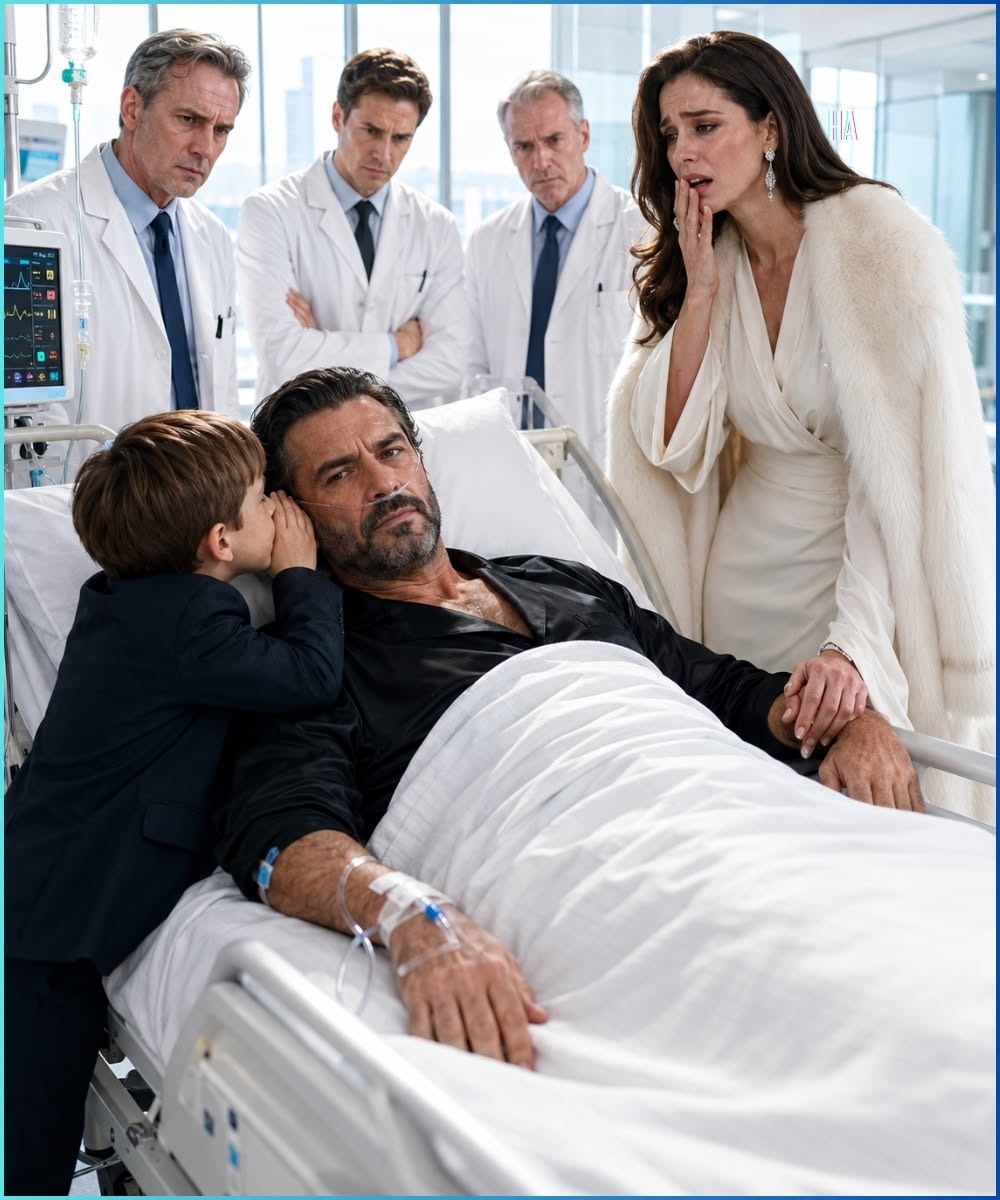
“Gentlemen, this is Lucia Reyes. Three days ago, she whispered in my ear that I was being poisoned. Yesterday morning, a man took her from school to make sure she never whispered again. She came back because she is smarter at six than most people are at forty.”
He looked at Lucia.
“Sweetheart, tell them what you heard in the car.”
Lucia looked into the camera. She was not performing. She was simply carrying the truth because someone had asked her to.
“The man who took me called someone,” she said. “He said, ‘It’s handled, Lupo Vecchio.’ He said it twice. I practiced so I wouldn’t forget.”
The silence became something physical.
On the screen, the Volandi underboss went pale.
Dante turned toward him.
“In this country, on this coast, there is exactly one man ever called the Old Wolf. Your boss told us ten years ago he was retired. He sent flowers to my mother’s funeral. He swore there was no war between our houses.”
Vivian stared at the floor, finally understanding the architecture of her own cage.
“My wife thought a private investor was whispering in her ear,” Dante said. “The whisper was Marco Volandi. He used her ambition, Klein’s access, and a hired animal to silence a child.”
Dante leaned closer to the camera.
“Tell your boss I’m awake. Tell him the little girl he tried to erase remembered his name in Italian.”
Then Dante ended the call.
At 11:17, federal agents entered Marco Volandi’s Staten Island estate with financial records Daniel had provided and photographs of Klein meeting Volandi at the Plaza. Volandi did not resist. He simply asked for his attorney.
At 11:31, agents entered Dr. Klein’s office. He was standing beside a shredder, half of Dante’s medical file already in strips.
Rachel Doyle turned herself in that afternoon and talked for four hours.
Vivian was allowed to leave St. Raphael by Dante’s specific instruction. When she returned to Long Island, her closets had been packed into eight matching suitcases. Daniel waited in the living room with one document. It revoked her authority, erased her access to Moretti assets, and gave her enough money to live modestly somewhere very far from New York.
Vivian signed.
There was nothing else to do.
Two months later, on a bright Saturday in late fall, a black car stopped outside a third-floor apartment building in Sunset Park.
Dante Moretti stepped onto the sidewalk wearing a charcoal coat and carrying a white bakery box tied with red string. He walked with a polished cane, but he walked the last block himself.
Elena opened the door in socks, wiping her hands on a dish towel. The apartment smelled like garlic, tomato sauce, and warm bread.
“Mr. Moretti.”
“Elena,” he said. “May I come in?”
She stepped aside.
Dante placed the bakery box on the kitchen table. Almond biscotti. Butter cookies. The kind his mother used to make.
He looked at Elena for a long moment.
“I don’t know how to thank a woman who lent me her daughter long enough to save my life.”
Elena covered her mouth.
Before she could answer, Lucia burst from the bedroom in a red dress, barefoot, her hair still damp from a bath.
She ran straight to him and wrapped both arms around one of his legs.
Dante handed his cane to Elena.
Then, slowly and carefully, the old boss of the Moretti family lowered himself to his knees on the floor of a small Brooklyn apartment.
“Anything you need,” he told Lucia, voice rough, “for the rest of your life, I’ll be there. Do you understand?”
Lucia nodded solemnly.
Then she ran to the table and brought back a folded drawing.
It showed three people holding hands: a tall man, a woman, and a little girl. Beneath it, in wobbly kindergarten letters, Lucia had written a sentence Elena helped her spell.
The strongest person is not the one who never falls. It is the one who has someone stay when they fall.
Dante read it twice.
Then he folded it carefully and placed it inside his coat, over his heart.
He had built an empire on blood and silence.
But what saved him was not power.
It was one small voice in a room where every adult had chosen to stay quiet.
And from that day on, whenever Dante Moretti entered a room full of dangerous men, they no longer feared only the boss who had come back from the edge.
They remembered the little girl who whispered the truth into his ear and made the whole empire open its eyes.
THE END