At exactly 1:04 p.m. on Easter Sunday, retired Colonel Daniel Mercer expected nothing more than a quiet afternoon.
His modest home in a peaceful neighborhood outside Nashville smelled of roasted lamb, rosemary, and fresh coffee. The windows stood open, a mild spring breeze moved through the rooms, and for the first time in years, Daniel was not waiting for military orders, emergency calls, or terrible news.
At 1:04 p.m., his phone vibrated against the kitchen table.
His daughter, Emma, was calling.
Daniel smiled as he answered, but he never had the chance to wish her a happy Easter. Instead, he heard uneven breathing, muffled crying, and a voice so fractured it hardly sounded like his daughter.
“Dad… please… come get me… he hurt me again.”
Daniel went completely still.
Emma had been married to Andrew Prescott for six years. Andrew was the chief executive of a rapidly expanding technology company with government contracts worth millions throughout Middle Tennessee. In public, he was refined, charitable, and endlessly charming. In private, he controlled the finances, Emma’s phone, her clothes, and even the people she was permitted to contact.
“Where are you?” Daniel asked.
“At the house… it’s worse this time… Dad, he’s—”
A scream cut through the call.
Then Daniel heard a heavy impact, the metallic crash of something striking the floor, and a man shouting insults.
The connection went silent.
Daniel dropped his coffee cup.
He did not even glance at the broken pieces.
He grabbed the keys to his aging Ford truck, opened a drawer that had remained untouched for years, and slipped an old satellite phone with no battery into his jacket.
Then he walked out without switching off the oven.
Twenty minutes later, he reached the gated estate where the Prescotts lived in Belle Meade.
Children were searching the lawn for Easter eggs. White flowers covered long tables, and cheerful music drifted through the gardens.
Everything appeared unnaturally perfect.
Daniel entered using the access code Emma had secretly given him several months earlier.
Waiting at the main entrance was Margaret Prescott, Andrew’s mother.
She wore a beige linen suit, held a glass of sparkling wine, and looked far more annoyed by Daniel’s arrival than worried about what might have happened inside the house.
“Emma had another one of her episodes,” she said. “She’s resting. Go back to your little house and stop trying to create a scene.”
Daniel continued toward the door.
Margaret pressed one hand against his chest.
“You have no authority here.”
Without injuring her, he removed her hand and opened the door.
The living room was filled with pastel Easter decorations.
Bowls of candy.
Crystal glasses.
Embroidered napkins.
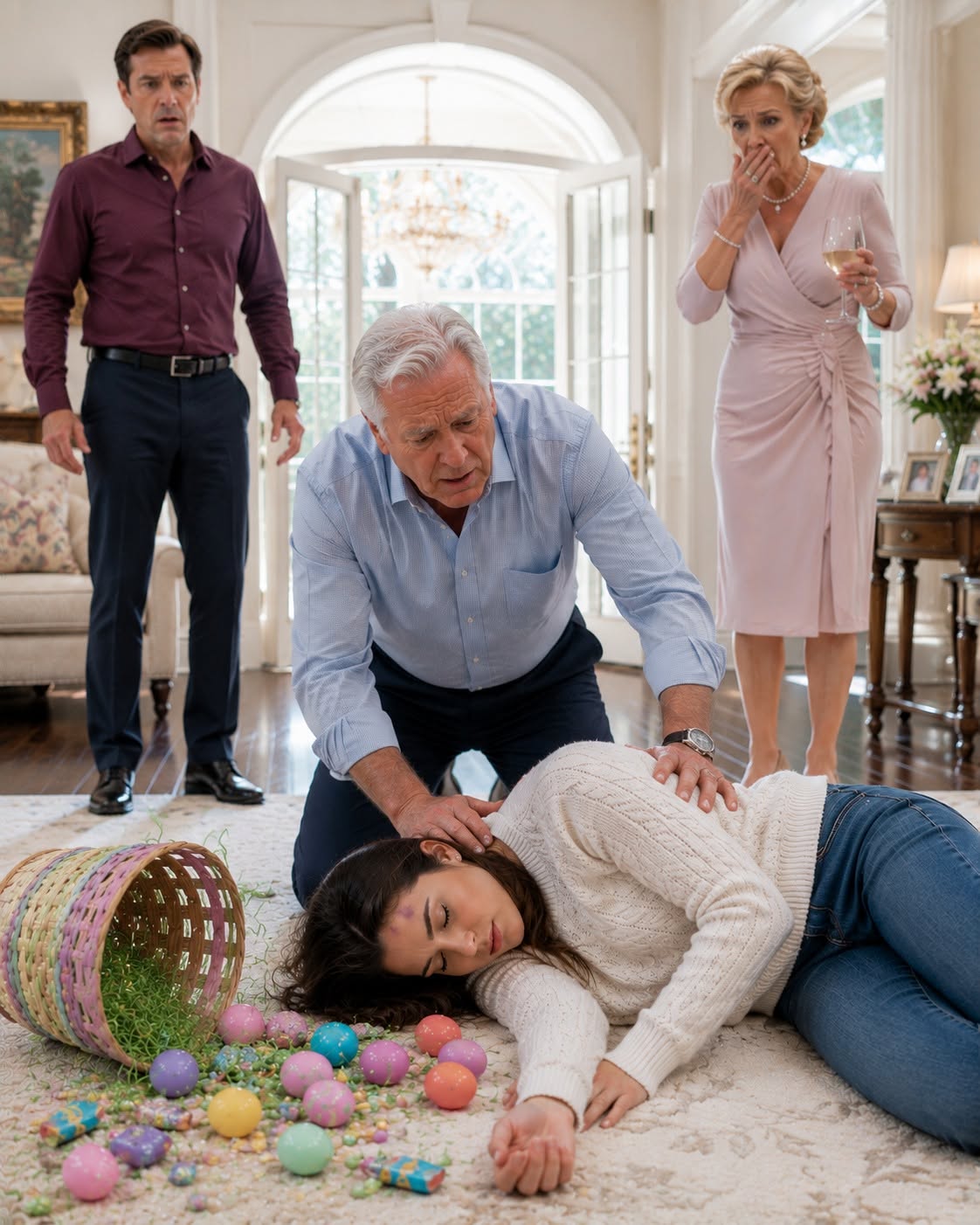
And in the center of it all, Emma lay unmoving on a white rug.
Her face was severely swollen.
One eye was almost completely shut.
Blood stained the floor beside her head.
Every breath came with difficulty.
Several feet away, Andrew calmly adjusted the band of his expensive watch.
“She fell,” he said with terrifying calm. “She always makes everything seem worse than it is.”
Daniel dropped to his knees, checked Emma’s pulse, and saw dark marks circling her throat.
“So she strangled herself while she was falling?” he asked quietly.
Margaret glanced down at the rug and sighed.
“What a disaster. That rug cost more than your truck.”
Daniel carefully lifted Emma into his arms.
Andrew laughed.
Then he reminded Daniel that the county sheriff, two deputy district attorneys, and a family court judge were all personal friends of his.
“Do whatever you think you can, Daniel,” Andrew said. “No one is going to touch me.”
The retired colonel did not argue.
He carried Emma to the truck, opened the glove compartment, attached the battery to the satellite phone, and turned it on.
He dialed a number he had not used in eleven years.
When someone answered, Daniel said only:
“Crimson Lighthouse Protocol. Civilian injured. Local authorities compromised. Activate response.”
There was silence for three seconds.
Then a steady voice replied:
“Identity verified. The operation is now active.”
Daniel drove away while Emma struggled for every breath in the back seat.
He did not take her to the private hospital funded by Andrew’s company.
He did not go to the closest emergency room.
If the Prescott family’s influence truly extended as far as Andrew claimed, medical files could be altered or erased before morning.
Instead, Daniel drove to a restricted federal treatment center concealed behind a military facility north of Nashville.
For years, the clinic had quietly cared for protected witnesses, injured federal personnel, and victims who could not safely depend on local institutions.
Two physicians were already waiting with a stretcher before Daniel’s truck came to a full stop.
Emma had two fractured ribs, a serious wound to the head, and injuries consistent with attempted strangulation.
There were also older bruises at different stages of healing.
Dr. Hannah Reed looked at Daniel with grave concern.
“This did not begin today.”
Daniel lowered his eyes.
Emma had always claimed she walked into doors.
That she slipped on stairs.
That she was careless.
Daniel had suspected something was wrong, but she denied it so insistently that he eventually convinced himself he was respecting her privacy.
Understanding the truth now hurt more deeply than any injury he had received during his military service.
While the doctors worked to stabilize Emma, the satellite phone rang again.
Retired General Thomas Walker, Daniel’s longtime friend, spoke immediately.
After leaving the Army, Thomas had become an adviser to a federal task force investigating corruption and financial crimes.
“The protocol remained active because Prescott’s company is already part of an open federal investigation,” he explained. “What happened today connects directly to evidence we’ve been collecting for eighteen months.”
Daniel felt the room grow heavier.
Andrew’s company, Sentinel Dynamics, had secured valuable contracts involving surveillance technology, municipal data systems, and cybersecurity for cities across Tennessee.
Investigators had already found fraudulent invoices, shell businesses, and payments directed toward public officials.
But one essential piece was still missing.
Someone inside the company who could explain how the money was moved.
“Emma served as administrative director,” Daniel said.
“Exactly. Three weeks ago, she attempted to download financial records. The system recorded her access.”
Daniel closed his eyes.
Andrew was not attacking her only because of jealousy or rage.
He was afraid his wife knew too much.
At 2:07 p.m., the Easter celebration continued at the Prescott mansion.
Guests still drank wine.
Children continued collecting candy from the lawn.
Margaret ordered the stained rug removed and the living room cleaned before the family pastor arrived.
Meanwhile, Andrew called Sheriff James Coleman.
“My father-in-law took Emma,” Andrew said. “I want him arrested for trespassing and kidnapping.”
Coleman promised to resolve the situation within fifteen minutes.
He never got the opportunity.
Before he could send a patrol unit, investigators from Internal Affairs entered his office carrying a federal warrant.
They seized his computer.
His safe.
And two phones.
Within minutes, agents discovered monthly payments from a consulting firm connected to Sentinel Dynamics.
At the same time, a federal unit quietly blocked every exit from the gated community.
There were no gunshots.
No shouting.
Agents temporarily shut down the neighborhood’s private security system so that no surveillance footage could be deleted and no emergency destruction program could be activated.
Margaret stormed into the front yard.
“Do you have any idea who we are?”
The federal commander directing the operation, Commander Natalie Grant, raised the warrant.
“Yes, ma’am.
That is precisely why we are here.”
Andrew frantically called the regional prosecutor, the family court judge, and three prominent business executives.
None of them answered.
Two were already being questioned.
The third had left the country the previous evening.
Andrew then opened a concealed application on his phone designed to erase Sentinel Dynamics’ servers remotely.
The screen stopped responding.
At the secure clinic, Daniel watched on a tablet as federal cyber specialists copied the servers before Andrew could destroy a single file.
It was not personal revenge.
It was not coincidence.
It was the final phase of an operation that had been prepared for months and had finally been authorized to proceed.
At 3:12 p.m., Emma woke up.
The first thing she did was ask about Andrew.
Anger surged through Daniel, but Dr. Reed quietly urged him to remain patient.
Victims of prolonged abuse could experience fear, emotional dependence, and even a powerful instinct to protect the person harming them.
Emma began to cry.
“I didn’t want him arrested,” she whispered.
“I only wanted to leave.”
“Why didn’t you tell me what was happening?” Daniel asked.
She gripped the hospital blanket.
“Because he promised he would ruin your life. He knew things about your military service… names… old assignments… He said he could accuse you of leaking classified information and make sure you spent the rest of your life in prison.”
Daniel finally understood why Emma had withdrawn from old friends and family members.
Andrew had not only assaulted her.
He had created a prison out of carefully selected threats.
“He never had anything real against me,” Daniel said. “He only needed you to believe that he did.”
Emma slowly shook her head.
“He did have something.”
Months earlier, she had discovered a digital folder containing copies of military records, government contracts, and photographs from private meetings.
Andrew often bragged that he had purchased access to a restricted federal database.
Emma copied several files onto a flash drive.
She hid it inside a stuffed rabbit she planned to give her niece on Easter Sunday.
But Margaret caught her examining the files.
“She was the one who told Andrew I planned to report him,” Emma whispered.
“She also closed the door when he started hitting me.”
That confession changed the entire case.
Margaret could no longer portray herself as an unaware mother protecting her son out of blind loyalty.
She had actively participated.
She had also helped conceal the assault.
Commander Grant immediately ordered the agents to search for the stuffed rabbit.
There were twenty-three nearly identical Easter bunnies inside the mansion.
Margaret claimed she knew nothing about any flash drive.
She even smiled as agents searched boxes and closets.
“You are wasting your time.”
Then a seven-year-old girl raised her hand.
She told investigators that Grandma Margaret had thrown a gray rabbit into the laundry room and warned her never to touch it.
The flash drive was found inside the toy.
It contained duplicated contracts, lists of payments, and audio recordings of Andrew instructing employees to bribe government officials.
It also contained security footage from inside the house.
One recording showed the assault from that afternoon.
Emma attempted to leave carrying a folder.
Andrew grabbed her by the throat.
He struck her.
Then he threw her against a table.
Margaret stood in the doorway and watched.