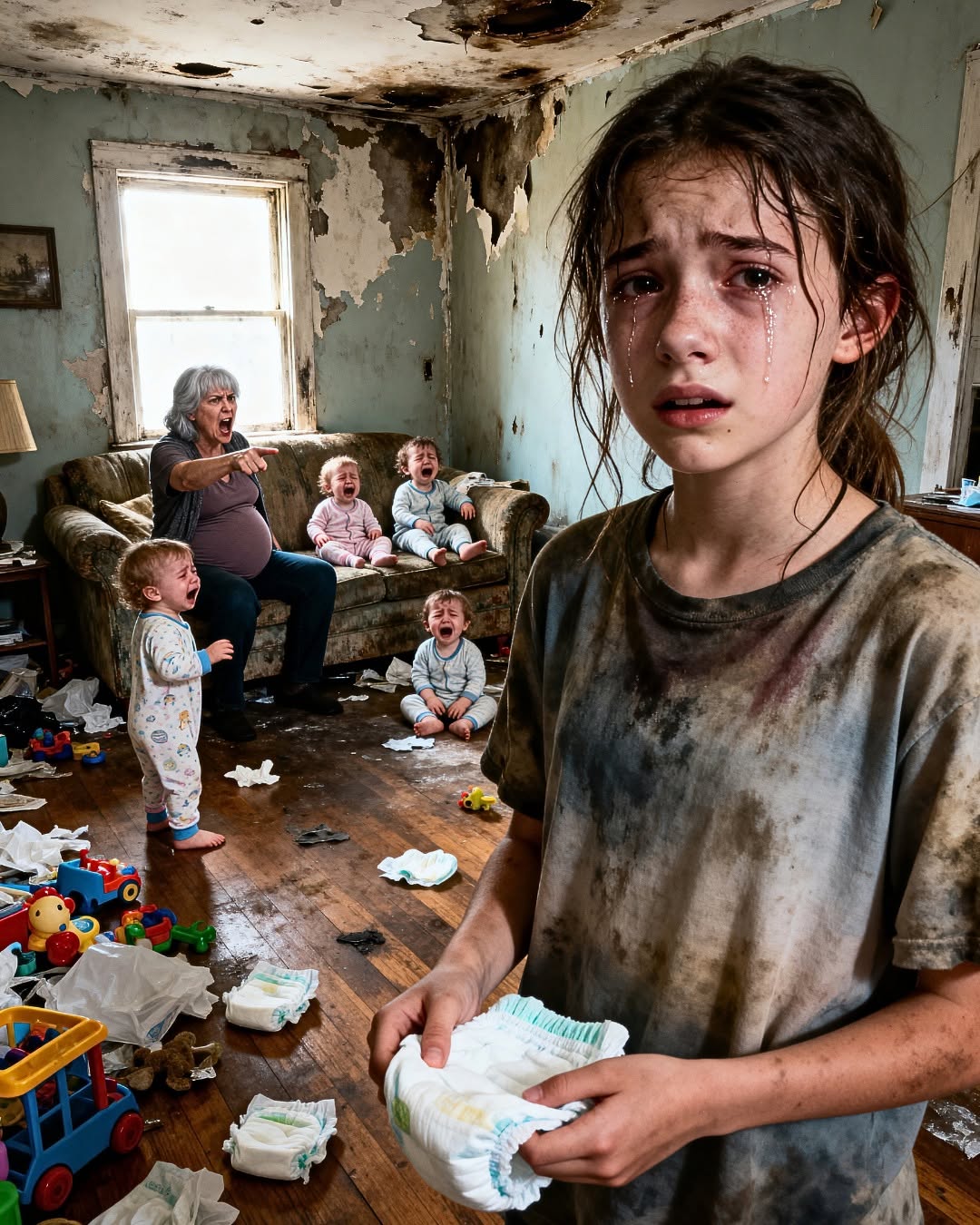
When the pounding started, I knew my mother would never let me leave without turning it into a war.
These were not the uncertain taps of a neighbor delivering mail to the wrong address. Someone was striking the thick front door of Aunt Rebecca’s house in Des Moines with sharp, deliberate force.
The entire living room fell silent.
Even the grandfather clock in the corner seemed to stop.
I sat curled up on my aunt’s patterned sofa, clutching my worn canvas backpack against my chest. My fingers were wrapped around it so tightly that my knuckles had turned white.
Everything I owned was inside.
Three sets of clothes.
A toothbrush.
And the desperate hope that sixteen years of living as my mother’s unpaid servant had finally ended.
Aunt Rebecca slowly placed her coffee cup on the table. The familiar smell of dark roast and lavender suddenly seemed strange beside the fear spreading through the room.
She looked at me with concern, but there was steel in her eyes.
“Stay here, Madison,” she whispered.
She walked toward the entrance.
I tried to remain on the sofa, but my body refused. I rose on trembling legs, my heartbeat pounding so hard that the room blurred around the edges.
Rebecca opened the door.
Two police officers stood on the porch, one man and one woman. Their dark uniforms looked severe against the pale morning sky.
“Does Madison Parker live at this address?” the male officer asked, peering beyond my aunt into the hallway.
Hearing my name spoken in that official tone felt like an accusation.
Rebecca straightened.
“She is staying here. Madison is my niece.”
The female officer’s name tag read Officer Bennett. She glanced at me with an expression that was professional but not entirely cold.
“Your mother reported you missing this morning,” she explained. “She said you left home without permission. Since you are sixteen, we need to make sure you are safe.”
A missing-person report.
The absurdity of it made something twist painfully inside me.
My mother had spent years leaving me alone to raise six children while she slept, disappeared, or complained about how difficult motherhood was.
I was the one warming bottles at three in the morning.
I changed diapers, cooked meals, cleaned the house, and calmed screaming toddlers while trying to complete homework on the kitchen floor.
My classmates were going to football games, learning to drive, and planning for college.
I was buying diapers after midnight and failing geometry because I could not stay awake in class.
My safety had never mattered to my mother.
Not until the person doing all her work walked away.
“I didn’t run away,” I said, although my voice cracked. “I walked here. I called my aunt first. I left because I had to.”
The officers exchanged a quick look.
Rebecca opened the door wider.
“She is safe here,” she said. “But she is exhausted. Her mother has forced her to raise those children for years. She has been treated like free labor.”
The male officer frowned.
“We still need to speak directly with Madison and assess the situation.”
I stepped forward.
Anger was beginning to rise beneath the fear. It came from years of carrying crying babies across stained carpets while my mother, Carla, slept behind her locked bedroom door.
It came from every failed exam, every forgotten birthday, and every night I was told that being the oldest meant I had no right to complain.
“My mom is pregnant again,” I said. “This will be her seventh baby. She expects me to raise this one too. I haven’t slept through the night in years. If you force me to go back, I don’t think I’ll survive it.”
Officer Bennett’s expression softened.
She appeared ready to respond when the roar of a damaged muffler tore through the quiet street.
A dented gray sedan stopped partly on the curb outside.
My blood turned cold.
I didn’t have to look.
The police were not the real nightmare.
The real nightmare had just arrived.
The car door slammed.
Carla climbed out, one hand resting over her seven-month pregnancy and the other gripping her old purse.
She was not alone.
She dragged my six-year-old brother, Noah, from the back seat.
He wore pajamas far too small for him. His face was dirty and wet with tears.
My mother’s expression changed before she reached the porch.
It became the face she wore at church and parent-teacher meetings: the exhausted, selfless mother who had sacrificed everything for her children.
She rushed through the doorway.
“Madison!”
Her cry was perfectly measured to sound devastated.
Before I could move, she threw her arms around me and pulled Noah with her. There was no love in the embrace. Only cheap perfume, stale laundry, and the pressure of a jailer reclaiming a prisoner.
“You terrified us!” she sobbed loudly. “Your brothers and sisters have been crying all morning!”
While holding me, she placed her hand on Noah’s shoulder.
I saw her fingers tighten through his thin shirt.
Noah screamed.
Then his scream became desperate sobbing.
“Please come home, Madison!” he cried, grabbing my shirt. “Mom said we can’t eat if you don’t come back! Please! I’m hungry!”
His words poisoned the room.
Officer Bennett’s face hardened.
To anyone who did not understand what my mother was doing, it looked as though I had abandoned helpless children.
The male officer stepped closer.
“Ma’am, release her.”
Carla let me go and pressed a tissue to completely dry eyes.
“I nearly collapsed from the shock,” she said. “Especially in my condition. I don’t understand why she’s behaving this way. I give that girl everything.”
“Stop,” I whispered. “Let go of Noah. You’re hurting him.”
“Do not speak to your mother like that,” the male officer snapped.
Rebecca stepped between us.
“You are misunderstanding everything! Madison did not abandon those children. She escaped a home where she has been treated like a servant.”
Carla’s mask slipped for half a second.
“Stay out of this, Rebecca. You don’t have children. You have no idea what motherhood requires. Madison is simply rebellious.”
“I am not furniture you can drag home to clean your house,” I said. “I’m not going back.”
My mother’s expression turned dark.
She reached into her purse.
“If she wants to accuse me of being a bad mother,” Carla said, “then perhaps the officers should see what I found hidden beneath her mattress.”
She pulled out a small blue spiral notebook.
My journal.
The one place where I had recorded the truth.
Carla held it by the binding with a triumphant smile.
“You need to read this,” she told the officers. “Then you’ll understand how dangerous my daughter really is.”
The room seemed to sink beneath water.
That notebook contained everything.
The night she pushed me down the stairs because I forgot to buy milk.
The bruises on my arms.
The hours I stayed awake with the babies.
The pantry she kept locked while the younger children cried from hunger.
“Give it back,” I said. “That’s private.”
“It’s evidence,” Carla replied.
She handed it to the male officer.
“I found it while searching for her this morning. She isn’t escaping household responsibilities. She is mentally disturbed. I am afraid she will harm the younger children.”
“What exactly is written here?” he asked.
“Read the pages with paper clips.”
He opened the notebook.
As he read, his posture changed.
His shoulders stiffened.
His jaw tightened.
When he looked at me again, his expression held disgust.
“Is this your handwriting?”
“Yes, but—”
“Did you write this?”
He turned the journal toward me.
The writing looked like mine.
The same uneven loops.
The same slanted letters.
But the words were monstrous.
I can’t listen to Noah cry anymore. I want it to stop. Sometimes I stand beside baby Ethan’s crib and imagine covering his face with a pillow so I can finally sleep.
Nausea struck me so violently that I stumbled into the wall.
“I never wrote that,” I gasped. “She changed it. She tore out the real pages.”
“She has episodes like this,” Carla cried, clutching her stomach. “I have tried to protect her reputation, but she needs professional treatment. She is a danger to my babies.”
I looked closely at the notebook.
The paper near the binding was jagged.
My original pages had been ripped out.
My mother had forged my handwriting and replaced the truth with threats against the children.
She intended to have me confined to a psychiatric facility.
Officer Bennett removed her handcuffs.
“Madison Parker, for the safety of the children, you need to turn around and place your hands behind your back. We are taking you for an emergency psychological assessment.”
Rebecca shouted.
“You cannot be serious! Look at Carla. She is lying.”
“Step aside or you may be arrested for obstruction,” the male officer warned.
Carla stood behind them with a tiny smile that only I could see.
She thought she had won.
Cold metal touched my wrist.
Panic narrowed my vision until all I could see was the notebook and my mother’s face.
Then I remembered something.
A camera flash in my dark bedroom.
“Wait,” I said.
Officer Bennett tightened her grip.
“Do not resist.”
“I’m not resisting. Check the emails.”
Everyone paused.
I turned toward my aunt.
“Rebecca, get your tablet. Now.”
Carla’s smile vanished.
“What are you talking about?”
“I knew you searched my room,” I said, using her first name for the first time in my life. “I knew you picked the lock. Did you think I would leave the only proof under my mattress?”
I looked at the officers.
“Every night after the children fell asleep, I photographed every page I wrote. Then I emailed the pictures to a secure account connected to my aunt’s tablet.”
My mother went pale.
“She’s lying! She’s trying to delay you.”
Rebecca ran to the kitchen and returned carrying her tablet.
Her hands shook as she opened the hidden email account.
“Everything is here,” she said. “Two years of photographs, organized by date.”
Officer Bennett opened an email from three days earlier.
A clear photograph of an intact journal page appeared.
She read it aloud.
“Tuesday, 3:00 a.m. Mom locked the pantry again. Noah was crying because his stomach hurt from hunger. I removed the hinge from the garage door to reach the emergency peanut butter. She said if I tell my teacher I’m tired, she will accuse me of using drugs. My wrists still hurt from where she pinned me against the sink.”
Bennett compared the photographed page with the physical journal.
She studied the pressure of the ink, the torn edges, and stains on the original paper.
Then she held up the page my mother had forged.
“This imitation is convincing,” she said. “But the pressure is different. The original pages show water damage from formula. These replacements are completely dry.”
Carla began breathing rapidly.
“Digital photographs can be altered! She created those.”
“The email metadata will show when each photograph was taken and sent,” the male officer replied.
The trap my mother created had reversed.
She realized it too.
Her face twisted.
“You ungrateful little brat!” she screamed at me. “I feed you. I give you a roof. I needed you in that house!”
“You use her,” Rebecca said.
“I have babies!” Carla shouted. “Someone has to take care of them!”
Officer Bennett guided Noah behind her.
“You brought a six-year-old here and hurt him to make him perform for us?”
“I had to get her back,” Carla yelled. “She is the only one who knows how to manage the children. I knew I should have locked the deadbolts and left them in their cribs instead of bringing Noah!”
The room froze.
Officer Bennett looked up slowly.
“What did you just say?”
Carla blinked.
“I said Madison should have been home.”
“No,” the male officer replied. “You said you locked children inside the house. Who is watching your other five children right now?”
My mother’s mouth opened.
Nothing came out.
“They’re sleeping,” she finally whispered. “They are safe. I have only been gone for an hour.”
Officer Bennett grabbed her radio.